REDCOATS AND BURGERS

only in gibraltar…

I remember my history teacher at secondary school explaining to me that the reason British soldiers wore red tunics in battle for over three centuries (starting during the English Civil War and ending with the Zulu War) was for two reasons; the first being to mask blood from wounds, and the second, because the sight of massed ranks of red-coated soldiers instilled awe and fear in the enemy.

Whatever the merits of either of these theories (and I think the revolutionary American armies would have had a their own distinctive opinion concerning the latter), the emergence of accurate, long-range rifles towards the end of the 19th century turned British redcoats from swaggering symbols of imperial might into haplass sitting ducks for snipers everywhere – from the Hindu Cush to the high velt.

Fortunately for the makers of the film Zulu, and little Adams throughout 1960’s UK, the red tunic was still in use by the British Army at the outset of the Zulu war of 1879. For, if the redcoat was nothing else, it was highly photogenic, especially against the majestic backdrop of the Drakensburg Mountains of Natal. Several historical inaccuracies notwithstanding (e.g. the British troops engaged belonged to the 2nd Warwickshires and not the Welsh Borderers, with most of the men hailing from Birmingham rather than South Wales, and the Zulu force being led by a young renegade prince, acting against the orders of King Cetshwayo), the film Zulu fired the imaginations of a generation of children. In my case, together with Rudolf Maté’s worthy-but-wooden 1963 offering of The 300 Spartans, Zulu began and shaped the entire course of my lifelong self-education in history, ancient and less-so.

All of which brings me to the slightly surreal photo which heads this piece – members of Gibraltar’s Reenactment Society, in uniforms of the Zulu War period, taking a lunchbreak in our local Burger King, here in Gibraltar. Every Saturday, throughout the Spring and Summer, this little band of enthusiasts, entertains (and in some cases perplexes) locals and tourists alike with a march or two up and down Main Street, to and from Casemates Square. Their uniforms cover most of the British imperial era, from the scarlet of the American and Napoleonic wars all the way to the khaki and green of WWII. And, although I’ve seen them on their well-earned breaks many times, normally with a refreshing pint in hand, and perhaps a slice of pizza, this scene struck me as particularly curious. So much so, a third practicality for the redcoat tunic occured to me that probably never occurred to men like Cornwallis and Wellington, that being a mask for ketchup stains as well as blood!

GILBOA, WHERE THE MIGHTY FELL – and a nation rose…

When I first saw the movie The 300 Spartans I was only seven-years-old but it made an impression on me that has endured for the following fifty years. The story of King Leonidas and his heroic stand at the Pass of Thermopylae lit a touch paper in my young spirit that shaped the course of all my future careers, and even perhaps the way my life has panned out.

Artist & Illustrator
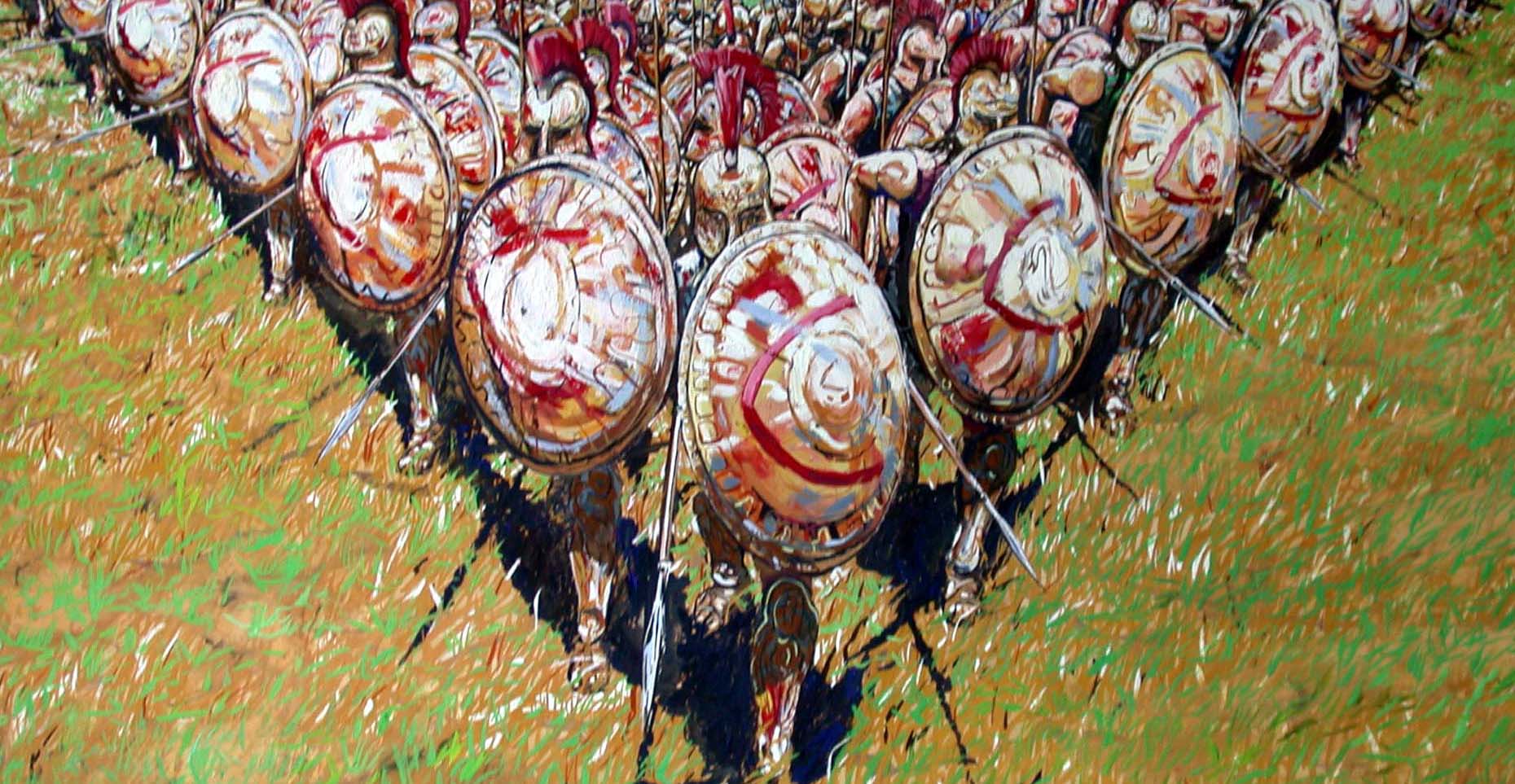
This is a detail from my painting “The Pausanias Wedge at Platea”  – I used it on my business card during my years as a commercial illustrator.

Most peoples and nations on Earth have their own such iconic tales of heroic defeat, which seem to lend themselves to idealistic notions of ultimate sacrifice for the sake of freedom. For instance, the (European) Americans have their Little Bighorn, the British, their Charge of the Light Brigade and the French, the last stand of the Old Guard at Waterloo.

The thing however, that distinguishes the action of the 300 at the Hot Gates back in 480 BC from all of the above, and gives it such universal and lasting allure to most peoples of the Earth (with the possible exception of Xerxes’ modern heirs) was its almost total contextual non-ambiguity.

The actions of Yankee Blue Coats against the Plains Indians, Cardigan’s “Cherry-Bums” in the valleys of the Crimea, and Napoleon’s “grognards” (grumblers) in a Belgian wheat field; for all their undoubted courage were primarily in the interests of conquest — the very thing that Leonidas was attempting to halt. Custer, Raglan and Napoleon — their widely varying military abilities notwithstanding — were all closer to Xerxes than to Leonidas in the context of their respective battle objectives. Thus, in many ways, the Spartan King offers us an historical rarity; a genuinely noble defeat in the purest of causes — defense of the homeland; more of a Wounded Knee than a Little Bighorn.

About two years after my young imagination had been fired by the story of Leonidas and the 300, I became familiar with an account of a similar military engagement in the even more ancient annals of my own people’s narrative. And so enthralled was I by the story of King Saul and his son Jonathan’s defeat at the hands of the Philistines on the slopes of Mount Gilboa I actually wrote a book about it some forty years later. (That book, among other things, led me to setting up this blog and so it’s probably high time I posted an article along these lines.)

And just as Leonidas’ death was a powerful inspiration for the following Golden Age of Greece, the defeat of Saul and Jonathan actually secured both the concept and the durability of Israelite, and then Jewish nationhood.

However, while Leonidas is lauded by the modern Greeks as their consummate national hero, for reasons too complex to go into here, the only monuments to Saul’s act of ultimate sacrifice at Gilboa are the exquisite seasonal wildflowers which annually defy the curse of David upon the mountain’s slopes (2 Samuel 1:21). My book was a vain attempt to rectify the situation; to raise the status of Saul within the national consciousness of modern Israel and Jewish people everywhere, so that instead of heading straight from Ben Gurion Airport to Jerusalem and the other “holy sites” ; they would instead make for Gilboa, where a nation was forged in the blood of its first, and most noble king. So noble in fact, his own usurper felt obliged to concede as much in his timeless lament (abridged here)…

Battleground
 “A gazelle lies slain on your heights, Israel.
    How the mighty have fallen!.. 

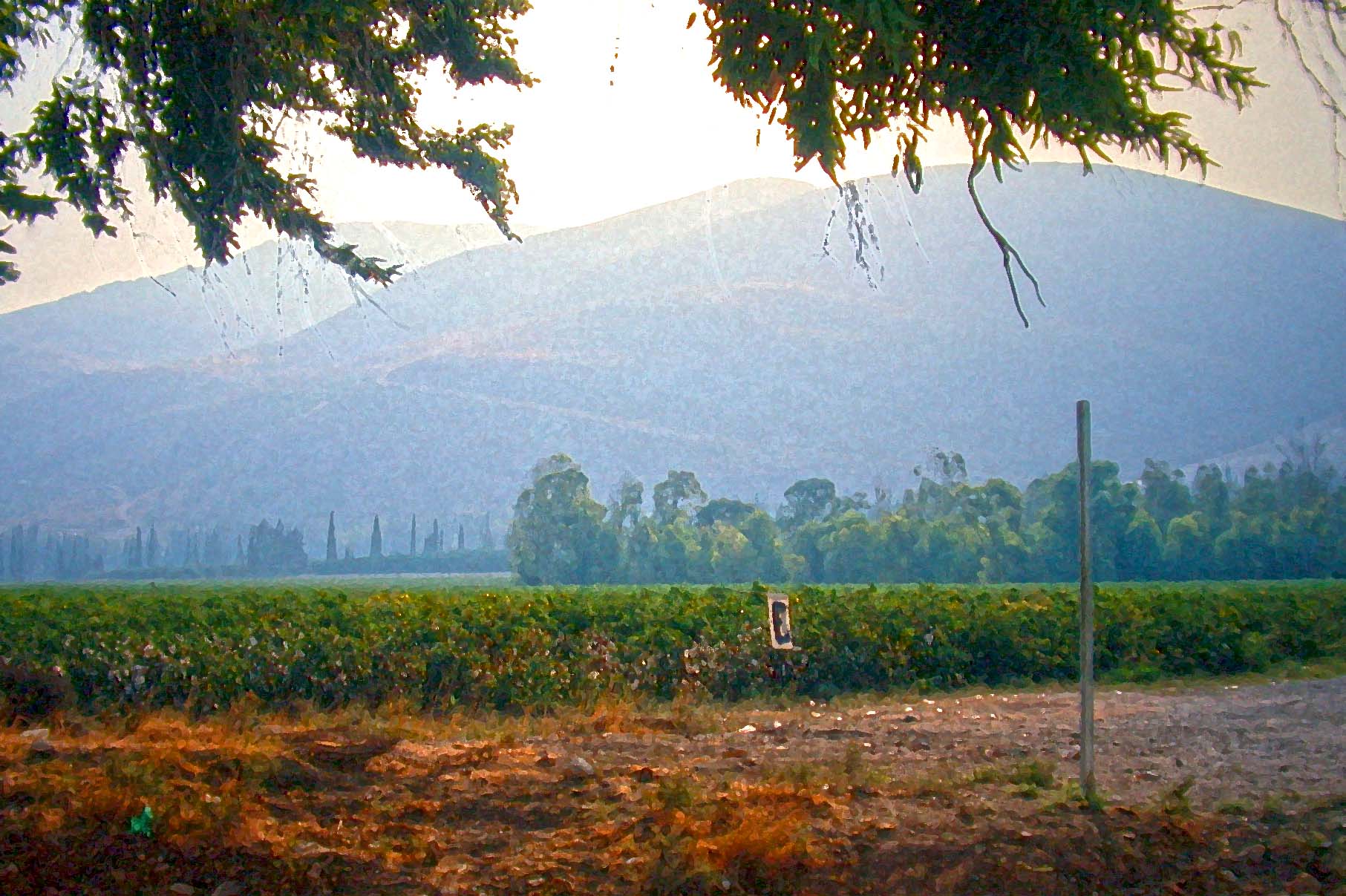
Gilboa Massif from the Jezreel Plain
“Mountains of Gilboa,
    may you have neither dew nor rain,
    may no showers fall on your terraced fields.
For there the shield of the mighty was despised,
    the shield of Saul—no longer anointed with oil…

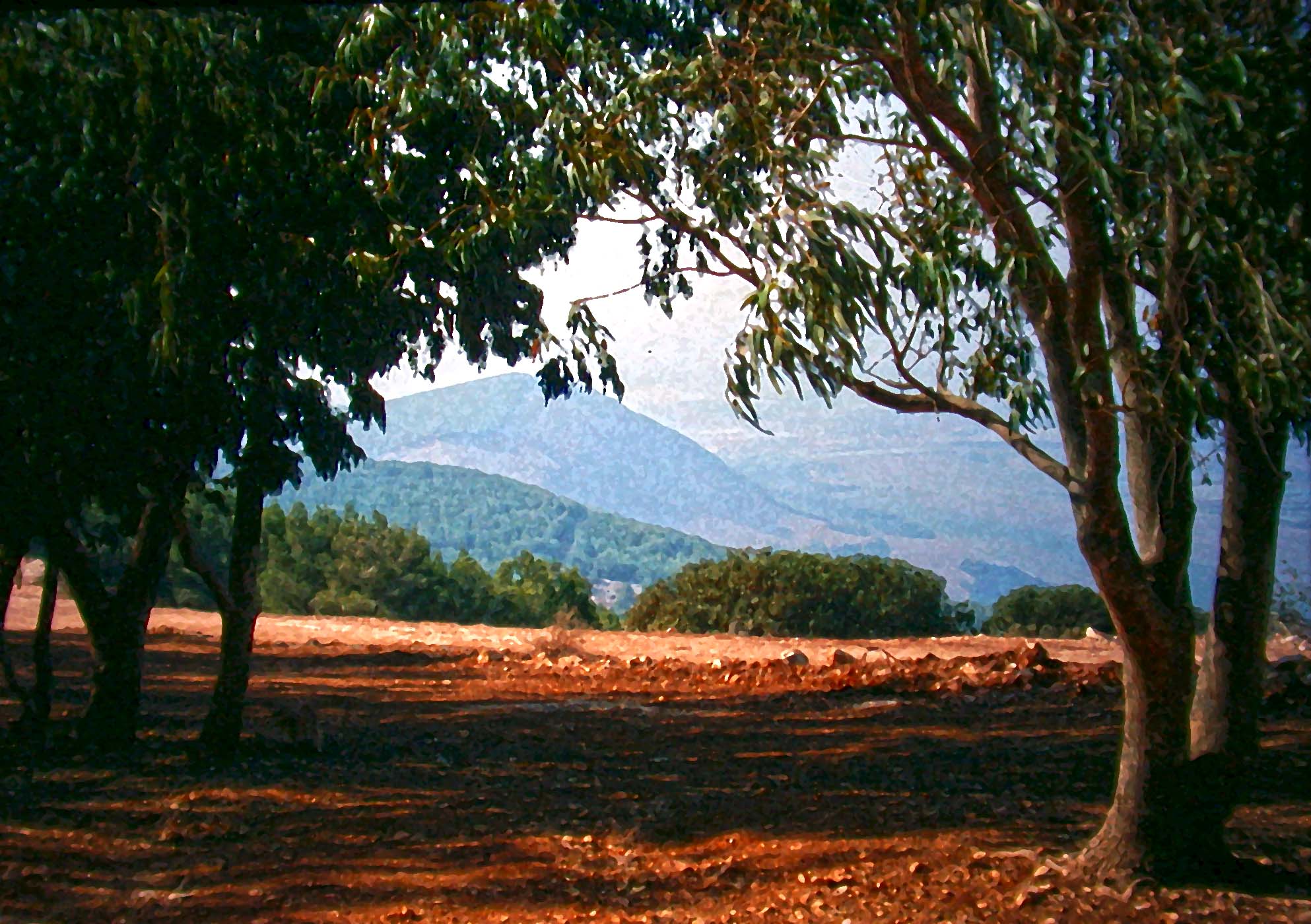
Gilboa summit
“From the blood of the slain,
    from the flesh of the mighty,
the bow of Jonathan did not turn back,
    the sword of Saul did not return unsatisfied.
Saul and Jonathan—
    in life they were loved and admired,
    and in death they were not parted.
They were swifter than eagles,
    they were stronger than lions…

Gilboa trees
“Daughters of Israel,
    weep for Saul,
who clothed you in scarlet and finery,
    who adorned your garments with ornaments of gold…

On Gilboa
“…How the mighty have fallen!
    The weapons of war have perished!”