

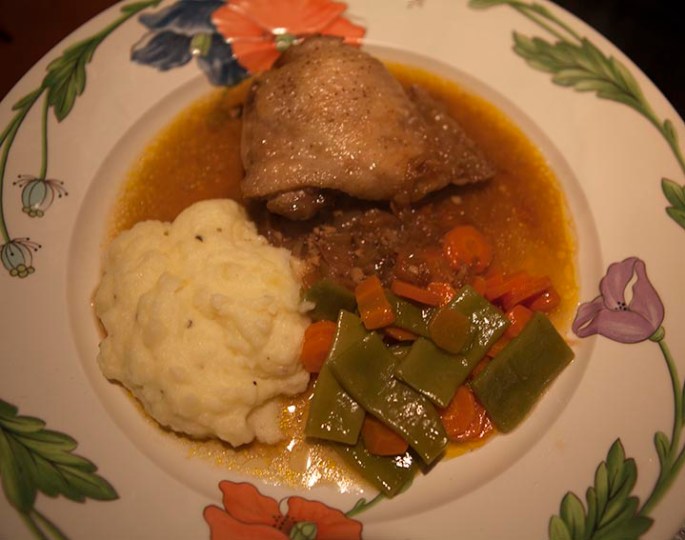
As with most Yiddish words and, or phrases, gedempte does not translate easily into English. The most literal meaning could be steeped, but as this sounds so unlike an actual cooking term most cookbooks go with braised. And I suppose that in a purely technical sense the chicken (or the beef in the case of gedempte fleisch) is braised, in that it is first sealed in hot fat before being cooked slowly in a covered pot. But a Jewish cook would no more refer to her / his gedempte chicken as Braised Chicken than a French chef would call her / his Boeuf Bourguignon a beef casserole.
In any event, this is my recipe for Gedempte Chicken, or more properly, my recipe based closely on my late Great Auntie Ray’s recipe…
As with cholent (see my earlier post) there are many subtly different recipes for Gedempte Chicken, mostly influenced by from which part of the old Ashkenazi world the given recipe originated. For example, Jews of Hungarian decent always add large amounts of sweet paprika, whereas Yekkes (Jews hailing from the German-speaking lands) tend to use celery and tomato puree. However, my maternal great aunt’s grandparents (she was third generation British) were from Lithuania, and her cooking, although always excellent and delicious was highly minimalist. She considered vegetables/fruits/herbs such as celery, tomatoes and even paprika as exotic and unnecessary and thus her Gedempte Chicken was incredibly simple. Nevertheless, the handful of times I was privileged to sample it remain some of the most precious culinary memories from my childhood.
But whatever its embellishments, the template for all Gedempte Chicken is the same: Chicken, onions, garlic and heaps of schmaltz (rendered chicken fat which, as my auntie always knew, is very good for you!).*
The recipe presented here uses that template, with those basic ingredients processed as closely as possible to Ray’s recipe – with just a few tiny embellishments of my own…
INGREDIENTS (serves 4)

2 generous tablespoons – schmaltz (rendered chicken fat – now available ready-made)
4 – large chicken thighs (bone in and skin-on)
2 – large cooking onions – halved and finely sliced
1 – large carrot – roughly sliced
1 – medium-sized head of garlic – peeled and finely chopped
1 cup – chicken or meat stock
salt and ground white pepper to taste
(Optional additions include either; a large stick of celery – thinly sliced – or 2 tablespoons of Hungarian “Noble” sweet paprika, or 1 tablespoon of tomato puree, or any combination of the three)

METHOD
1) Choose a wide heavy pot and melt the schmaltz over a medium heat…

2) Brown the chicken pieces in two or three batches – don’t crowd the pan…

3) Once browned and sealed, set the chicken pieces aside…

4) Add the onions and carrots to the same pan and saute until well browned, stirring every-so-often – about 10 minutes…

5) When the vegetables are well browned add the chopped garlic, and cook stirring for a further 2 minutes…

6) Return the chicken to the pan, placing the pieces on top of the vegetables…

7) Add enough stock to just cover the vegetables and bring to the boil – then add the seasoning and cover the pot with a tight fitting lid. Finally turn down the heat to very low and simmer for about 80 minutes…

8) Ready to serve!

(At this stage, if you are making the dish for a dinner party and you want to impress, you can make a thickening einbren – a kind of Jewish beurre manie, only made with schmaltz, not butter. Firstly remove the chicken and all the solids from the pot and place neatly onto 4 heated plates. Then, simply melt another 2 tablespoons of schmaltz in a small saute pan before adding two tablespoons of plain white flour. Cook until the flour goes brown and just begins to burn. Then, a small ladle at a time, add the liquid from the chicken pot until it is all incorporated and you have a rich, emulsified sauce. Finally, spoon a portion of the “einbren” over the chicken on the plates.)
9) Plate up and serve…

Here, I served the chicken with a tzimus of carrots and beans and mashed potato. Mash is fine but this works best with potato latkes.
Make sure you have a hearty red wine to wash it down and enjoy.
Betay avon!!
 ARKS, ADAM AND AXARQUIA