CHILE – OUR REAL CARTOON ADVENTURE (part 6 of 11)

(SEE PART 5 HERE)

16

No stay in Chile’s northernmost city of Arica is complete without an excursion to the Lauca National Park – with its fabled lakes and volcanoes. Only problem was, the park sat at 4500 meters above sea-level, and altitude sickness was likely to be a serious issue. One of the ways of militating against the worst effects of this however was to make sure one traveled up to the park in the hands of expert guides with state-of-the-art oxygen and resuscitation equipment. But sadly, our limited budget made us forget the lessons of our near-disastrous trip the previous week to Atacama Giant and we opted for the cheapest guided tour we could find. We sensed the worst when we boarded the clapped-out minibus with hard wooden benches for seats and two broken windows on the right-hand side. However, there was a big oxygen canister on a shelf above the driver, and it was only a day-trip for goodness sake, we reassured ourselves – what could go wrong on such a short trip? There were about ten of us on the bus, and by the time our vehicle had crawled up past 3.500 meters the more elderly passengers were already beginning to feel the effects of the thinning air. Dido and I at least, felt fine during the entire drive up and it was only when we disembarked at Lake Chungara that the “puna” (the colloquial term for altitude sickness) hit us both – like a brick. The only way I can explain the sensation was that when I tried to walk it felt like one of those bad dreams, when one is trying to flee from some horror or other and one’s legs won’t move. And it wasn’t just the sluggishness; it was actually quite hard to think straight. To this day, I have barely any recollection of how I managed to fill an entire roll of film with some the most spectacular shots of the entire trip – of the lake itself, the surrounding volcanoes, the herds of grazing guanaco and the incredible candlestick cacti. Even Dido, who was super fit in those days, had to lie down after a few minutes of walking around, while I found the only way I could be comfortable at all was to adopt a kind of Muslim prayer position on the ground. Meanwhile, I recall seeing people chucking-up all over the place and one other poor old American guy pass out altogether. It was then that the guide told us that the oxygen canister was empty, resulting in another member of our party – a retired GP as it turned out – having to resuscitate the American gentleman in the manner illustrated in the picture below. Eventually, we all managed to clamber back onto the bus where the guide had brewed up a kettle of coca tea. Whether or not the tea had any effect, somehow we were all still alive by the time we got back to Arica…

16 Dizzy heights at Chungura

17

As I’ve implied earlier we liked most of the food we ate in Chile. While the cuisine is basic, there was a wide and exciting variety of raw material – animal and vegetable – and nearly everything was simply yet expertly prepared. This included the hamburgers, which, everywhere from Puerto-Varas in the south to Arica in the north, were always huge, freshly made prime-beef patties. Grilled over charcoal in the posher establishments, or on hotplates in the diners, they were reliably succulent and filling. The only problem I had with the Chilean hamburger was the choice of accompaniments with the burger within the bun. At first I found the ubiquitous slice of beef tomato, cos-lettuce and thick slab of avocado – yes, avocado – to be a novelty. A tasty and healthy change from cheese, bacon or salad onion say… But by the time we were in Arica the novelty – of the avocado in particular – had worn thin. I’d come to the conclusion that avocado and a beef patty just weren’t good bedfellows. They didn’t so much complement each other as vie for attention in the mouth. In simple terms, they just didn’t get on. But by removing the avocado, the burger then became somewhat plain and bare, and the local vinegary ketchup certainly didn’t help matters. Then one afternoon we were at our favourite eatery (where we’d already established a steady supply of good fresh coffee) and I asked the cook if I could have some onion with my burger in place of the avocado. First of all, he looked at me as if I were crazy, but then he shrugged his shoulders and accented. He asked me how I wanted the onion cooked? I tried to explain that I wanted it raw. More looks of incredulity and then another shrug of the shoulders…I went and sat down and waited for my burger, which came about five minutes later with an onion; with a raw onion no less; a bloody great onion, skin and all, perched precariously on top of my beef patty…
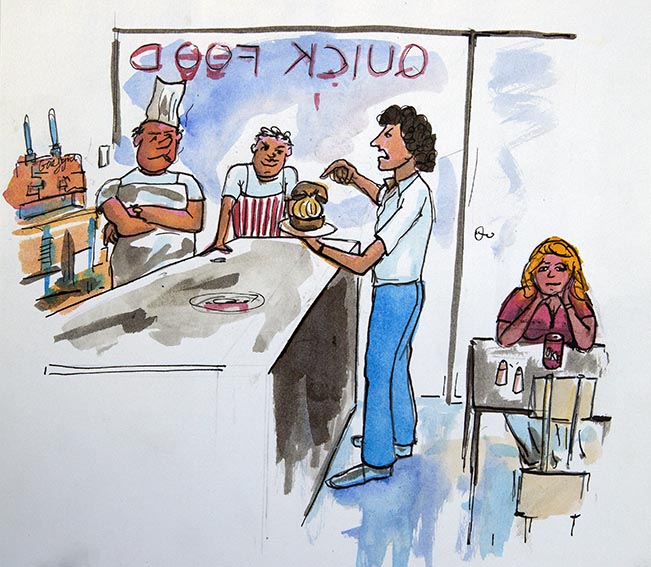
17 Too heavy on the onion...

18

For most non-European readers of these adventure, the next two episodes will not seem surprising at all. But for us, then, the whole concept of “fruit checks”seemed like a hangover from the Pinochet era – just a way of controlling the free movement of citizens. As it happens we were wrong and fruit-checks were / are a key method in preventing the spreading of potentially lethal agricultural pests. Nevertheless, the fact that in Chile, these checks were carried out by jack-booted carabineros with all the charm of a pack of pit-bulls on an enforced vegetable-only diet merely reinforced our misconceptions and resentments. Both of our fruit-check experiences occurred on the long bus ride back south from Arica to Santiago. The reason for this was that our luxury “cama” coach journey (we were feeling a bit more flush with our budget by now) crossed several regional (state) lines and the unlicensed movement of  fruit and vegetables was prohibited from one region to another. Our first check was on the Arica/Iquique border when we were all ordered off the bus while two officers searched the vehicle. We’d all been nervously standing around on the roadside for about five minutes when one of the carabineros slowly made his way down the steps of the coach. Holding up a half-eaten bunch of grapes in his right arm he glowered at us before demanding that the guilty party declare him or herself. After a few moments, during which we all exchanged anxious looks, a middle-aged man stepped forward with his head bowed in shame – like a naughty schoolboy being summoned to the front of the class by the teacher. The carabinero then read the poor man the riot act, threatening him with all sorts of sanctions and fines before eventually offering him a way to make amends – to finish the bunch of grapes then and there. This the man did, fairly gorging them down in his relief , and so allowing us to continue on our long journey…

18 Whose grapes!!

CHILE – OUR REAL CARTOON ADVENTURE (part 5 of 11)

(SEE PART 4 HERE)

13

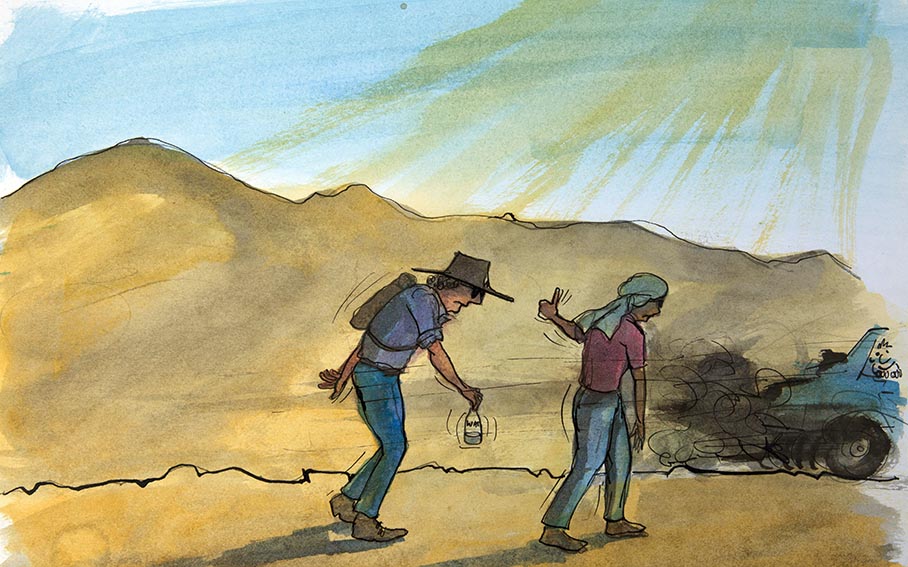
During our stay in Iquique we took a day trip to see one of Chile’s ancient man-made wonders, The Giant of the Atacama. We anticipated that getting to see the “largest anthropomorphic geoglyph in the world” with our own eyes would be one of the highlights of our entire visit to Chile, and so it would have been, if we hadn’t vastly overestimated the number of fellow travelers to the same site. We presumed The Giant would be a mecca for a whole host of visitors, including everyone from the millions of credulous believers in Von Daniken to the thousands of people with an interest in pre-Columbian civilization – and all those in between. Obviously, knowing the remoteness of the site we didn’t expect everyone to be there at the same moment, but we took it for granted that there would be dozens of people there at any one time. Thus it never entered our minds that we would have any trouble getting to and from The Giant without our own car. Even worse, we had misread the distance on our – by now very worn – map, from the Highway 5 bus stop to The Giant as being only 2 kilometers (easily walkable, even under the desert sun) when it was in fact 12! Nevertheless, when a car stopped and we were given a ride to The Giant almost before we had even begun to raise our thumbs, our original presumption seemed to have been correct. However, we had been at the site barely ten minutes when our kindly lift-givers got bored and decided to leave. So, when they offered to take us back to the highway bus stop (which we now realised was 12 ks and not 2) we had a decision to make. Ignore the significant fact that we and our ride buddies were the only people there and stay on a while longer at this amazing site, or do the sensible – “been there / seen it” – thing and accept the lift. Like the classic “Darwin Award” idiots we all read about everyday in the newspapers (who go fell walking in sneakers, or swimming in pools known to be infested with salt-water crocodiles or who light up a cigarette while standing over a cesspit) we decided to stay on “a while longer”… Needless to say, an hour passed and nobody came. So, we decided to walk the actual 2 kilometers back to the dirt track (marked as “minor-road 15) and see if we could at least get a lift from there. Problem was, by this time we were already down to the last few sips of water in our single 1/2 liter bottle and beginning to roast as the sun reached its highest point in the vast desert sky. By the time we made it onto the track we knew that we might be in serious trouble. There was no shelter of any kind, our water was gone, and our exposed arms were beginning to burn. At this point we didn’t know whether we should stay put or attempt the 10 k walk to the main road. After a ten minute rest we began to walk – or rather, stagger along the track, and then almost immediately we heard a vehicle approaching from behind, going in our direction. But our elation was only momentary, as the car sped past without even slowing down, it’s exhaust and dust adding mocking insult to injury. But then, after about another hour, a second vehicle – a small truck – emerged from the east, heading west and its driver , this time, took pity on us and dropped us at the bus stop. Now whenever we think of The Giant, or just about any other South American geoglyph our first reflex is to reach for a water bottle…

13 20 kilometers! Not 2!

14

From Iquique we made our way to Chile’s northernmost major city of Arica. The picture below is an exaggeration of what at the time, we feared might really happen when, during the drive north we passed a military airbase of some kind. One can imagine our fright when a light aircraft flew just a few feet over the roof of the bus before landing on the road in front of us causing our driver to make an emergency break. For some reason unbeknownst to us and our driver too, judging by his outburst of expletives – and presumably something to do with financial expedience  – it turned out that this particular section of road  doubled as a runway. Whatever, it certainly livened up what up until that point had been a particularly dull, desert drive…

14 Dual purpose highway

15

One of the few things that disappointed – not to mention surprised – us during our first weeks in Chile was the fact that wherever we went, and wherever we stayed (smart or shabby) we could only seem to get instant coffee. To make matters worse, this wasn’t even granulated coffee, but old fashioned, cheap and nasty powder coffee. But then, in Arica, we befriended a likable and knowledgeable young English couple taking their gap year in South America – let’s call them Susan and Bob – who explained to us where we had been going wrong. It turned out that if one wanted real coffee in Chile one had to ask for it twice. In other words, instead of asking for a “cafe” one asked for a “cafe, cafe”. When they told us this we thought that our new friends were teasing us, but when we went to dinner with them for the first time, at the end of the meal Bob asked for “Cafe, Cafe”. And hey presto! As if by magic, four cups of exceptionally good real coffee were delivered to our table…

15 Cafe, Cafe

CHILE – OUR REAL CARTOON ADVENTURE (part 4 of 11)

(SEE PART 3 HERE)

10

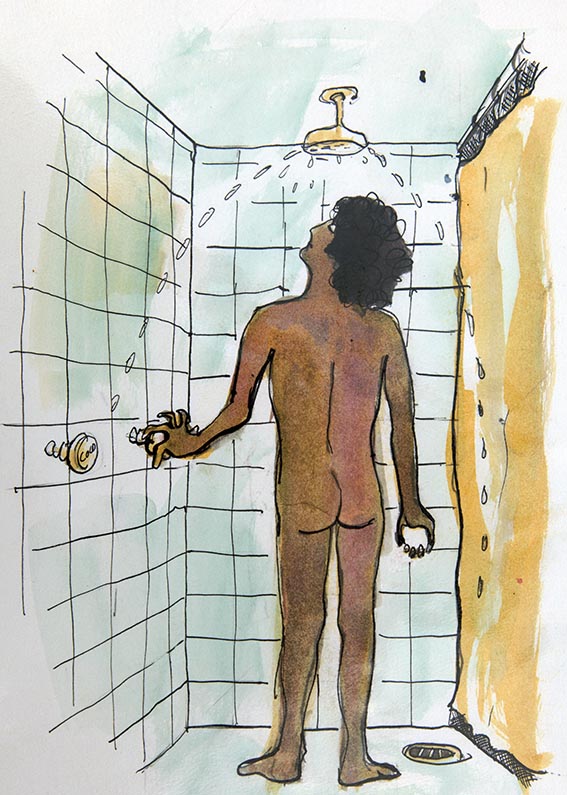
Back in the early 90’s the place to stay in San Pedro de Atacama, at least if one considered oneself a real traveller, was “Bobby’s Place”. From what I can recall Bobby herself (Bobby was a she not a he) was an Australian lady in late middle-age. She was the epitome – almost to the point of being a walking-talking cliché – of the intrepid travelling adventuress, finally settling down in the  evening of her years. Long silver hair tied back in a ponytail; sun-stained leathery skin; bright eyes glistening with weary knowledge and intelligence, she could have been Karen Blixen’s antipodean younger sister. And her eponymous establishment was as laid-back, affable and welcoming-yet-world-weary as she was herself. We loved almost everything about our stay at Bobby’s – the faded Hemingway-esque hunting-lodge atmosphere, chilly evenings, sat around the vast open fireplace sipping her delicious pisco sours and the clean, comfortable quiet rooms. The only feature of Bobby’s place which failed to please was the shower. Not so much a shower actually as a gravity defying twin trickle/dribble of water which miraculously descended in a form of arc, so that if one stood beneath the shower-head it missed one altogether. Getting clean meant opting for one of the two dribbles  and having the patience of a saint…

10 Bobby's shower

11

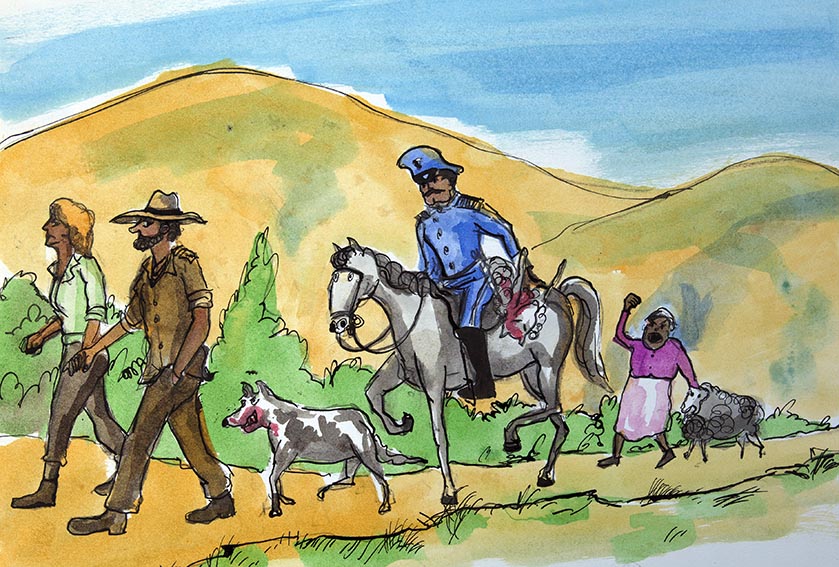
Bobby had a large dog of mixed parentage and as with his owner, the dog was hugely affable towards all the guests staying at his mistress’s establishment. But on occasion, with guests who reciprocated his friendliness, he would take a special liking and become virtually inseparable. During our stay the dog took just such a liking to another couple. His affection towards them was understandable as they were particularly charming and charismatic. A little older than us, she was German and ran a travel business in Santiago, while he was a  junior English diplomat on secondment at the British Embassy. They’d come to San Pedro for a romantic long-weekend and their favourite pastime (when not in their bedroom) was going for ambles alongside the local river. On the third afternoon of our stay we were sitting on the stoop outside our room when we were confronted with the scene portrayed in the drawing below. But it was only later that night that we found out the story behind the picture: Our couple had gone off on their usual riverside walk accompanied by the dog, which was fine, until they passed by a woman grazing her two sheep. Without warning the dog jumped one of the sheep and killed it. The woman, naturally distraught and angry began screaming and shouting at our couple for failing to control their dog – at which point, as if on cue, the local mounted policeman appeared. After listening to the woman he told our couple that they would have to compensate the woman for her dead sheep. When they then explained the situation and their relationship to the dog, the dubious policeman told them to take him to the actual owner of the dog, which they did, with him – bearing the woolly carcass on his mount – the bloodied dog, the woman and her remaining sheep in tow. Of course Bobby sorted out the situation, and even cooked the sheep a couple of days later for her guests. It was the best mutton stew I ever tasted!

11 The case of the dog and the lamb

12

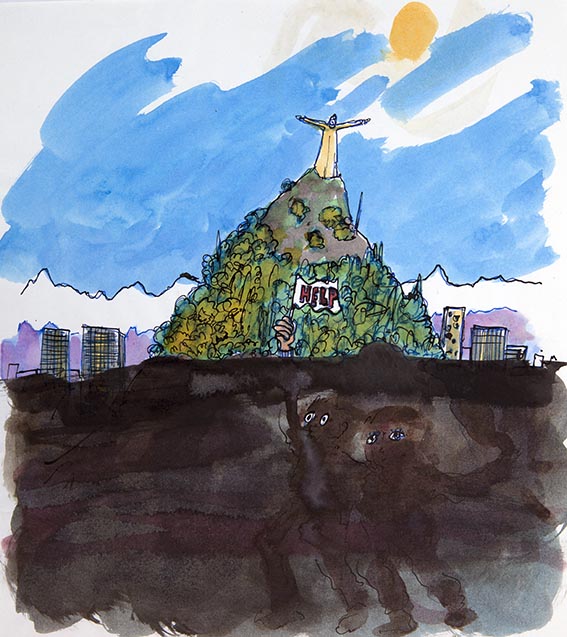
After Dido had finished her work in San Pedro we headed north-west back to the coast and the city of Iquique. We arrived in Iquique in the early hours of the morning and our small, family-run hotel wouldn’t be opening for hours. I think it was about 5 am when we settled down on a bench in a small park near our lodgings waiting for the town to wake up and find somewhere to have breakfast. I guess we’d been sitting there  around half-an-hour when two weird and wonderful things occurred, the second of which is depicted in the picture below. Just as the sun began to rise, we noticed that the trees surrounding us all contained large dark oval fruits; but then the fruits all began to move, and then expand, and then we realised that these weren’t fruits at all but a gathering of dozens of crow-like birds, waking up and opening their wings. And just as we were recovering from that shock, something else began to stir; about ten feet along the path from where we sitting, a steel trap door, slowly opened. Then, from under the ground a group of four men emerged – yawning and stretching . When three of them were out, the fourth passed them up assorted brooms, dust-pans and litter spikes, and they immediately set to work sweeping and cleaning the park. This wasn’t so much a case of sleeping “on” as sleeping “under” the job. Surreal…

12 Dawn Suprise

CHILE – OUR REAL CARTOON ADVENTURE (part 3 of 11)

(SEE PART 2 HERE)

7

One of the most exciting aspects for me in particular regarding our adventure was that it was my first time across the Atlantic Ocean – in fact, it was my first journey into a significantly different time-zone. So, when by our third evening in Chile I still hadn’t suffered any apparent symptoms of jet-lag it made me sceptical about the whole concept. That evening, following our long bus journey from Santiago, we were spending the night in the coastal city of Antofagasta before catching our next ride to Calama the following afternoon. Dido was still sort of vegetarian in those days (she ate some fish) and often got a craving for pasta, and as luck would have it, our Lonely Planet guide recommended an Italian restaurant as being the best place in town. After almost a day on a coach eating nothing but snacks, we were both ravenous and ordered extra large portions of pasta and we must have been about half-way through our respective plates of spaghetti when I was struck by an acute attack of something known as “delayed jet-lag”. The last thing I remember was feeling as if I’d been given a sudden heavy dose of anesthetic gas. Then, the next thing I knew, I was staggering into the street with my arm over Dido’s shoulder with Bolognese sauce all over my face. According to my mortified wife, I had fainted head-first into my pasta, and the maitre d, assuming I was drunk demanded that we leave – immediately…

7 Jetlag

8

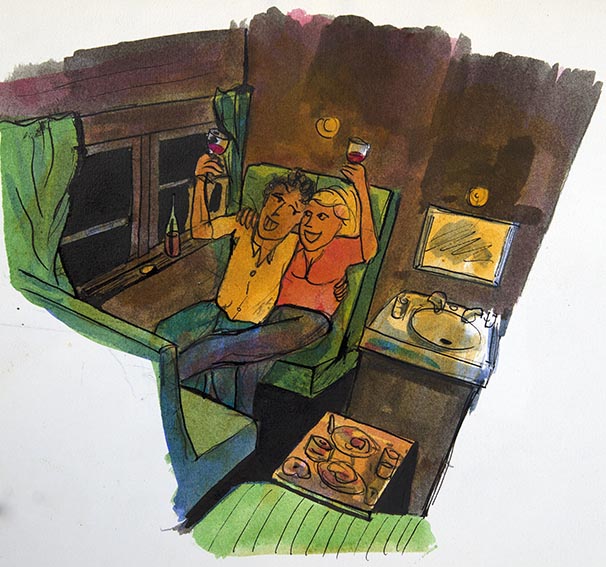
We had one night in Calama to kill before catching another bus to our final destination the next day, San Pedro de Atacama. Following our expensive dining fiasco of the previous evening, Dido opted for a hostel described as “modest” even by our Lonely Planet Guide. Perhaps, because it was called Residencial Splendid, we hoped that it might not be all that bad, which only goes to show that one should never be deceived by a mere name. The Splendid was utterly awful. The rooms were filthy and more like prison cells than holiday accommodation and as for the state of the bathrooms – well, I’ll leave that to the reader’s imagination. But by far the worst feature of our night at the Splendid, was the bed itself – a grubby, smelly, piece of foam rubber, suspended in a steel bed-frame, devoid of support of any kind. The picture below describes exactly what happened when we got into bed, and that our extreme discomfort was accentuated by the fact that during the night icicles formed from the light and on the metal window grates due to the freezing desert night air of Calama…

8 Residencial Splendid - in name only!

9

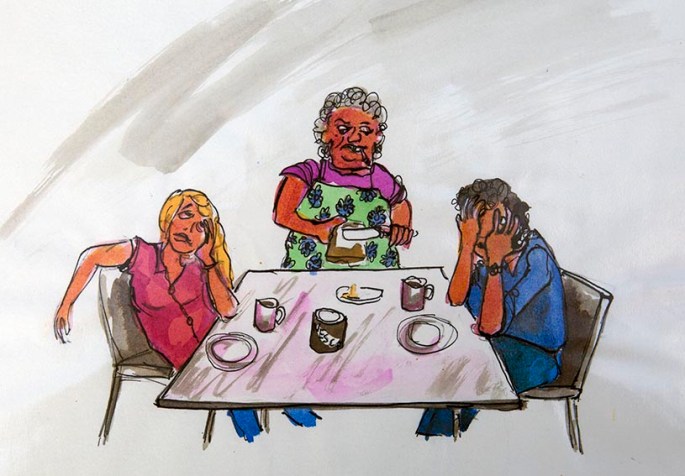
The breakfast turned out to be about as “Splendid” as the sleeping arrangements. As we took our table in the dingy breakfast room we were confronted with a pot of hot water, a jar of instant coffee and two slices of dry toast. When I asked the lady of the establishment – a stocky little woman with unkempt greasy grey hair, a cigarette stub apparently glued to her lower lip, and wearing a grease splattered pinny –  if there was any butter, she grunted in the affirmative. Then, to my amazement and horror, she went over to the neighbouring table where an elderly man in a dressing-gown was eating his breakfast and took the piece of toast from his hand, picked up his knife and scraped all the butter she could from it. She then came back to us and spread his butter scrapings onto my toast…

9 Splendid breakfast included

CHILE – OUR REAL CARTOON ADVENTURE (part 2 of 11)

(SEE PART 1 HERE)

4

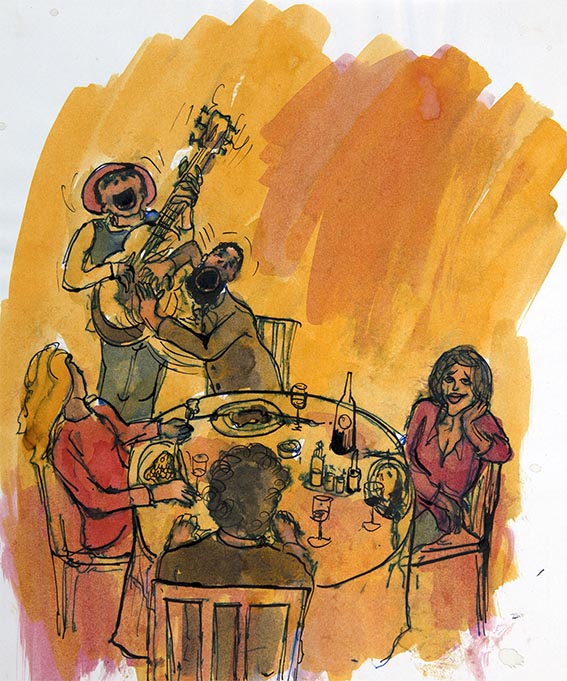
On our second night in Santiago we were taken out to supper by one of Dido’s contacts at Sename (Chile’s National Youth Service – responsible for the protection of the legal rights of children and adolescents, among other things). He had helped Dido plan her trip from the UK and would be her main facilitator while we were in Chile. A warm and exuberant young man as I recall and, accompanied by his equally charming fiancee, he gave us a lovely night out on the town. This was to be the first of many enjoyable dining experiences throughout our long trip, highlighted by our host’s impromptu collaboration – on vocals and percussion – with a passing guitar-playing serenader. What the performance lacked in fine harmonies and tunefulness  it more than made up for with sheer gusto and enthusiasm…

4 Accompanying the serenade

5

The next day we went to the Sename HQ in Santiago for a meeting with our host of the previous evening. The two things to bear in mind at this point in the proceedings are that Dido’s Spanish was still embryonic and we were a young European couple entering a complex devoted to issues related to parent-less children. However, neither of these two key factors prepared us for what was about to happen when we found ourselves sitting in an office opposite a smiling, affable woman who we assumed was our friend’s secretary. We must have been sitting with this kindly lady for about five minutes exchanging what we thought were pleasantries – her in pidgin English and Dido in pidgin Spanish – when the office door finally opened. But, instead of seeing our friend, a grinning nurse (at least she was wearing a nurse-type uniform) walked in holding a bonny baby boy in her outstretched arms. Before we knew or understood the mix-up in progress, Dido found herself with said bonny baby boy sitting on her lap smiling expectantly into her eyes. Then, after a moment or two we realised that we had been misdirected to the adoptions section of the building instead of our contact’s admin’ office. Eventually, our friend appeared and cleared up the confusion. But, as we left her office, the lady, asked us if we wouldn’t like the baby in any case, even suggesting that we could pick him up at the end of our stay in Chile. She was serious…

5 One to Go!

6

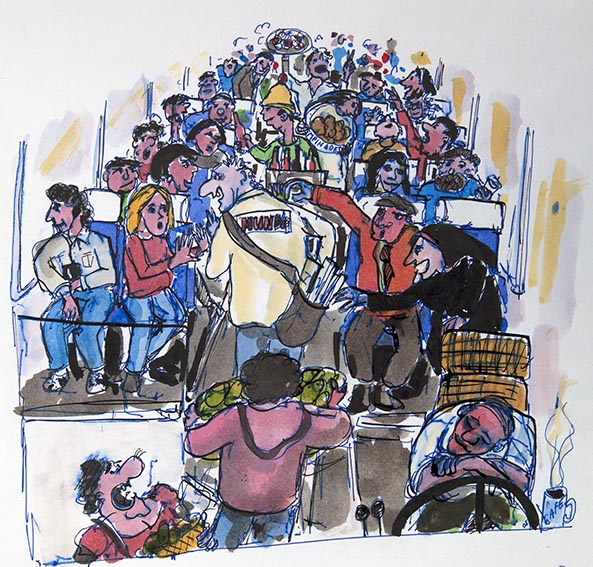
Dido’s first port of call was the small Atacama Desert town of San Pedro – just over 1000 miles north of Santiago. We decided to use the same mode of transport that most Chileans used then for such long journeys – the famous Tramaca coach. Being only the start of the trip we were as-yet uncertain of how our funds would hold out, so rather than travel in the relative luxury of the cama bus with their lauded 1st class aircraft seats and cocktails, and airline-style meals served by attentive stewards, we opted for the regular-seated bus. We would be traveling to San Pedro in three stages, stopping first for a day at the port of Antofagasta – a journey of twenty-five hours. Initially, apart from the stunningly beautiful landscapes we motored through, there was nothing remarkable about the coach journey itself. But then we stopped for a  driver’s rest break and it was like no driver’s rest break on any coach journey we had ever encountered before. As the doors of the coach opened a virtual caravan of peddlers and food sellers streamed onto the vehicle, offering assorted newspapers and magazines, all sorts of drinks, from fresh juices to beer and tasty things to eat. Most delicious of all were the empanadas, fried and baked – reminiscent of Cornish pasties – filled with either cheese, tuna or meat. And there were also huge, green, sweet ripe palta – known to just about everyone else in the world beyond the borders of Chile and Peru as avocado…

6 The Tramaca experience

CHILE – OUR REAL CARTOON ADVENTURE (part 1 of 11)

In November of 1991 my wife Dido won a Winston Churchill Traveling Fellowship to Chile to study the role of folk dance as a therapeutic tool for children with learning problems. Because it was going to be a long trip – about three months in all – and we had been married less than a year we decided that I would go along too. As it happened, Dido required her work with the kids to be recorded and as I had some experience with cameras she appointed me her video cameraman.

When we arrived in the country, Chile had been a democracy about the same length of time that we had been married, so this was a dramatic voyage of discovery in more ways than one. In fact, looking back on that trip now after nearly a quarter of century, I think that Dido and I agree that it remains one of the two or three most remarkable experiences of our time together.

We had decided to keep a written journal of the trip even before we left England, but within a few days of our arrival so many weird and wonderful – not to mention hysterical – things had happened to us that I decided to record the most amusing and surreal in a series of cartoons.

Presented here are those  thirty-three pictures – made literally on the hoof; on trains, on buses and even on planes as we traveled the length (there is no breadth) of one the world’s most spectacular, most beautiful and most crazy countries.

These pictures are a humorous and very affectionate record of all aspects of the then new democratic Chile through the eyes of two wide-eyed newly-weds.

In the words of Inti Illimani – “VIVA CHILE”!!

1 Arriving at Santiago Airport

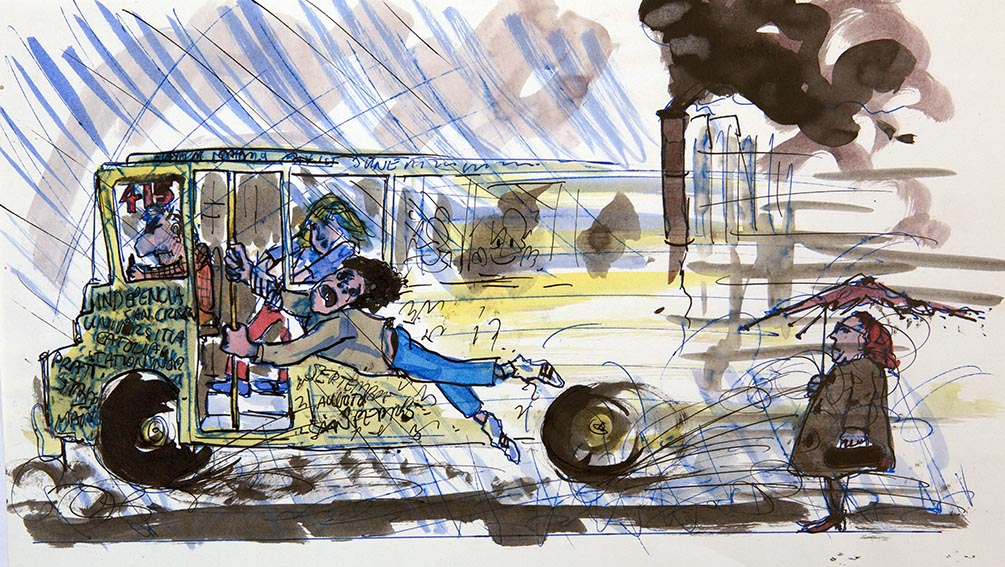
When we arrived at Santiago Airport we were virtually kidnapped by a trolley porter who then took us through the red channel. When we were then searched by fearsome looking Carabineros and I couldn’t find the paperwork for the large video camera in my possession. My explanation that the camera was not new and the property of the Ealing Educational Authority failed to impress the policemen who then separated me from Dido and escorted me – with the camera – to a small room by the side of the customs hall. Once in the room they told me to sit down on a low wooden chair in the corner and to keep the camera on my lap. There was a glass window in the middle of the opposite wall through which I could see a very worried Dido still standing among all our ransacked baggage and suit cases. For about twenty minutes I was left alone with one Carabinero, who stood leaning against the door just staring at me expressionlessly. Then two more policemen entered the room and – ignoring me completely – turned on a TV fixed to a bracket suspended from the low ceiling. There was a football match on and soon all three men were totally engrossed, occasionally shouting at the screen. At first I’d been too frightened by my predicament to take much notice of the game, but as the minutes passed I realised it was an international game and one of the teams was Chile. And then, as fear turned to boredom I began to watch the match too until I finally recognised one of the Chilean players. Without thinking, at the moment I recalled his name I blurted it out, “Ivan Zamorano!” The three jackbooted Carabineros all instantly turned to look at me with looks of amazement on their faces. Then, one of them who spoke English asked me, “Zamorano! You know him?” “Of course! He plays in Italy for Internazionale” I replied, then added, lying through my teeth, “He’s one of my favourite players. I’m a big fan!” And with that it was as if I had turned on a switch. Next thing I knew, the three men were all smiles and charm personified and I was being escorted back to Dido, with our camera and sent on our way. Who says football is just a game…2 Cerro San Cristobal above the smog - SantiagoThe first thing you noticed upon arrival in Santiago back in 1991 (I’m sure it’s improved by now) is an all pervading smell from the heavy smog, trapped over the city by the surrounding mountains. The smell was distinct and highly reminiscent of burnt cooking oil. The only way to be outside and escape the smog was to climb the famous Cerro San Cristobal hill that rises some 300 meters above the city. However, the problem with this was that the climb was steep and until one emerged from the polluted air very painful on the lungs. Still, the rewards were both clean air, and once at the top, beneath the statue of the Virgin Mary, stunning views of the Andes rising above the city like a sheer and mighty snow-capped parapet.

3 A typical Santiago bus experience

There must have been many culprits responsible for Santiago’s poor air quality back then, but I guess the greatest contribution were the hundreds (if not thousands) of small buses speeding about all over town, belching great gobs of black sooty exhaust from their tin chimneys. More daunting than their exhaust though, at least to the newly arrived foreign traveler was negotiating how to use the things. Each minibus had its own peculiar route scrawled on its side in barely legible graffiti-like writing. Then, once one had decided to gamble on a particular vehicle, and waved it down – there didn’t seem to be any official bus-stops – one had to literally leap on before the impatient driver lurched off almost immediately. On several occasions either I or Dido were too slow and ended up being dragged along the curb, holding onto the door rail for dear life.

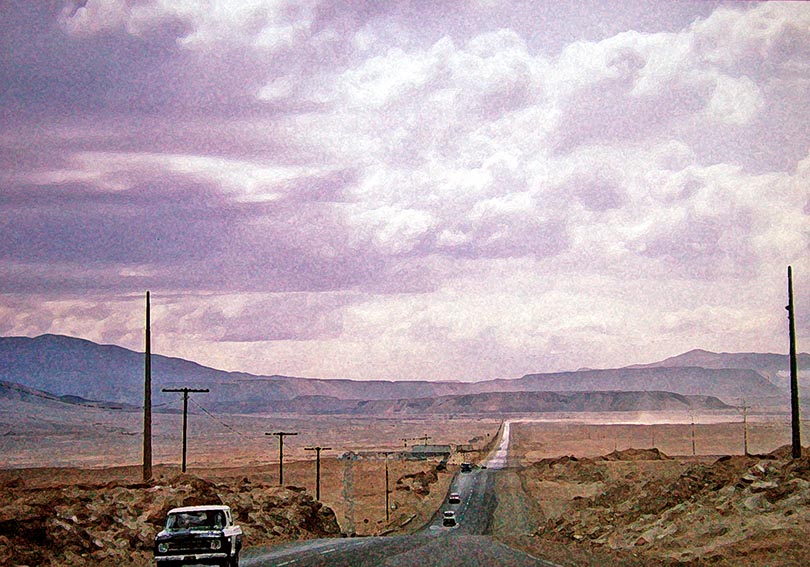
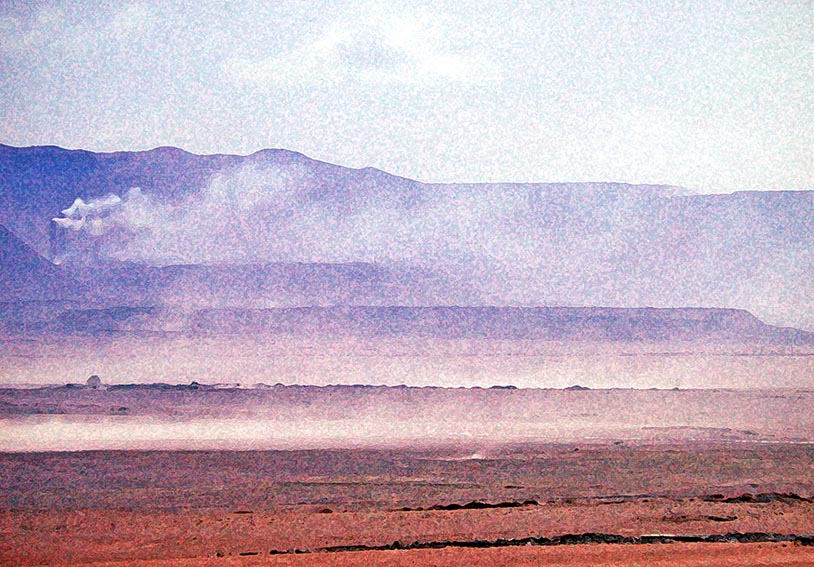
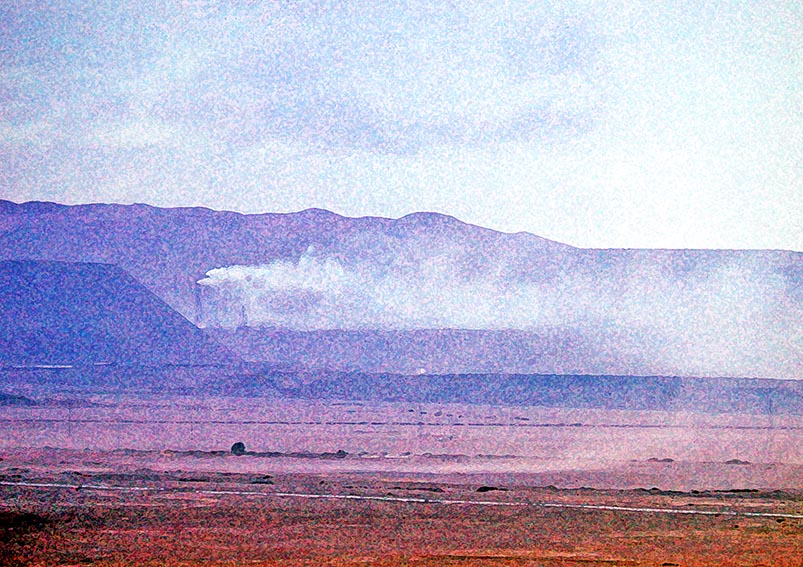
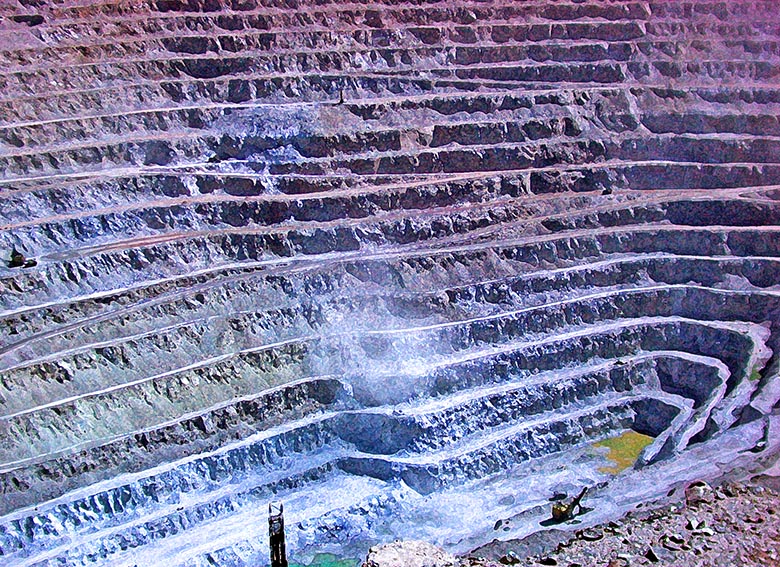
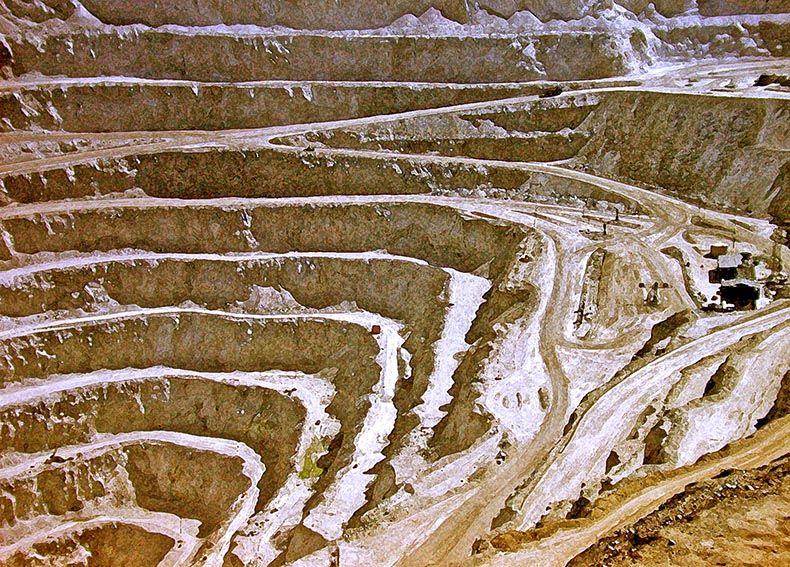
CHUQUICAMATA – EYESORE OR THING OF BEAUTY?

It’s been the best part of three decades since we visited  the copper mine at Chuquicamata in Chile, and I still can’t decide whether it was a thing of stunning aesthetic quality or a vast, hideous blemish on an otherwise almost virgin landscape.

The facts are these: It’s the second deepest man-made pit, and the largest open-cast copper mine in the world by volume.

Moreover – before anyone gets all outraged and self-righteous about my conundrum – the copper wiring powering the laptop, Mac or PC you’re currently looking at this site on comes from this very pit or another mine just like it somewhere else on the planet.

What I remember mostly from our visit (apart from the terrible air quality from the smoke stacks nearby) was the sense of overwhelming awe when we first looked over the edge of the mine. I also remember the expressions upon the faces of all the members of our little tour party at that moment as we all looked at each other in disbelieving amazement. Everyone was smiling – inanely and bemused for sure – but we were smiling.

As usual with these gallery posts, ultimately it’s the images which must do the talking and the convincing – or otherwise. Do they make you smile or make you cry.