MY JOURNEY FROM HARROW SCHOOL OF ART TO ST. MARTINS IN GOUACHE
I’m not sure what the art education system is these days as I have totally lost touch (and interest) with the British art world and all its academies, institutions and philosophies. However, in my time, after leaving high-school for art college, one did a one or two-year foundation course, and then typically went on to do a BA.
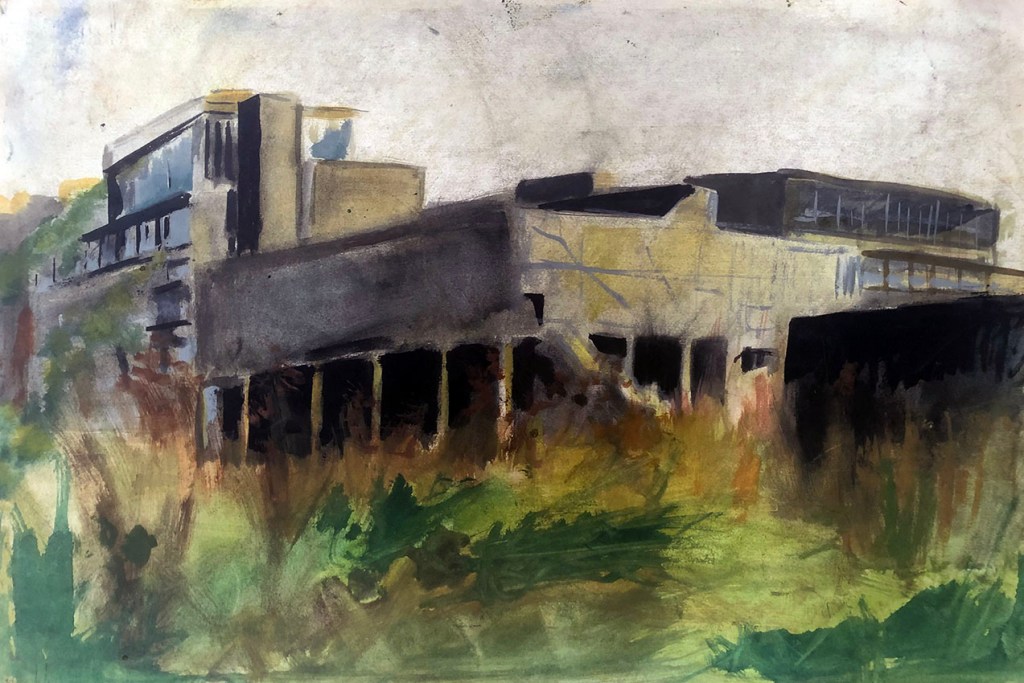
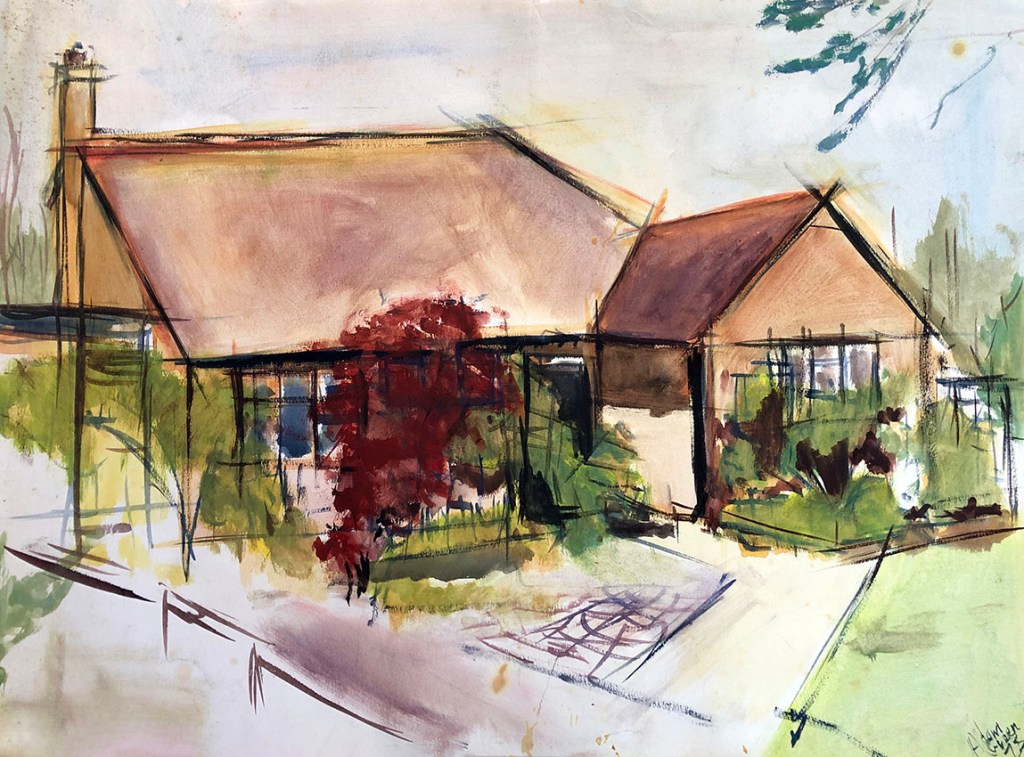
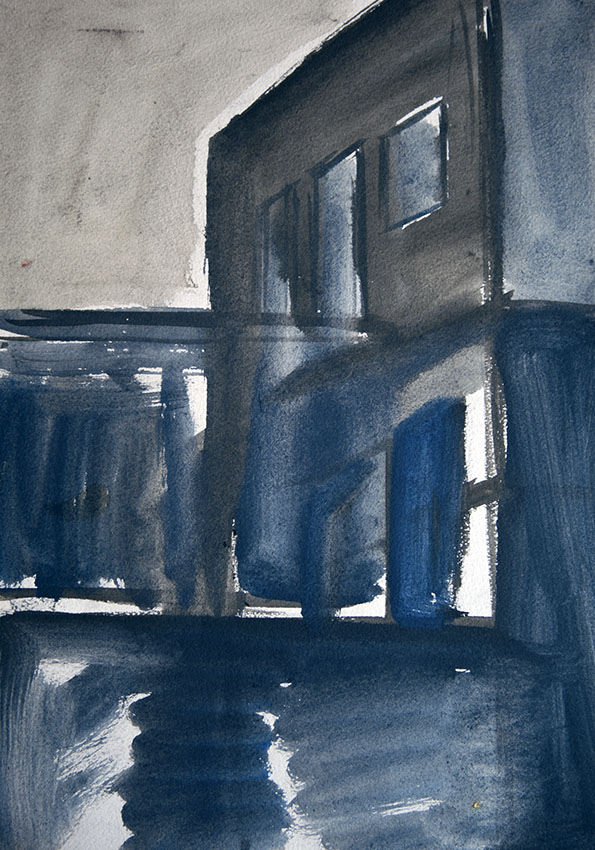
Northwick Park Hospital (Harrow) – gouache on paper – 1976
My era at art school ran from 1976 – 1981 and was something of a grand experiment, as it more-or-less coincided with the formalisation of art as an “academic” subject. Whether or not there was any merit in this move is still debated today, but from my own experience, and that of many of my art school acquaintances, the BA’s we left school with were utterly useless for furthering our careers as artists (or anything else). Ultimately, our degrees were little more than educational bling.
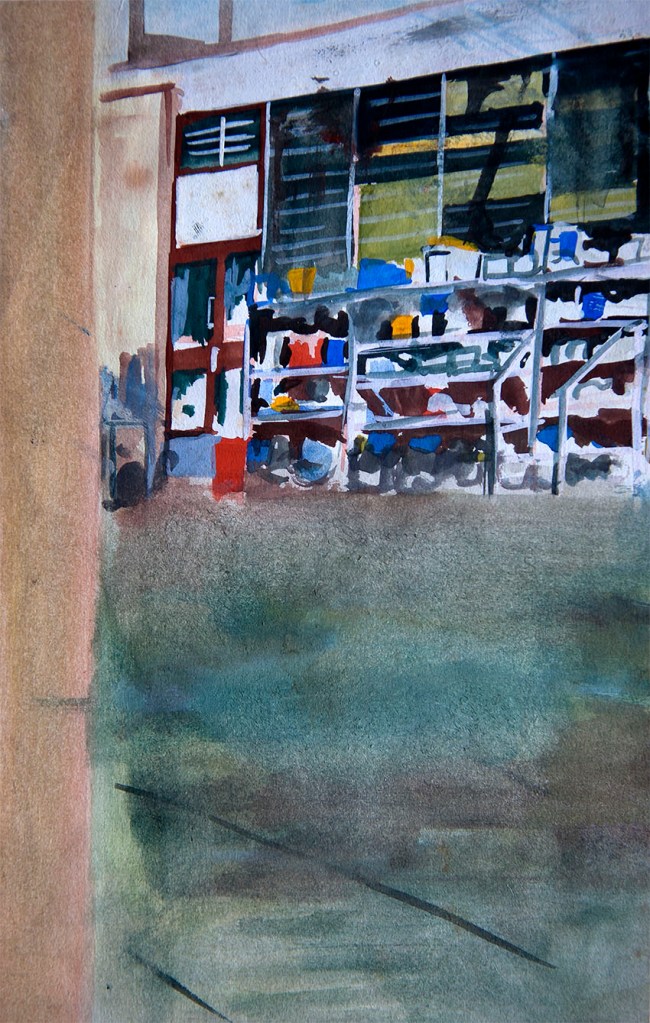
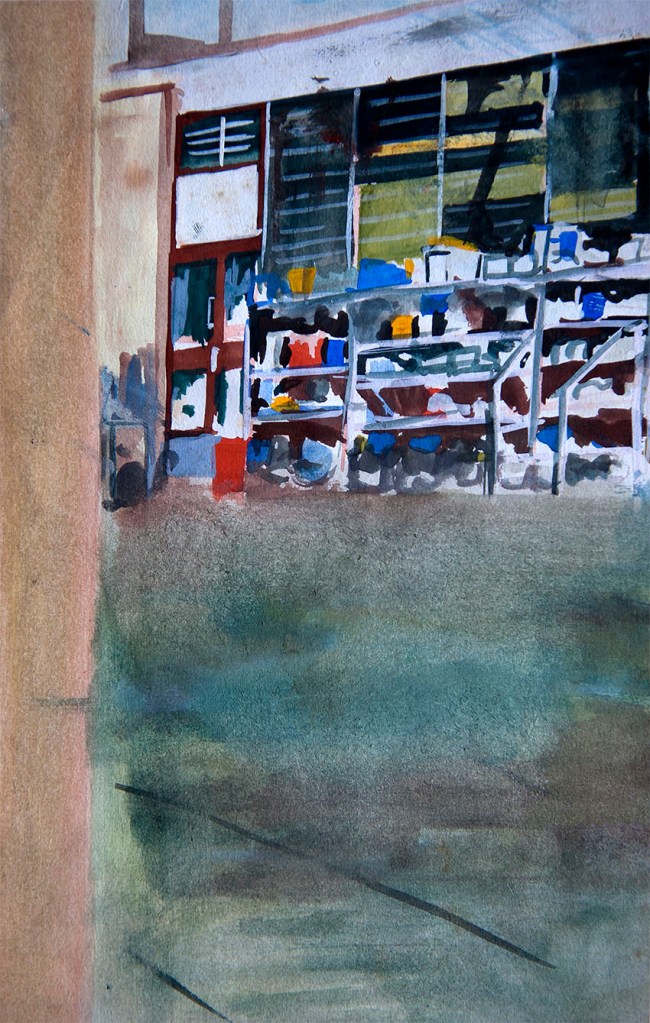
The Pottery Courtyard (Harrow School of Art) – gouache on paper – 1976
All these years later I console myself with the fact that both Harrow and St. Martins, in their very different ways offered many valuable (if often somewhat turgid) life experiences, and that the fairly successful artist I went on to become was as much in spite of those experiences, as because of them.
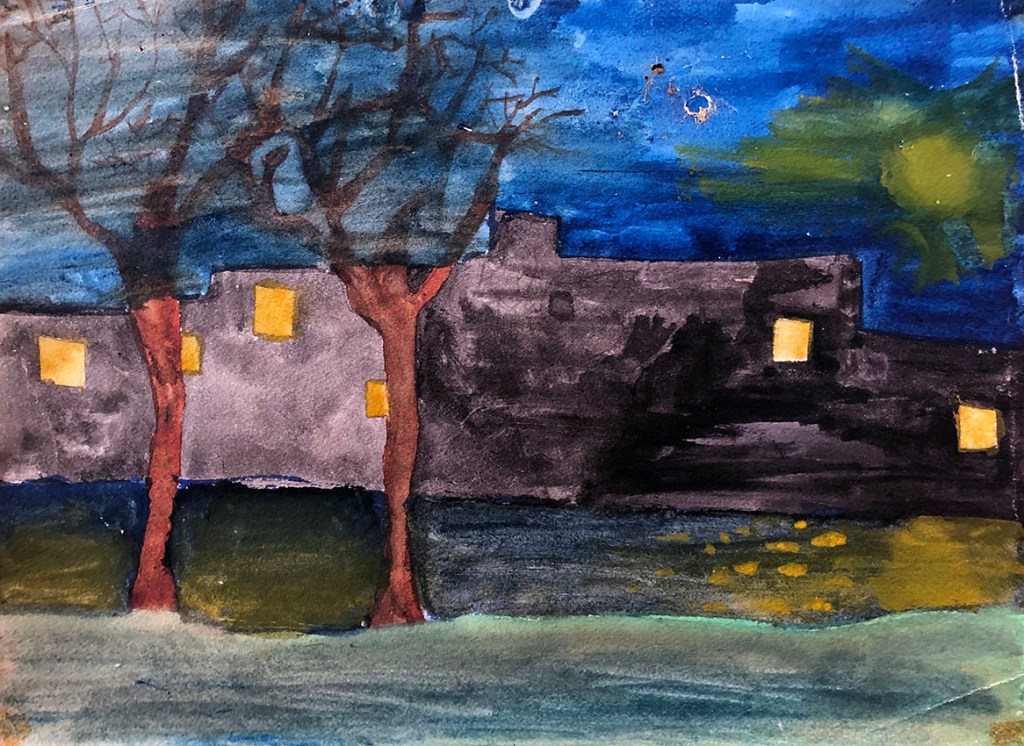
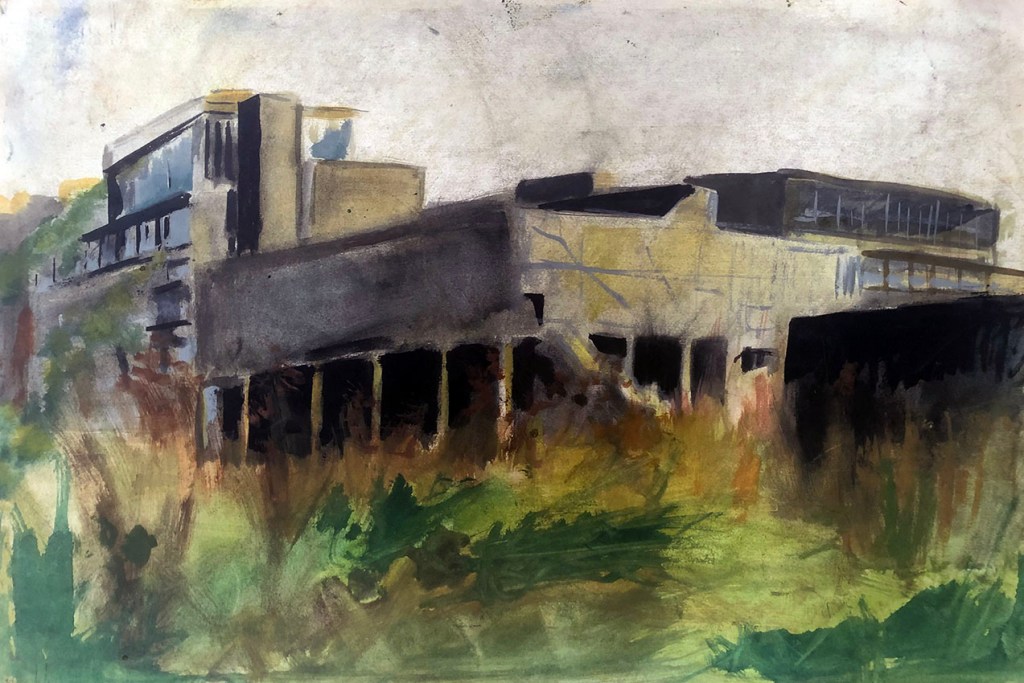
Northwick Park Hospital on a Winter’s Eve – gouache on paper – 1976
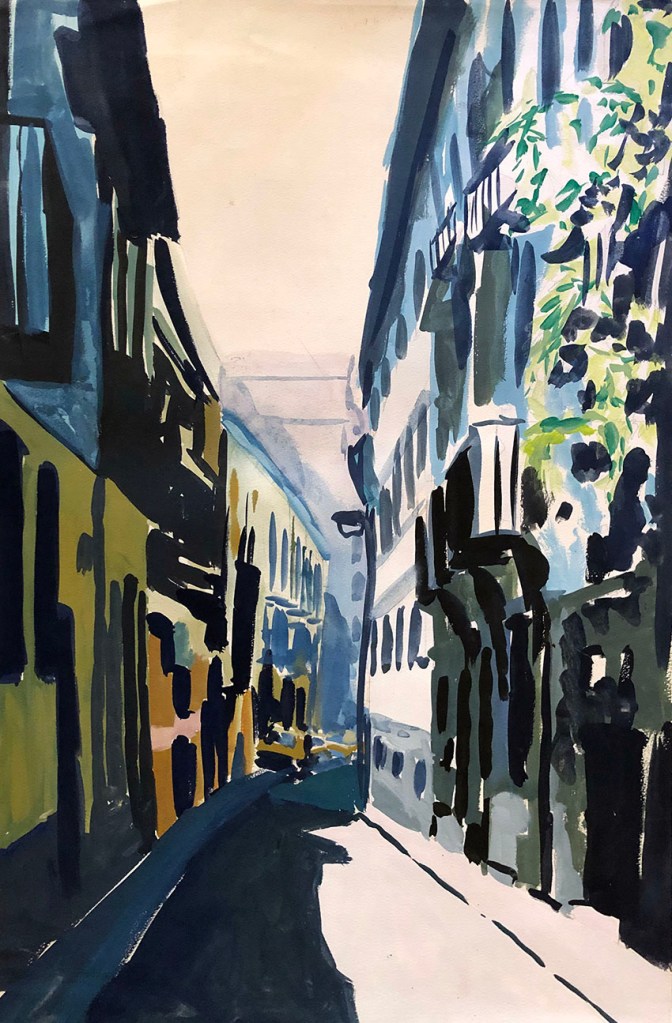
The half-dozen gouache washes here cover the end of my time at Harrow and my early days in Soho, with a visit to Spain in-between. They reveal my dabbling with a gentle form of constructivism, which was in reality a mostly contextual necessity, given the locations of my subject material. In any event, as with most of my work, in all its forms, they are ultimately all about the light – light that can lend drama and even a little beauty to most brutalist of concrete structures. There’s a deep message in there somewhere, but that’s another story…
THE AMUSING TALE OF HOW I ACQUIRED MY MOST ILLUSTRIUS PATRON, CONCLUDED (part I here)…
I arrived at the imposing front door of the Duke of Devonshire’s red brick Mayfair house in Chesterfield Street a few minutes early. Because I was carrying two 3×2 foot canvases my mother had kindly offered to drive me into town from our home in Edgware (north London), rather than have me negotiate the tube or a bus with my awkward burden. With just a polythene sheet to protect them, I was terrified of presenting two dented paintings.
Mum offered to try and find a parking space and wait for me, but I told her not to bother. For one thing, I had no clue how long I would be with the Duke, and for another, I’d either be returning with one or two “rejected” pictures, or hopefully, emptyhanded. In any case, I would be happy to risk some form of London transport.
Tel Hai – oil on canvas – 1983 – The painting which was kept at Chesterfield Street
Within moments of me ringing the door bell, for the first and (thus far) last time in my life, I was greeted by a butler, who with a mixture of firmness and politeness guided me up a flight of stairs to the “drawing room”. After I carefully set down the paintings against an armchair, the butler, who could have been the role model for Jeeves himself, informed me that “His Grace” would be down “presently”, then, gesturing toward a well stocked eponymously-named tray, asked me if I would like a drink while I waited. Thinking a stiff scotch might be just the thing to calm my slightly frazzled nerves I answered in the affirmative. Then, after having served me a large, heavy, cut glass highball, filled to the brim with Dimple Haig and ice, the butler left me alone to contemplate my extraordinary surroundings.
The fine regency and early Victorian furnishings were typical of such an environment, but what was less expected was the array of modern artwork hanging on all the walls. It comprised a comprehensive collection of pictures by nearly all the major painters of the 20th Century – from Picasso to Rothko, and from Matisse to Miro. While I knew the Duke was a keen collector of contemporary art, nothing could have prepared me for such a superlative display.
The Hula Valley (from Tel Hai) – oil on canvas – 1983 – The painting destined for Chatsworth.
As I shifted my gaze from an unexpectedly vivid and jolly early portrait by Munch to my own two modest canvases, I found myself taking an extra large slug of the Dimple. Then, fortunately, before I had time to terrorise myself further, the door opened and the Duke entered, walked toward me, a welcoming smile on his face, and arm outstretched. He was taller and leaner than I expected, and similarly to his butler, drawn straight from the pages of a Wodehouse novel, almost as if I was being approached by Lord Emsworth. “What a great pleasure to meet you Mr Green!” he said, with disarming warmth and charm, gently but firmly shaking my hand. “How kind of you to come!” Then, noticing the state of my glass, and no-doubt sensing my agitated state he suggested I go and top myself up, which I gratefully did.
“If you would be so kind, I think we had better take a look at what you’ve brought, don’t you?” he said, then added, “Why don’t you unwrap them and put them up on the couch.” I did as he requested, and then stood back, by the Duke’s side while, chin in hand, he contemplated my two humble landscapes. “From the north of the country, if I’m not mistaken?”
Impressed with his knowledge of Israeli geography, I confirmed he was correct and then explained a little about the paintings. “I think they are both terrific Mr Green! Sadly, one doesn’t see many competent landscapes like this of Israel – at least not done by Israeli artists. They capture the essence of the place so precisely! I would love to add them to my collection!”
With that, he went over to a sideboard, opened a drawer, withdrew a large chequebook and a pen, handed me both and asked me to write a cheque for the value of the two pictures. Having done as requested, the Duke then signed the cheque, tore it out of the book and handed it to me. “Now” he said, “let’s go and see where we can hang the one staying here…”
Chatsworth House – arguably, the greatest stately home and palace in Britain, with an art collection to rival that of the Queen herself.
He then led me on a remarkable tour of the Chesterfield Street house, from the cellar to the upper bedrooms, stopping from time to time, to give me some fascinating anecdote about this or that amazing picture, the artist who made it and how he came to purchase it. About ten minutes into the tour, we were half way down a staircase, when he pointed out a space between two small oil paintings. “I think we could put your Tel Hai painting here? What do you think Mr Green?” he asked. The painting on the right of the space was a very early Lowry painting of a street scene, dating from before he developed his stick-figure style – and all the better for it – while the painting on the right was a colourful still-life by Mathew Smith. I was speechless for a moment or two, then mumbled my approval. “In case you were wondering, I thought we’d take the other one of the Hula Valley back to Chatsworth. I think it would be lovely to have a picture of Israel in our bedroom. I hope that’s okay?”
A few minutes later, with me still in a kind of euphoric daze, we walked into a bathroom, and there, leaning over the sink, putting on her lipstick, dressed only in a black silk and lace negligee, was the most beautiful sexagenarian lady I had ever seen. “Excuse us Debs darling” said the Duke, “this is that brilliant young artist I told you about, Adam Green, and I just wanted to show him that little Henry Moore by the bath”. “Don’t mind me you two” replied the Duchess (and the youngest and last surviving of the famous and infamous Mitford sisters). “A pleasure to meet you” she added, glancing at me in the mirror, still applying the finishing touches of lipstick, “but do hurry Andrew dear, we can’t be late for the reception”.
The Moore was a miniature, or possibly a sketch piece for a far larger work I thought I recognised, but my main impression from that fleeting visit to the Ducal bathroom was the blemish-less, glowing skin, and youthful form of the Dowager Duchess of Chatsworth, not to mention her lack of inhibition.
If the Duke reminded me of a more together version of Lord Emsworth, the Duchess, even in her underwear, oozed that peculiar type of serene confidence that is the birthright of the British upper class.
The tour lasted about 45 minutes in all, and I was shown to the door by the Duke himself. As we shook hands for the second time, he said in parting, “Do be sure to keep me informed about your progress Mr Green, and do let me know if I can ever be of service…” As I sat on the top of the 113 bus back to Edgware, I felt as if I was waking slowly from a dream.
It wasn’t a dream however, and several years later, the Duke, true to his word, generously opened my one and only West End one-man-show with a typically kind and charming address.
Looking back at it all now, my abiding memory isn’t of walls laden with modern masterpieces, nor of my own pictures being among them, nor even of the sweet and kindly old Duke; but of the beautiful Debs, in her negligee, and her stick of crimson lippy…






 ARKS, ADAM AND AXARQUIA