“A light unto the nations”* like it or not…

an optimistic new year message

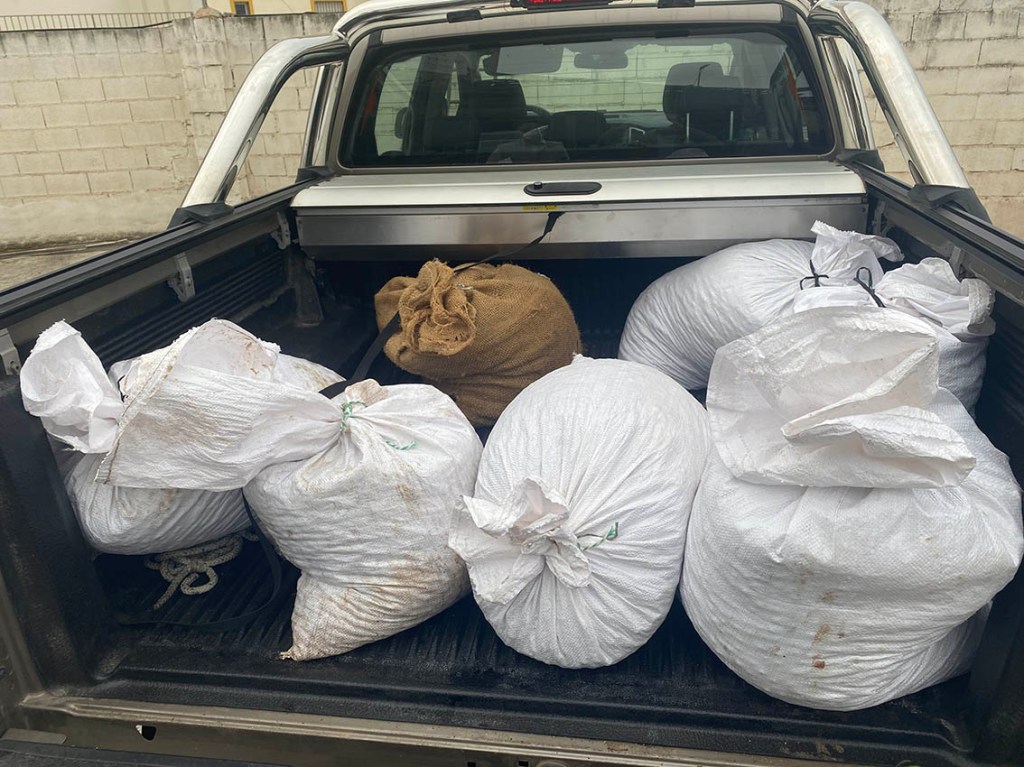
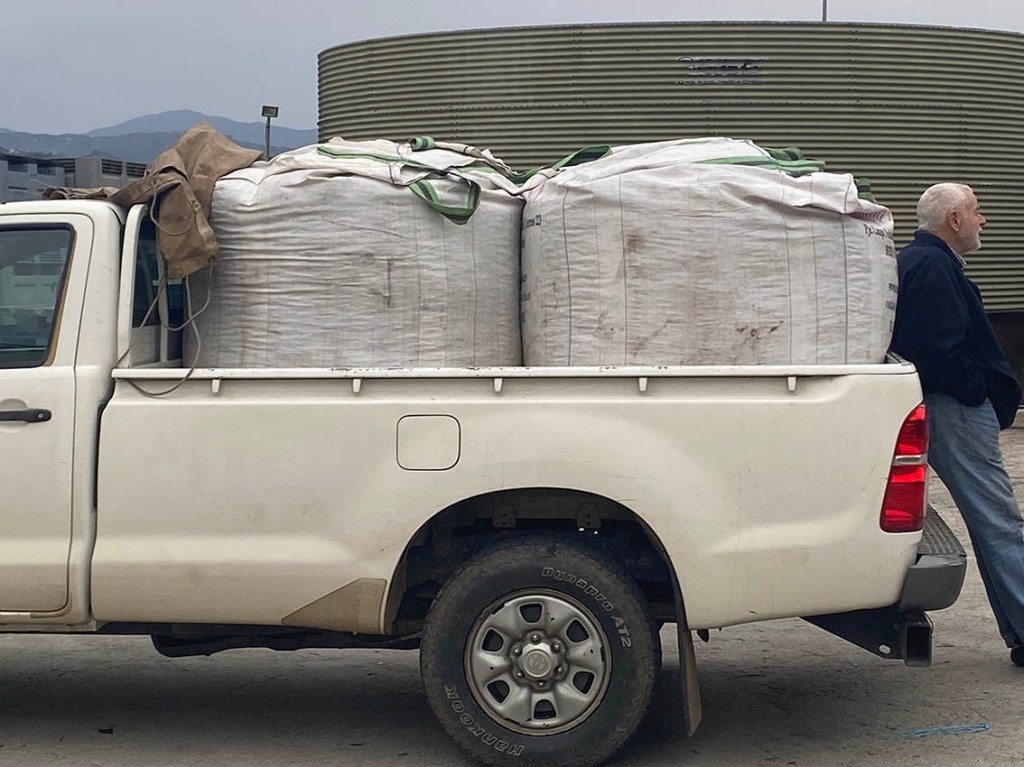
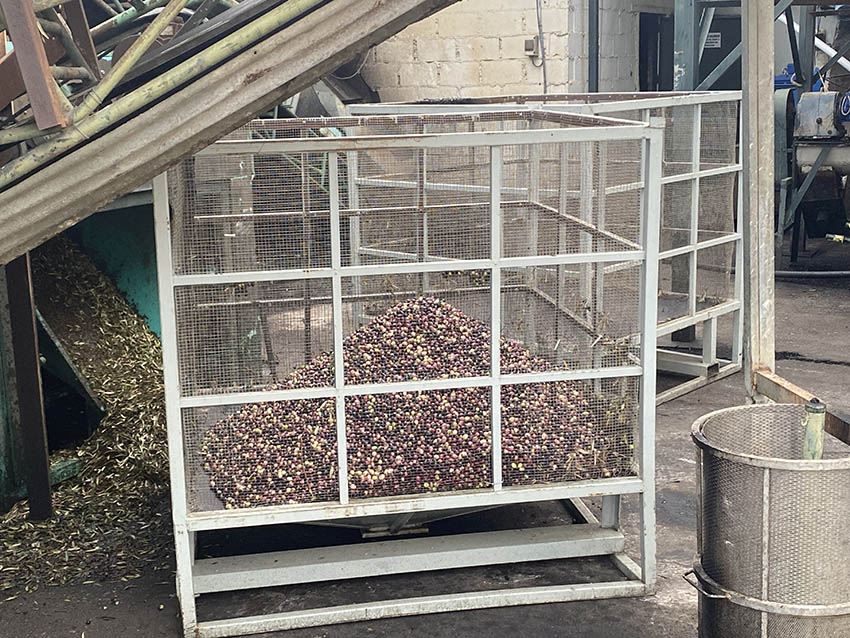
This year we have a bumper olive harvest – the biggest, since we planted our new grove twenty years ago. The work of picking, pruning and burning off is the most intense of the year.

The large crop feels somehow auspicious, as do the copious rains and the unusually crisp temperatures. When we first arrived on these rugged hills, some 33 years ago in 1993, we remember hearing a climate scientist assuring us that due to global warming this region of Spain would resemble the Sahara by 2003. We heard this on the BBC World Service program “Science in Action” on our short wave radio, our only form of communication back then with the outside world. Having just settled here, and having absolute faith in the reliability of the BBC you can imagine how this highly confident prediction alarmed and depressed us.

Well, since then, many things have happened, both predictable and unpredictable from the continued veridian fecundity of the Andalusian countryside, to the increasing unreliability of the once-great BBC.

New years have a funny way of making us reflect on all of these things. They are times of rejoicing but also of deep, and often sad reflection. We are reminded of those we have lost and of our own mortality and of those we love, and of those we do not – and of those who love us, and of those who do not.

All of which brings me to the Hanukkah story: The story centres around the miracle of the olive oil for the Jerusalem Temple Menorah – sufficient only for one day’s illumination, but miraculously lasting the eight days required for new oil to be made and sanctified (hence the eight stemmed candlesticks lit in the windows of most Jewish homes). As an olive farmer, whose crop is exchanged for oil, the story has become increasingly resonant and moving with each successive harvest, and never more so than this year, following the horrific events on Bondi Beach.

As many of you reading this know, I am not religious, but I am nevertheless deeply moved by the symbolism and central message of Hanukkah on a fundamental human level; that message being one of enduring light and of steadfast hope despite the worst efforts of all those who oppose our existence.

Thus, at the risk of contradicting/upsetting “omni-causers” everywhere, my predictions for 2026 and many more years to come, are repeated Andalucian olive harvests, the continued and uncowed thriving of the Jewish People, and the assured reoccurrence of the light of the Hanukkiah – itself, a metaphor for Isaiah’s famous dictum, that our credo was, is and forever will be, “as a light unto the nations “.

Happy New Year, and a hearty l’chaim!

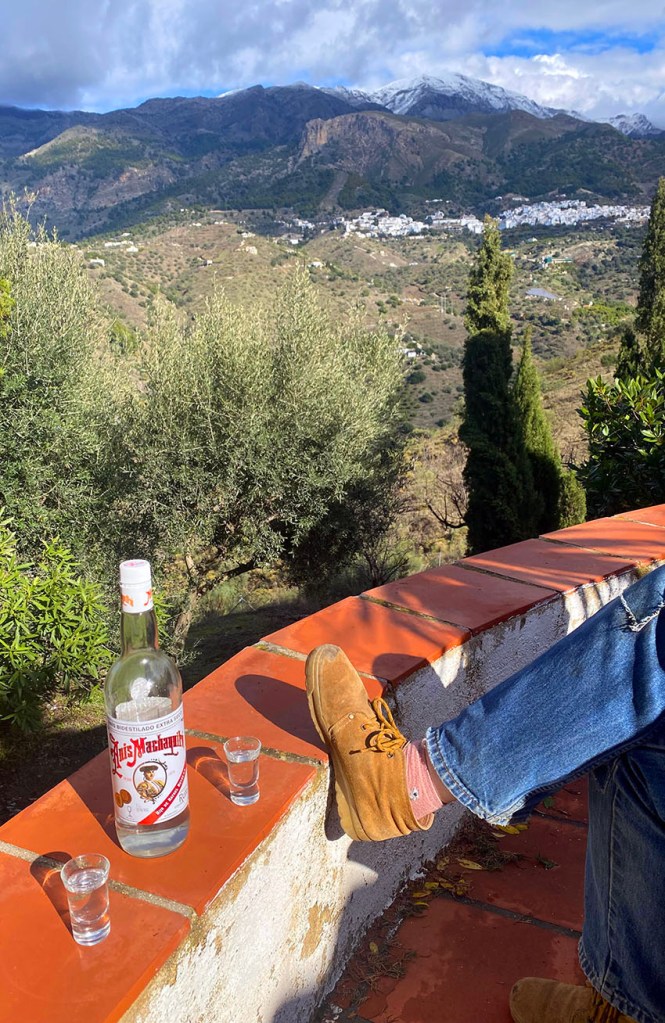
A sustaining mid-morning tipple with a snow-capped Mount Maroma in the background.

*Isaiah 42:6. Header photo shows the large Hanukkiah (the Hanukkah candelabra) in the synagogue at my old school, Carmel College.

AN ILLUSTRATED GUIDE TO MAKING THE ULTIMATE BEER-NUT…

…for beer nuts (and others)

ALMONDS FRIED IN OLIVE OIL WITH SEA-SALT

We grow three types of almond here on our finca in southern Spain, including the indigenous (earthy) “fina” , the (scented, sweet) “desmayo” (similar to the Californian nut, and what is typically seen on the shelves of north European and British supermarkets and fruit shops) and (the dry) “marcona“. With summer water so scarce here, Andalusian farmers, as a rule, do not irrigate their almond trees, which on the one hand means lower yields and smaller fruits, but on the other, ensures their fruits are intensely flavoured. All delicious in their different ways, we find that the marcona works best for most cooking purposes.

Before we spent so much time in Spain, I only knew the almond as something seen in the nut bowl at Hanukkah / Christmas time; and in its ground form, as a cake ingredient (my great aunt Fanny’s almond cake was my favourite), and as the famous Jewish party nosh, rozhinkes mit mandlen (raisins and almonds).

However, that all changed drastically, and much for the better once we discovered the local cuisine, here in Andalusia, and throughout the Iberian peninsular, where the humble almond (always known to be a “super-food” by the long-lived locals) is a key constituent of every cooks larder.

Of course, just about everyone around here, with a finca, like us, or just a small patio garden, has at least one almond tree, so that in addition to the ubiquitous sack of stored almonds in the pantry, or the bodega, there’s generally a proliferation of the fresh fruits from mid-July until the end of August. Whereas the older nuts will typically be used for such winter staples as Almond Chicken and Albondigas (meatballs) in Almond Sauce, in summer, the fresh, softer fruits, will be blended with stale bread, garlic, olive oil and spring water to produce, rich-yet refreshing ajo-blanco – garnished with halved moscatel grapes, perhaps the greatest of all chilled soups (commercial “almond milk” – eat your heart out!).

But undoubtedly the simplest of all our regular almond recipes, is also the most moreish and is equally good made with fresh or dried almonds. It even works quite well with the sort of (mostly American – heavily irrigated) almonds one has knocking about in plastic packets in British, European and American kitchen store cupboards. The only thing I would suggest doing differently from my recipe below, is to use a cheap, refined olive oil, rather than the first cold press oil I use. Unless one has a Spanish finca like ours, with our own olives and copious amounts of the finest oil, or is extremely wealthy, the taste benefit of using extra virgin oil over refined olive oil is minimal.

Whatever olive oil you use, if you’ve had a packet of almonds hanging around for too long, this recipe is a simple and delicious way to use them up. Salud y buen provecho!

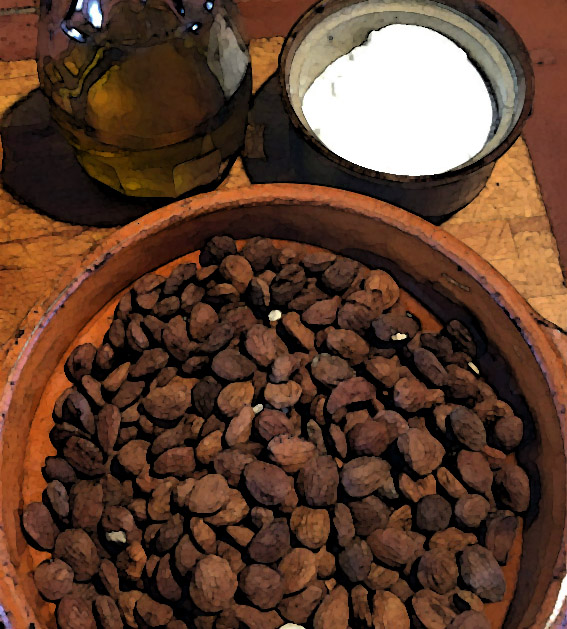
Just the three ingredients; almonds, olive oil and sea salt…
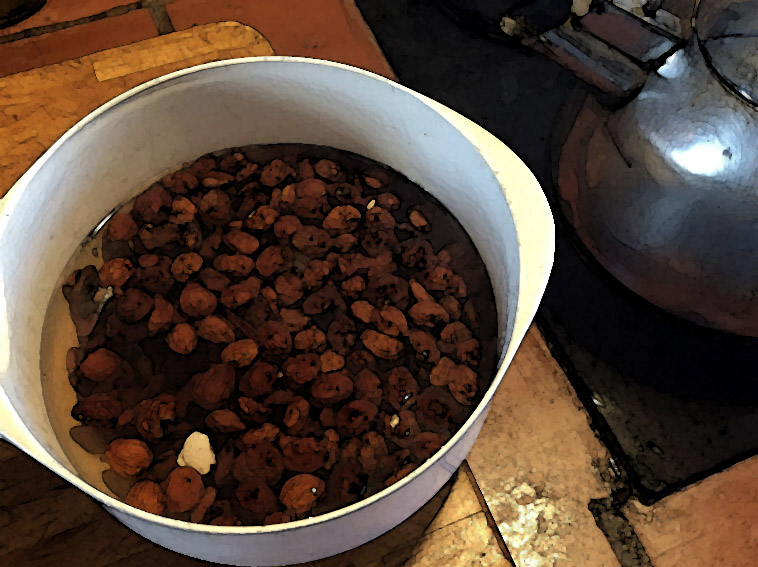
Blanch the nuts in a deep bowl of boiling-hot water, then skin them…
Set sufficient olive oil to comfortably deep-fry the almonds, over a high heat…
Stir the almonds constantly to prevent them sticking and ensure they cook evenly as possible…*
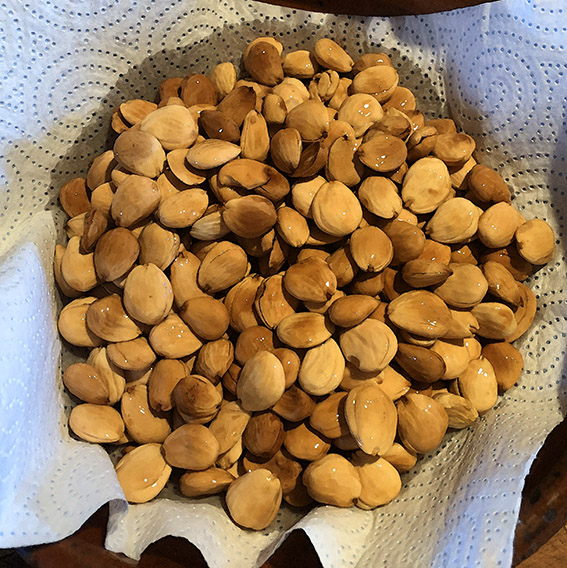
When all the almonds are at least a deep honey colour (some will be darker), lift them out of the oil with a slotted spoon, and place in a shallow dish lined with generous amounts of kitchen role. Toss well to remove as much excess oil as possible. It’s better to slightly over-do the almonds than under cook them and have them bland and oddly “milky” – rather like the tasteless “roasted” almonds in those little bags one gets given on aeroplanes with a drink…
Toss the almonds in a generous pinch (or two) of sea-salt, to taste. Do not be sparing with the salt, and remember, that this is not a low-sodium snack. Better to restrict oneself to just a couple of well-seasoned nuts than to spoil the dish by using too little salt, or foregoing it altogether…
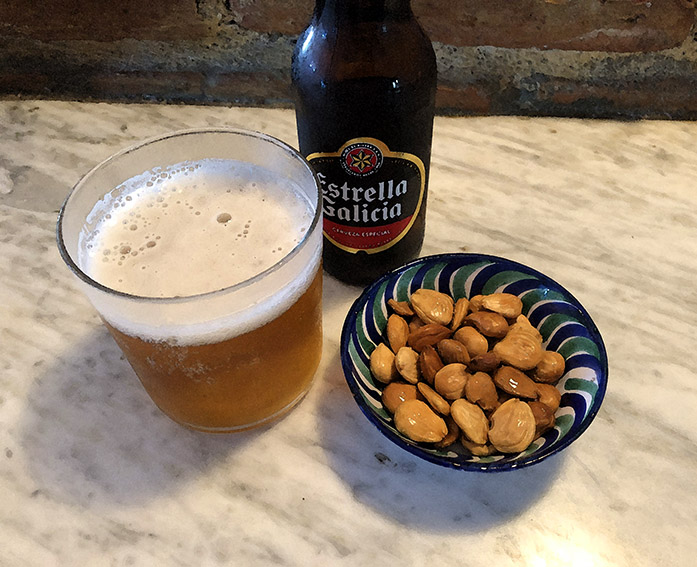
The almonds are fabulous with an ice cold beer, though equally delicious with just about any aperitif, spirit, or cocktail.
*Be sure to keep the used olive oil for further cooking (unlike sunflower oil, but in common with nut and rapeseed oil, olive is safe to reuse  many times). It adds a subtle almond note to things like chips (fries) and even deep fried fish...