THE ANSWER TO THE QUESTION/S WE ARE ASKED THE MOST…*
Well, not exactly, is the answer, in that they do all nearly end up as oil, but the oil is not made by us.
Olive presses, in all their forms, are serious pieces of machinery and far too ambitious and expensive for a small farm like ours. That is why, we, in common with all of our neighbouring growers take our harvests to one of the several local presses or factories.
Most of the larger growers will typically belong to a cooperative such as the one in our local village, and which has its own press. Smaller “independent” growers like us will head to one of the nearby commercial operations.
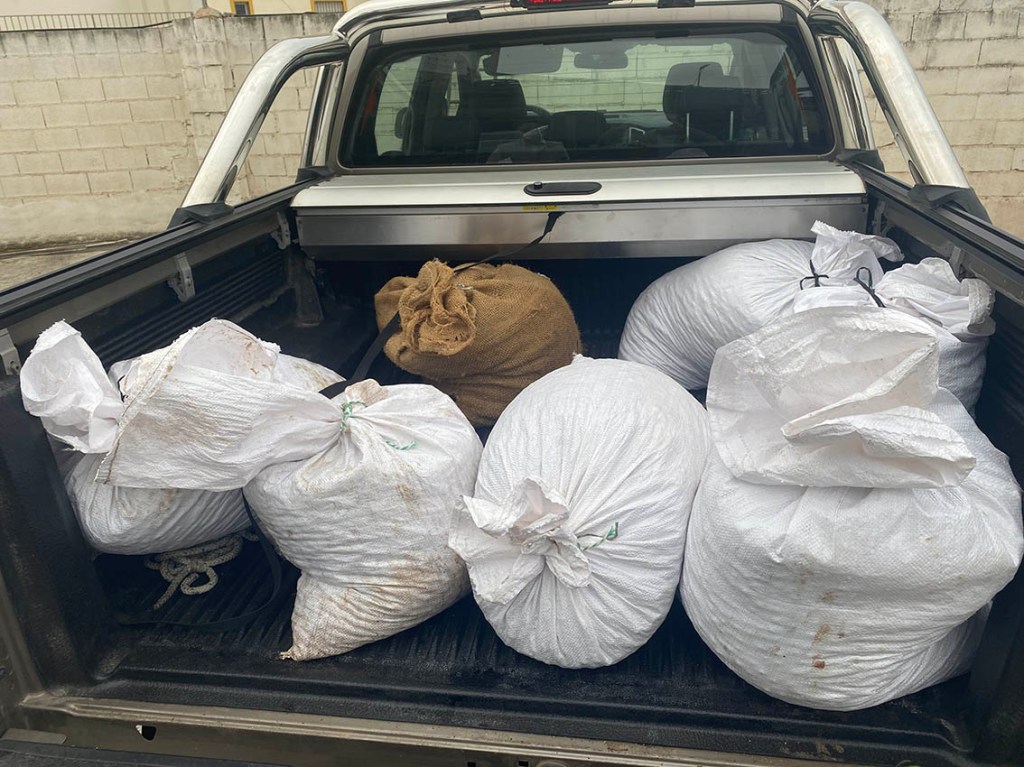
This year’s olive harvest on the back of our truck. Half an imperial ton, so not bad for two old codgers!
The larger growers will have hundreds of trees, sometimes thousands, producing several tons of fruit. Smaller growers like us, will have anything from half-a-dozen to a hundred trees, giving crops from a couple of sacks to a couple of tons. When we purchased our finca in 1993 it had only three young olive trees (the finca being then primarily turned over to almond and vines). Since then, we have planted around fifty more olive trees which is about as many we can handle on our own, vis-à-vis, annual pruning, burning off and harvesting.
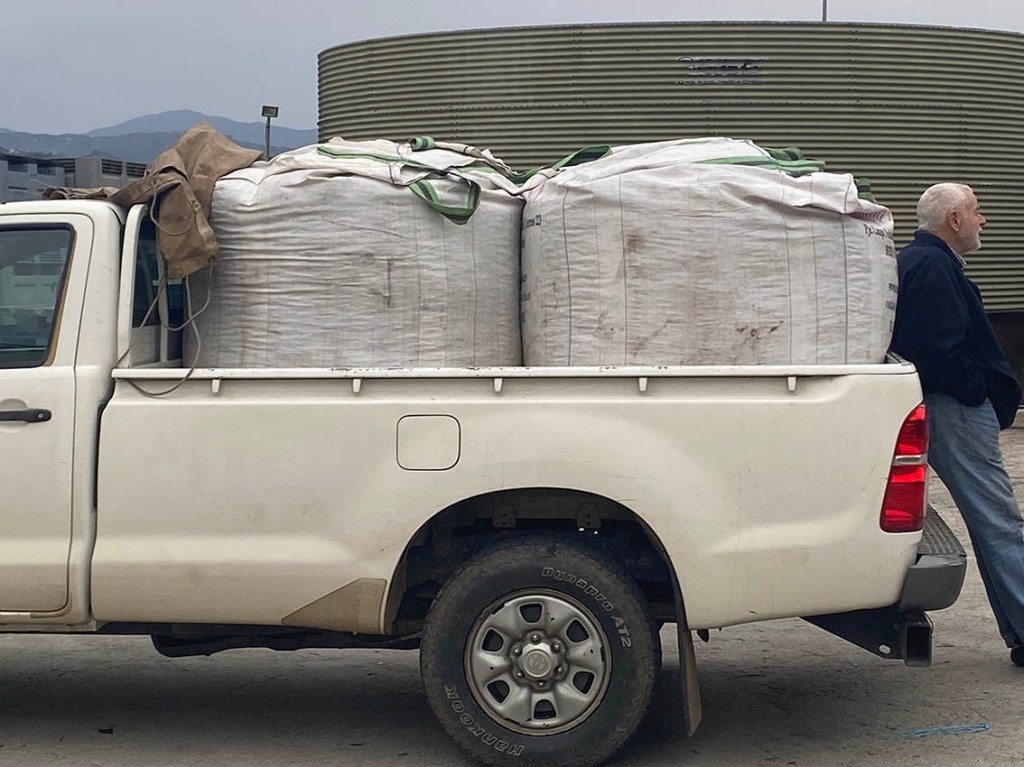
The guy before us at the press, with nearly a ton and a half of olives…
We normally harvest in late December/early January. The smaller trees we pick simply by hand, but the larger trees in heavy crop, require the setting up of nets and the use of whacking-sticks, and picking all the fruits often means quite a bit of climbing too. Fortunately, Dido and I both retain an almost childlike enthusiasm for tree-climbing!
Most of the local presses (including the cooperative) produce first cold-pressed extra-virgin oil. However, as a rule, to get a proportion of your own oil back, one’s load must exceed 500 kilos (half a metric tonne / about 1100 pounds). Although our crop is doubling each year, now that our trees are all “on-line”, we still only managed about 250 kilos this past harvest. This means that although we do get about 20 litres of fabulous oil in exchange (the press retains 50% of the oil yield), it is not actually ours. Hopefully, if this coming year is as fecund as the last, next year we will comfortably reach the 500 kilo target and receive oil from our own fruits for the first time.
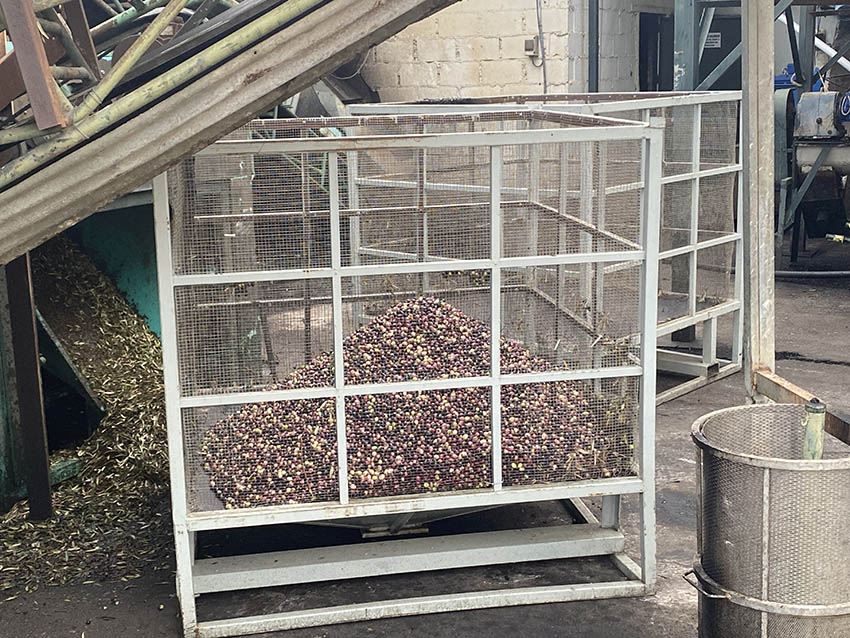
Our olives, ready for the press.
As for our local Axarquian oil, it is famed throughout Spain for its low acidity, and its smooth, slightly peppery apple flavours. Of course I am biased, but I far prefer it to most mainland-French and mainland-Italian oils, which tend to be too astringent for my taste. In style, our oil compares well with, and is very similar to those from Sicily, Corsica, Sardinia, Greece and the Levant. Fundamentally, the stronger the sun, the smoother and more buttery the olive oil.
* The header photo shows our main olive grove, about eight years ago, a year or two before they all began to yield significant amounts of olive.
Having just returned from another fortnight stint working our finca in the Axarquian mountains, sporting our latest collection of cuts, bruises and aching muscles, I was reminded of the wise words that head this post, uttered by the late lamented Fred, an early, fellow British, expatriate neighbour.
A neighbour proudly showing off the succulent fruits of his labours…Moscatel grape has been grown in the area since the time of the Phoenician settlers, and used for both raisins and sweet, strong wine. The grape constitutes the main ingredient of Malaga wine (which predates Sherry by many centuries), and was hugely popular across the Europe of the Elizabethan age.
Fred, a taciturn Yorkshireman, when he did offer his rare nuggets of wisdom, had an uncanny way of getting right to the heart of the matter under discussion, and never were his few words wiser or truer than when he coined the now famous phrase (famous in our neighbourhood at least!), “Spain ‘urts”.
What many tourists and visitors to the region might not appreciate, in awe as they are of the stunning landscape of Andalucía, is that the agricultural land itself is mostly rocky, jagged, prickly and generally unforgiving for those who have to work it. Moreover, while the soil is often fertile, it is a fecundity requiring arduous effort to extract, and if Andalucía in general, is hard country to farm, then the mountainous slopes of the Axarquia often verge on the impossible.
A man trudges back to his finca with a snack for his mule…There were few metalled roads in 1993, and most campesinos used mules and donkeys, for both transportation and ploughing their land.
This is why most of the agriculture of the region was for centuries, the exclusive domain of those both sufficiently hardy, and expediently motivated – or, in other words, the local peasant citizenry of the dozens of pueblos blancos (white villages) which dot the countryside like so many bleached apiaries. And like bees, these small, tough, resourceful workers would leave their village hives for the summer months and move into their finca homes, to tend their vines, pick their crops of grapes and nuts, dry their raisins, and finally, before returning to their pueblos, make their strong, sweet, fortifying mountain sacs.
A goatherd takes a rest…Goats and sheep, and their keepers were a mixed blessing in the campo; while providing good cheese and excellent meat they could be incredibly destructive if not guarded carefully, forcing many of us to reluctantly fence off our land.
Finca’s (privately owned small farms, or small-holdings) are dotted across the countryside in a seemingly random and chaotic, ill-fitting jigsaw of orchards and vineyards, that reflects the interminable division of parcels down the generations, from fathers to sons and mothers to daughters. In 1991, when we (and Fred) moved to the area, fincas were still a major source of self-employment and income for much of the Spanish agrarian working class, and being a “bueno campesino” (a good peasant farmer) earned one a measure of respect within the tight-knit pueblo communities.
But as Fred implied, this might have been an honourable life, but it was also painful and unforgiving. Hence, and quite understandably, as Spain softened and modernised, the attraction of the “campo life” dramatically decreased for the children of the pueblos whose gaze strayed hungrily to the newly flourishing cities and towns, with their universities, and their opportunities of well-paid work and rewarding careers.
Our neighbour “Curro” – not only a fine and proud campesino, but also a skilled ploughman.
This changing demographic is nowhere more starkly illustrated than in our own locality, where the vineyards, raisin-drying beds and almond groves are steadily disappearing, and the old finca cottages are either left to crumble back into the landscape from which they emerged, or are converted into tourist b&bs. Dido and I, together with an aging and dwindling generation of mostly 60-somethings are rapidly manifesting as living relics, as we continue to brave the constant cuts and bruises, the back-breaking tending of vines and trees, wasp stings, and extremes of weather (hot and cold, dry and wet).
What happens when we are all gone is already being mapped out, as the valleys, and easier lower slopes, are all being transformed into fashionable, low maintenance and lucrative plantations of avocado and mango. (The fact that these new “super crops” require hugely greater volumes of water to flourish than the traditional crops and that they are a disaster waiting to happen, is whole other story…)
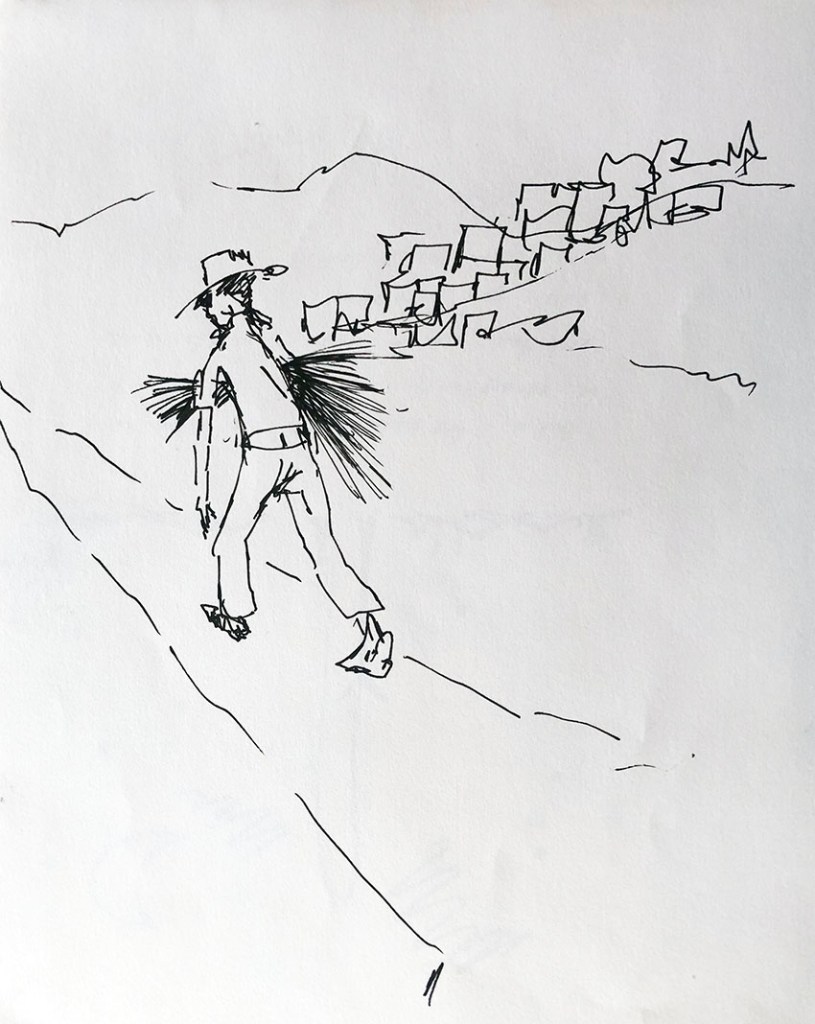
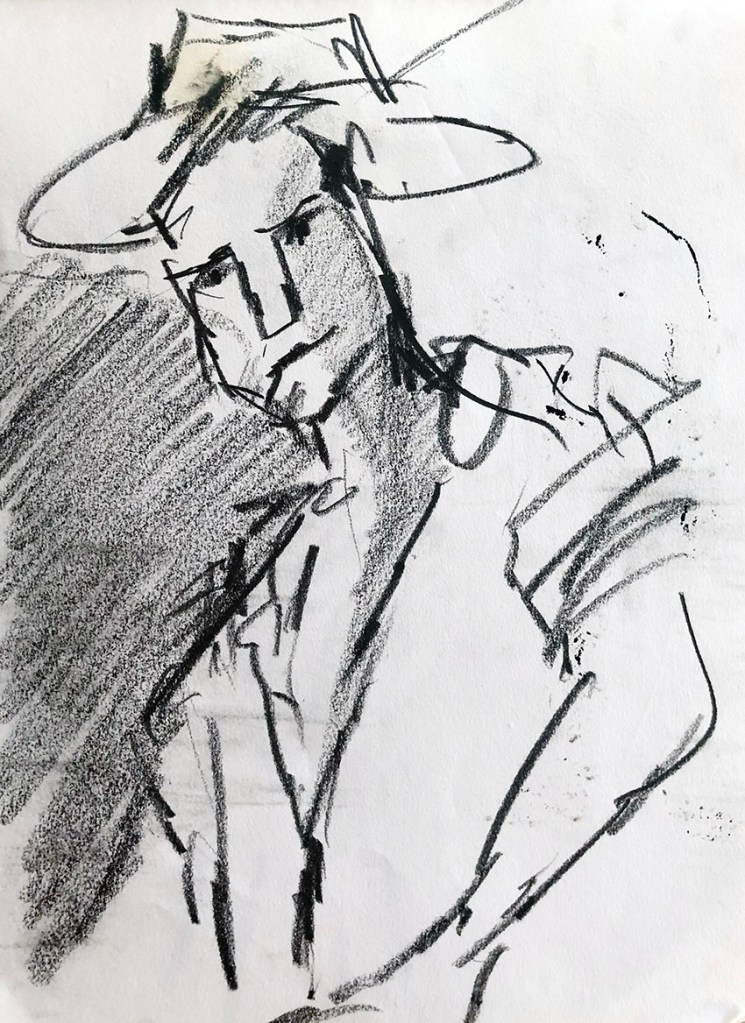
My drawings of campesinos displayed here were done during our first summer at our new home, in 1993, and are a reminder of how things used to be, when Spain (at least our part of Spain) really ‘urt…
“Old Juan” – another neighbour, and typically long-lived. It’s interesting to note that our local village is full of noctogarians like Juan, who swear by their daily shot of brandy or anis at breakfast, and a glass or three of their own wine in the evening. Other factors, such as their active lifestyles and diets must also be taken into account. In common with all Iberians, our locals are fanatics for fresh fish, with inexpensive anchovies and squid (brought up daily to the villages by mobile fish mongers) being central to their daily diets. This, in conjunction with the fact that meat consumption was often confined to what people grew themselves – the family pig, rabbits and chickens, always accompanied by mountains of their homegrown vegetables and legumes which must also contribute to their general longevity.
Header photo is a panoramic view of the campo as viewed from our finca – looking south-east – in 1993.







 ARKS, ADAM AND AXARQUIA