I am an artist, illustrator and author. I trained at St. Martins School of Art and exhibited regularly in the UK and abroad throughout the 1980s. My illustration highpoint was designing the cover for the UK paperback edition of the novel, Billy Bathgate. I lived in Israel in 1970 and then again from 2009 until 2012. I continue to write, as well as make Moscatel wine. My first book, King Saul – The True History of the First Messiah was published to critical acclaim in 2007. In 2014 I published my first novel - ARK (previously, The Sons of Kohath).
It’s a well known fact that up until relatively recently, painters made up their own colours from ground pigments and whatever carrier mediums they preferred; most commonly oil, water or egg yolk. One of the marks of the successful artist was being able to afford an apprentice (or two, or three…) to do the blending of the paints for them, and so the acquiring of the skill of paint blending became a crucial rite of passage for all aspiring painters.
By the time I entered art school however, the era of commercially produced, convenient pre-prepared paints, of all media was firmly established, and pestles and mortars had long disappeared from our studios. Nevertheless, I, and one or two fellow students of a more traditional persuasion were curious to experience, at least fleetingly, both making and using our own paint.
Fortunately, our school was close by an art shop that still supplied raw pigments, so we were able to have some fun making up our own oils, watercolour and egg tempera and then trying them out on paper and canvas.
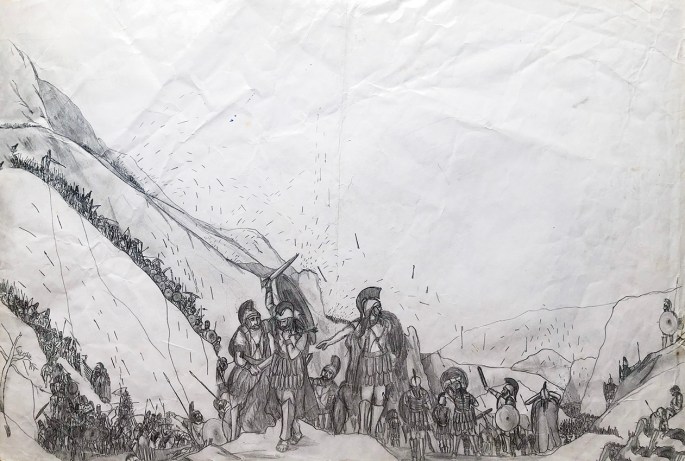
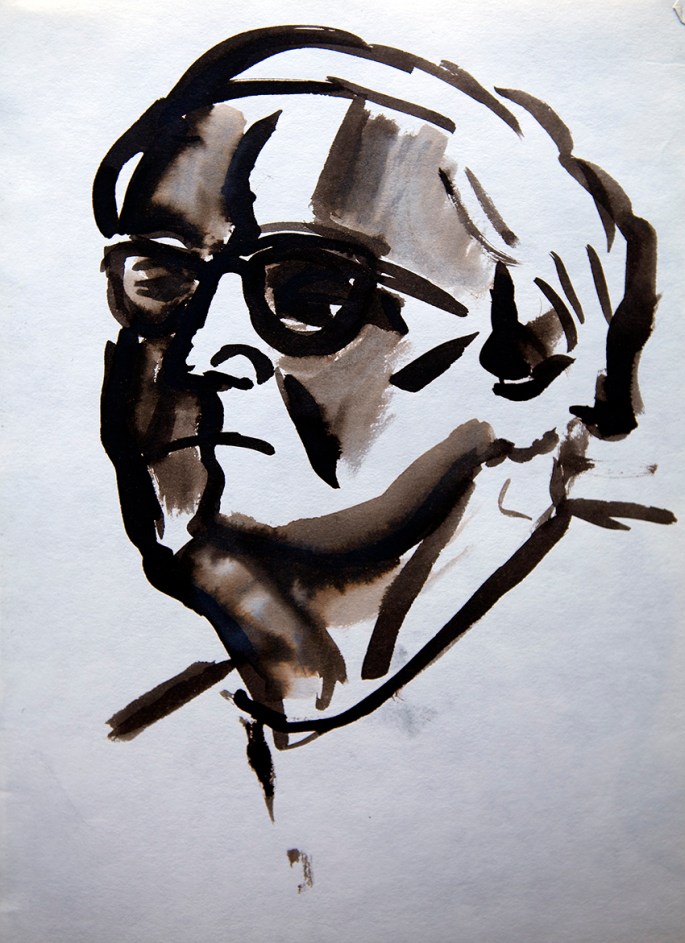
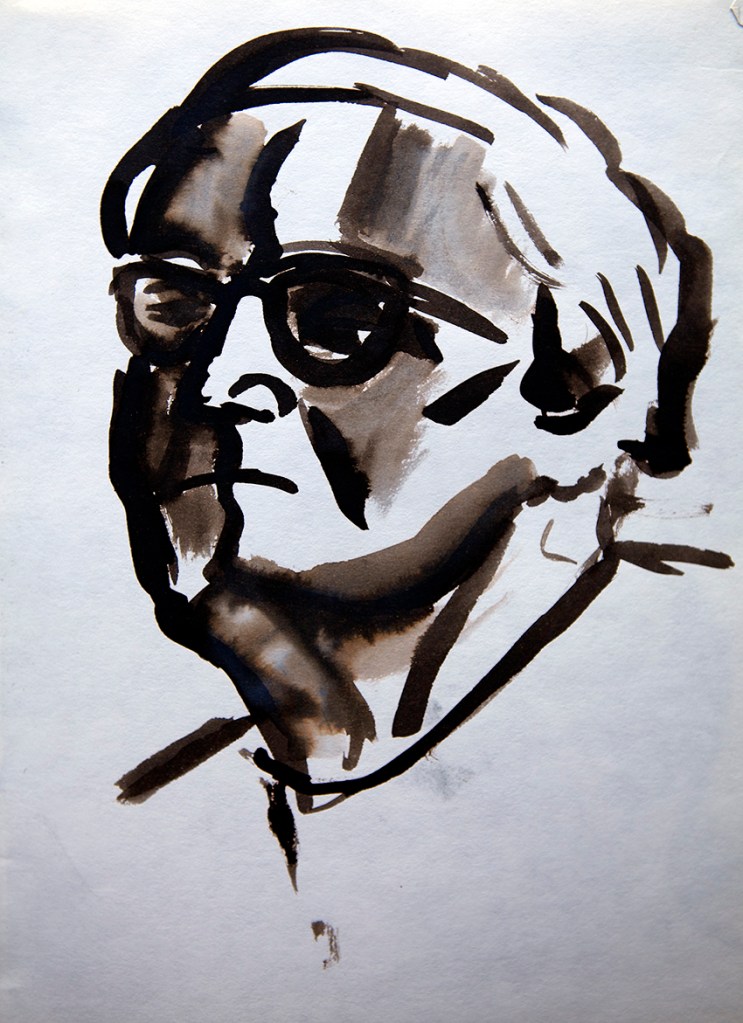
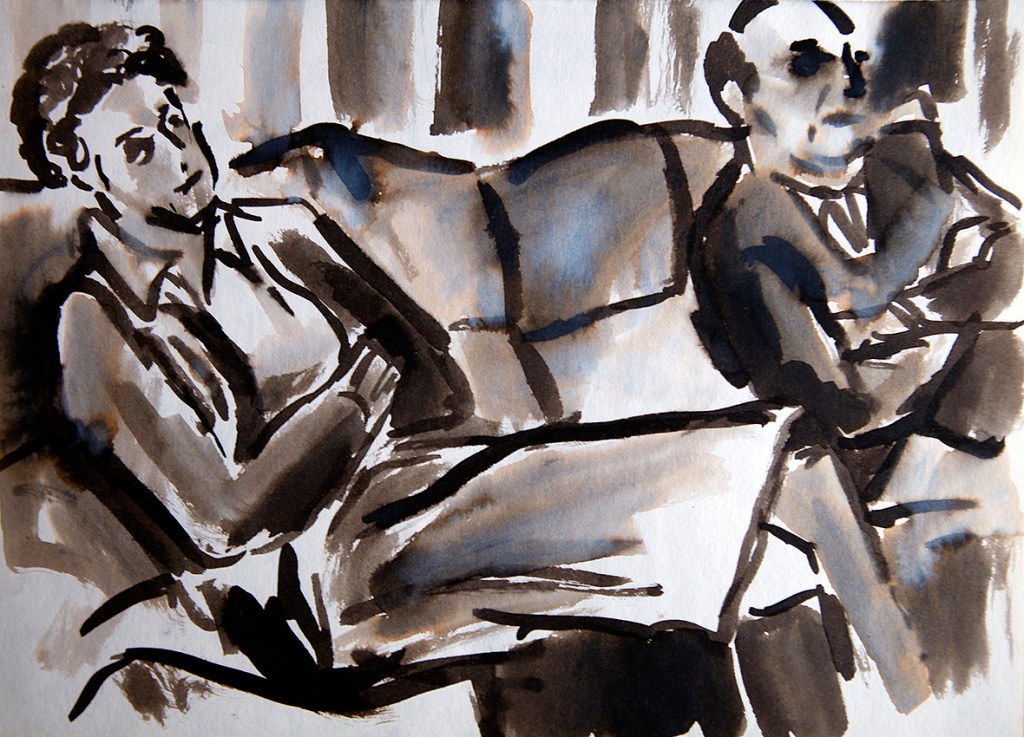
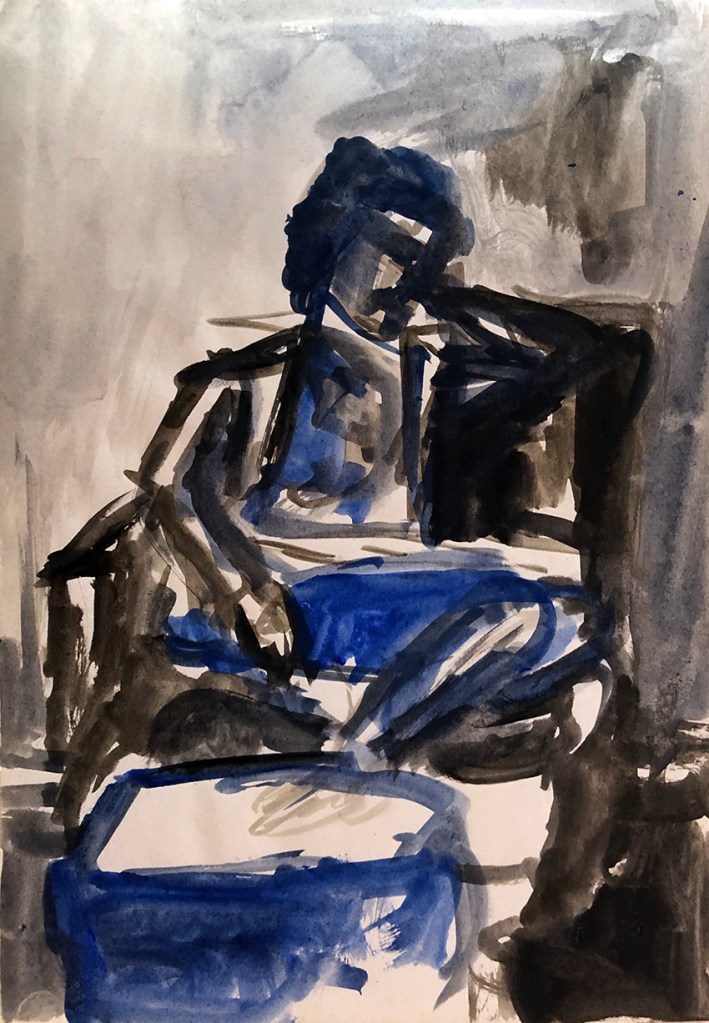
Presented here are the results of my own experimentation with tempera and watercolour. Because water was free, and even back then eggs were relatively expensive, I was able to create a far broader palette in the latter, and had to restrict myself to just two colours in egg tempera – Prussian blue and burnt umber – hence the several monochrome sketches…
Becky – tempera on paper – 1981Hannah and Harry – tempera on paper – 1981Hannah – tempera on paper – 1981Hannah on the phone – watercolour on paper – 1981
The story of the building of our home in southern Spain – in pictures
We’re often asked by people we meet, and who are familiar with our life story, if we watch the TV show, Grand Designs (on the UK’s Channel 4). For the uninitiated, in 1993 Dido and I together with a small team of local builders and on a limited budget built a house on a rugged hilltop in the south of Spain. Grand Designs is a program which follows people – often young-to-middle aged couples (as we then were in 93) – as they undertake unusual and ambitious house-building projects similar to our own, with much of the drama emanating from all the trials and tribulations of the process. Invariably dreams turn into nightmares and then finally – though not always – the original dreams are more or less attained. And perhaps because there was so much pain, mental and physical, during our building experience my answer to the question is that I rarely watch the program. The few times I have it usually culminates in me experiencing a mild form of post-traumatic stress disorder, especially when the subject suckers – I mean subject couples – go through their own darker moments and mini-disasters.
Nevertheless, at the risk of sounding clichéd, for us, as with most of the Grand Design people, it all worked out in the end and we now have an extraordinary house and home. The question of whether or not it was worth it, and if, given the choice we would do it all again is something of a moot point. Certainly, we wouldn’t do it the same way again. We wouldn’t restore an existing ruin and tie it into a new additional structure – a process that doubled both the time and cost of the project, and necessitated Dido and I becoming labourers on our own build to speed things up and to save costs. No, if we did it again, we’d do what the locals here do – bulldoze the site into a flat platform and build a completely new structure.
This is something of a second instalment to an earlier post called Walking over Almonds and some of the background, including what the original semi-ruined cottage looked like can be found there. Suffice to say here that with one or two expedient modifications from the original plans the build took around six months, beginning in the summer of 1993, and used up every penny we had (although at least we didn’t go into debt). Our architect was the gifted – Bartlett trained – Seattle-based Mark Travers (who we paid with one of my huge oil canvases of the Atacama). Between the three of us (with some help from a structural engineer friend of Mark’s) we came up with a well-built house exactly suited to our needs and passions, and, for a contemporary Andalusian dwelling, unusually sympathetic to its immediate environment.
This is an unavoidably larger post than usual, though I hope there is much of interest here, for those who know us as well as for those who do not, and perhaps even one or two useful pointers for those thinking of embarking upon a similar project…
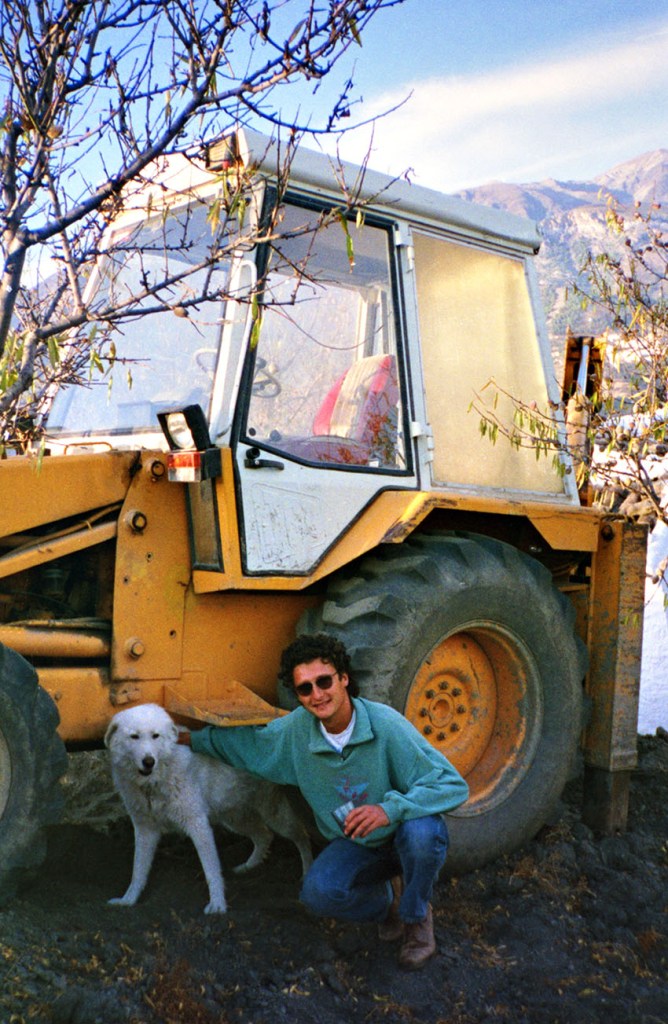
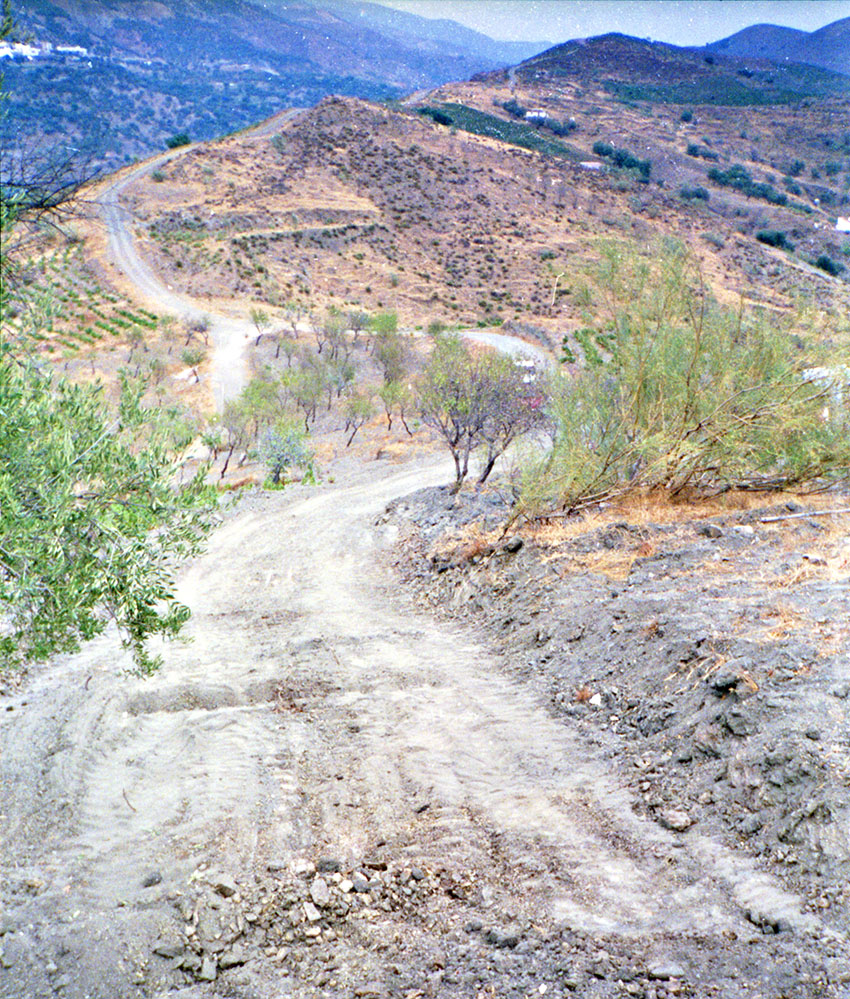
Our hilltop property was only accessible by a goat track so the first thing we had to do was get a JCB to cut us a drive. For some reason, our beautiful Maremma Sheepdog Aura liked taking naps underneath it and getting covered in grease…
Said driveway…
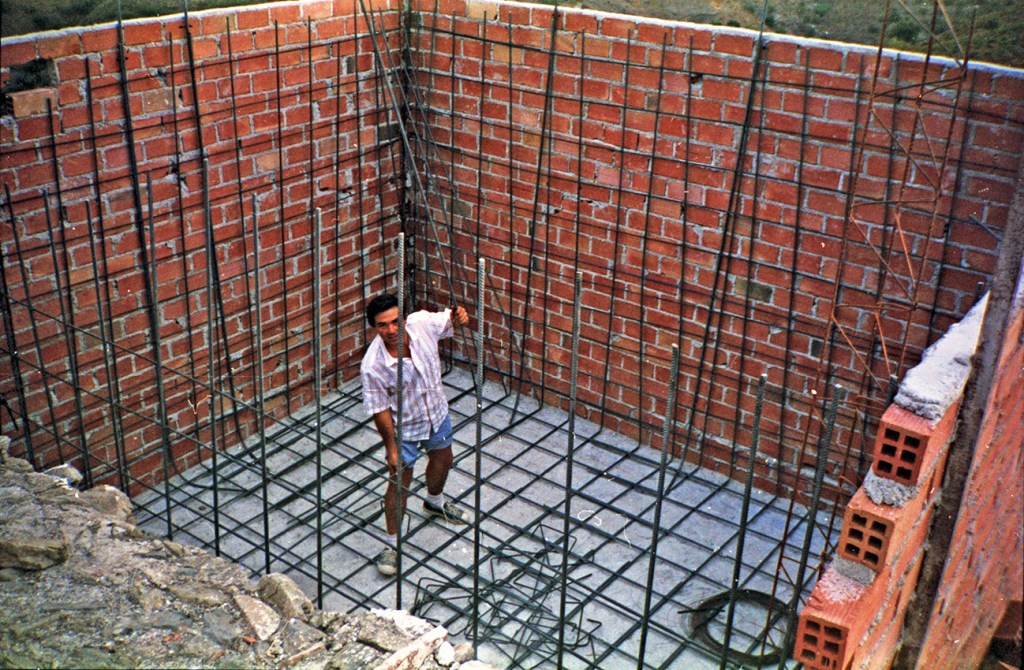
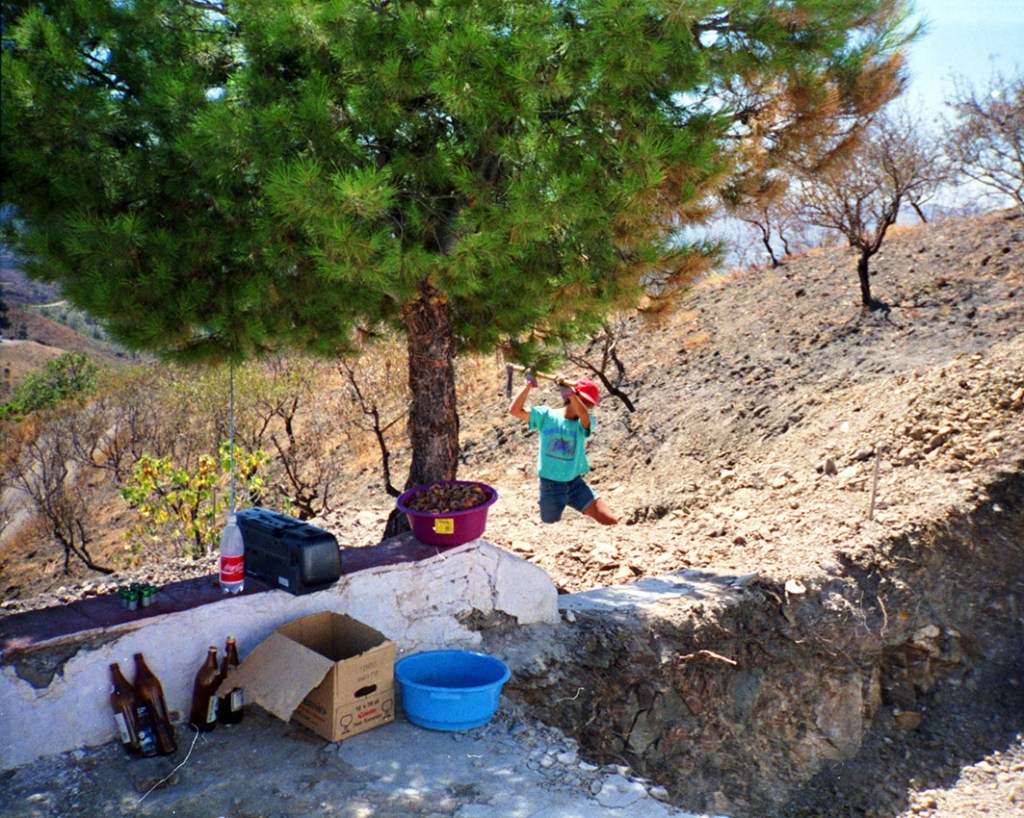
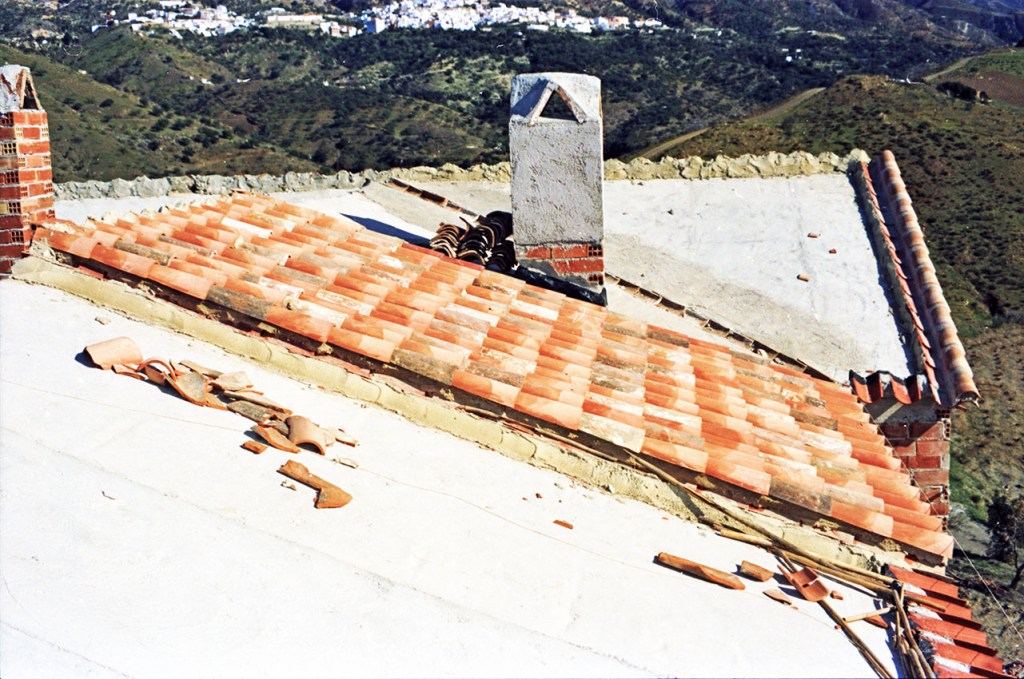
The first priority was to build our main water tank. Until it was completed we had to schlep over to the local spring three or four times a day to provide the builders with water for cement etc. It took several weeks to finish. Here is the tank progressing. With all its steel it was the most expensive element of the build…Here’s the JCB just about to demolish the old pigsty…The water tank and bodega were excavated beneath the east side of the old cottage. They would eventually become the ground story of the east side addition, comprising our bedroom and library. That’s me inspecting the completed water tank. With its 38,000 litre capacity (designed to capture rain water from the roof and terraces) its completion represented significant progress…It didn’t take long for us to realise that to stay on time and on budget we would have to get involved physically in the building. This was my “first day” and I’m using a pickaxe to make a pipe channel for the 5,000 litre grey water tank…
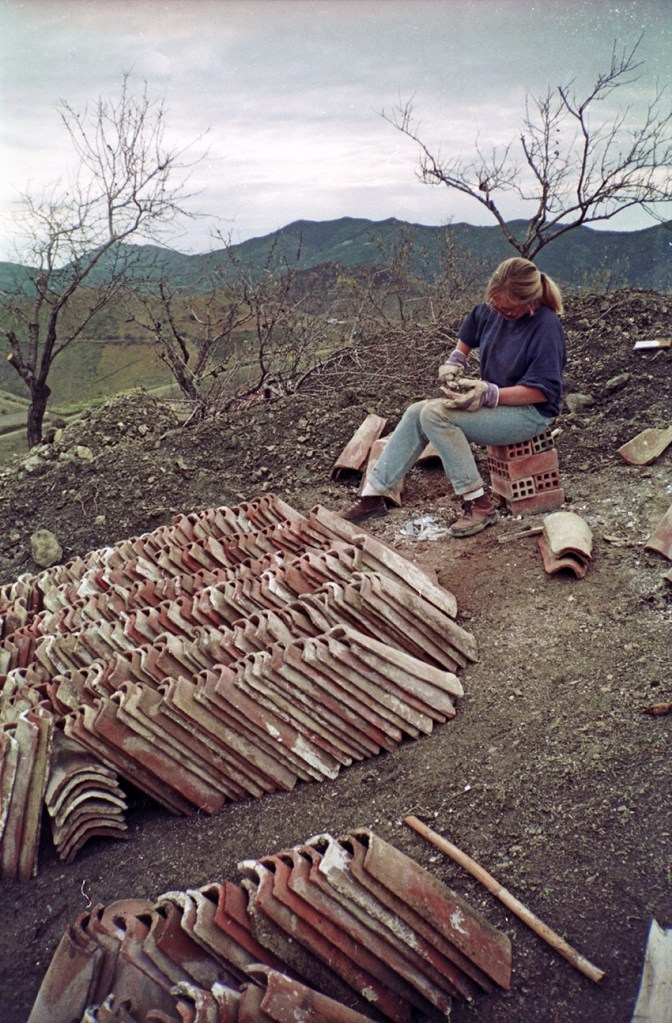
Here’s Dido cleaning hundreds of roof tiles reclaimed from the old house. The finished roof eventually comprised 1 in 3 old tiles and looked all the better for it…
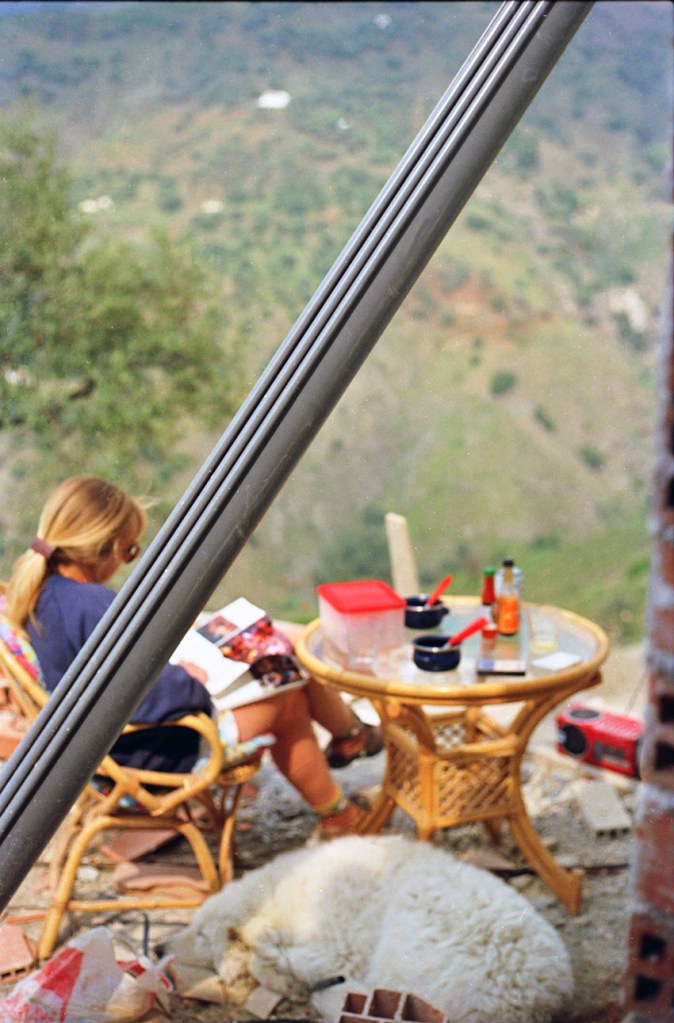
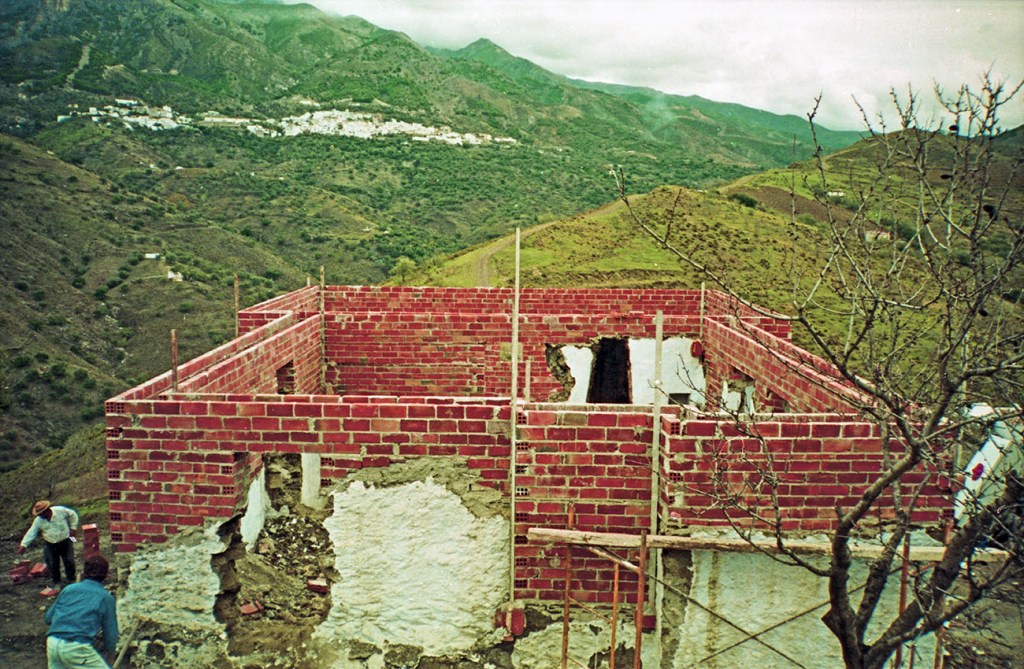
One of dozens of truck deliveries…Southern Spanish builders work long and hard, but their one hour lunch and snooze siesta is sacrosanct. Here you can see Aura getting more into the siesta spirit than Dido…Baldomero (our foreman), Paco and Pepe eating their lunch and taking shelter from a sharp north wind by one of Dido’s dry stone redoubts…Two thirds of the house beginning to take shape – looking across the main room (the restored old cottage) towards the library and main bedroom…
A beer break – Dido up an almond tree, as usual…
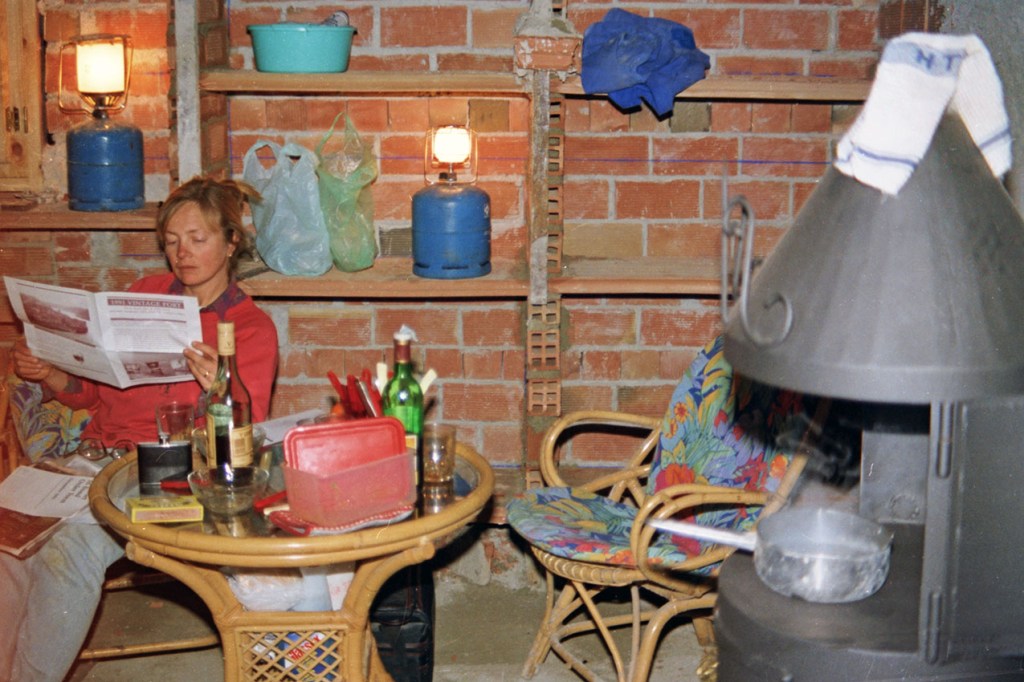
We had to remove the old wooden roof of the original cottage then rebuild the tops of half-meter thick walls. Much of the resulting rubble was reused as aggregate in various parts of the new construction. However, this entire process was hugely time consuming. Mark and his engineer buddy (who had also worked on the Seattle Space Needle) came up with this trussed roof solution for preserving the old walls and making sure they could tolerate the weight of the new steel and concrete roof. The rods were meant to be temporary, but we liked them and kept them. Dido is standing in our front door……The east addition roof taking shape…We loved seeing the tiles go over the screed – real progress at last (one in three tiles was from the original house). Incidentally, Dido was on hoist duty, and we later estimated that she winched up more than 2,500 buckets of cement and mortar all told during the roof construction…The trussed roof allowed us to have very high ceilings without the need for supporting walls or pillars. This is the restored main room. The original cottage was a warren of four tiny rooms…Fortunately the library was sufficiently finished for us to move into it by the autumn. The stove in the background (christened Dalek) was a reclaimed BBQ and it doubled up as our oven…
These gesso’d book shelves looked great, but during the wet winter months they absorbed moisture like a bath sponge, ruining hundreds of our books into the bargain. You live and learn I guess…
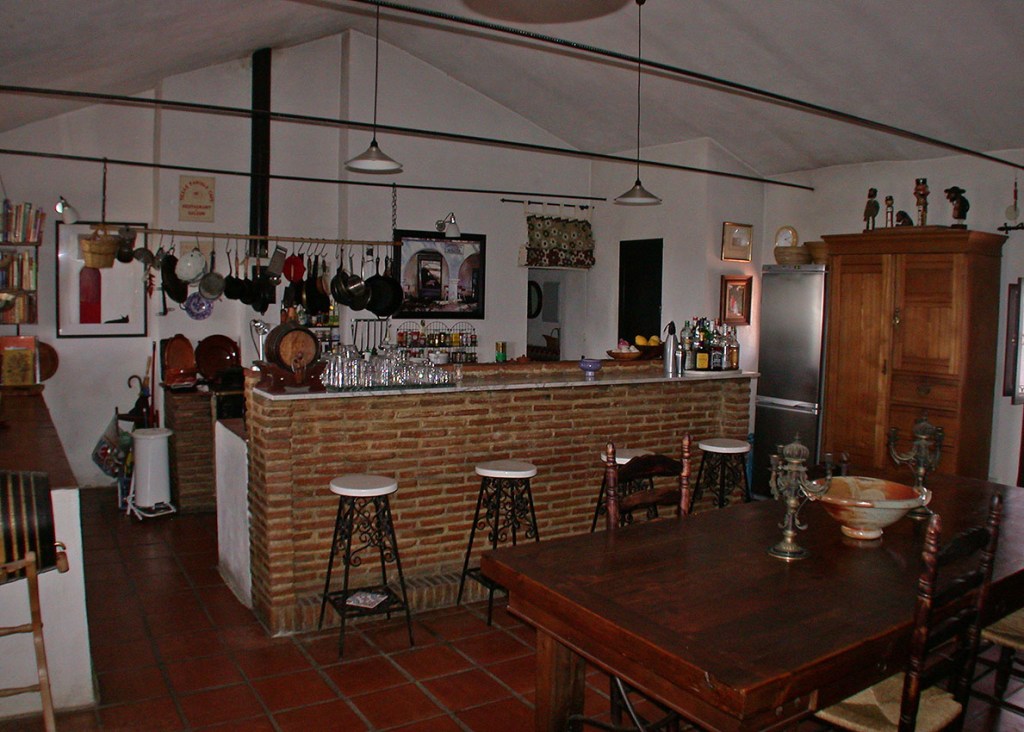
Aura loved lying on the cool sand, much to the annoyance of the builders trying to finish our floors…Our kitchen was constructed entirely from local materials including a fine wood-burning stove from Asturias, only cost us about £450 with labour!!The south aspect taking shape, with the “original cottage” section and old casemate wall already rendered, while Dido works on her drystone redoubt…The east addition nearing completion. Here one can see how the library and bedroom form an upper story above the bodega and water tank. The little window is our en suite bathroom…This is how the main room looks today…And the bar and kitchen…
And the library, now with modular wooden shelving…
And our bedroom…And finally, our emerging garden, about five years ago. Welcome to Finca Carmel!
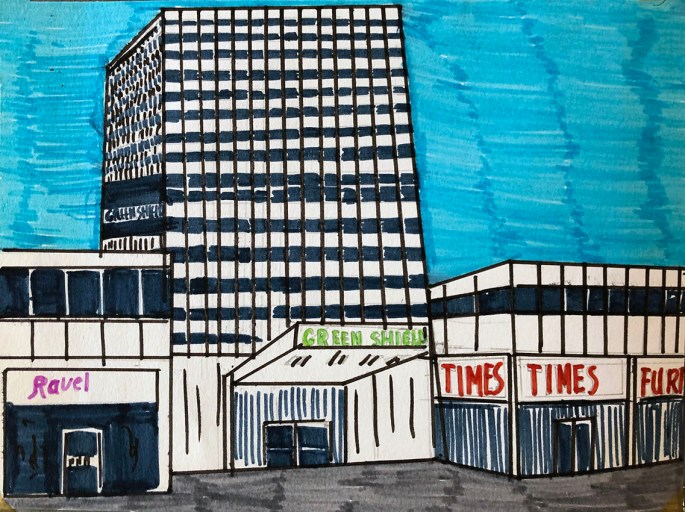
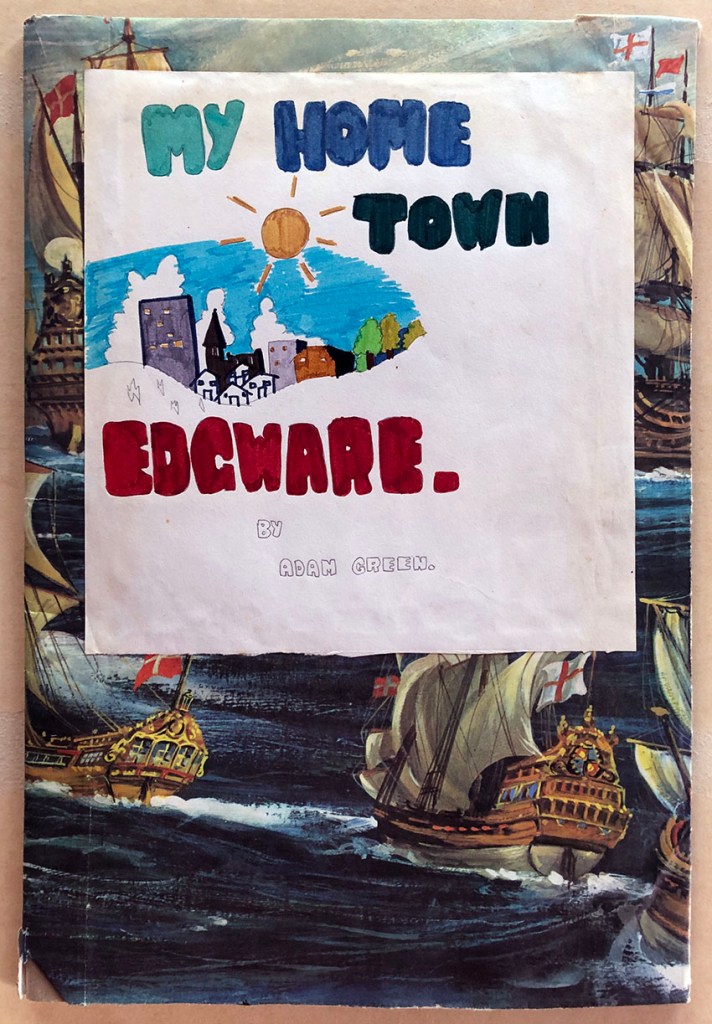
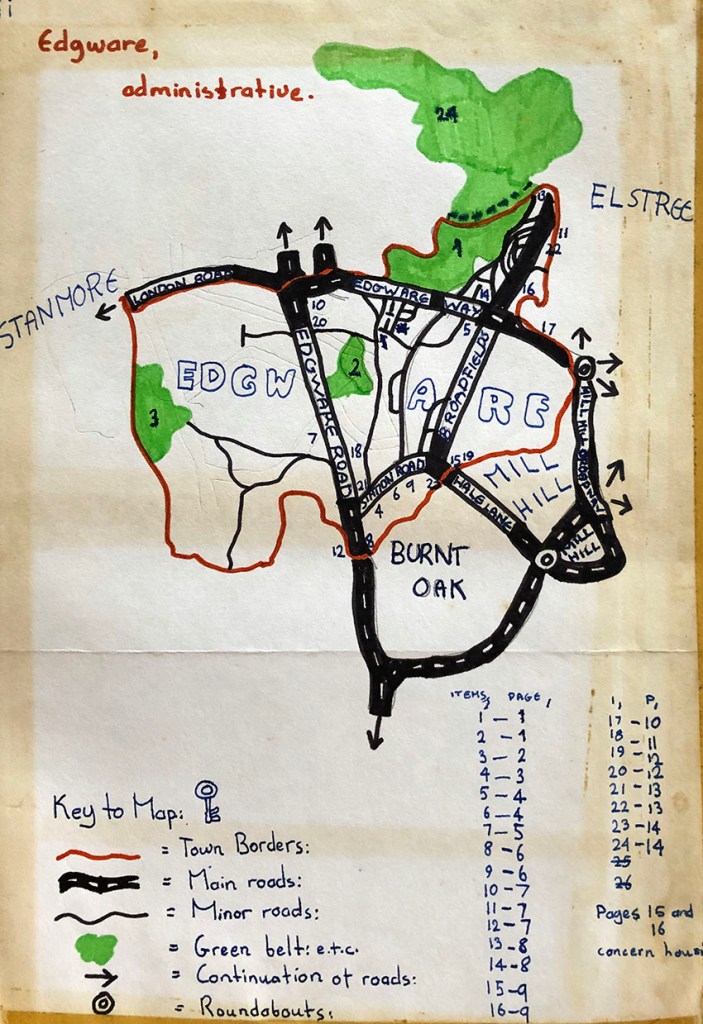
Occasionally, our teachers at my boarding school would give us projects to do during the holidays, and although these were never arduous tasks, I always resented them as intrusions into our precious time at home. Nevertheless, being the conscientious little chap I was, I always did them as best I could, as the one presented here bears testimony.
As far as I recall, this was the very first such project I was assigned, back in the Christmas new year break of 1971/72, making me 11 at the time. Certainly, my use of felt tip pens would be consistent with that dating, making these pictures exactly, an incredible 50 years old.
Looking at them now raises a mixture of emotions; of nostalgia for a happy and safe childhood on the one hand, and a reminder of the sense of relief I felt a few years later at escaping from dreary, peripheral suburbia into the city itself.
In any event, for better or for worse, here is Edgware; famous for it’s eponymous Roman road; boasting one of the oldest avenues of sequoias in Europe, being the home of George Fredrick Handel, and indisputably, “My Home Town…”
FRONT COVERThe closest Edgware had to a cooperate skyscraper was the UK Green Shield HQ.The war memorial.Stonegrove ParkEdgware had one of the UK’s biggest Jewish communities, and consequently, several synagogues, including this – The United Synagogue – the largest synagogue in Europe at the time.
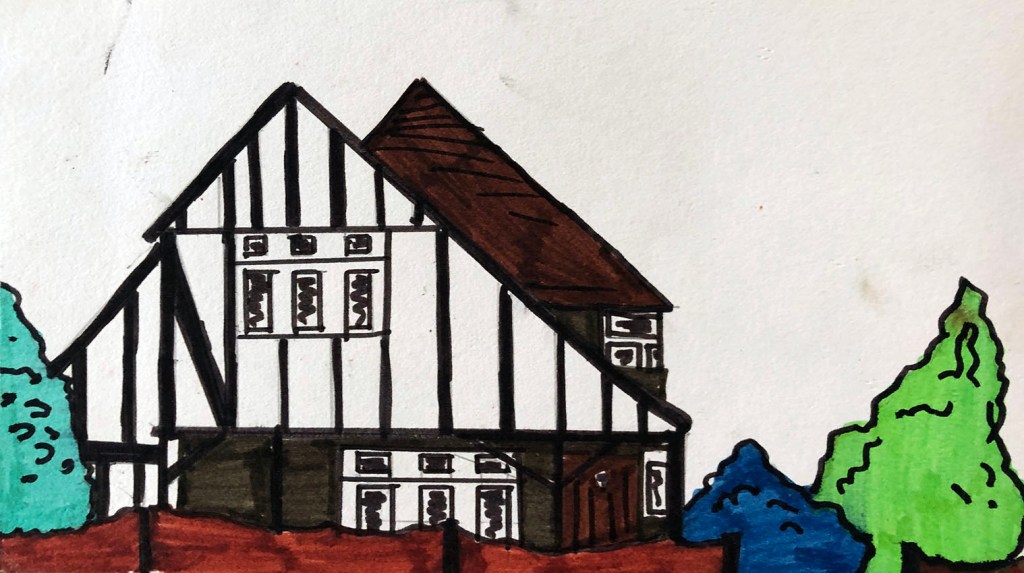
The parish church of Saint Margaret’s is one of the few reminders of Edgware’s picturesque village past. My old primary school, Rosh Pinah, since moved to a new site, and more evidence of Edgware’s then-thriving Jewish community.Most of houses in Edgware (in common with several other outer-London suburbs) were built to one of two architectural “formulae” laid down in the 1930’s. This was a typical “mock Tudor” house by the building company Curtain……and this, more appropriately deco style house by the Laing company.
Not wishing to bore anyone with all the tedious whys and wherefores (which will be pretty obvious to many), suffice to say here, that long-haul travel – even when “turning left” onto a brand new 787c Dreamliner is something we will not do again until normal/normal returns – which probably means never.
Our recent flights, to and from the United States, to scatter my mother-in-law’s ashes, among many other essential tasks related to her passing 13 months ago would have been a sombre experience in any event, but with the added maelstrom of Covid-19 related dos and don’ts, a sad business was transformed into a sinister taste of dystopia.
But never mind all of that; these posts were never intended as platforms for my views on anything more serious than daubs of paint, poor grammar and the correct way to render chicken fat. Although, over the past two years I have hinted at my opinion on Covid, and our various governments attempts at dealing with it, I realised by the first April of the crisis, that my views were at odds with the consensus, and thus I risked being regarded as a hopeless heretic – at best! So, not wishing to alienate or offend many of the readers of these pages, I have thus far kept my feelings more or less to myself, and this post will be no different.
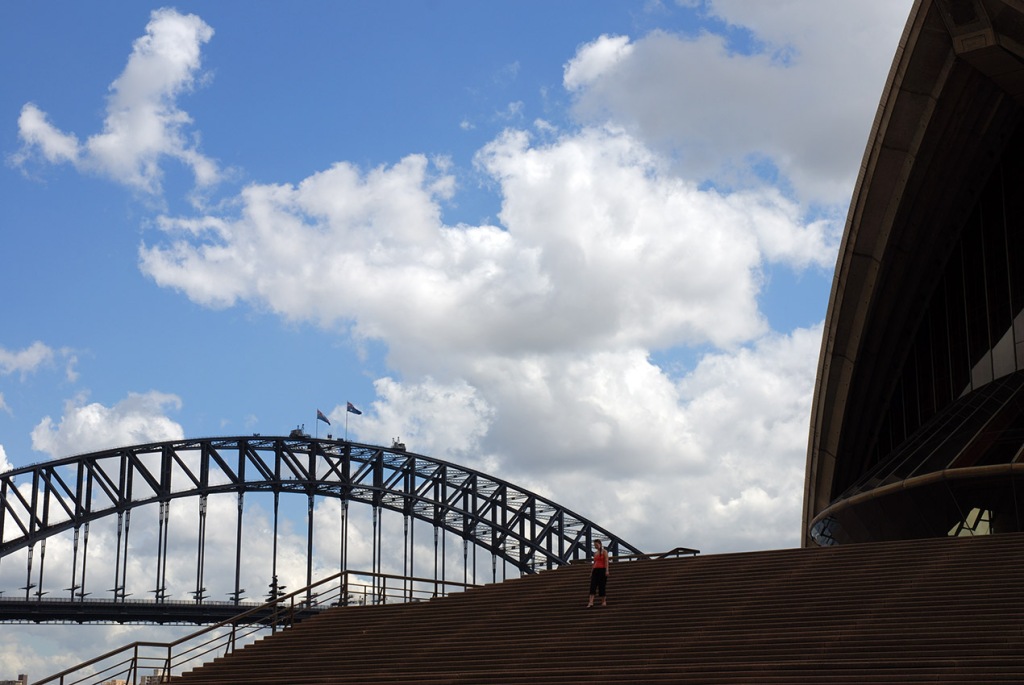
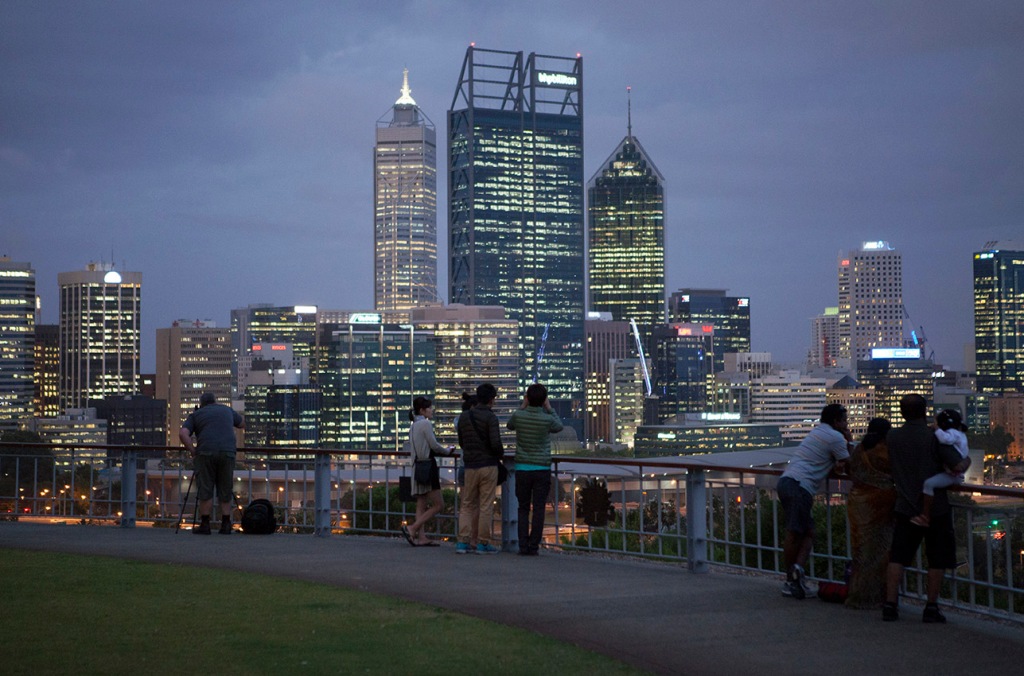
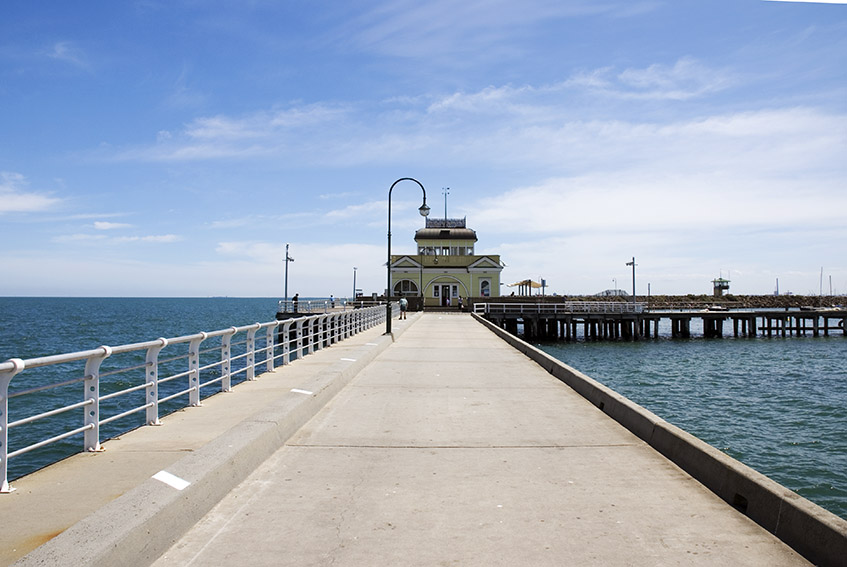
One of the things many of us can agree upon, is what a miracle of modern life long haul air travel used to be BC, especially if one was fortunate enough to travel at the front of the aircraft, when the getting to wherever, could be almost as much fun as the destinations themselves. However, nothing epitomises for me what we are missing from our lives more starkly now – from a UK perspective at least – than the current inaccessibility of the extraordinary lands of the Antipodes. Hence this offering of a series of my favourite scenes of Australia (Victoria, New South Wales and Western Australia, to be precise), which either offer longing for a return to a normal future, or images of a golden past, lost forever…who knows?
As a young artist I went through numerous phases and enthusiasms, the briefest of which, being a desire to master the portrayal of animal-kind. I think my “animal period” lasted about five months in all, but despite its brevity, I still managed to fill several sketchbooks and give myself highly useful reference material for my later professional career.
Sadly, I have since mislaid two of the main sketchbooks, and could only find a handful of pictures as examples for this post. Nevertheless, I think they are sufficiently worthy, and interesting to be reproduced here.
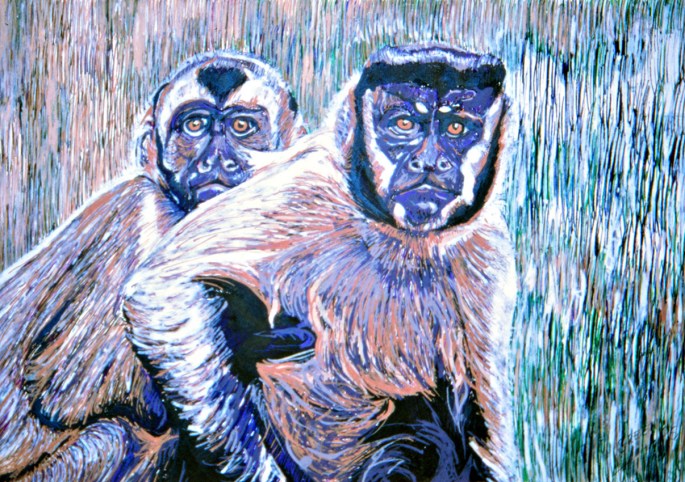
Capuchin Monkey – Pen and Ink Wash – 1981: I spent two or three days at London Zoo studying mostly monkeys, the big cats, and birds. The monkeys were particularly fascinating as they all had distinct personalities and facial expressions. This guy/girl was always alone and sad. I think he/she was in want of a mate, but I can’t be certain. Mother and Child Capuchins – Pen and Ink “linear” – 1995: Fourteen years after those visits to the Zoo in Regent’s Park, I made a small series of highly detailed drawings from some of the better sketches. All sold, and sadly this is the only picture I have on my files from that hugely successful group. There’s little doubt that I could have carved out an extremely lucrative career if I had continued making these drawings, but after about six of them, I couldn’t face doing another. They were painstaking in the extreme, and took many days each to complete, requiring a depth of concentration that drove me half-mad. Cat Studies – Conté – 1981: The zoo was an expensive place to visit, even back in 1981, thus I mostly resorted to studying pets of friends (we had no animals at home) and when out and about in places like pubs. This little girl, whom I seem to recall was called Daisy was no shrinking violet however – hence some my humerous additions to the original sketches.
Make My Day! (British Bulldog) – Pen and Ink Wash – 1982: Meet Harry, who despite the title of the picture was as docile and sweet natured as he appeared.
I’ve talked about the distinctive qualities of black and white photography before on these pages, and how it has an uncanny ability to capture the spirit and mood of a subject far more intensely than colour. It’s something the greats of the genre understood and exploited brilliantly; from the epic landscapes of Adams, and the deeply personal portraiture of Karsh to the lyrical life observations of Bresson; they all utilised the cleansing distillation of grey-scale-monochrome to the ultimate dramatic effect.
However, while the great masters took black and white photography to the level of high-art, equally nostalgic monochrome images were being snapped countless millions of times by less gifted photographers across the globe. And while their results might not classify as works of art, they nevertheless rarely fail to evoke and to entertain.
The images presented here are intended as a case in point and offer a small glimpse into my childhood, growing up in suburban London, which for all its fatherless challenges was almost as idyllic as it looks…
Summer , Edgware, 1963-ish, our back garden “pool”, with me and my big brother Michael and our lovely neighbours, Peter and Susan Gerard…Same garden, different amusements, summer 1966, with Michael again, and assorted neighbours and school friends… Edgware, Spring, 1967, in the kitchen, Michael and I using our baking sets. We both developed a keen interest in food and cooking from an early age, although I seem to recall that the results of this particular session ended up being fed to the birds…London Transport Museum, Covent Garden, London, 1968; Being the nephew of Sidney Pizan, one of London’s top fashion photographers had all sorts of perks, like having the run of a fabulous steam locomotive during a shoot for Burberry. That’s Peter Watkins, one of Sidney’s assistants/apprentices setting up a shot with the Polaroid. Incidentally, the legs of the male model standing on the footplate above me belonged to soon-to-be-007, George Lazenby, who began filming On Her Majesty’s Secret Service a few weeks after this photo was taken.
Oxford has been our on and off home now for the past ten years, and as someone from a family with far more connections to “the other place”, it has taken me most of that decade to come to really like and appreciate the city.
Typically, as luck would have it, my liking of Oxford has more or less coincided with our leaving the city for pastures new.
And pastures don’t come much more picturesque, or quintessentially English than those of South Park on the eastern edge of the ancient town centre.
And as for those famous dreaming spires, there’s nowhere they look dreamier than from the steepling fields of South Park on a late summer’s evening.
This view of Oxford; largely unchanged since Matthew Arnold penned his famous verse; and not that different from when Oliver Cromwell’s besieging army was camped on this very spot; and when this great dead English oak was a foot-high sapling, has gradually ingrained itself into the core of my consciousness, and something I shall carry with me and treasure for the rest of my days.
Whenever people ask us about our commercial crops on our little Andalusian farm, we always mention olives and our almonds. Grapes were once a commercial crop for us – in the form of our Malaga-style wine – but that was many years ago. And, while it’s true we also once sold a bushel of pink grapefruit to a greengrocer in our local village, the only other crop we ever used to sell regularly was carob (algaroba in Spanish). Known as boxer in Britain, carob was best known as a chocolate substitute, especially during wartime, when supplies of the real stuff were sparse, and these days, it’s popular as candy (in the States), ground for flour, eaten as a dried fruit and made into syrups and even alcoholic drinks. But, in the 90’s it’s popularity seriously waned, and the price for the brown pods and seeds fell so low, it cost us more in diesel to get the carob to the factory than we got paid for it.
However, the emergence of veganism has seen a massive spike in the demand for carob, and a corresponding rise in its value, making it a worthwhile crop once again. And, in the event we were paid a handsome €60.00 for our modest three sacks, giving us in turn, a pleasant excuse to continue along the road, to spend our earnings – somewhat ironically – on some delicious, decidedly non-vegan Malagueño cuisine…
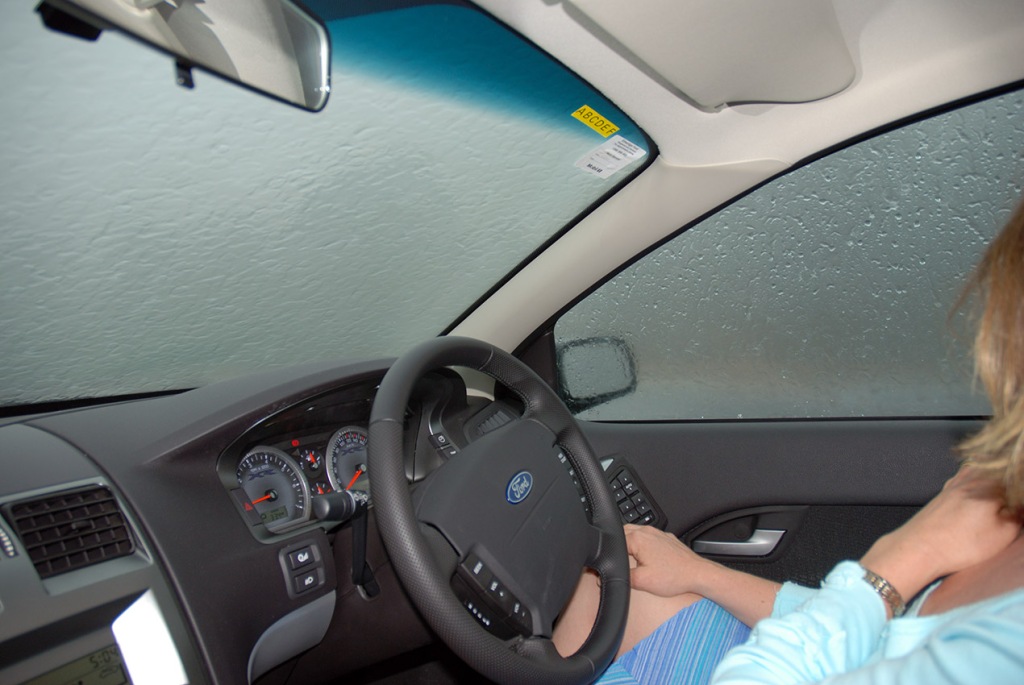
Adding our 50kilos (highlighted) to the mountain of carob at our local depot/factory. Then off to Malaga to spend our not-so-hard earned pocket money – firstly on these delicious caracoles (snails) in a spicy, cumin-infused sauce (a recipe from Córdoba)... …Then down to the beach, for a few espetos (wooden skewers) of sardines , roast against smouldering olive wood. This shot, taken through a Perspex windshield, gives the scene a slightly wobbly look!
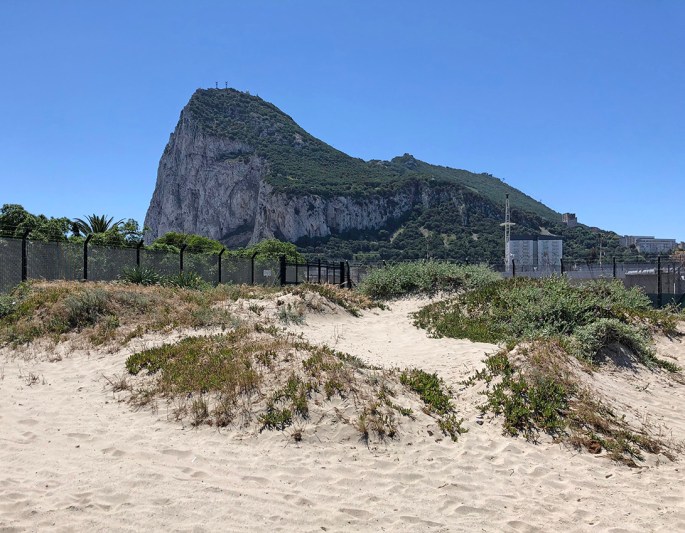
We’ve been to Gibraltar several times over the past two years and each time we seem to discover something new. For such a small territory it’s surprising how many little secrets it manages to keep from the general tourist and day tripper, who’s itinerary seems restricted to a cable car ride to the top of the Rock, finished off with a pint at the pub and a plate of fish and chips. Not that there’s anything wrong with these activities, which do at least ensure the preservation of hidden gems like Rosia and Catalan Bay for the lucky few.
Our discovery of Catalan Bay was particularly accidental, as we had to arrange a last minute trip to Gibraltar, and the only room available was at the Caleta Hotel, on the relatively remote (remote only in a Gibraltarian sense), sparsely populated, eastern side of the Rock. But while the bay on which the hotel sits may be named for Catalonia, the seaside hamlet along which it resides is far more reminiscent of a Sorento on the Italian Riviera – albeit, in microcosm.
Moreover, with the Caleta Hotel being Italian owned, with an Italian head chef, this tiny enclave has a feel and an atmosphere all of its own.
I would recommend the hotel as a decent place to stay (comfortable rooms and a bar and restaurant with a stunning, maritime outlook), but it’s to be torn down in January, with a Hilton rising up in its place. Nevertheless, for those visiting Gibraltar for more than a day or so, Catalan Bay is a charming place to visit.
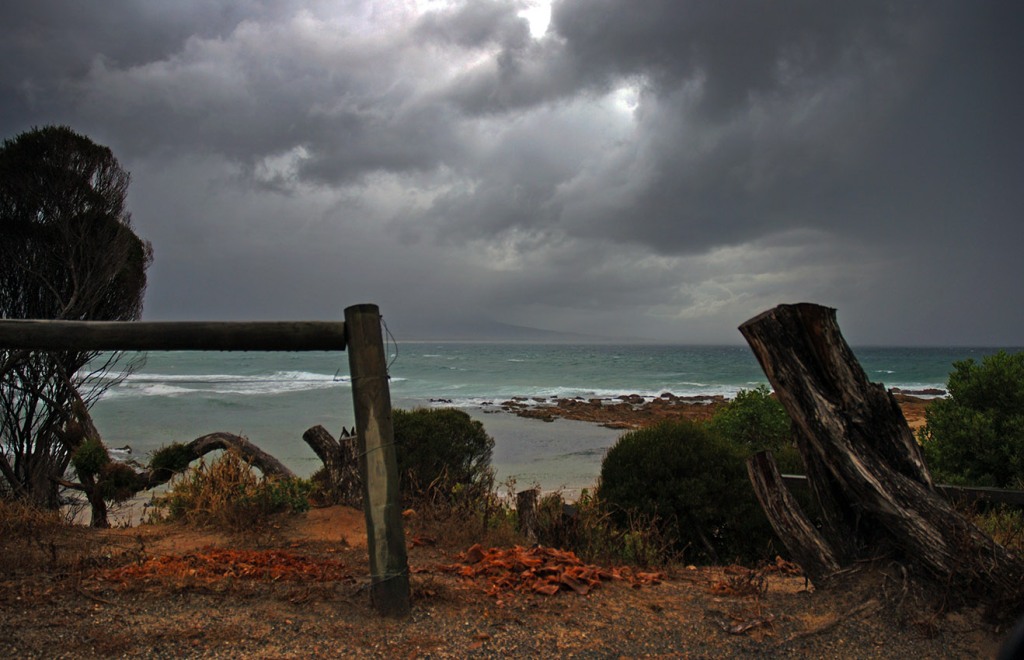
Despite the overcast skies, I think these photos offer something of the peaceful, secluded atmosphere of the place.
Before my uncle Sidney became one of the star commercial photographers of “swinging sixties” London, he qualified as a dentist. He had wanted to be a doctor, but despite his stellar exam marks, as a Jew, he fell victim of the wicked anti-Jewish quota that was (quite incredibly, given the historical post-WWII context) still in force in 1950’s Britain, so he had to settle for a career in dentistry.
Funnily enough, there was no such quota when it came to National Service. As far as the recruiters for Her Majesty’s armed forces were concerned, so long as you weren’t flat-footed, just about anyone would do, including criminals – and even Jews. Fortunately for Sidney, as a recently qualified medic – though a humble dentist – he was assured a highly enjoyable and adventurous two years, that were to enrich his life in many unforeseen ways.
In Sidney’s case, he was drafted into the medical corps at the rank of lieutenant, and following some very basic military training, was soon promoted to captain, before receiving a dream posting, to a grand schloss, in the Black Forest (in Germany), as part of a medical team.
When not examining mouths, which was not all that much, Sidney’s “onerous” existence included hardships such as learning to drive, and being taught to ski in the nearby Bernese Oberland (across the border in Switzerland), and perhaps worst of all, being put in charge of the schloss’s vast wine cellar. But perhaps the biggest change in Captain Pizan’s life – a seismic change in fact – was to his diet; from that of an observant, kosher, North London Jewish household, to that of a British Army officer’s mess; and thereby hangs an amusing and delicious little tale…
Sidney’s schloss-full of medical officers was commanded by a Colonel (let’s call him) Mackenzie, who happened to be an extremely proud Edinburgh Scot. And like all proud Scots, he loved his Scottish traditions, the most important of which was the piping in of the haggis on Burns Night. However, having little trust in the Sassenach mess cook’s abilities to produce the genuine article, Colonel Mackenzie had his mother’s haggis flown over from Scotland.
And thus, on this particular Burns Night 1954, the entire medical team, in full dress uniform – Mackenzie in his kilt, lined the lavishly presented long dining table. The company then stood to attention, as two squaddies carried in the steaming haggis, born upon their shoulders, on a large silver salver, preceded by a finely regaled Scots Guard piper playing the stirring strains of A Man’s A Man For A’ That. Then, after coronating the delicacy with a dash of flaming whiskey, the colonel himself cut up the haggis which was then distributed among the diners.
But, as a waiter approached him with his portion of sheep’s stomach stuffed with offal and oatmeal, a wary Sidney declined his serving, thus triggering the following exchange between Colonel and captain…
“Captain Pizan” said the colonel.
“Yes Colonel?” replied Sidney.
“Are ye nay gonna eat me mother’s ‘aggis?” asked Mackenzie in his heavy Edinburgh brogue.
“I apologise sir, but my religion forbids me from eating it.”
“So ye say Captain Pizan.”
“Yes Colonel.”
“Captain Pizan.”
“Yes Colonel?”
“Had I nay seen ye tuckin’ into yer bacon and eggs this mornin’ with such relish, I would nay insist ye eat me mother’s ‘aggis. But as I did see ye tuckin’ into yer bacon and eggs this mornin’ with such relish, ye will not only eat me mother’s ‘aggis, you will like me mother’s ‘aggis!”
And so Sidney was involuntarily introduced to the delights of Scottish cuisine, which turned out to be a very good thing indeed, as not only did he like the haggis; he loved it.
Somewhere in all of this there might be a moral lurking, but I can’t quite put my finger on it?
A “full English” (including the American baked beans interloper) 2020’s style. I doubt that baked beans were served in Sidney’s officer’s mess – at least not with breakfast. In their place, there would have been additions such as black pudding (blood sausage – morcilla, for my Spanish readers), devilled kidneys, and perhaps minute steaks too.
The traditional piping in of the haggis on Burns Night.