
Did God Workout? (Part 3 – God’s Women)

The artistic shaping of visual perceptions of, and sensibilities  towards biblical events and personalities from Bible times to the present day.

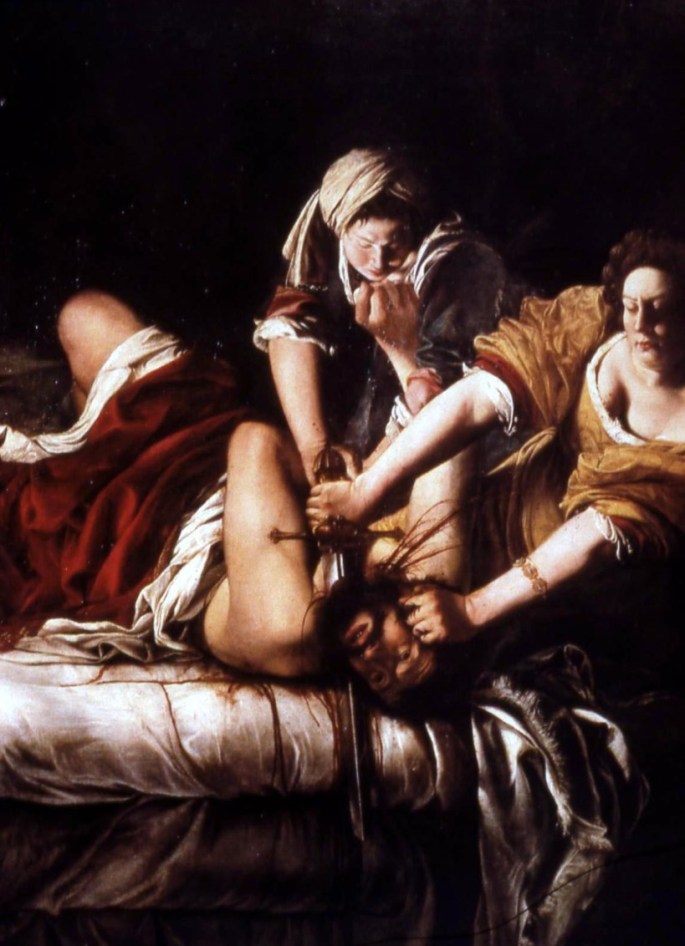
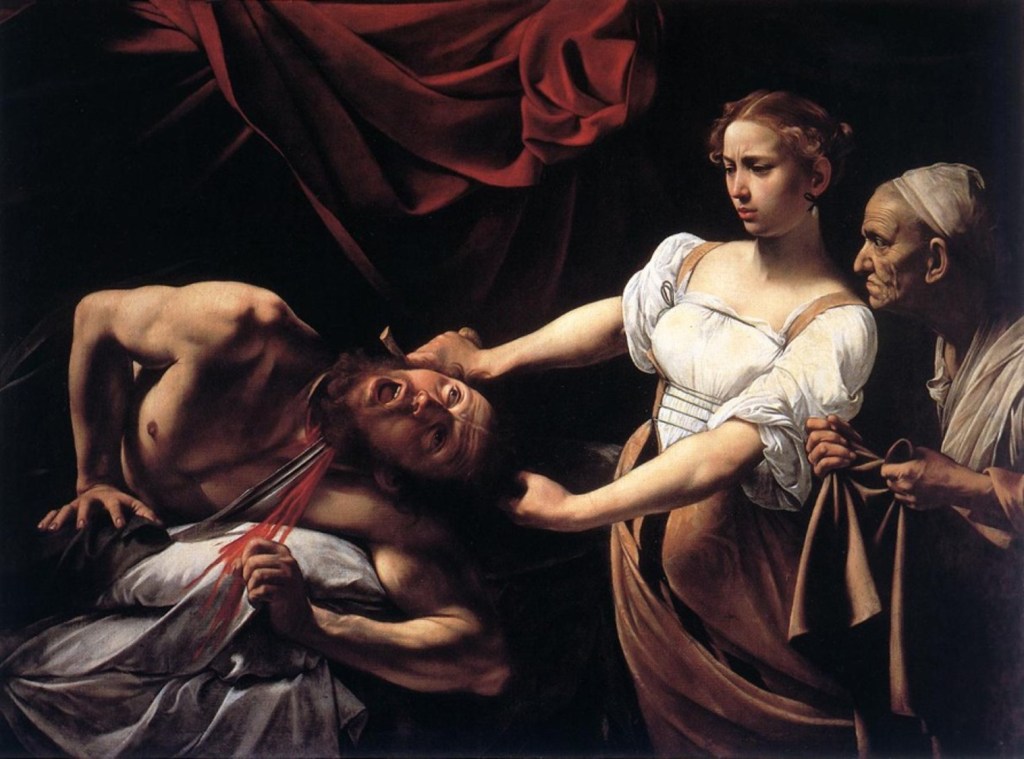
If the High Renaissance saw the visual portrayal of God reach its climax upon the lofty surface of Michael Angelo’s Sistine Chapel, it would be another century or so before the genesis of authentic female portrayal in art. And, if Michelangelo’s name is synonymous with the ultimate visual image of God and several of the Bible’s star male personalities, then it is the remarkable Artemisia Gentileschi who, with her masterpiece Judith and Holofernes, gave us our first experience of believable and empathetic biblical womankind in paint. While this isn’t the place to examine in detail the life, the struggles and the triumphs of this courageous woman and supremely gifted artist, her most famous painting heading this piece nevertheless reveals much about Artemisia Gentileschi and her times.

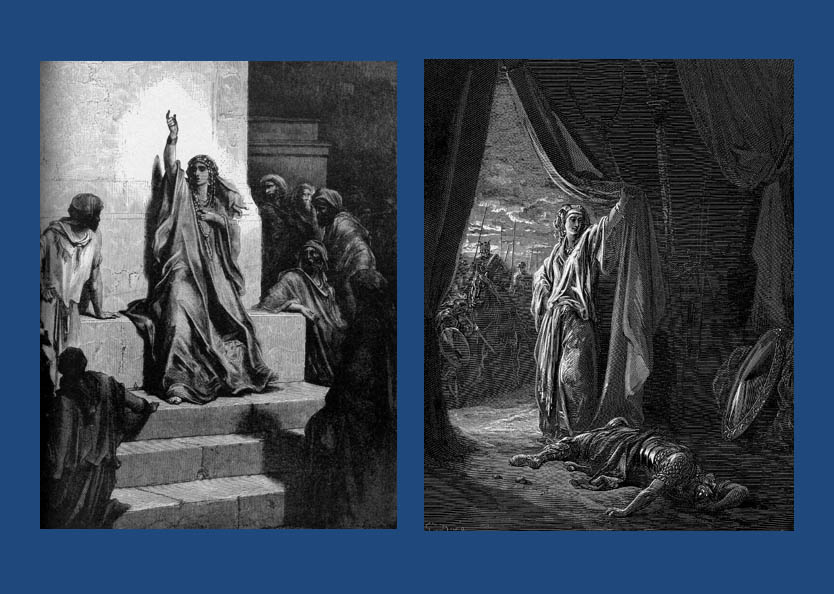
Prior to Gentileschi, artists generally restricted biblical female characters to a narrow range of stereotypes – albeit both they themselves and their roles often having technical importance – from people like the prophetess Deborah (portrayed here by Dore in an appropriately “Marianne”-like pose) commanding Israel into war and her compatriot Jael (also by Dore – and probably the source character for Judith herself) cementing the victory of that war…

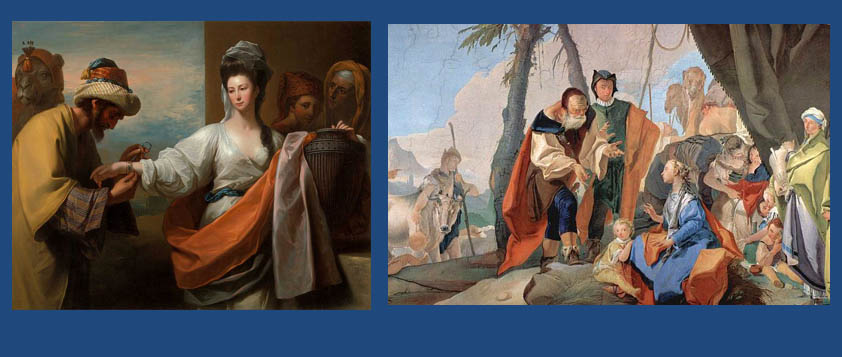
…to being national matriarchs such as Rebecca and Rachel, depicted here by Benjamin West and Giovanni Battista Tiepolo respectably…

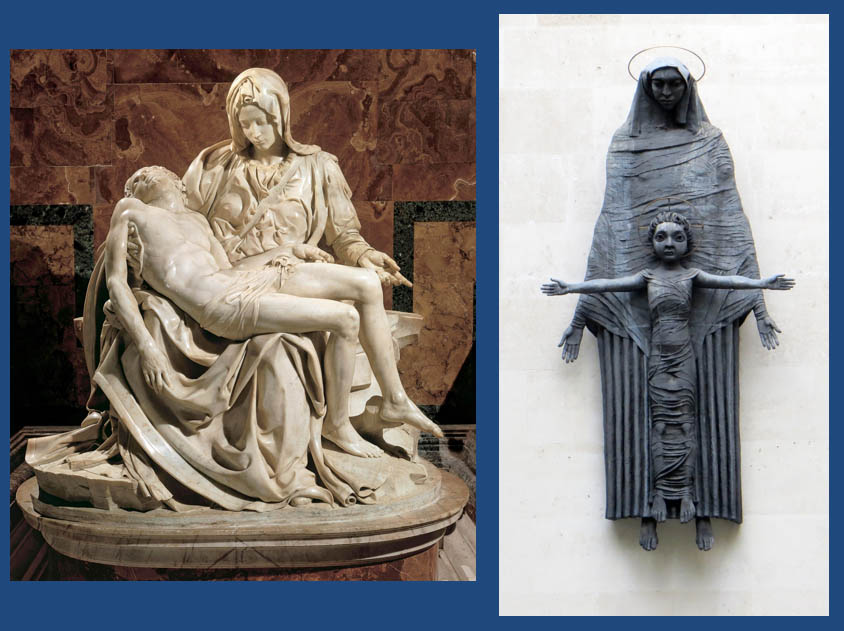
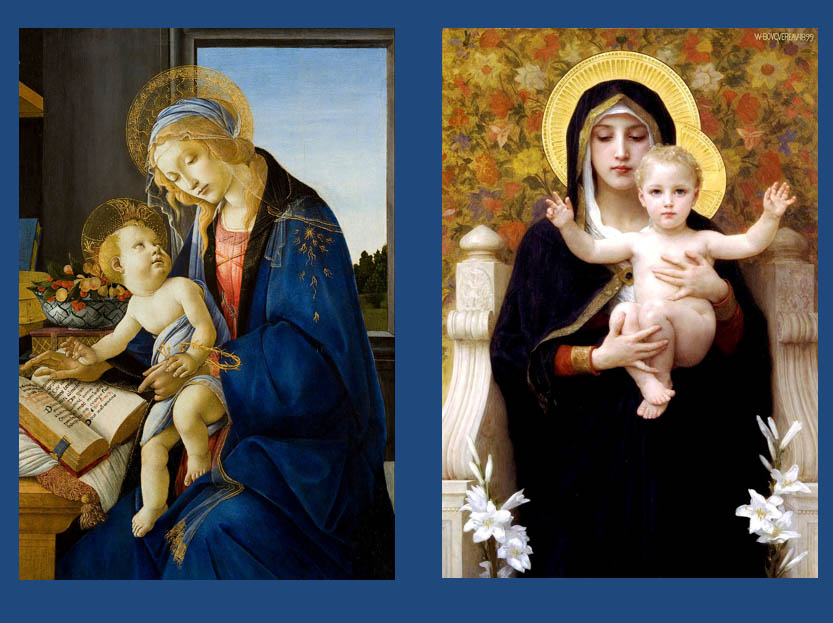
…and even being the bearer of the Son of God as portrayed here by Botticelli and William-Adolphe Bouguereau…

Bible women folk, and their deeds and purposes were predominantly passive. In the few cases, where women showed personality and/or character, or initiative, socially or actively, these words and deeds were almost always described as basely motivated at best, or outright treachery at worst, and always deserving of patronising chastisement and/or severe punishment. The examples of Sarah laughing at the news of her imminent pregnancy and the contempt towards David displayed by Saul’s daughter Michal are typical examples of this and artists across the ages – all of them men of course – loved to paint them.

The fact that Sarah’s incredulity, given that she would have been well into her 70’s at the time, was perfectly understandable, and that Michal was a proud daughter of a usurped king are irrelevant to the mostly pious biblical illustrators for whom a woman’s role was almost exclusively, to be faithful to her husband and to God, and to propagate the race, no matter the context.

In Christianity, until the unveiling of Artemisia Gentileschi’s Judith and Holofernes the overriding adjectives to cover the artistic attitude towards the women of the Bible were noble passivity for the good girls and fickle treacherousness – often revolving around sexual misbehaviour – for the naughty girls. Thus, Judith (and her role model Jael) whose deed was both proactively heroic and righteous presented a conundrum for all of Gentileschi’s predecessors (and many of those who followed), epitomised by the likes of Caravaggio below (left)…

Caravaggio’s Judith, despite its undoubted artistic, technical mastery has all the passion of a medical autopsy whereas Gentileschi’s heroine is deadly earnest, determined and resolute. She’s obviously doing something that has to be done, that simply must be done. It is a struggle, and her equally heroic and resolute maid has to actively help her pin Holofernes to the bed , as if Gentileschi is stressing this is a universal struggle faced by women in general, of all backgrounds.

However, Caravaggio’s Judith beheading of the Assyrian general is effortless, almost like a child pulling the wings off a butterfly. Yes, she’s a young woman killing a large powerful man, but for Caravaggio, even in this act the noble woman must retain her innocence and femininity at all costs. In other words, for Caravaggio and by implication for the Church, and the Italian world of the late 16th century, the Judith and Holofernes narrative is actually an aberration – a unique exception to prove an unshakeable rule. The more one looks at the Caravaggio painting – with Judith’s attitude of curious disinterest, plus the almost voyeuristic presence of her ugly maid – the more one realises that the artist actually disapproves of her actions. It’s as if he’s telling us through the canvas that yes, I know we’re supposed to admire this women for doing this, but…

It is hard to overstate the impact the Gentileschi painting made upon Christian Baroque sensibilities when it first appeared, with its graphic depiction of a woman taking control of hers and her people’s destiny. Gentileschi, one of the first women of her era to successfully pursue her own male attacker through the courts of law, imbues her Judith – who she gives her own face and body – with this same spirit of pioneering defiance against the male brute, who is similarly, a likeness of her own attacker.

I’m neither the first person to so-juxtapose these two Judith paintings or to suggest a strong element of autobiographical feeling in the Gentileschi, yet the fact that the Baroque masterpiece sits more than comfortably with its Renaissance forerunner is rarely admitted. This state of affairs betrays a significant element of a sadly enduring sexist bias.

Artemisia Gentileschi was one of a long line of great women artists going back to at least the early 15th century and she had several notable contemporaries. However, it was only Gentileschi who significantly challenged the received versions of biblical womankind with her famous masterpiece in a way unheard of before her day, and very sadly, not sufficiently emulated since. Nevertheless, the fact that an essay like this would be incomplete without a significant consideration of her work is a testament to the scale of her achievement.

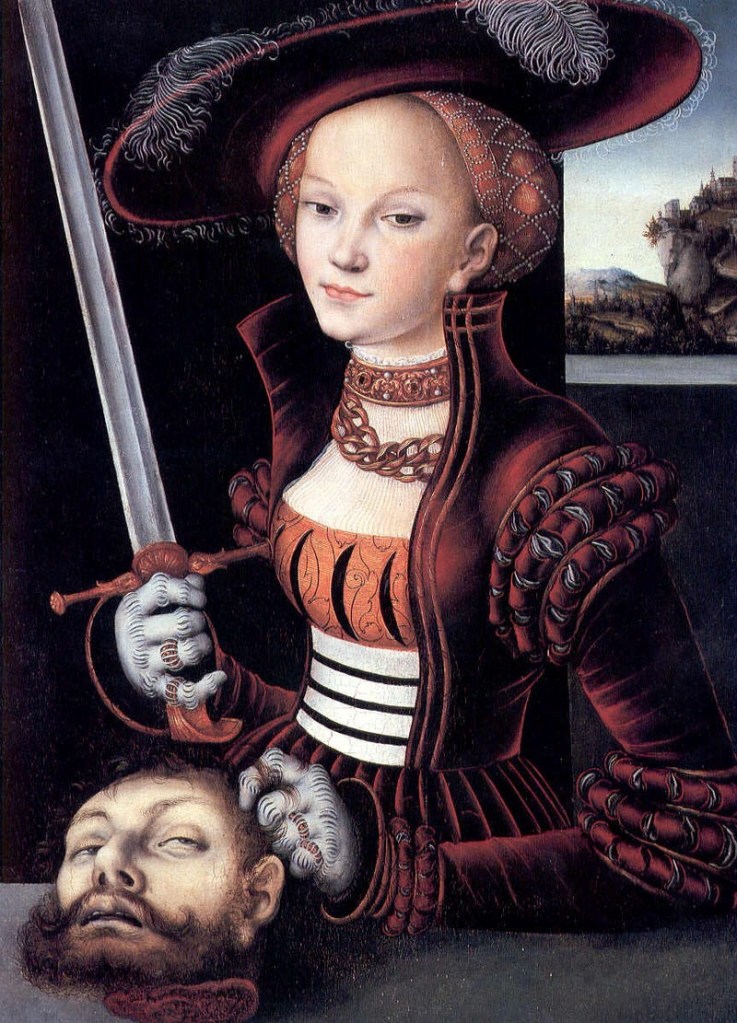
To emphasise this point, here is a selection of alternative, lesser versions of the same supposedly grizzly incident by inferior artists like Lucas Cranach the Elder, whose offering from the previous century presents a bizarrely immaculate and elegant Judith presenting Holofernes’ head as a sort of fashion accessory, like the latest handbag. No wonder she looks so smug! This is one seriously cool and curiously untroubled lady…

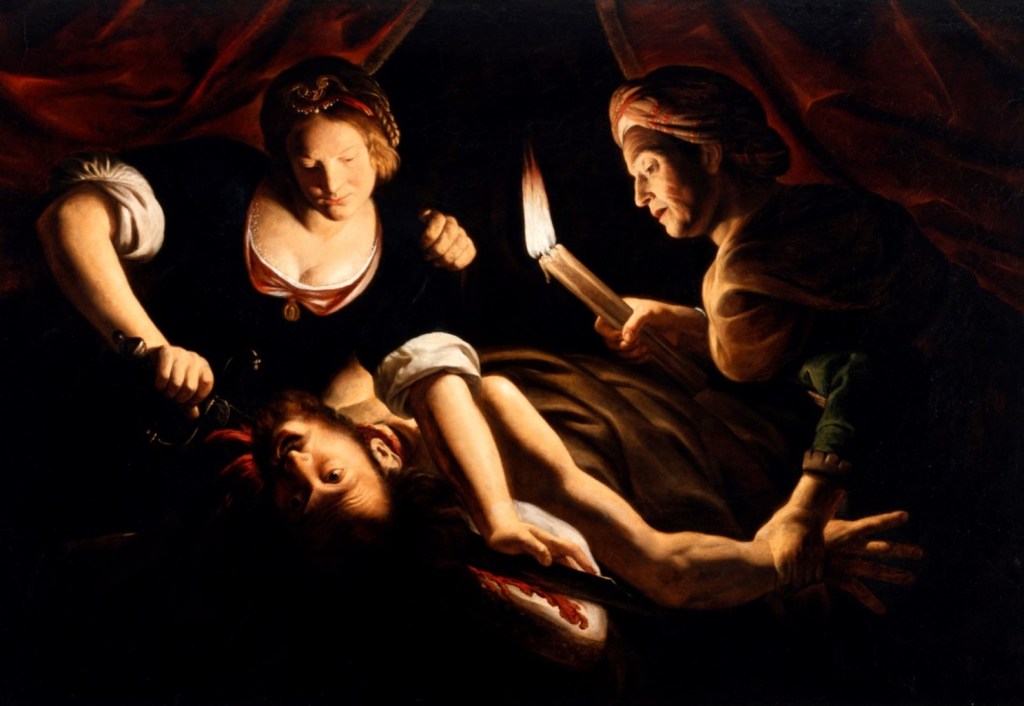
Trophime Bigot’s Judith (painted about the same time as Gentileschi’s) is normally described as “serene” but for me she seems less serene than effortlessly adept – like an experienced butcher approaching boning a piece of meat, while her maid looks on in the manner of an attentive apprentice …

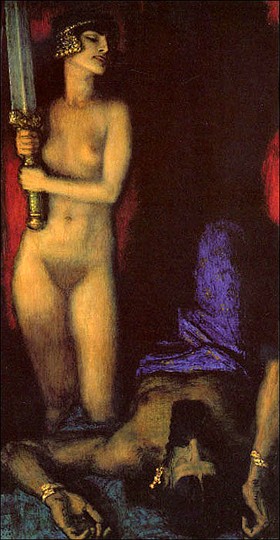
But if there’s an element of ambiguity over Bigot’s painting, that certainly isn’t the case with this final example by early 20th century German artist, Franz Stuck, whose sensually naked Judith anticipates what she is about to do as blatantly erotic. Stuck succeeds, albeit with elegant artistic skill, in reducing the episode to soft porn…

Conditioned as I am by my traditional Jewish upbringing, with women supposedly knowing their place, especially in the synagogue, where they are put upstairs and out of the way, I have always found the Jewish take on biblical women and their roles, paradoxically, to be more nuanced, and less defined than in Christianity, and certainly more proactive.

Somewhat counterintuitively, this might be because of our lack of a pictorial tradition. For the very reason we, as Jews, had so little fixed female imagery, our imaginings of women like Miriam, who stood up to Moses her brother, the formidable Deborah, a national leader, the heroic Jael (and Judith) and the spirited and defiant Michal, daughter of Saul; certainly, as drawn in the biblical narratives – fiercely patriotic, physically courageous, independent spirits – don’t easily make the transition onto the canvases and frescos of Christian inspired pious art.

In fact, it would be tempting to say that within the Christian world, it took a woman artist, in the form of Artemisia Gentileschi to paint the first biblically accurate portrayal of an Old Testament biblical female personality, which perhaps explains why, from a pious traditional Jewish perspective, despite its decidedly non-feminist reputation, the Judith painting was and remains somehow less intimidating than it did, and still does to many traditional, pious Christians.

YAHWEH’S ANVIL – SINAI “THE GREAT AND TERRIBLE WILDERNESS” (revisited…)

Bedu playing a form of draughts with petrified camel turds

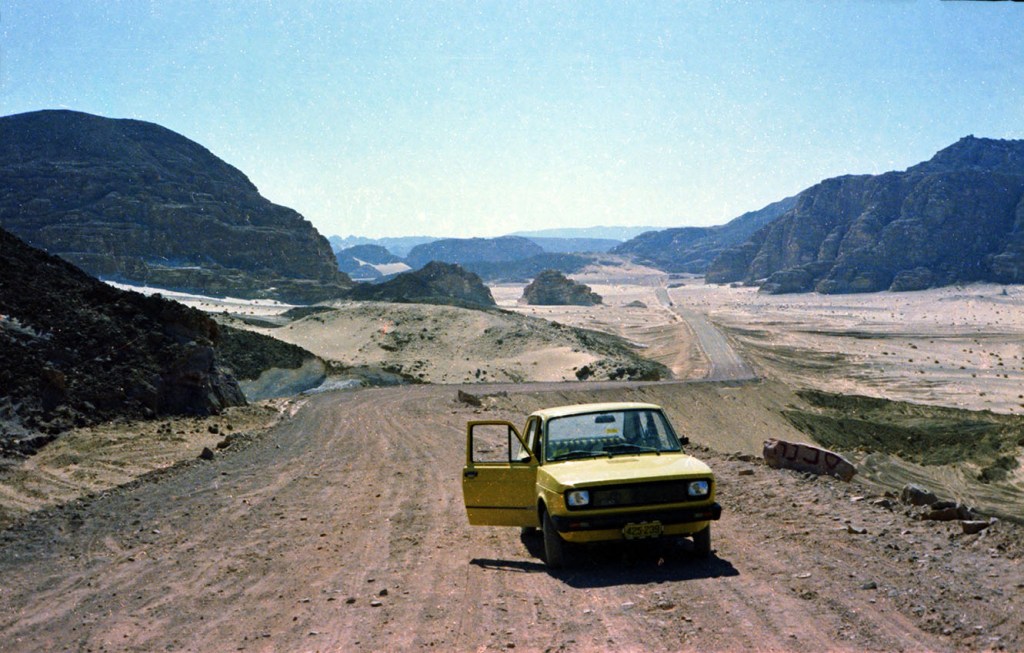
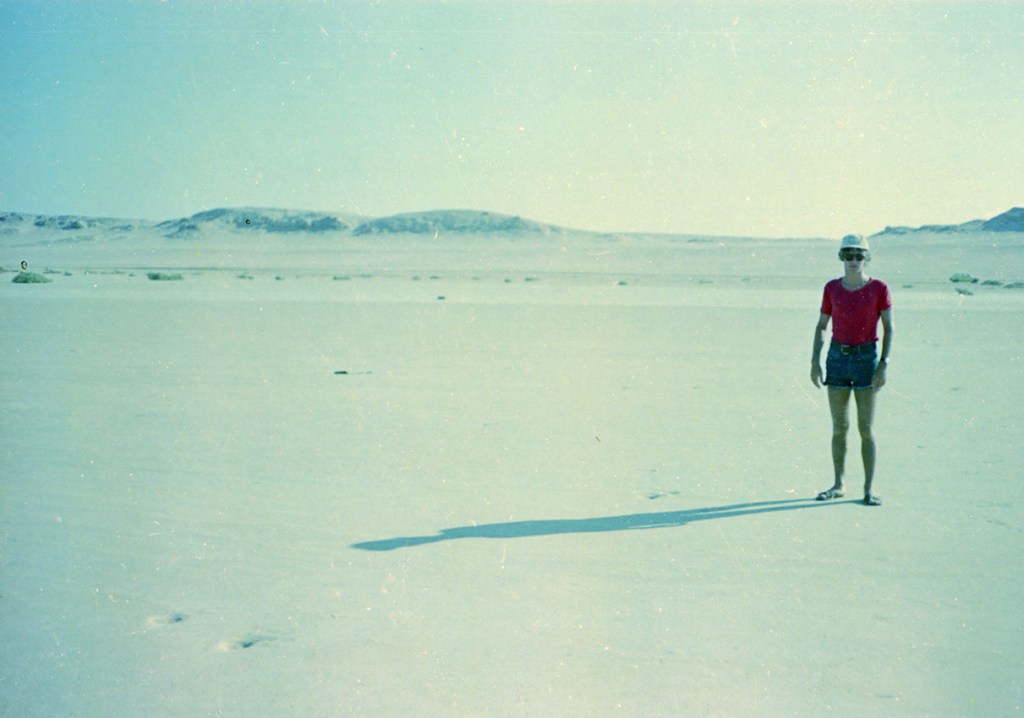
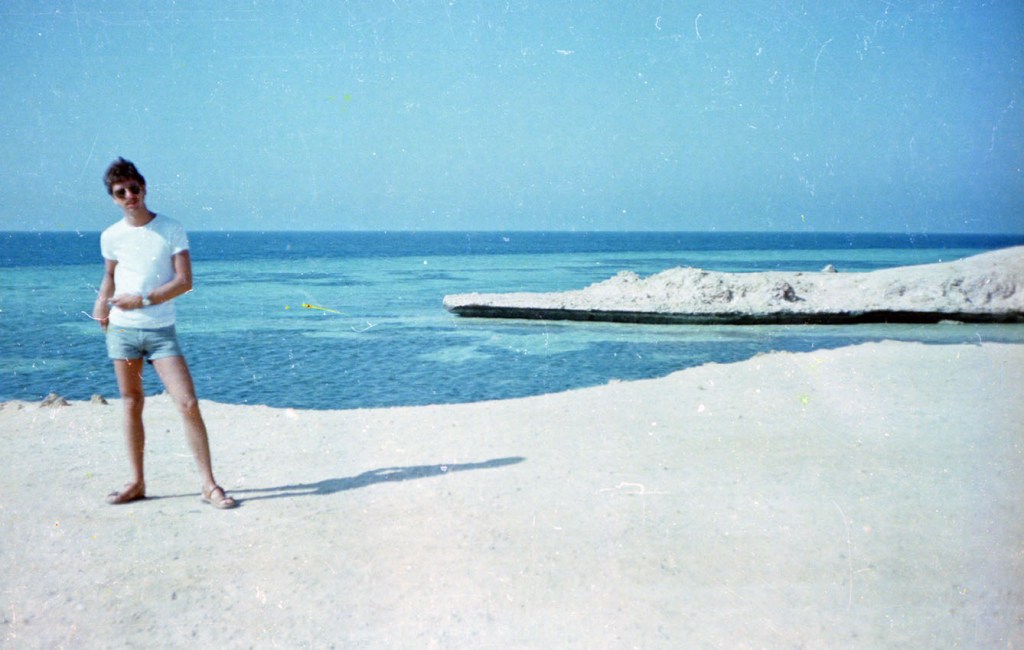
In 1978, my oldest friend Simon and I spent the summer as volunteers on a kibbutz in northern Israel. Although our labour was voluntary we were paid a weekly amount to cover basic needs such as cigarettes, booze and staples from the kibbutz general store. Fortunately, we didn’t smoke; the beer was cheap, and we were sufficiently content with the food produced in the members’ dining room that we’d spent relatively little, and by the end of the stay had a reasonable amount of money saved up. We decided to pool our savings with another couple of English guys, Tim and Ben, hire the cheapest car available (which happened to be a typical 70’s yellow Fiat 127) and drive down south to spend a week in the Sinai Desert.

Our trusty yellow “horse with no name” above the Valley of the Inscriptions

The Sinai was still under Israeli rule back then, free to roam almost all the way to the edge of the Suez Canal. Little did we appreciate then, that a uniquely peaceful era in the modern history of the Sinai was nearing its end and that we were about to enjoy privileged access to virtually the entire peninsula.

A typical scene at Nueba

These days, most travellers associate the Sinai primarily with its exotic beach resorts and scuba diving and snorkelling. And little wonder, as the peninsula is blessed with a sublime coastline both above and beneath the waves. Even now, the beach at Dahab remains the most beautiful I have ever seen, and the Sinai’s coral reef―as regards accessibility and quality―is a match for any other in the world.

My old mate Simon, on salt flats near Ras Mohammed

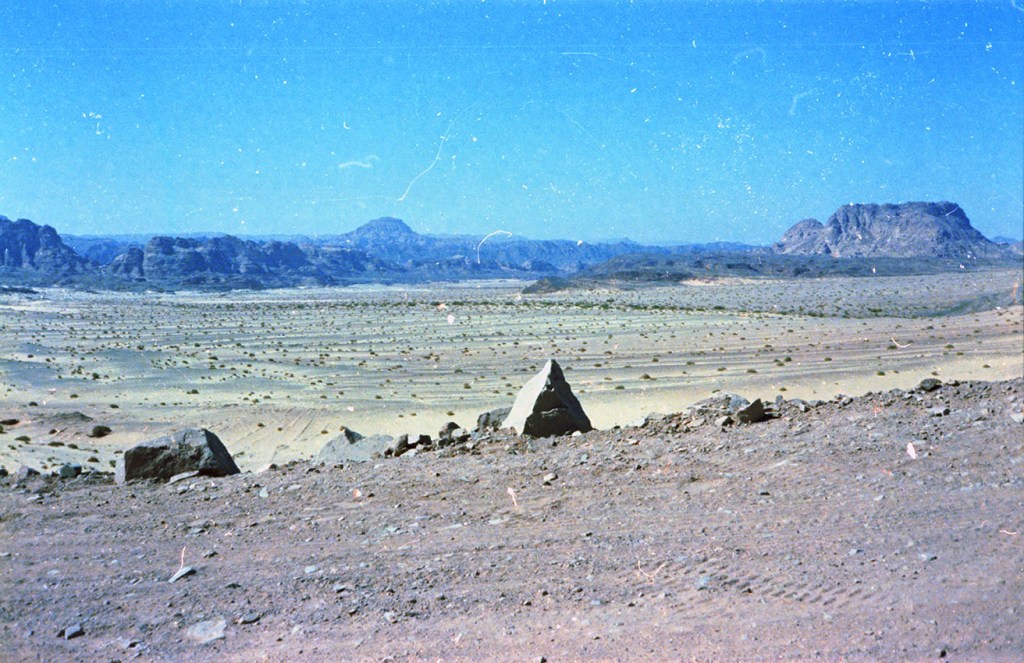
But for me, from the moment we passed through Eilat and entered the peninsula its superlative watery attractions notwithstanding, the feature which most grabbed my attention was the equally extraordinary landscape. The combination of desert plains and craggy mountains in a myriad of different colours; from white, to golden ochre through deep umbers and sienna, and culminating in blues and purples, was simply astonishing. The changing light; the chromatic sunrises; the intense sapphire of the day and the copper-tone sunsets reacted with the multi-surfaced sand and rock, presenting an optical feast of shifting tones and colouration.

The southern Sinai range erupting from the flat desert plane “like brooding granite ice bergs above a gravelly, sandy ocean…

In the south of the Sinai Peninsula in particular it was easy to see how its awesome visual dramatics gave birth to Yahweh―the eventual supreme divinity of the Israelites, and which would gradually evolve into the monotheistic Judeo-Christian concept of “God”. And funnily enough, of all the many remarkable aspects of the Sinai, the one which struck me most had an appropriately biblical reference: I recalled, even back then, the passage (Exodus 19:12) where Yahweh warns the Children of Israel not to touch the sacred mount (Mount Sinai / Horeb) “or they shall certainly die”. Until witnessing for myself the “biblical wilderness”―familiar then, only with the mountains of Europe which have nothing like defined parameters, but rather evolved from their neighbouring foothills which themselves slowly emerged from undulating plains―I had always found that to be an odd warning. I even recalled as a child in Synagogue on a Saturday morning, when first reading the relevant passage, asking my grandfather how the poor Israelites were supposed to know where the sacred mount began. But now, looking at the actual mountains of southern Sinai, thrusting forth from ironing-board-flat plains like brooding icebergs above a gravelly, sandy ocean, I could immediately attest to the voracity of the biblical author’s knowledge of the geography he was describing. And it sent a shiver down my spine.

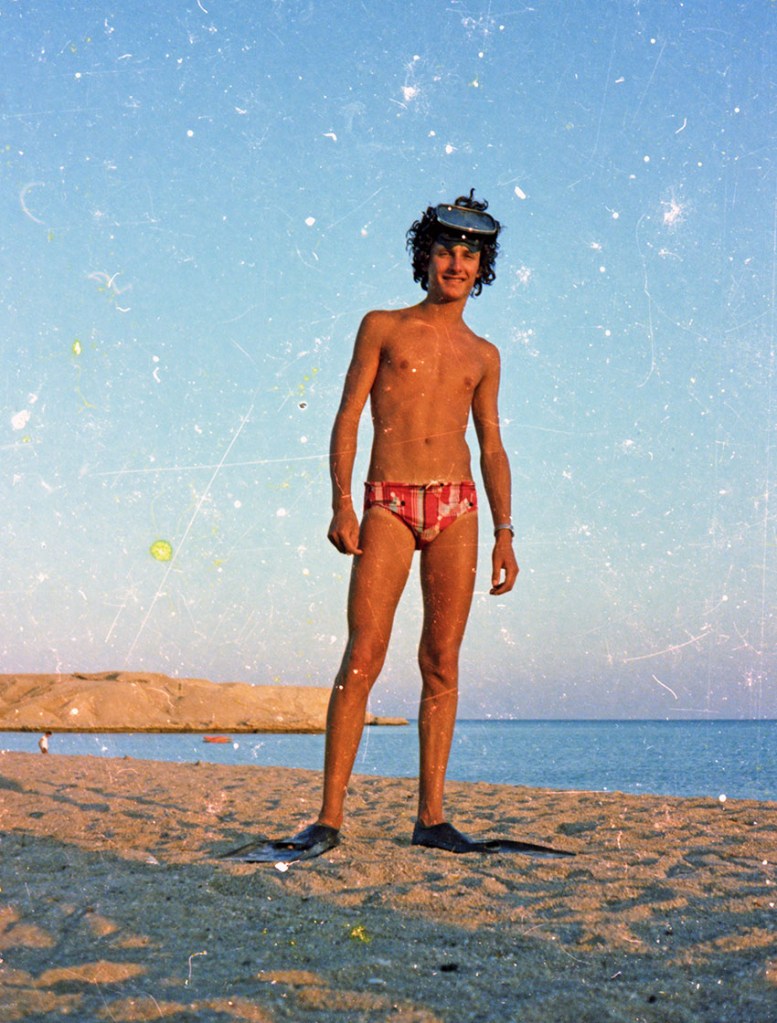
Snorkelling off the southern Sinai coast was beautiful and awesome in equal measure…

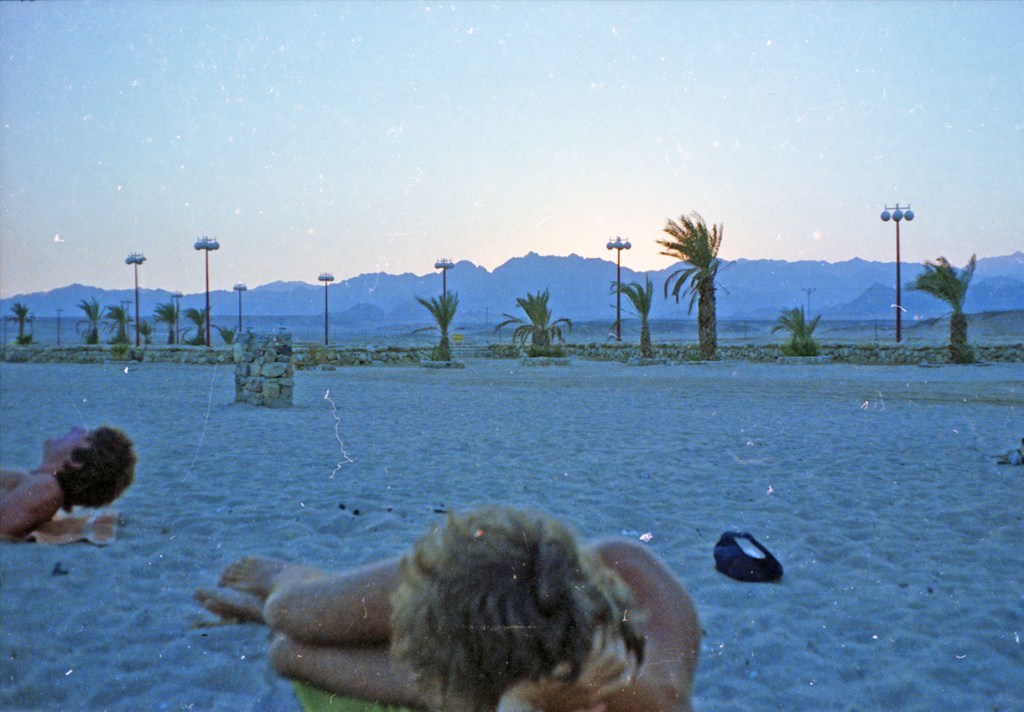
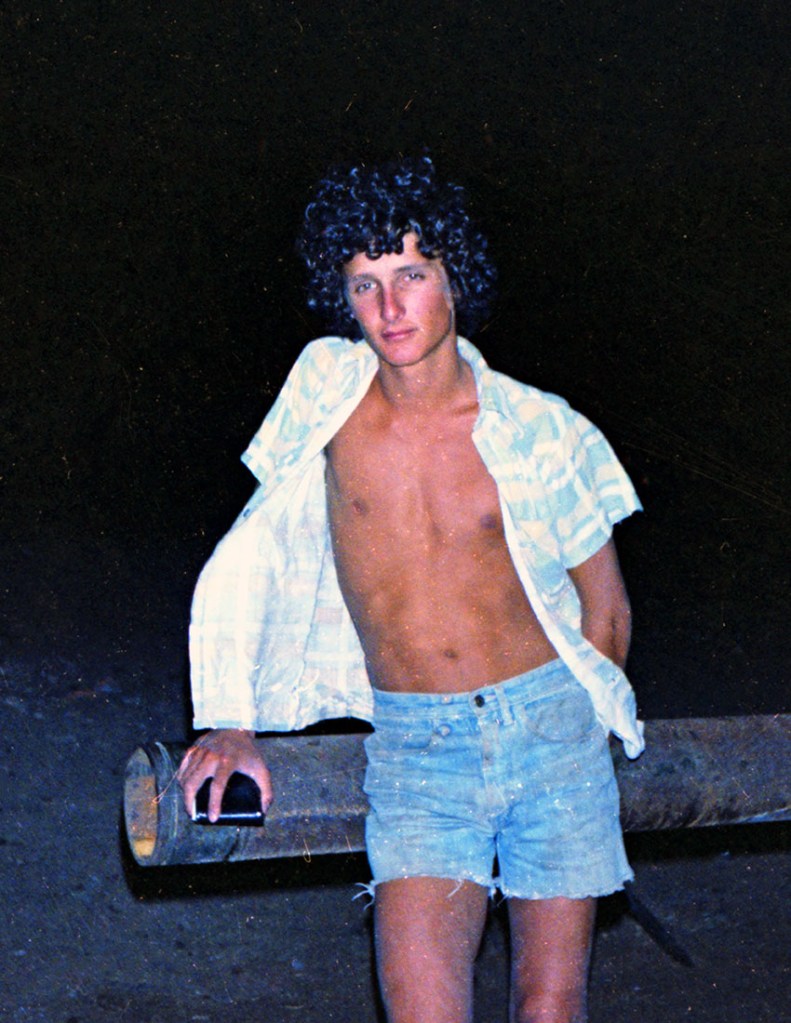
Presented here are a handful of the dozens of photos I took on that trip with my old Cannonet 28 on high-speed Ektachrome film. Sadly, most of the transparencies were too damaged to convert, but I think these few, in their raw, scratched and grainy condition, begin to convey to sheer wonder of what we saw on that wonderful trip to that “great and terrible wilderness”.

Finally, and on a lighter note, I recommend viewing these images to the sound of America and their iconic track The Horse With No Name . This song became a kind of unofficial anthem to our trip, and thus the adoptive name of our trusty little Fiat…

The exquisite beach at Dahab.

“YOU SAY MERON, I SAY MAROMA – let’s call the whole thing a tantalising 2800 year-old probability…”

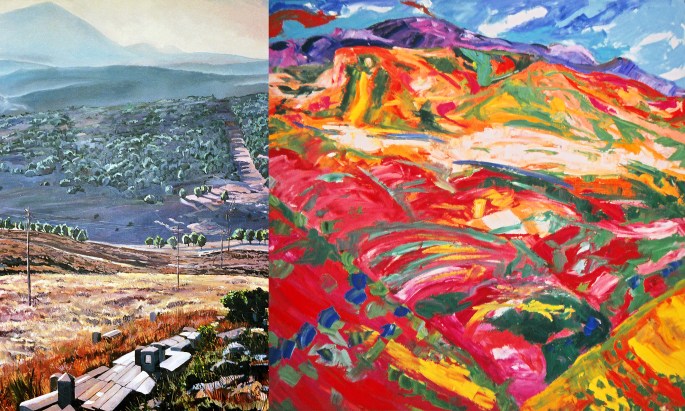
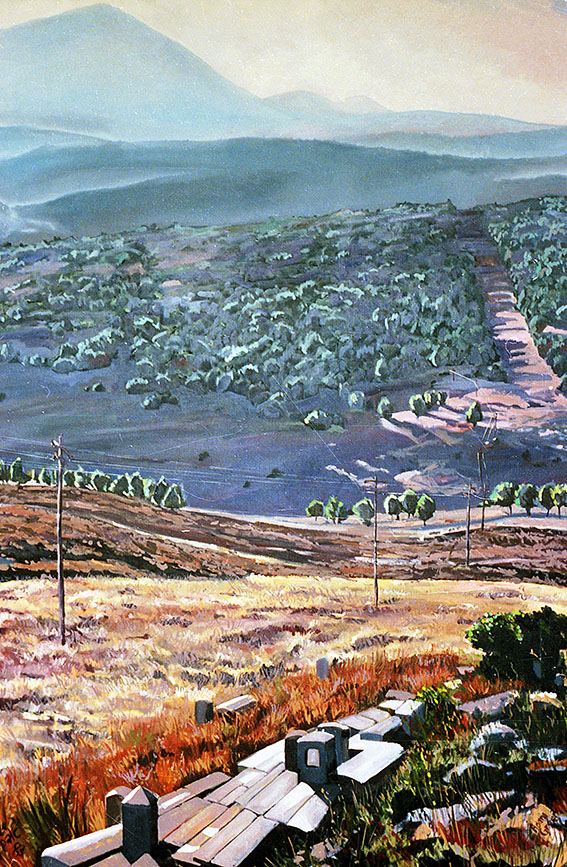
In 1983 I painted one of my largest oils on canvas, and at over seven feet high (about 2.1 meters) it was certainly the tallest oil I ever did. It dates to the height of my post Saint Martin’s landscape period, intended as the centre piece for a proposed exhibition of my works at the Israeli embassy in London (why that show never materialised is a story for another post). At the time, I still harboured a naive ambition to become a sort of 20th century successor to artists like Claude Lorraine and William Turner, and was thus obsessed with the spectacular, the epic and visions of the sublime. As with the subject of an earlier post , I was still, at this stage, exclusively applying the paint with brushes, and consequently, my pictures could take weeks to complete.

6 Meron - Mount Meron detail
Mt Meron from Sefad – distance detail

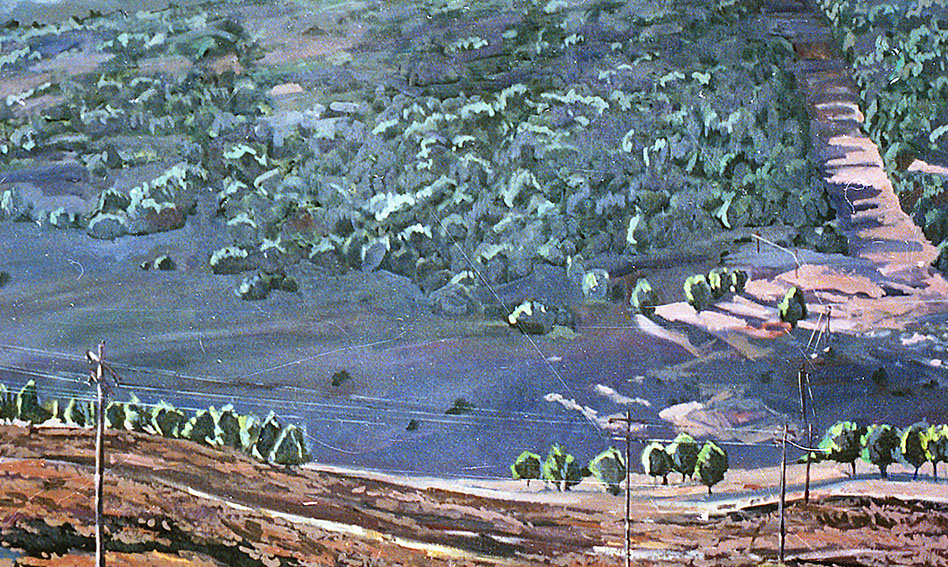
Mount Meron from Sefad manifested as one of the more arduous pictures I painted, taking around a full month from sketch to final brush stroke. But, it was also one of the most satisfying experiences of my painting career as regards both making the painting, and my contentment with the finished work. My “technical intention” had been to draw the viewer in from the bottom of the picture and then send them on a virtual journey down into the valley and then upwards towards the distant mountain. My “intellectual intention” had been to stir the mind of viewer by the use of “sublime” tonality and rich graduated colour. Whether or not I succeeded as well as I believed back then is hard to tell without standing in front of the painting itself (last I heard, residing on the walls of a private home somewhere in France), but from the little one can tell from this format I didn’t do too badly.

5 Meron - mid distance detail
Mt Meron from Sefad – middle distance detail

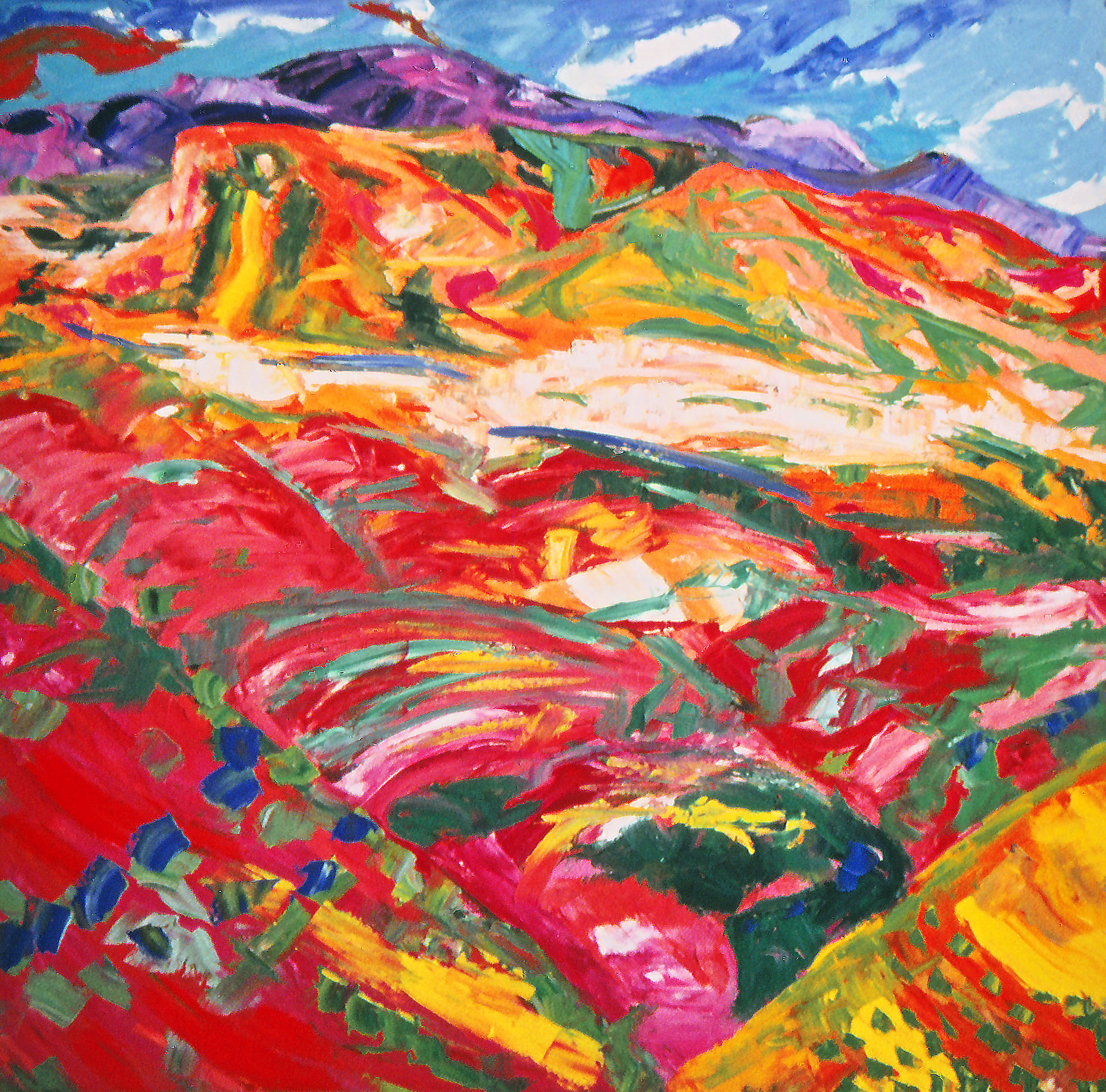
Ten years later, toward the end of 1993 I made another large oil painting of another mountain, but for very different reasons, and with a very different approach. Around the mid to late 80’s I’d become bored with brushes and moved on to the more immediate and primal method of applying thick daubs of paint with palette knives. My mostly large canvases, were still spectacular and even epic, but “the sublime” had been replaced with raw painterly passion. The spacial illusion of the former supplanted by a flat tapestry of thick impasto.

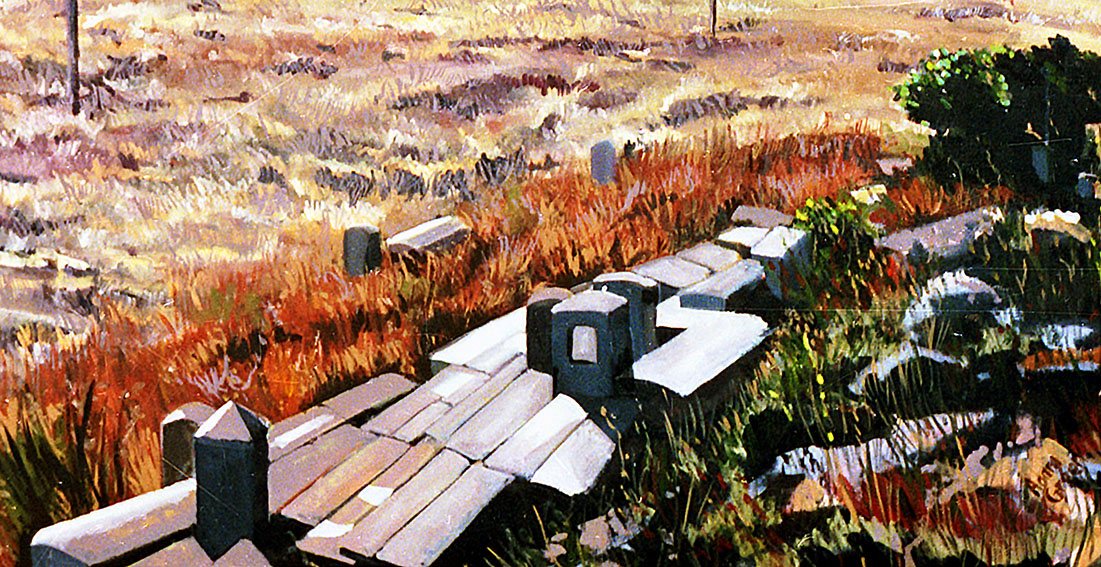
4 Meron - Cemetary Detail
Mt Meron from Sefad – foreground detail

[Mount] Maroma Sunbathed turned out to be the final large scale oil on canvas I ever painted – or “knifed” (about 4 foot square). I did it the first day my studio was set up in our then-brand new house in southern Spain. After eight long, hard months of building the house and living rough the work was a celebratory expression of pure joy and relief. I merely pointed the easel at the mountain across the gorge from our home and proceeded to pictorially express the view before me. It took only about two hours, from start to finish.

2 Meron
Mt Meron From Sefad

Two oil paintings of two different mountains; executed in two hugely contrasting styles, separated geographically by 3000 miles and ten years in time. But here’s the funny thing; the genuinely wondrous thing. For, totally unbeknownst to me until I prepared and researched this post; I was painting two mountains with the same name!

Briefly; the name of the Galilean mountain, Meron is recorded in the Bible, in which it is also known as Merom, which itself (and this is the bit I was ignorant of until very recently) is an ancient Hebrew derivation from the earlier Canaanite Maroma.

The Canaanites in question were either identical with, or at least closely related to the Phoenicians of ancient Lebanon, and who ruled over what later became Galilean Israel well into the time of the early Israelite kings – perhaps as late as around 950 BCE.

3 Maroma Sunbathed
Maroma Sunbathed

About 800 BCE, Phoenicians settled along the southern and south western coast of Spain and quite possibly, in a way identical to European colonisers of the New World, brought the place names from their old world with them for recycling in their new land.

Bearing in mind the similarities the settlers would have noticed between the two mountains; both being the tallest in their native locales (the Galilee and the Axarquia respectively) and both sharing strikingly similar physical form, it seems highly plausible that they named their new mountain after the original Maroma.

This is at least as plausible as the currently accepted theory, that the word maroma (which means a rope or a cord, or a twisted flax in modern Spanish) has vague Arabic origins, but with no apparent etymological evidence for such a linkage. Far more likely it seems to me, that just as the Phoenicians indisputably named the nearby city of Malaga (Malaka – mlk), so too they named the region’s most imposing mountain, Maroma!  The fact they were the subjects of my two most ambitious mountain landscapes proves nothing on the other hand, but it is one hell of a coincidence…

The Wilderness of Zin – Yahweh’s Kingdom?

10-timna-sth-moab-mountains-3-b

This next post is a rare acknowledgement by yours truly of the approach of a Jewish festival. The Ten Days of Penitence, beginning with Rosh Hashana (the Jewish New Year) and culminating with Yom Kippur (the Day of Atonement ) are nearly upon us and it got me to thinking about desert landscapes.

1-ramon-crator-looking-east-3

I nearly always think of desert landscapes when any of the four main (“Mosaic”) Jewish festivals come around (Rosh Hashanah, Passover [Pesach], Pentecost [Shavuot] and Tabernacles [Succot]) as they were all – according to tradition – conceived during the desert wanderings of the Children of Israel – sometime around the 12th to 11th centuries BC.

2-ramon-crator-looking-south-3

These days most biblical historians, archaeologists and scholars dispute these wilderness origins for most, if not all of these festivals, dating them instead to reigns of the later kings of Judah – somewhere about the 8th to 7th centuries – or even as late as the Babylonian exile during the 6th to 5th centuries BC.

3-ramon-crator-looking-south-1

But whatever the exact historical origins of these celebrations they are fundamentally related to the worship of the ancient desert god Yahweh – one of the several Israelite/Hebrew components for what would gradually evolve into the eventual single Jewish God.

4-ramon-crator-clarinet-practise

Having been fortunate enough to travel extensively throughout most of the “Mosaic Wildernesses” – known today as the deserts of Sinai and the Negev (or Arabah) it is not hard for me to understand how the ancients came to regard these spectacular landscapes as the domain of supernatural beings, and even gods. They have a mystery and a feeling of wonder, which in certain lights and conditions can be almost overwhelmingly sensually intense. The evening winds cascading and rebounding through the canyons of the southern Sinai mountains at dusk sounds like the angry roar of giants – or even the voice of the gods.

5-ramon-crator-looking-south-2

However, the current scholastic consensus is shifting northwards from southern Sinai to the less lofty, though equally spectacular jagged hills and psychedelic plains of the central Negev – formally known as the Wilderness of Zin – as being the true domain of the Hebrew Yahweh and even the location of his sacred mountain stronghold of Horeb.

6-timna-mushroom-and-half-view-1

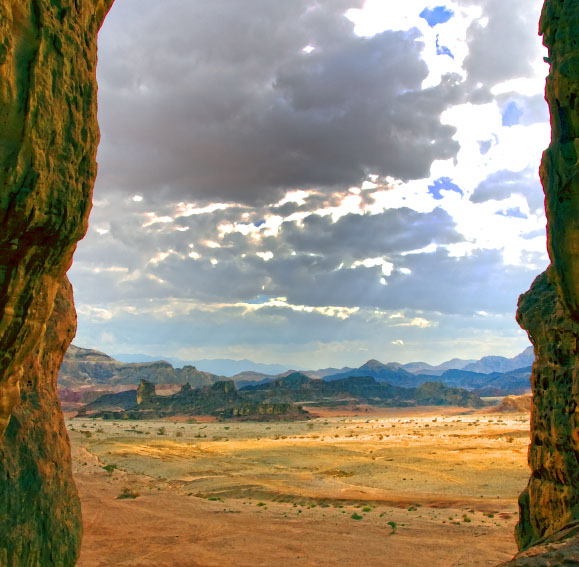
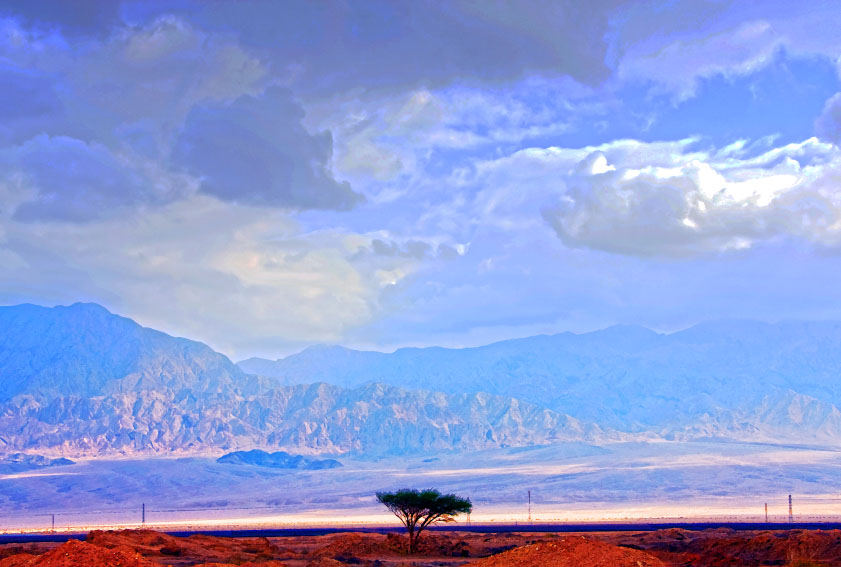
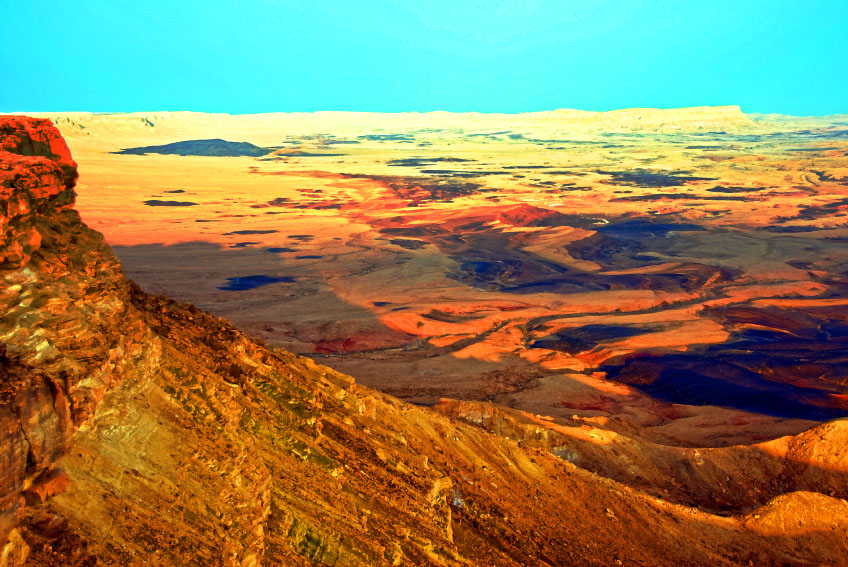
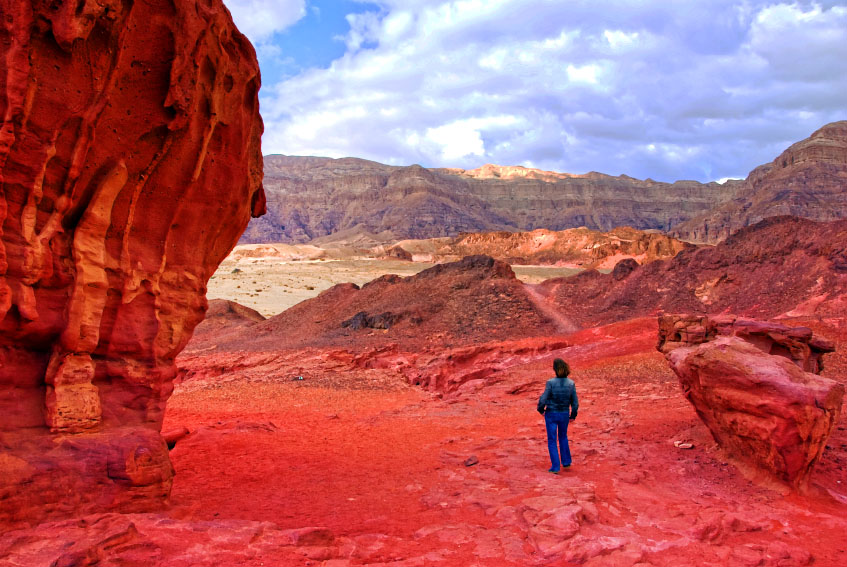
Whatever the eventual verdict regarding the birthplace of the Jewish God will be – assuming a verdict is ever arrived at – Zin remains my favourite place on Earth. I think these images here give you a taste of the “divine” and rugged beauty of the place.

7-timna-park-looking-west-1

A very hearty Shanna Tova to you all!

9-timna-solomons-pillars-walk-way-view-3

ARK – excerpts – Part 2

I PRESENT HERE THE SECOND IN SERIES OF SIX EXCERPTS FROM MY NEW NOVEL (Paperback available from Amazon and on Kindle and to order online from selected bookstores)

ARK

Tragedy, Travesty, Tapas and the Ark of God

14

Miguel and Loli Garcia had a traditional Castilian style villa in the comfortable middle class Aravaca suburb on the western side of Madrid.

Driving into Aravaca filled Alex with bitter-sweet nostalgia. It was where he had spent the first eighteen years of his life.

An only child, Alex was a rare species in post-war Spanish suburbia. This combined with a mostly absent and philandering father and a mother who suffered from what would eventually be diagnosed as clinical depression resulted in him developing a high degree of self-resourcefulness from a young age.

His favourite strategy for coping with the dullness and melancholy of his home life was through his innate interest in history.

As his interest developed into a passion, his bedroom transformed over the years into a library of history books, each one a portal through which he could escape Aravaca into exotic past worlds filled with colour and adventure.

In common with most Spanish kids, history began for Alex with the legendary hero El Cid, but unlike his peers, Alex was far more interested in discovering the actual history behind the legend than in the legend itself. The Cid was merely a stepping stone for him into the world of medieval Europe. And after devouring medieval Europe he travelled further back and further east to the stories of Rome, then Greece and ultimately, via Persia, Babylon and Egypt, the origins of civilization itself upon the marshlands of ancient Sumer and the central Asian Steppe.

By the time Alex was fourteen, driven on by an ambition to read the Cambridge Ancient History, he already had a prodigious grasp of English. And by the time he was half way through the tenth volume he had decided that he would get his master’s degree and his PhD in the same town where the book was published. So determined was he in this aspiration that he spurned earlier offers from both Princeton and then Oxford on the off chance that a place would materialise at Cambridge.

When it finally did, six agonising weeks after he had turned down Oxford he was so overjoyed he even managed to cheer up his mother sufficiently to convince her to go out with him for a celebratory supper in town.

His time at Cambridge followed by spells in Seville and London merely confirmed how suffocating and dreary growing up in Aravaca had been and accentuated what he termed the “cosy certainty” of it all.

Yet, Alex understood that it was this same “cosy certainty” which explained why so many of his colleagues either moved or returned to the suburbs to raise families, ‘like herds of animals migrating to their breeding grounds’.

He supposed now, as he parked his Alpha Spider in front of their house that this was why the Garcia’s had moved here. He knew they had two grown up children and that Miguel considered central Madrid to be ‘unsuitable for bringing up a healthy family’ being so ‘polluted and stiflingly hot in summer’.

Alex and Elena being childless however, lacked the “migratory instinct” that seemed to accompany the condition. Often Elena would suggest, only half in jest that they ‘must be perverse in some way—deficient in these normal human instincts.’ Alex would then point out that they had ‘plenty of other human instincts and much more time to indulge them!’

‘In other words’ Elena would then challenge, ‘you’re saying we’re selfish.’

To which Alex would respond; ‘That’s a pious attitude—the concept that not having kids is in some way selfish and sinful and that we have a duty to procreate. If you ask me, it’s the instinct to have children which is selfish. The belief that by spreading one’s seed one is doing society a service.’

‘Yes, but it’s also locked into our DNA—to continue the species. Which brings me back to my first point—that you and I, selfish or not, are maybe lacking something…’

‘Or, are just more highly evolved?’ he would quip. ‘Like oppositional thumbs and cognitive thought? Maybe this lack of a need to procreate is the next level—the next rung on the evolutionary ladder?’

‘If so, it will be the final rung on that ladder—an evolutionary dead-end. Not so much an evolvement as a culmination. I wonder what Darwin would have thought about the concept of evolution leading to culmination?’

‘Whatever he’d have thought I don’t think we need worry yet—not if all the priests and mullahs in the world have anything to do with it. There’ll be no baby shortage in our lifetime…’

Alex smiled wryly to himself at the recollection of this perennial conversation as he opened the black wrought iron gate to the Garcia’s front garden.

15

The straight pathway from the road to the front door was lined with alternate boxed oleanders and laurel glistening under the heavy autumnal dew. The terracotta tiled path bisected an immaculately maintained formal Spanish Mudéjar style garden of topiary, cypresses and citrus. Standard rose grew from circles of soil edged in Roman brick, set within a sandy gravel surface. It was a modest homage to the grand gardens of the Alcázar in Seville and the Generalife in Granada and betrayed the Andalucian taste of its owners.

Alex found the garden seductive and he stopped so that he might fully appreciate it. Even allowing for the overcast September light this was never intended to be a riot of colour. The garden was primarily tonal in concept; all subtle shades of greens and blues with the roses; only pink or white, providing dynamic points of contrast. It was immaculate, reflective in mood, almost melancholic and it reminded Alex of Loli Garcia.
Then, right on cue he heard someone say, ‘So you like my garden Alex.’ She must have seen him drive up from inside the house.

He turned towards her and there, standing at the front door was Loli looking even smaller, paler and thinner than he remembered her.

‘I love it Loli. My compliments to the gardener.’

‘Gratefully received’ and she made a little bow. ‘The back is even nicer. There are fountains and pools and shady places to sit. It’s my sanctum.’

He was alarmed at her decline since they had met at the hospital eight days before. Miguel was fifty-eight when he died and he guessed that Loli was around the same age but as he approached her he noticed that her naturally white skin had become transparent and dry. It had a parchment-like quality of someone twenty or thirty years her senior and her eyes had the same moist filminess as Miguel’s on his death bed. All this and her painfully thin limbs and tied back hair gave the impression of someone shrinking into themselves.

Given her physical deterioration Loli’s outward calm was disconcerting to Alex. He almost needed her to demonstrate her grief overtly, just to break the spell. There was something unnatural about Loli and he was frightened for her.

As they kissed on each cheek and entered the house he thought she smelt odd; a vaguely sweet smell that reminded him of something from his past, like the odour of vellum in old books or ancient parchments.  It was the peculiar odour of someone who was malnourished; someone living on a diet of caffeine.

The interior of the house was typical, simple Castellano but of the finest materials with perfectly plastered white walls, dark oak doors, heavy brown wooden furniture and a floor of handmade terracotta tiles.

Loli led Alex into the main living room and invited him sit down on an austere high backed couch. She remained standing.

‘Can I offer you a coffee Alex?’ she asked.

‘Yes please Loli, I’d love one—black, no sugar.’

While she went and made the coffee Alex stood up again and explored the room. The walls were festooned with large dark clumsily painted oils, mostly copies of equally clumsily painted seventeenth and eighteenth century original Spanish minor “masters”, all contained within broad gilded frames with velvet slips.

The subject matter of the images comprised all the usual suspects for this type of Spanish art: A kitsch representation of an enraptured red-headed Madonna holding a smug looking naked child suffering from what appeared to be a severe case of hydrocephalus; several turgid attempts at Arcadian landscapes, with all the depth and life of a series of worn and dirty billiard cloths; a pair of grotesque portraits, apparently painted by someone influenced by Goya while high on an eighteenth century version of speed and finally; above the hearth, an overly large and unintentionally fauvist still life dominated by a gargantuan lobster painted in lurid ultramarine seemingly locked in mortal combat with a floating string of indigo coloured onions. ‘Gosh!’ Alex thought to himself. ‘If Kenneth Clark could see these he’d say—here you are! You see what I mean! Hopeless! Bloody Hopeless!’  Yet, in a strange way they perfectly suited this particular environment and the overall effect was somehow pleasing and satisfying.

He strolled over to a full sized grand piano in the far corner of the room sitting under a tall window with a full view of the street. Although Alex could not play an instrument he was passionately interested in all things musical. He noted that the piano was a Bluthner; the same make as his late mother’s old baby grand. On the lid of the piano there stood dozens of framed photographs. Among all the usual pictures of weddings and communions were many with images of men who looked similar to Miguel; probably his father and brothers and others of Carlos from when he was younger. In the photos they all shared that same Picasso like face and head and it occurred to Alex that like Picasso, the Garcia clan came from Malaga. ‘Must be a Malagueño gene’ he thought.

He was impressed to see the music for Schubert’s “Wanderer Fantasy”, a piece well beyond his mother’s ability open above the keyboard. He supposed Loli had been sat here playing the Wanderer as he drove up.

He was about to press down on the piano keys when Loli returned with the coffee.

‘It’s no Steinway I’m afraid’ she said placing a tray onto a low glass table with ornate wrought iron legs, ‘but it has a pleasant tone—perfectly adequate for me and this room.’

‘You play Schubert Loli?’ Alex said sitting down again on the couch.

‘I play just about everything Alex. In a former life I had ambitions of being a concert pianist but that was a long time ago. Miguel never stood in my way, you understand. In fact, he was a highly progressive man for these parts. It wasn’t his fault. It was just that we had children and that put an end to my professional aspirations. But I’ve never stopped playing and I taught both our boys to play too. Jorge, our eldest, is really quite good. He performs contemporary jazz with his band at college.’

‘But why the Wanderer Loli?’ Alex asked a little too obviously more interested in her than in her offspring. ‘I love it, but I always find it a touch bleak—dark even.’

‘Well, at least it’s not Death and the Maiden’ she said smiling slightly giving him another fleeting impression of her past beauty. ‘At this moment’ she went on, ‘The Wanderer, to quote a phrase I think I once read in some American novel, touches my condition. I find it more helpful than I would say… a jolly piece of Mozart. Sometimes it’s best to confront one’s sorrow head on—to grab it by the horns, so to speak.’

They sat in silence for a few seconds. Alex felt useless in these situations and he had no idea what to say to Loli about Miguel that would not sound like a platitude. In the end, he just admitted honestly, ‘I’m at a complete loss at what to say to you Loli—about Miguel I mean.’

‘I don’t want or expect you to say anything Alex. I’ve had a house full of relatives and friends saying things to me about Miguel all week. I’ve been saturated in sympathy to the point where I can’t take another drop.’

‘You know Loli, Miguel and I had a good and amicable working relationship but we weren’t friends as such?’

‘Of course I know that. So what?’

‘It’s just that all this… me sitting here now with you…and before at the hospital. It all seems a bit odd. What I mean is… I feel false.’

‘Well, I can’t do much about that I’m afraid, but really all that matters now is that you need an important piece of information. Miguel had that piece of information. Miguel wanted you to have that piece of information. And now you’re sitting here patiently and politely waiting for me to carry out Miguel’s wish… his dying wish, no less…which was that I give you that piece of information.’

‘It’s no hardship sitting here with you Loli’ Alex said a little defensively but sincerely.  The more he got to know this small, intense, fading woman, the more he enjoyed her company.

‘That’s not what I meant. I wasn’t being facetious. I was simply defining the situation as it is. Our sensibilities and social etiquette are of no consequence compared to the bigger picture.’

She picked up her coffee and sat down on a high carver chair opposite him. ‘Look Alex, you’re worried about what I think of you feigning concern for Miguel. Well, never mind you—if you’ll pardon me—what about my Miguel?’ She took a long sip of the thick tarry coffee.

‘What do you mean Loli? What did Miguel do?’ Alex asked.

What did Miguel do?’ she repeated rhetorically. ‘I’ll tell you what Miguel did—or what he did not do to be more precise. He did not pass from this world thinking of me or thinking of us and our nearly forty years of life together. No. My Miguel, as ever solely concerned with the bigger picture died thinking about the same thing that brought you to his bedside that morning. You could even say that you were the only person Miguel actually required at his deathbed. Me and the entire family might as well not have been there so far as Miguel was concerned.’

‘I think you’re exaggerating Loli’ Alex said, genuinely dubious and amazed by her frankness.

Loli stood up and went over to large mahogany sideboard with a blue and white tiled top, opened a draw and pulled out a large thick white envelope. She then returned to her chair and placed the envelope down by the coffee pot. ‘In other words Alex’ she continued, ignoring him, ‘your motivation and your sincerity or lack thereof is of no consequence. In the event you did the right thing by default. All that really mattered to Miguel as he took his final breath was that you should receive this.’

16

She then leant forward and pushed the envelope across the table towards Alex.

‘Knowing that you would read this meant Miguel could die with a modicum of peace’ she added.

‘Why didn’t he just give it me? Before his heart attack I mean?’

‘At first he was simply scared. He only summoned up the courage to actually write this stuff for you about the Transito excavation when Franco relapsed in July. He then intended to give it to you after Franco was dead but when the old bastard recovered and took over again from the young prince it had a terrible effect on him. Miguel was already a shadow of his former self well before Franco’s recovery but once our blessed Caudillo did his Lazarus act it pushed Miguel over the edge. Then last week, the night before his collapse, he nearly phoned you at least half a dozen times. He got himself into a terrible state and eventually decided against it because he didn’t trust the phone. Since all that business with you last April his boss, the chief secretary, made him the scapegoat for the whole mess to protect himself from the wrath of Franco. He was convinced that his mail was being intercepted and that all his phone conversations were being listened to. He thought that they were desperate to get something on him. Miguel said he was at least fortunate that it wasn’t the early days of the regime. They weren’t inconvenienced by things like impropriety back in the ’40s and ’50s. They could have just made him disappear—no questions asked. Nevertheless, the constant worry and the coldness of most of his senior colleagues at the department had a devastating effect on him. You were familiar enough with Miguel to know what a fun loving man he was and so easy going. He just wasn’t cut out for dealing with the hostility and suspicion from people he’d only ever regarded as friends and colleagues. And in the end they destroyed him, just as surely as if they’d stood him up against a wall and shot him. Fortunately though, they failed to destroy what he knew because he wrote it all down, for you Alex.’

‘But what on earth has this business got to do with Franco?’ asked Alex. ‘And since when did Franco take such a keen interest in medieval Judaica? I always thought the guy despised everything to do with the Jews…’

‘He does despise the Jews—albeit more discretely these days since his drive towards modernisation. And you’re correct, that he has absolutely no interest at all in things medieval Jewish. But as you will learn when you read Miguel’s letter, what they discovered in 1964 at the Transito was far from medieval. It was much older and something moreover in which Franco took a most keen interest indeed.’

‘I see’ said Alex.

‘Anyway’ she continued, ‘our beloved leader’s recovery presented Miguel with a big problem. It wasn’t so much fear for himself anymore. He’d got beyond that. It was more a fear for me and Carlos with our knowledge of the Transito discovery and Franco’s little secret. He always felt that when Franco dies things will relax here. He had great faith in the young prince and thought it would be safe, at least after a while to let you in on the secret…safe for you that is Alex. But lying on that hospital bed dying, he changed his mind. He couldn’t face death knowing that he had deceived you and not put things right. So here we are and that’s why your motives are immaterial.’

‘Gracious!’ Alex exclaimed quietly, feeling a little overwhelmed. ‘You know Loli, since that phone call back in April with Miguel I’ve felt almost as I’ve entered a kind of dream state from which I can’t wake up.’

‘Miguel’s letter will wake you up I promise.’

Alex started to open the envelope.

‘No Alex!’ Loli said firmly. ‘Not here, not now. Take it home. It’s yours to keep. I want no more part of it.’

‘Of course, I understand’ he said placing the package on his lap.

‘I hope you never have to understand Alex. My Miguel is dead because of this business. My sweet gentle man has been taken from me and I can’t bear it.  I actually, emotionally and physically can’t bear it.’ This was her first verbal expression of her grief.

They sat in silence while she dabbed her eyes with the woollen sleeve concealing her bony forearm. Then she leant forward and looked intently at Alex.

‘Listen to me carefully Alex. What you are about to read will thrill you as an archaeologist and as a scholar and it will appal you as a Spaniard and a human being. Because of that your natural instinct will be to enquire and to seek and to act. But trust Miguel. Trust me. And wait. Whatever you do wait until the wicked old bastard is dead. Then wait some more. Wait until you are as certain as you can be that you have nothing to fear from people in high places. Wait however long it takes. Wait.’

‘But what if the prince turns out to be another tyrant or a puppet of the generals?’

‘The prince is a good man—pragmatic for sure—but fundamentally decent. He will bring us freedom, I know it. It might take him some time but he will succeed. And in any case Alex you have no choice. When you read Miguel’s letter you’ll see that even if you wanted to there’s nothing to be done until Franco is dead and buried.’

Loli took a deep sigh and stood up to signal that she wished Alex’s visit come to an end.

As they reached the front door she turned to him and gently held his arm. ‘After you’ve read Miguel’s letter go and see his brother Carlos tonight.’

‘He spoke to me at the hospital. He wanted to tell me about the Sons of Kahoth, or something?’

Ko-hath, not Ka-hoth. But don’t worry, he’ll tell you all about it. Meet him tonight if you can, after you’ve read the stuff in there’ she said tapping the envelope with her finger. ‘He’s expecting you at La Gamba at nine. He’ll have a quiet table at the back.’

Loli opened the door and as Alex passed her he stopped on the step and looked at her.

‘Can I ask you one more thing Loli?’

‘Of course Alex.’

‘Why didn’t you just tell me what Miguel’s has written here?’

‘I told you, I’m sick of the whole subject.’

‘But all the same…you’ve told me so much about the background to it. I’d have thought it would have been liberating for you in a way just to get it all out.’

She smiled and again he could perceive the attractive woman she must have once been. ‘Perhaps you’re right but I wanted Miguel to tell you himself in his own words. After everything that’s happened to him he deserves that, even in death…no…especially in death.’

Alex got back into his car and opened the window. The sun had emerged during his time with Loli and it was roasting inside the small cabin of the Spider.

As he was about to turn the key in the ignition he caught a familiar sound on the gentle September breeze coming from the Garcia’s house. It was the sublimely mournful opening bars of the Wanderer adagio.

Alex suddenly felt overwhelmed with melancholy and sadness. ‘She plays like an angel’ he thought to himself as he headed back to the city, ‘like an angel’.