Last month we sold our little flat in Hampstead, North London. In and of itself, not exactly an earth-shattering event, but in the context of my life, an extraordinary moment. The reason being, that for the first time in my then-64 years and 11 months I no-longer had even a toe-hold in the city of my birth.
Regular readers of these posts will know that I have always endeavoured to keep my blog as free from controversial subjects as possible, despite the fact – as those who know me well can testify – I am highly politically aware with a range of opinions, some strongly held.
Given the recent and current state of the world, this policy has not always been easy, but this blog, originally intended to publicise my books and my art, is not a forum I wish to use for expressing my views on putting the world to rights. Ultimately, from my own experience of sampling and following other people’s politicized sites, one inevitably ends up with a corrosive and destructive clash of echo chambers. Thus, our reasons for leaving London will remain known to only our intimates.
Presented here is a photo-record of the first 30 years of my own personal London life (several suitably grainy and scarred), from times past, when I could never have dreamed that I would ever cut my ties with my once-beloved city “north of the river”.
I was born in Edgware, in the county of Middlesex in 1960, strictly speaking, before it became part of Greater London. Famous for its eponymous Roman road, as the composer Handel’s temporary home, and being at the end of the Northern Line Tube, it was where I grew up. This picture shows me as a baby, with my mum, Hannah, older brother Michael and my great auntie Ray at my grandparents flat…
My final day at nursery in 1963 with my mum (left) and a friend. I seem to be clutching a postcard though I have no idea who from…
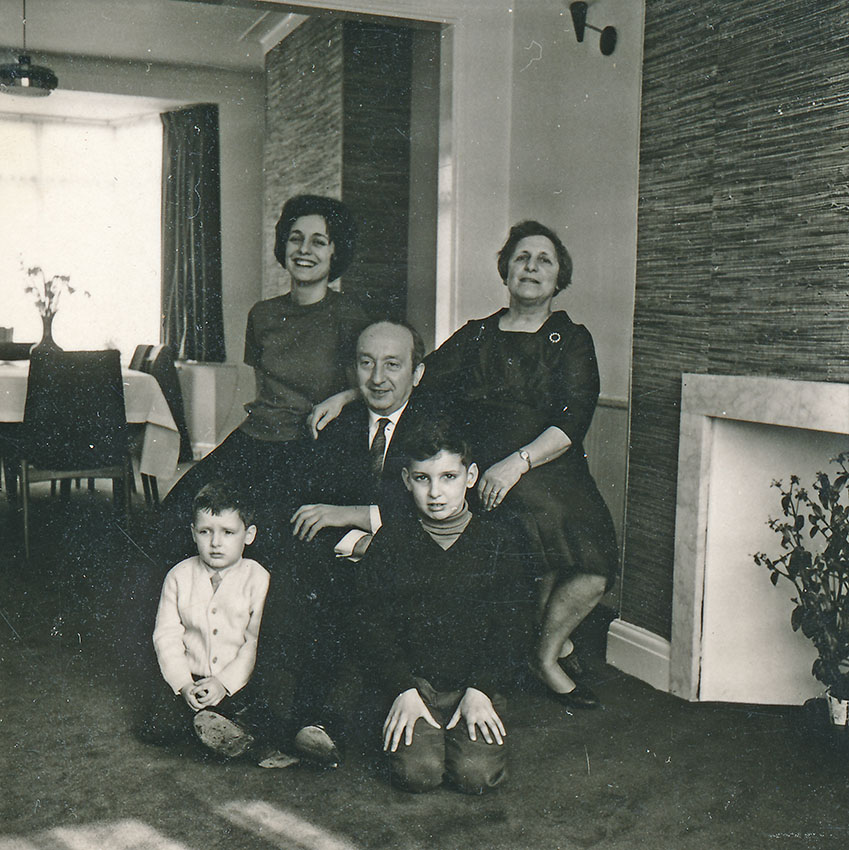
Apart from a bout of glandular fever when I was six, my childhood was exceptionally happy. Although my father had departed the scene when I was a babe-in-arms, my little family was a more than adequate compensation for his absence. Here we have Hannah and her parents, Becky and Harry, me and my brother Michael (my uncle Sidney took the picture), in my first home…
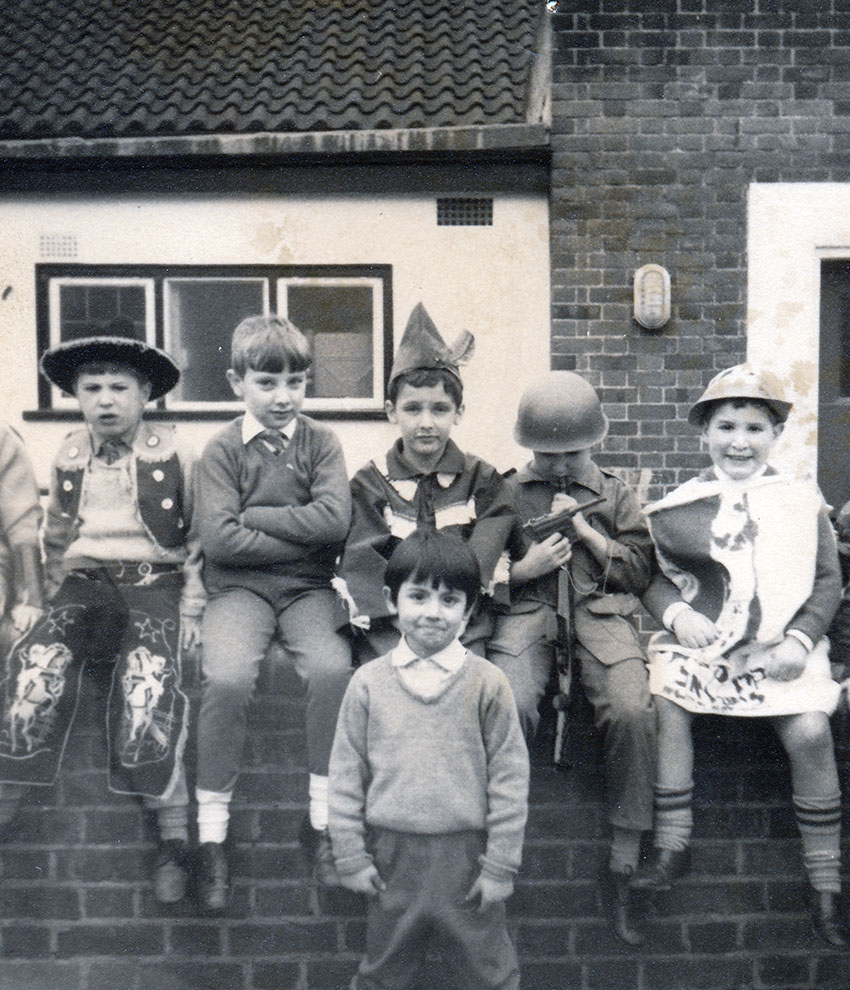
Purim at my primary school. I’m a rather lame-looking Robin Hood sat between cowboys and GI’s…
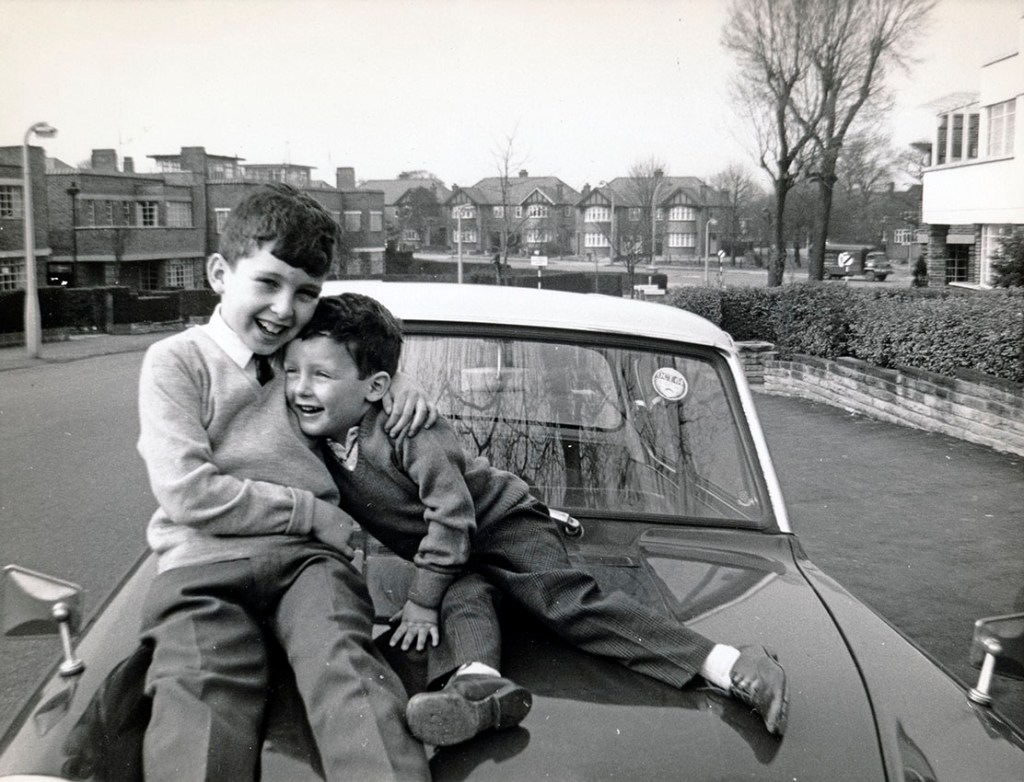
Between the War and my birth, my mum’s family lived in Hendon. Many of our closest family friends remained there, and this is Michael and I during a visit to one of them. We’re sitting on the bonnet of mum’s first Ford Anglia – eat your heart out, Harry Potter!
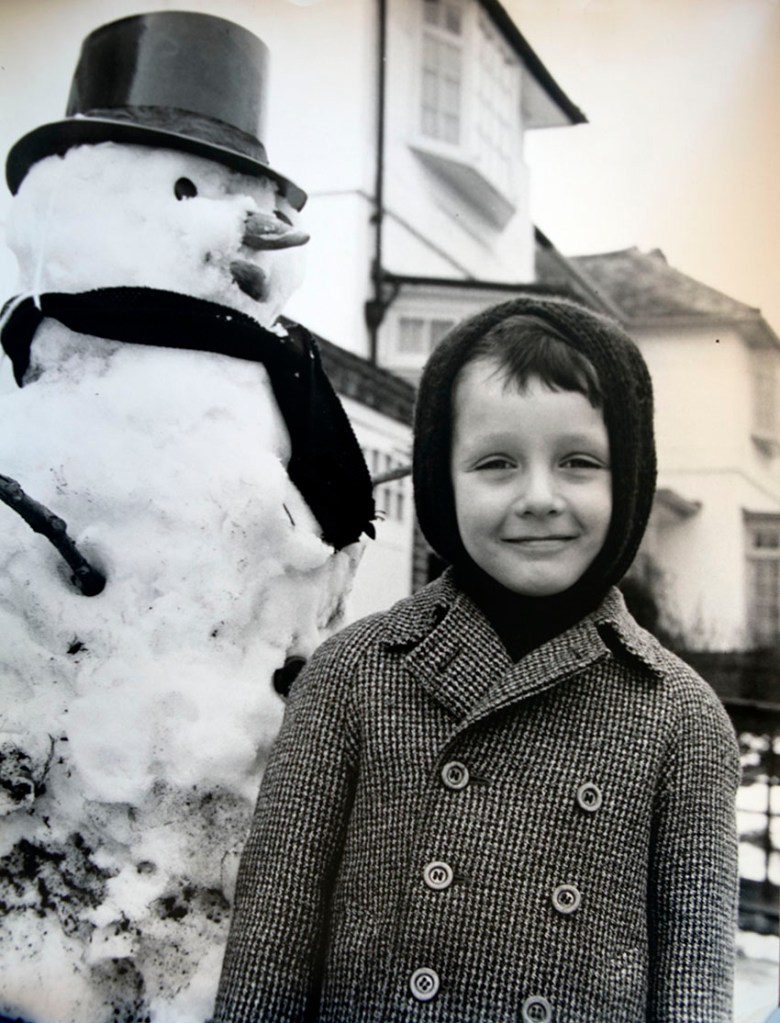
We took our snowmen very seriously back then…
Our second house in Edgware had a large back garden and by “London-clay” standards, half-decent soil. Sidney and I were both keen gardeners, something I remain to this day…
My studio space at Saint Martin’s, with friends and fellow students. The guy on the far left is my lifelong friend Simon – not an artist, just visiting. Next to him, looking at the camera is Robert, a hugely gifted portraitist, and the girl is Piyawan, another very talented painter and cartoonist. Judging by the coats, this was at the end of the day and when we would typically be preparing for a visit to one of the many local Soho pubs…
My final act at St. Martin’s was to undertake this temporary mural commission (I describe the story here) in James Street, Covent Garden…
My grandparents were moderately observant Jews (outside the Haredi communities – and even they differ from one another – there are as many nuances and degrees of “observant” as there are Jews who observe), and the traditional Shabbat supper was always partaken of. Here I’m “making Kiddush” (the blessing over wine) on one such occasion. By this time we had left Edgware and moved to West Hampstead, also North London, but closer to the centre…
I lived at home (in West Hampstead) well into my late 20’s, and this was my painting studio, which we built at the end of the garden…
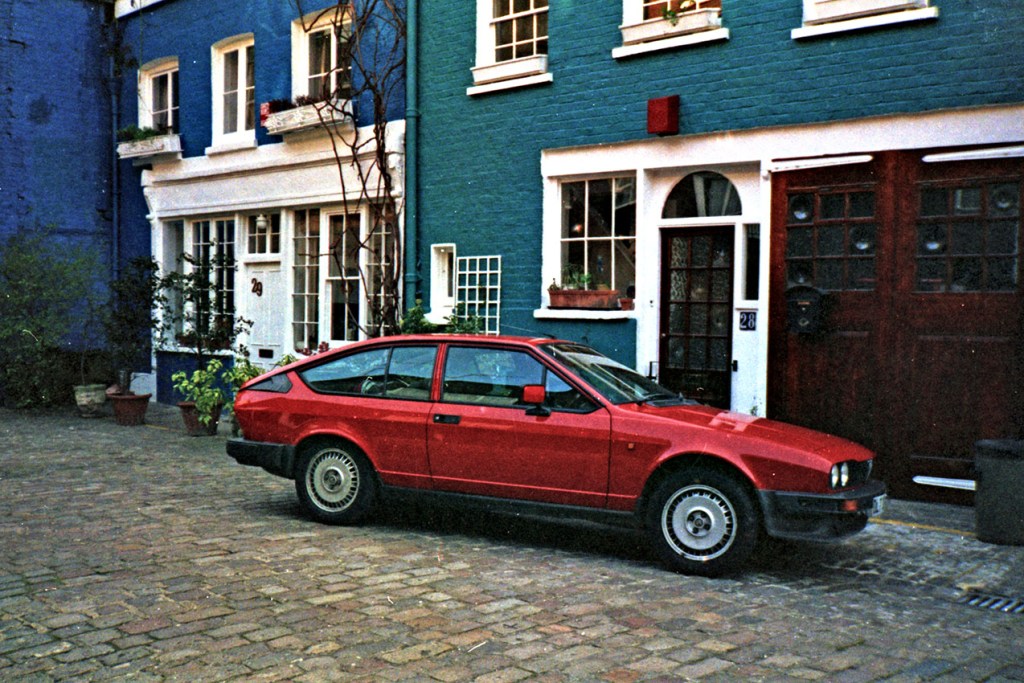
I met my future wife, Dido Nicholson, in 1988 and we married two years later. This was her cute little mews house in Lancaster Gate, close to Paddington Station and Hyde Park. She inherited the Alfa GTV from her uncle Leonard, who sadly died while playing real tennis at Lords (the “HQ” of world cricket)...
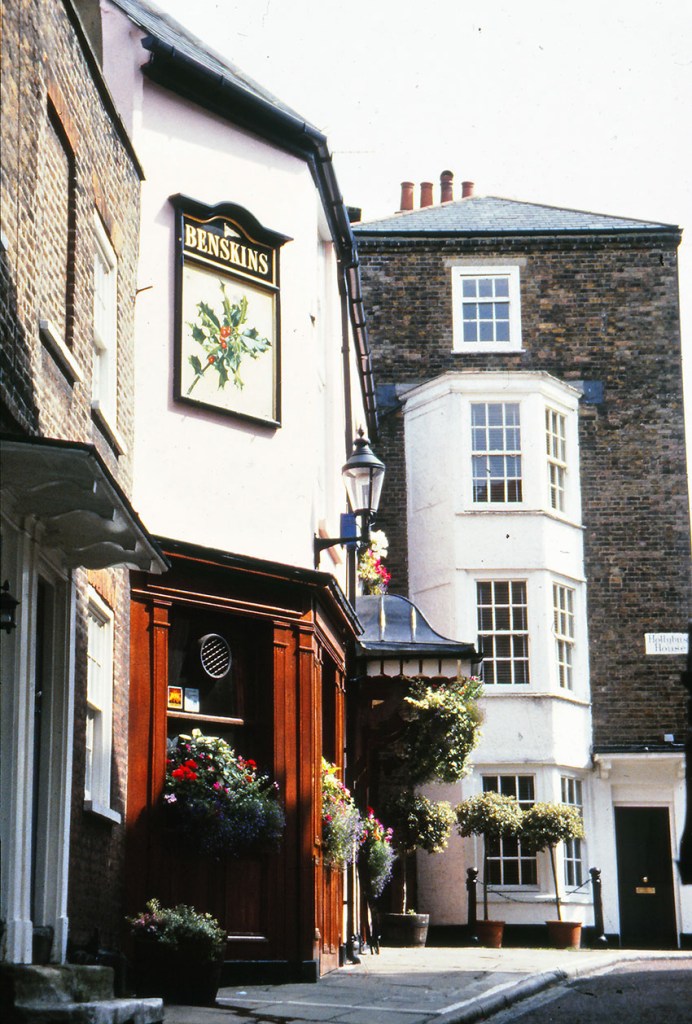
Like most Londoners, I was rarely happier than when visiting one of my local pubs, like the Holly Bush, here in Hampstead, which has turned out to be our final London Address…
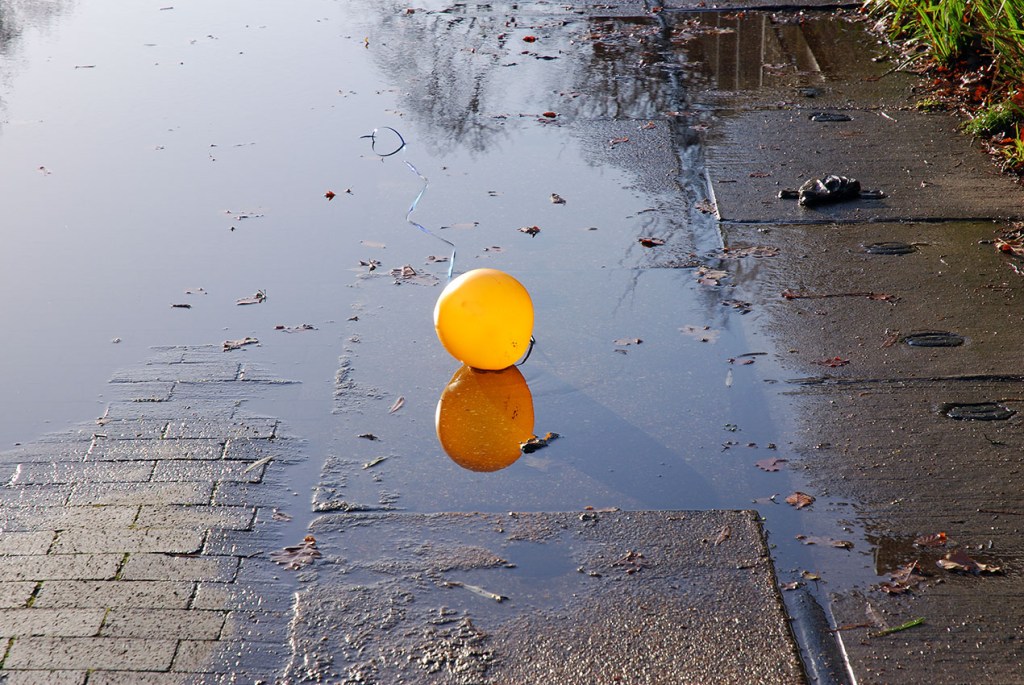
A melancholic New-Years-Day scene on the tow-path of the Regent’s Park, one of our favourite regular walks, and a fitting image to end this homage to a lost city.
The title picture is the top of Primrose Hill. It offers, arguably, the best view of London from north-west of the city. I always found the scene somehow reassuring, and no more so than one misty autumn morning in 2010, when my mother had just left for the airport on her way to Dignitas.
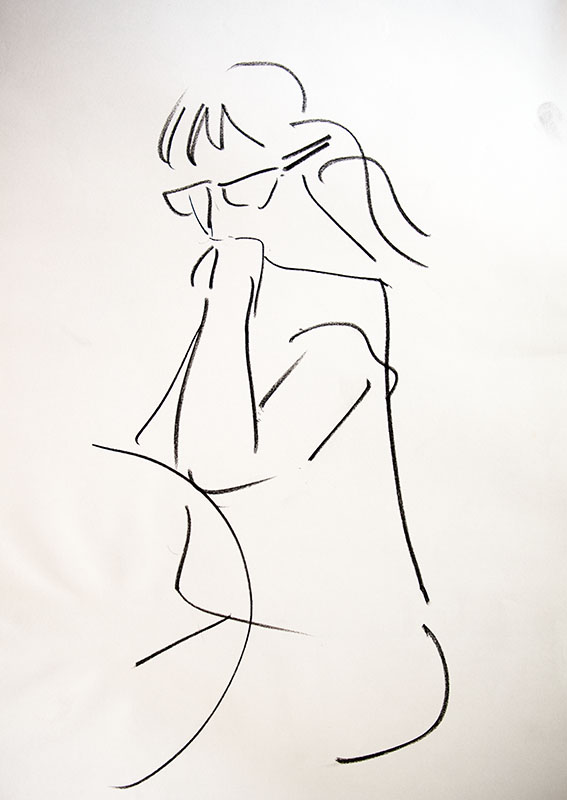
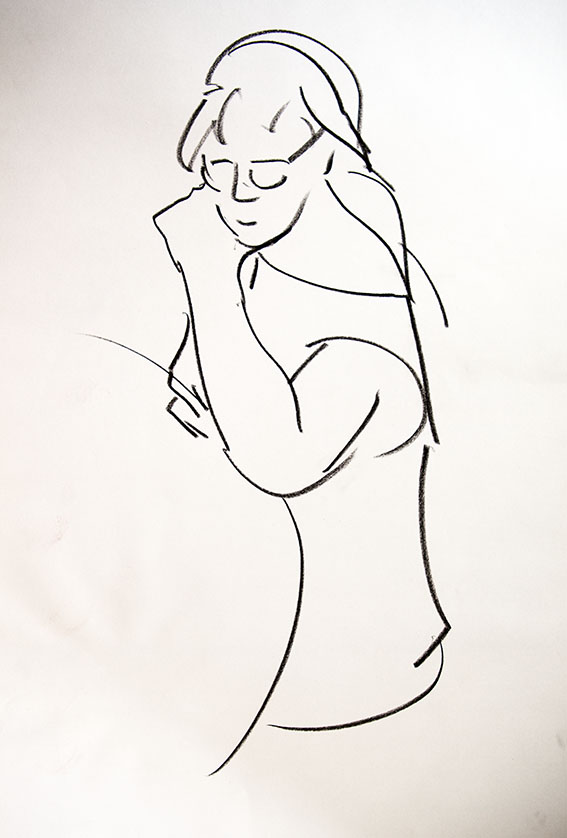
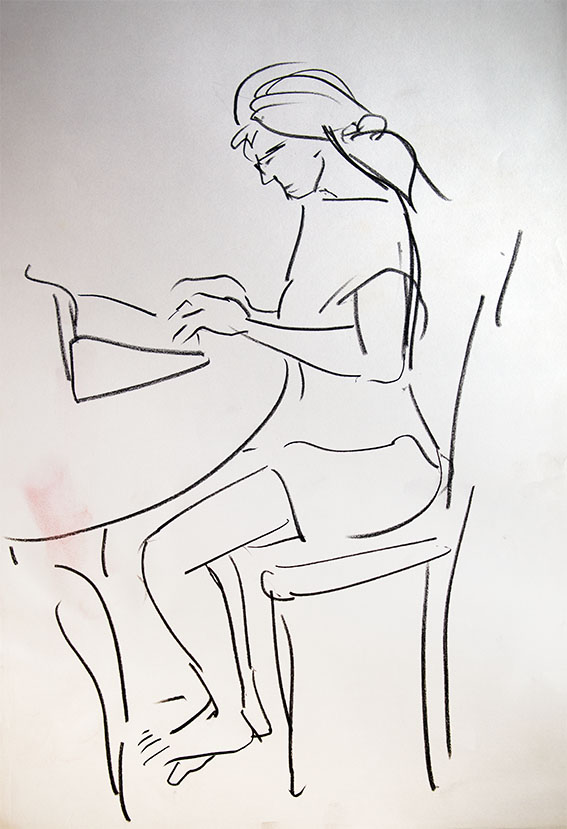
Yet more house tidying, yet more exciting discoveries of my ancient artwork. This time, of long-lost simple line figure studies, of my then-young wife Dido and of her friend and former ballet colleague, Frin.
Both, were natural and highly sketchable models as the images here attest, plus, I seem to have been in unusually relaxed with the old charcoal stick and conte crayon. My muses’ unaffected air and my good drawing form was a happy combination which I now look back upon, some 30 years later, with a deal of pride and not a little amazement.
Sadly, modernism and later, abstract expressionism (admittedly with a few glorious exceptions – from Modigliani to Rothko), inadvertently gave free license for non-drawers to thrive, resulting in the often talentless gimmickry that infests so much of today’s “art world”.
Ho hum…
Fortunately, my utter disillusionment expressed above, came after I had time to make my own joyous-if-modest contribution to the corpus of half-decent picture-making, as these humble sketches bear evidence…
This must have happened to most people reading this post. You mislay a possession somewhere in your home, and while turning out various drawers, cupboards and shelves searching for it, you discover something else, long-forgotten, and often more precious than the original object.
Last week I was rummaging through a wooden chest we use for storing bits and pieces, looking for a lost drawing when instead, I turned up a small bundle, packed with old photos of my wife Dido from her time as a ballerina and a model. My curiosity at finding dozens of images that I had never seen before was heightened, when among the pictures I also found a yellowed, newspaper article from the Saturday edition of the Glasgow Evening Times, featuring Dido and another Sadlers Wells dancer, Nick Millington.
Although the article was for a Glasgow newspaper, the shoot was done in London, before a Scottish tour. The reporter, Rosemary Long, writes an entertaining piece, but she gets a couple of things slightly wrong; Dido’s“huge – doe-like” eyes are blue-grey, not “brown”, and the other issues I deal with below.
However, while I of course enjoyed the article, and got the whole forthcoming Scottish tour – Scottish interest thing, there were several details, probably due to a desire to accentuate a direct Scots connection, the journalist got slightly wrong. And, as is often the case, the more complicated truth, is also much more interesting.
While Dido’s parents regarded themselves as proud Scots, they were both born continents and oceans distant from Saltcoats and Edinburgh respectively.
Ann’s very Scottish father (who was from Saltcoats) was a high ranking doctor in the British Army of India, where she was born in Murree (now Kashmiri Pakistan). Following the war, Ann was educated at the famous Quaker private school, The Mount in York where she met Judy Dench, a fellow pupil. So, while some of Ann’s family did indeed hail from Saltcoats (others also hailed from Pitlochry), she herself, was not a native.
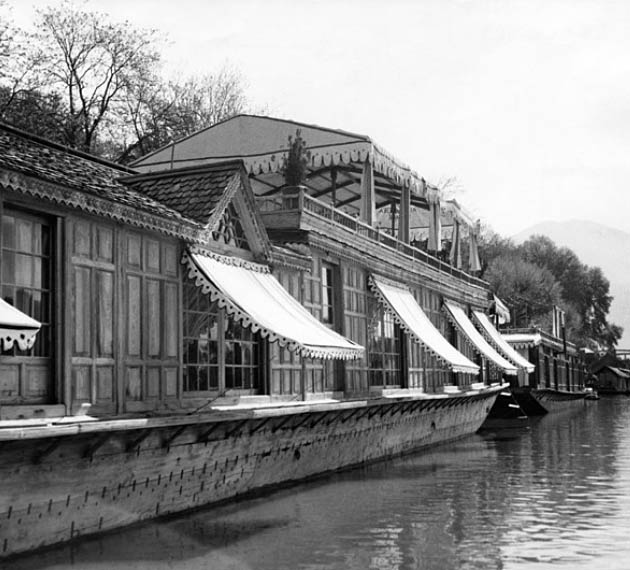
Ann’s family lived on a houseboat during her childhood in Murree, probably similar to this, from the 1930’s
Dido’s father, David, was born in Long Island (New York) during the journey to the UK from Chile where the family had interests in copper mines. He was later educated in Scotland where he attended Loretto School outside Edinburgh (Scotland’s oldest boarding school)) before leaving Scotland for London, where he studied medicine at Guy’s (teaching) Hospital (NOT “Edinburgh University”). David eventually became a general practitioner, later specialising in pulmonary medicine.
David’s family moved from Chile to the slightly less exotic west London suburb of Northolt, where he spent his childhood.
David met Ann in London where she was an opera student at LAMDA (London school of Music and Dramatic Art) and working as an usherette at Covent Garden. Soon after they married, they immigrated to Canada in the early 1960’s, and then on to Dallas (Texas). Together with their two children, Dido and her older brother Niall, they then moved around the United States according to David’s latest medical posting, including spells in Kentucky and Ohio before finally settling in Little Rock (Arkansas). There, David worked at the UAMS (University of Arkansas Medical School) and the VA (Veterans’) Hospital as professor of pulmonary medicine until his retirement, while Ann became something of an Arkansas celebrity, broadcasting a weekly culture “magazine” show (“Arts Scene“) for the state university radio station (KLRE-KUAR). In all that time, they never took up US citizenship – preferring the status of resident aliens, and “proud Scots”.
Thus, as I said, while Saltcoats and Edinburgh did feature in Dido’s immediate ancestry, it wasn’t in quite the way the journalist reported it. As for her “attractive Stateside drawl…”, these days it’s still attractive, but more mid-Atlantic.
Regular and long-term readers of this blog might remember a post I did a few years ago about my wife Dido’s part-time career as a model, and in particular, her role as the National Savings girl. Her modeling work coincided with her then-main career as a classical ballerina – a subject I have also covered at some length on these pages.
However, there are a couple of interesting and amusing facts and anecdotes related to Dido’s modeling which I omitted to mention previously.
This shot was used for the National Savings calander
Firstly; the fact that she fell into modeling accidently, when spotted and then approached on a street in Barons Court (in west London – near the Royal ballet School) by an advertising agency scout. And secondly; the resulting story behind perhaps Dido’s most high-profile photographic shoots, also for National Savings, in thenaturist colony of Cap D’Adge in the South of France.
In truth, the story of Dido’s time in the colony is as much farcical as amusing , stemming from the fact that her employers at Dorland (the agency then working for UK National Savings) were unaware of the fact that they had sent her to a nudist village for the shoot.
We believe this was the picture used for the “People Like Me” series of National Savings posters and ads…
Dido’s blissful ignorance of her impending sartorial dilemma was soon disabused when she entered the establishment by several welcoming scenes, none more surprising than being greeted by the photographer himself “déshabillé”.
One might have thought that the fact the photographer was none other than David Hamilton*, famous then for his soft-focus depictions of young, often naked girls, and for directing and photographing the hit film, Bilitis (erotic or softly-pornographic, depending upon one’s sensibilities) just a year or two earlier, might have raised some alarm bells, but apparently not.
As a confirmed non-naturist, Dido got around the compulsory nudity policy of the colony by convincing both Hamilton and the management that it was imperative for her to remain fully clothed at all times to avert the risk of tan lines on her skin.
When the Dorland team turned up for the main shoot the next day, they were similarly discomforted as their model (an angry Dido having decided not to warn them), a circumstance that led to a whole load of hilarious situations during the course of their stay – tan lines not being an available excuse for the director and his crew!
This was not from the official shoot, and just a bit of fun, and interesting, among other things for it being a very rare – if not unique – example of Hamilton not using soft focus.
Sadly, I’m not at liberty to divulge more than these barest details (pun intended), but one can imagine the sort of crazy scenarios that arose. Fortunately, despite everything, the shoot was a sucess as the very pretty photos presented here confirm.
*Hamilton’s now infamous reputation was unknown to everyone at Dorland at the time of the shoot, and he behaved with total decorum and professionalism toward Dido, both when dressed and disrobed.












 ARKS, ADAM AND AXARQUIA