THE MYSTERIOUS CASE OF THE TWO PIZANS – And more synchronicity?*

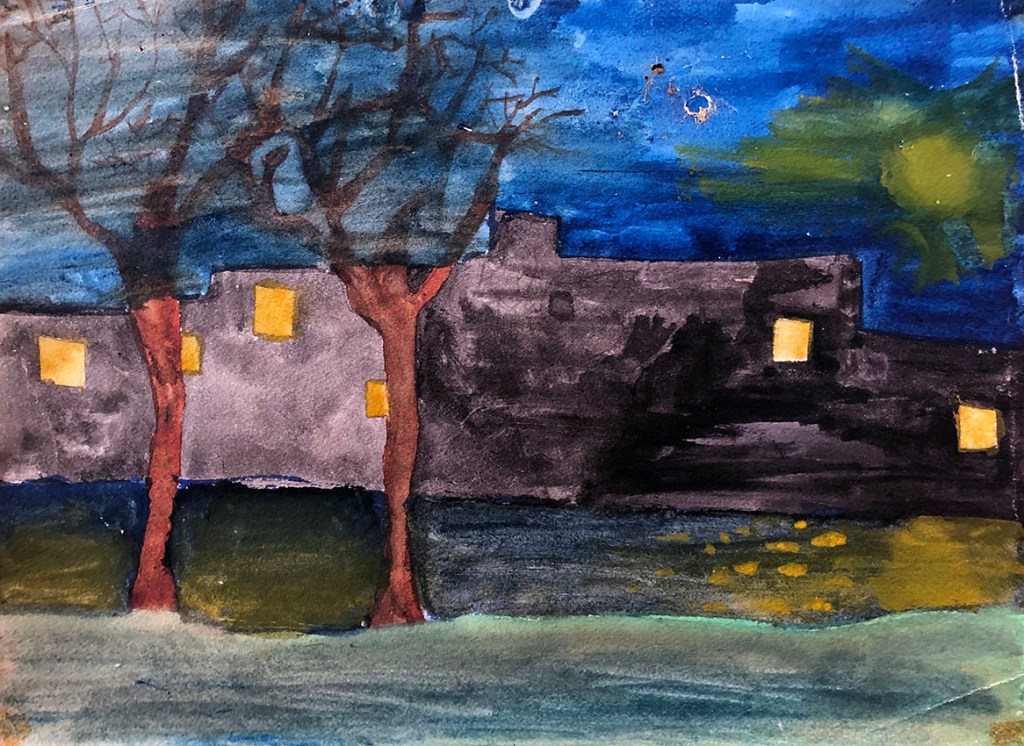
Hannah and Harry – 1980 – tempera

Carl Jung famously referred to occurrences of synchronicity as “meaningful coincidences that cannot be explained by cause and effect.” He thought that there was something more profound going on than sheer coincidence, something to do with a “deeper order of the universe…”

While I can see the attractiveness of this line of reasoning I find it hard to agree with the great man. For one thing, he does not seem to consider the far larger number of non-coincidences that occur every day to everyone on the planet. The countless times that coincidences are not happening is in some ways even more remarkable than the few times they do occur, given the billions of lives being lived at any one time. Indeed, one could counter Jung’s hypothesis by stating that the very scarcity of synchronistic events is proof that they are simple – albeit often remarkable – happenstance.

In my own life, I have experienced three remarkable, apparently synchronistic episodes. The first, I recounted in an earlier post (here), and was merely charming. The second, which I describe below, was moving, and the third, to which I will devote a future post, was both powerful and disturbing.

The only common denominator in all three events was the fact that they all involved my wife Dido, and all happened within a two-year timeframe – more or less. The first; from slightly before I met her, the second; just after we met, and the third; about the time we were engaged to be married. No doubt Jung would have something to say about that too, but for boring old me, it was just another coincidence.

Anyhow, this is the second “happening” and please judge for yourselves whether or not something “deeper” was going on: It was early in 1989, and Dido and I had been dating a few weeks. She was then an occupational therapy student working on her first clinical placement at Northwick Park Hospital in Harrow (North West London). During her placement, most evenings, she would stop by my family home in West Hampstead for some supper, and sometimes to stay over.

Just to paint the scene – our home was inhabited by my mother Hannah, my recently-widowered grandfather Harry Pizan, and me. After supper, we would typically settle down in the sitting room to either watch some TV or play something like a game of Scrabble. I think it was on the very first day of Dido’s Northwick Park placement, when, in this relaxing setting, she said, looking at my grandfather, ‘I was allocated my first patient today – an elderly gentleman with cancer of the spine – and strangely, he has the same surname as you! Pizan. Didn’t you tell me that your family were the only Pizans* in England?’

To which my grandfather replied, “Yes, we are.” he then asked Dido, “Is this man called Rube?”

“Yes, Rubin Pizan!” Dido exclaimed.

“He’s my brother! You patient is Rube, my younger brother…”

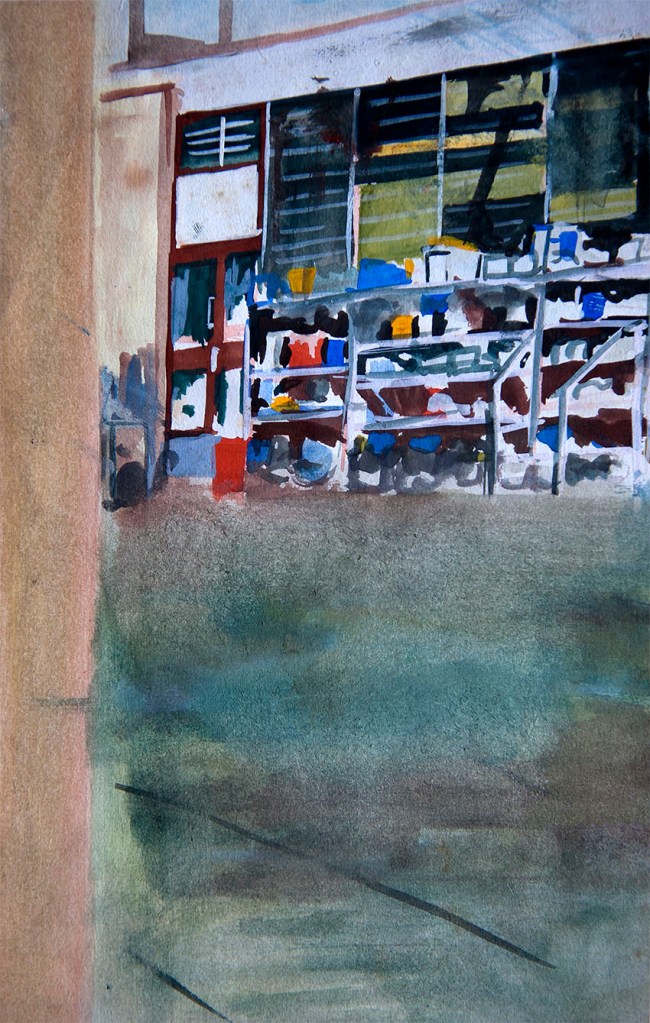
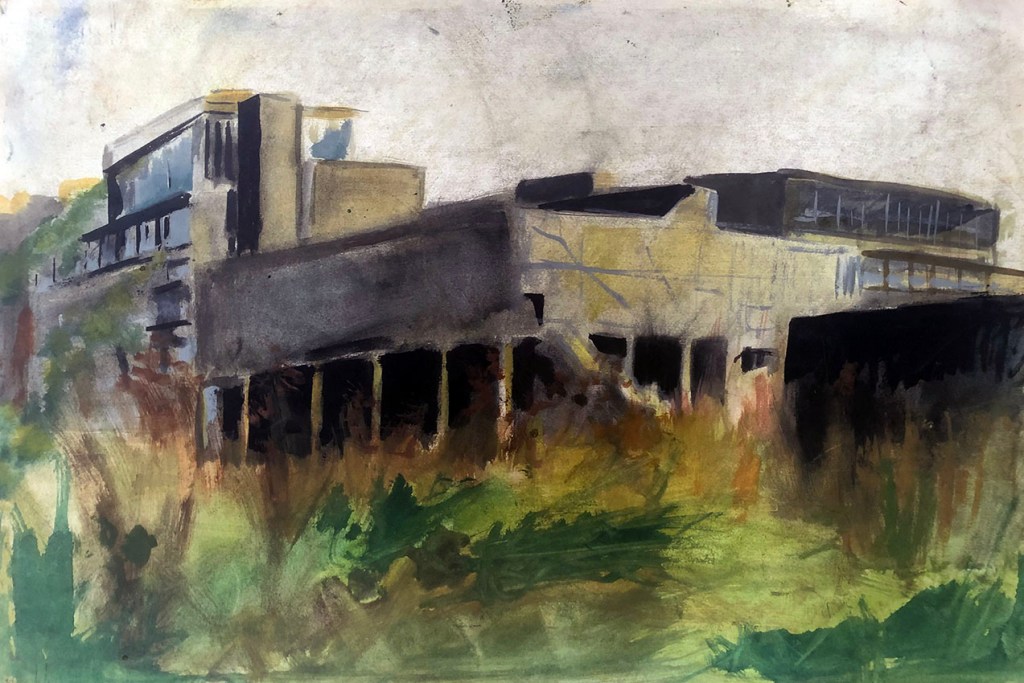
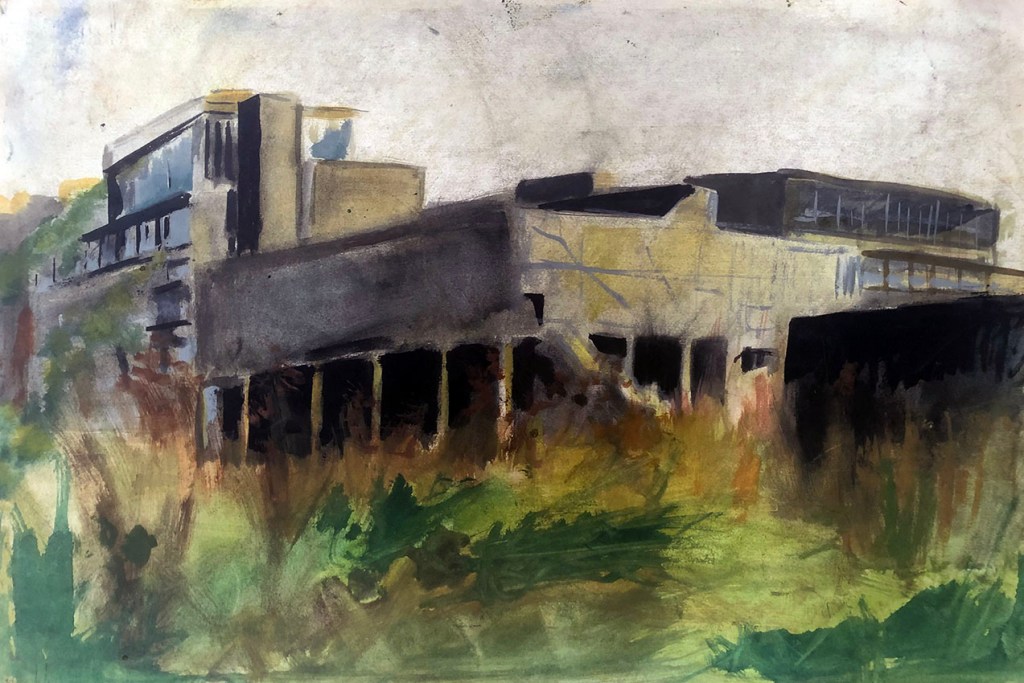
Northwick Park Hospital – west wing building – watercolour – 1976

(“Pizan” was a name allocated to my great grandfather – Harry’s father – and his then-small family, when they landed at Irongate Wharf, London, in 1903, by an immigration officer who must have thought it approximated to whatever name my Polish and Yiddish-speaking “great zaida” had actually said. My cousin Bernard informs me that the name was originally PISEM and was changed to Pizan by deed poll by the family members. We (the surviving family) are not quite clear why the change was made – whether Pisem was a misreading by an immigration official, and the name really was originally Pizan, or something else perhaps? At any rate the name was changed, and thank goodness it was! “Pisem just doesn’t do it for me! This sort of muddle was a common occurrence, wherever Jewish emigres landed up, from London to New York City.)

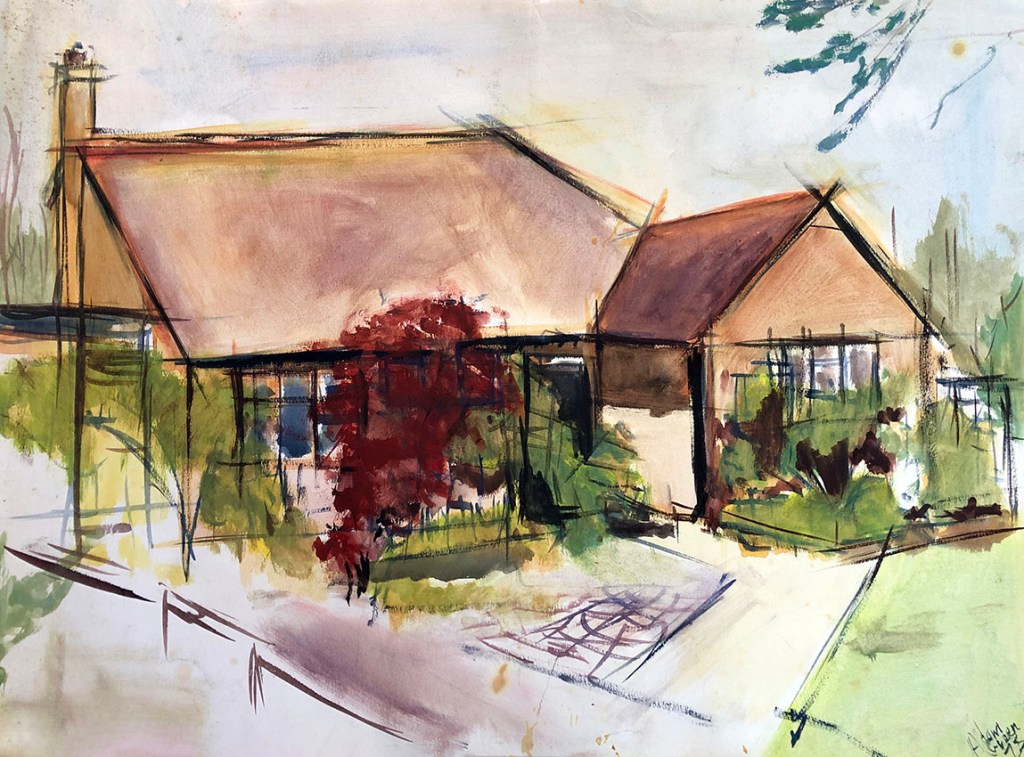
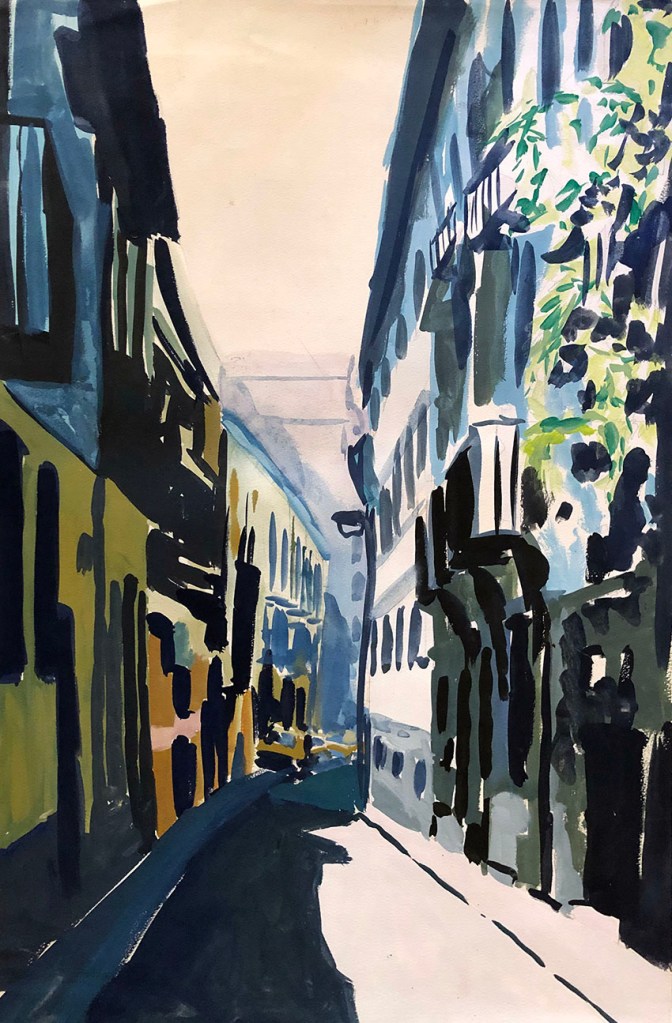
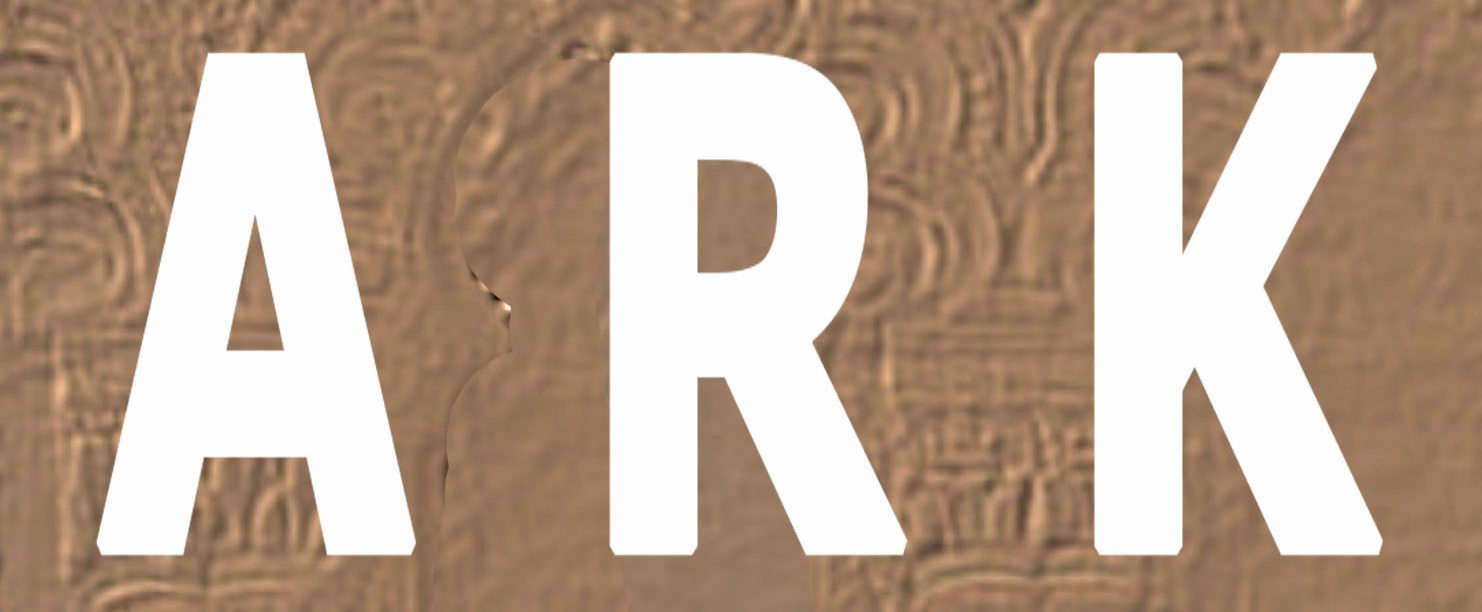
*The title illustration and the picture above are watercolours I made of Northwick Park Hospital when I was studying art next door, at Harrow School of Art.
A CONSTRUCTIVE TRANSITION

MY JOURNEY FROM HARROW SCHOOL OF ART TO ST. MARTINS IN GOUACHE

I’m not sure what the art education system is these days as I have totally lost touch (and interest) with the British art world and all its academies, institutions and philosophies. However, in my time, after leaving high-school for art college, one did a one or two-year foundation course, and then typically went on to do a BA.

Northwick Park Hospital (Harrow) – gouache on paper – 1976

My era at art school ran from 1976 – 1981 and was something of a grand experiment, as it more-or-less coincided with the formalisation of art as an “academic” subject. Whether or not there was any merit in this move is still debated today, but from my own experience, and that of many of my art school acquaintances, the BA’s we left school with were utterly useless for furthering our careers as artists (or anything else). Ultimately, our degrees were little more than educational bling.

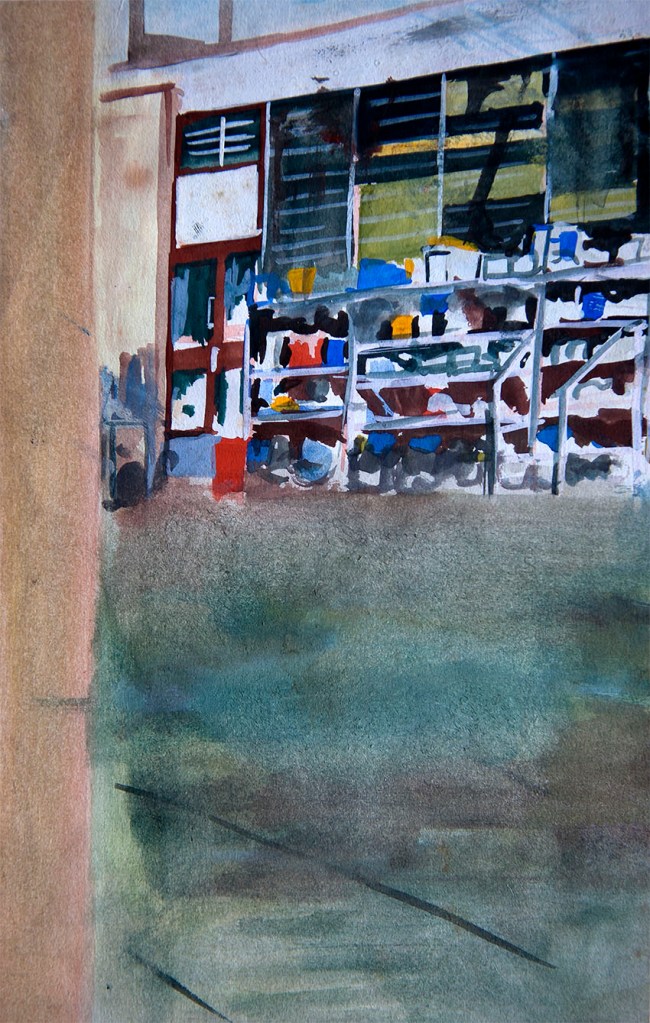
The Pottery Courtyard (Harrow School of Art) – gouache on paper – 1976

All these years later I console myself with the fact that both Harrow and St. Martins, in their very different ways offered many valuable (if often somewhat turgid) life experiences, and that the fairly successful artist I went on to become was as much in spite of those experiences, as because of them.

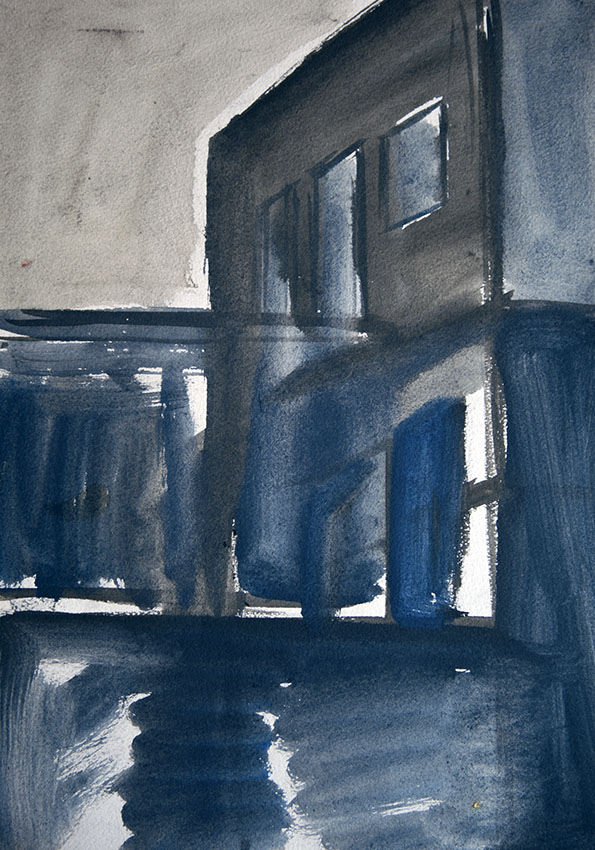
Northwick Park Hospital on a Winter’s Eve – gouache on paper – 1976

The half-dozen gouache washes here cover the end of my time at Harrow and my early days in Soho, with a visit to Spain in-between. They reveal my dabbling with a gentle form of constructivism, which was in reality a mostly contextual necessity, given the locations of my subject material. In any event, as with most of my work, in all its forms, they are ultimately all about the light – light that can lend drama and even a little beauty to most brutalist of concrete structures. There’s a deep message in there somewhere, but that’s another story…

A Street in Seville – gouache on paper – 1976

DRAW THE LINE…

and how less can be much more

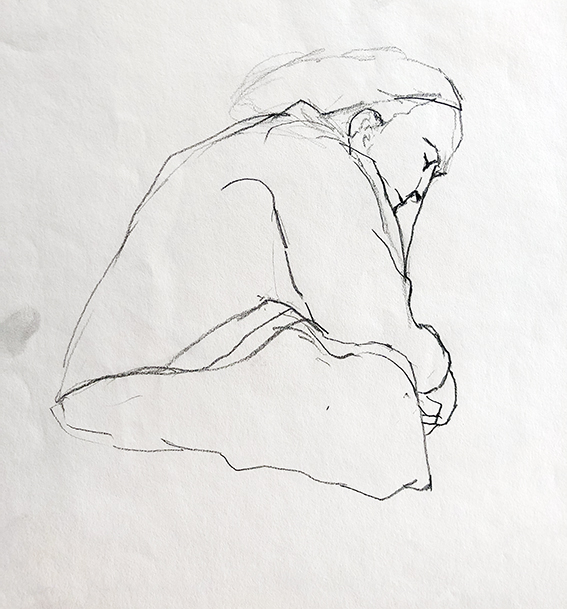
Lady Dozing (Rhodes old Town) – 1983 – pencil on paper

For reasons far too mundane to go into here, the next couple of months are going to be among the busiest and most frenetic for quite a while, and hence I will have far less time than usual to devote to these posts – at least in written form. Thus, for most, if not all of the next half-dozen or so offerings, I will revert to primarily presenting series of images, hopefully, linked by some kind of theme.

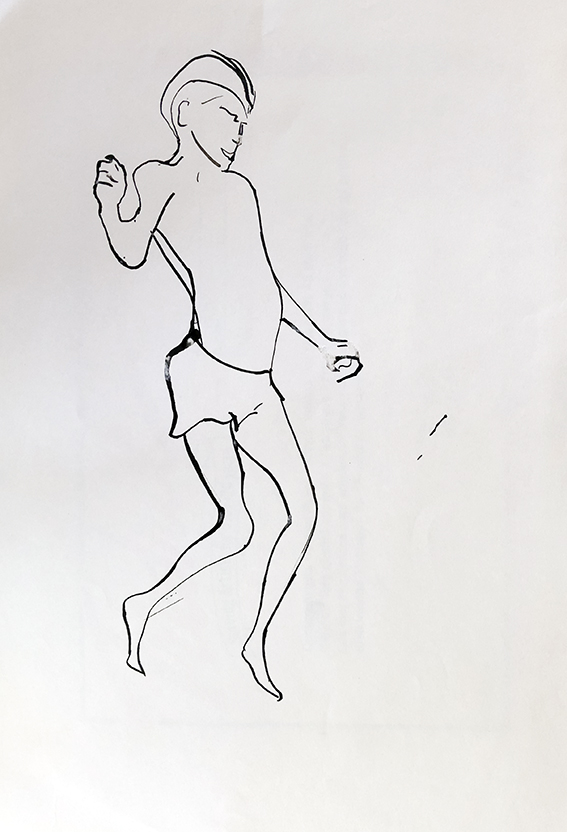
Boy Jumping off Diving Board – 1978 – pen on paper

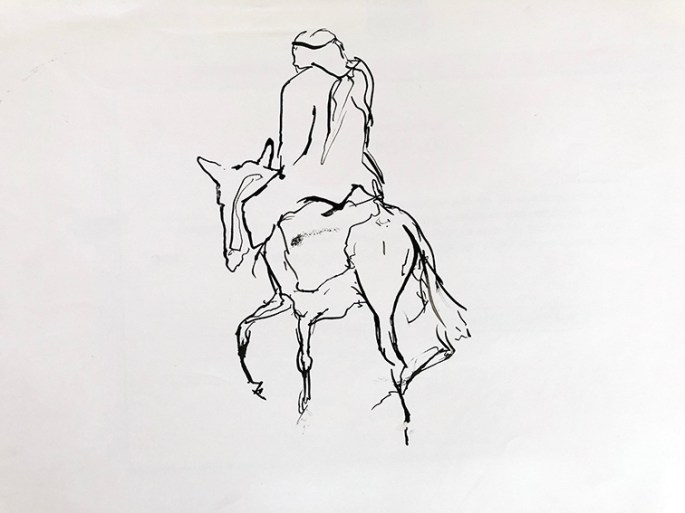
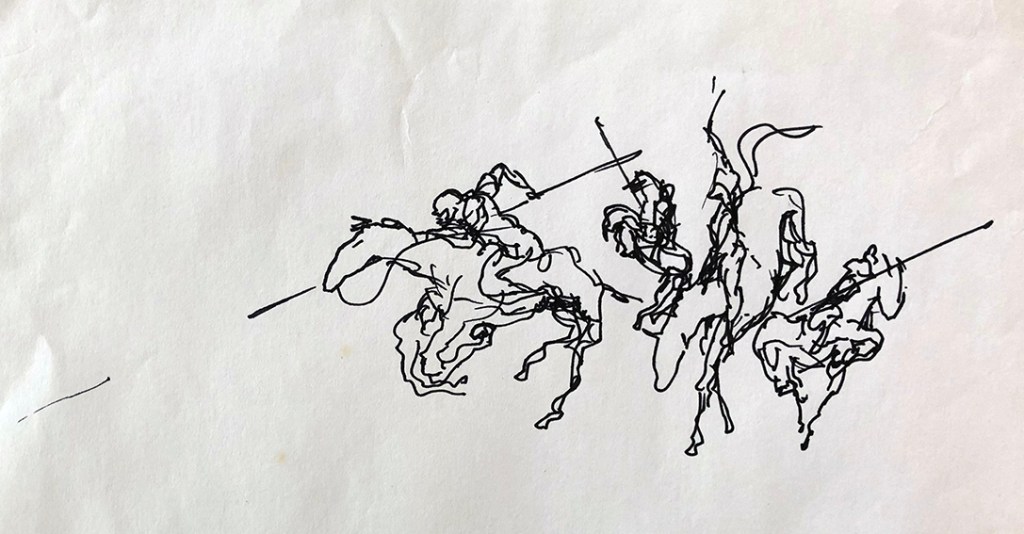
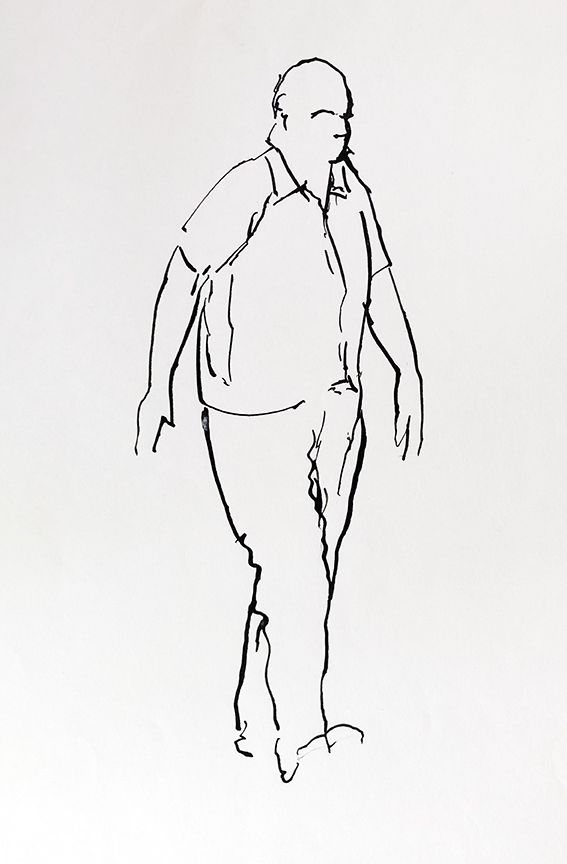
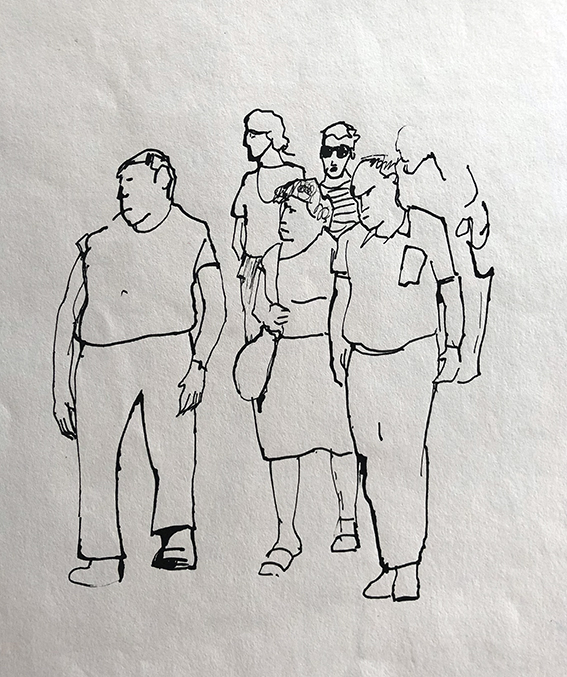
In keeping with this temporary minimalist expedience, I present here a series of my old line drawings, ranging roughly across a couple of decades, from about 1976 to the mid 90’s.

Macedonian Hipparchy at Issus (after Dali) – 1980 – pen on paper

A tutor at Harrow School of Art once told me that “the line is the foundation stone of picture making…master the line and everything else will follow. She added that “artists who fail in this are like musicians attempting to compose tunes without being able to read music…”.

Resting Girl – 1978 – pen on paper

It was a simple message, and all the more powerful for that, and one which stuck with me ever since – its truthfulness being self-evident. Then, when I taught for a while myself, I would begin every class with at least an hour of line drawing exercises, to the point where it drove some of my students to distraction. However, they would invariably tell me when we met up years later, how much they now appreciated, ironically, the freedom and confidence this grounding had given them to develop their artistic styles, however figurative or abstract.

Dido at Work – 1993 – pen on paper

But, apart from anything else, and continuing the musical analogy, the simple line drawing, when done well, offers so much in and of itself in a way similar to how a piano sonata, or a string quartet, may express a deep intimacy and subtle power, lacking in a massive orchestral work. And, hopefully, the selection of doodles here give some idea of what I’m talking about – all very much “quiet, solo instrumental pieces”…

Luis – 1992 – pen on paper
Walking Man – 1978 – pen on paper
Dido Writing – 1993 – pen on paper
Harry Bending a Rod – 1979 – pen on paper
Promenading at Colmar – 1985 – pen on paper
On the Via Dolorosa – 1978 – pen on paper