 As an amateur student of history, one of the phenomena I’ve noticed is how human nonconformities sometimes transform into mass consensus. It is perhaps one of the great historical ironies that people and ideas which start out on the margins of society, once adopted by society, have a tendency to marginalise the people of the existing consensus who previously marginalised them. This is a pattern common to all fields of putative human coexistence, which more often than not results in the followers of the usurped consensus being persecuted by the holders of the new. These persecutions are usually most obvious and brutal in the areas of religion and politics but they happen with equal intellectual ferocity at a cultural level.
In the 1960’s and 70’s Saint Martin’s School of Art was one of the world’s high temples of the-then recently adopted art consensus of Abstract Expressionism.
Abstract Expressionism developed out of the near-century old grand consensus of Modernism, in a similar way to how a reformed religion develops out of an existing ancient religion, with similar intellectual tensions and conflicts resulting – albeit without the physical violence.
Thus, when in 1978, a callow 18-year-old “classical” modernist, realist painter misguidedly found himself stuck for three years in the beating heart of western European Abstract Expressionism, his creative life was always going to be something of a struggle.
That young aspiring artist was me, and my time at Saint Martin’s School of Art was in fact, one long battle of wills between me and a group of teachers who almost* to a man and a woman regarded me as a hopeless heretic from the start. My overall experience of being “taught” comprised a mixture of verbal bullying – in an attempt to bend me to their will – and / or complete indifference to my work when these efforts eventually failed.
But one day in the Spring of 1981 during my final term at the school all that changed, when I was paid a rare visit to my studio by my 3rd-year head tutor John Edwards, who came bearing a surprising request.
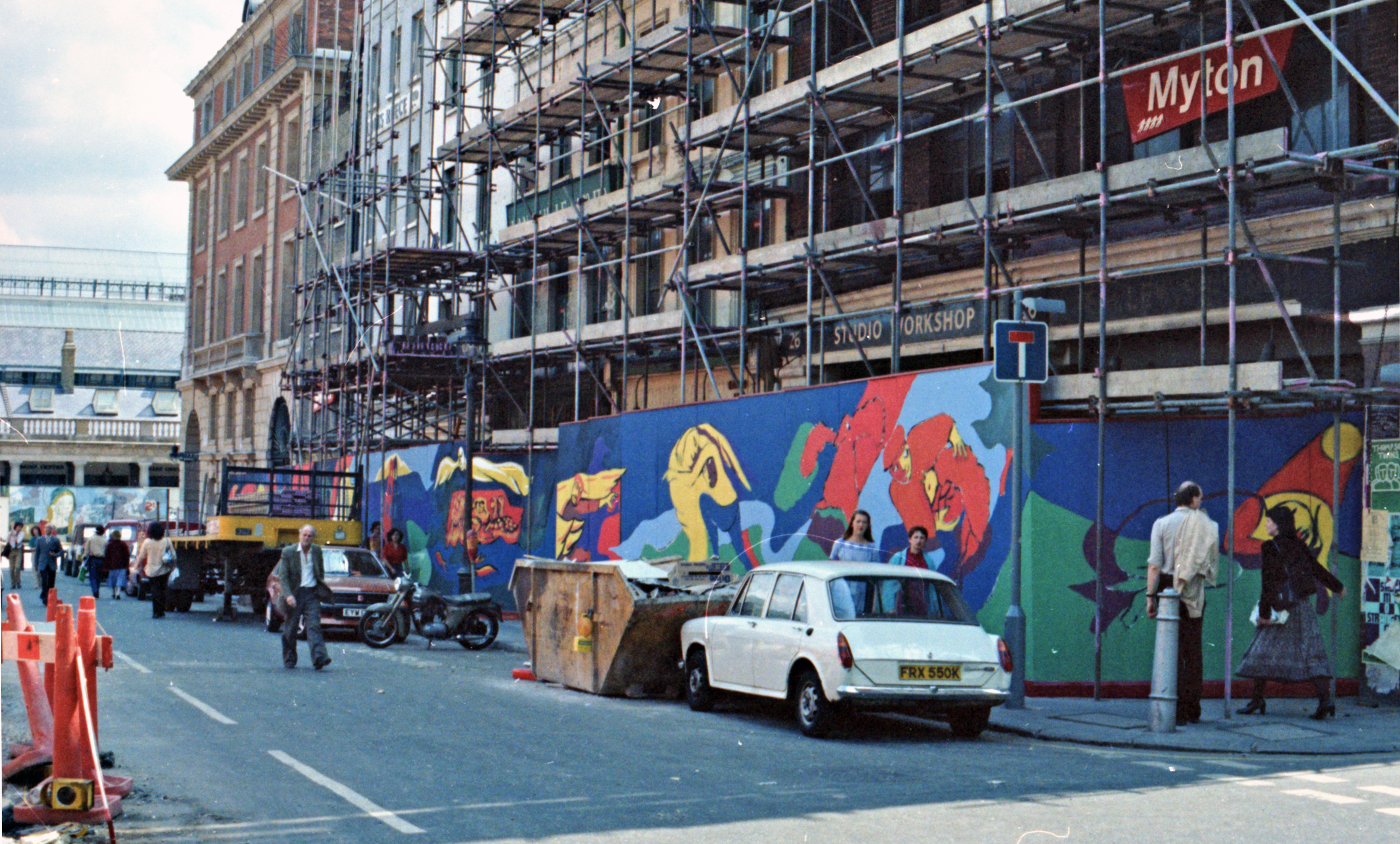
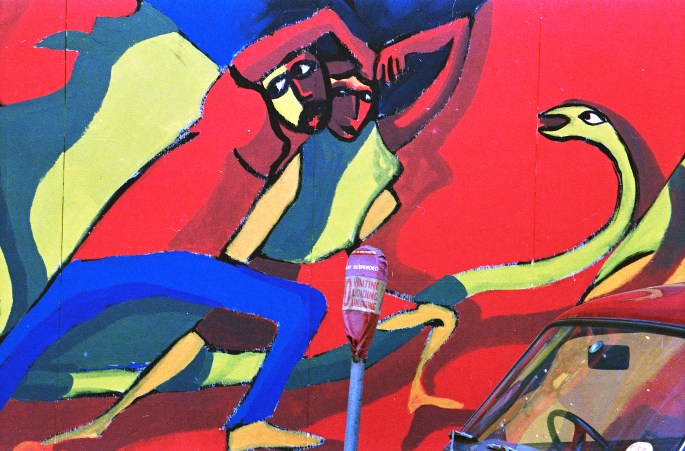
The Greater London Council (now defunct) together with the construction company, Myton Taylor Woodrow were looking for a student artist to paint a temporary street mural to jolly up a large hoarding in James Street, Covent Garden during the area’s major refurbishment. They wanted a student because they only had £100 on offer for the commission, and they wanted that student to be from the local art college, which was Saint Martin’s. However, they also wanted the mural to be figurative, and that was where I came in.
Edwards was typically candid with me, and admitted that when first approached by the GLC he had suggested one or other of his star students in Abstract Expressionism, but when they insisted on a figurative artist, the only person he could think of was me. While there were a couple of other representational heretics in our year, Edwards told me that he thought I was the only one with sufficient mastery of grand scale painting to handle such a large mural.
With just a £100 to spend and two weeks to execute the project, I was tempted to refuse what was a virtually impossible commission. But the certain public exposure of painting a mural in a bustling London street adjacent to Covent Garden Opera House was an opportunity too good to turn down; so much to John Edward’s and the school’s relief I accepted.
With half the £100, I employed two of my fellow student “Modernist heretics”† to help me with the huge physical task of covering so much white hoarding in paint. This left me all of £50 with which to purchase the paint itself, the brushes and rollers and plastic paint-mixing buckets. The only paint I could afford in sufficient quantity to finish the job was the cheapest industrial emulsion, and because of the time constraint, it had to be quick-drying “matt”. In other words, this was hardly going to be a Michelangelo or a de Rivera so far as colour intensity was concerned.
In the end, the subject matter of the painting was as much determined by these extreme material and time limitations, as it was by the unusually wide configuration of the street “canvas”. And so I came up with the idea of all the highlights of the Book of Genesis, with each chosen episode “bleeding” into the next. With only a few days to make a scale sketch and then just five days (London weather permitting) to execute the actual mural I decided to go with a kind of Chagall-meets-comic strip approach, allowing for quick, strongly drawn cartoon outlines coloured in with simple large blocks of colour.
As things turned out, the weather was unusually kind for May in London, and the three of us completed the mural with hours to spare.
All things considered, including the lifeless paint, it looked pretty good, and graced James Street for about the following two years. It received favourable reviews from the London and Jewish press and was probably my first claim to 15 minutes of fame. Perhaps more importantly though, it earned me the appreciation of my school and its tutors for the first time, and I’ll never forget John Edward’s response upon viewing it; “You know Adam, I’ve often wondered why we accepted you at Saint Martin’s, but seeing this, all I can say is that I’m bloody glad we did!” Even heretics have their uses I guess?
*David Hepher and the late Henry Mundy were glorious exceptions to this general dereliction of tutorship, and for that they both have my undying gratitude.
†Danny Gibson (now a brilliant printmaker) and Robert Lewenstein (the most gifted portraitist I ever knew).









 ARKS, ADAM AND AXARQUIA