You Chorelywood? I surely wouldn’t!

And my failsafe recipe for delicious bulka (and/or challah)…

Although I am not at all religious now I retain a fondness for the Ashkenazi/mid-east European food of my semi-observant north-London childhood. And fortunately, a non-kosher kitchen is no impediment to recreating some of my favourite Jewish foods and dishes. Growing up in 1960’s and 70’s suburban London, one of the advantages of a typical Jewish diet over that of my non-Jewish neighbours, was the quality of the bread we ate. While many of our non-Jewish neighbours were eating exclusively “Chorleywood” and other mass-produced batch-processed loaves, we had a more varied selection of far finer breads.

From Polish and Russian influenced light rye breads and bagels to the biblically derived (descendent of the sacred temple “shewbread”) twin challahs of the shabbat (sabbath) table, our excellent Jewish bakeries sold them all. Moreover, the fact that bakers like Grodzinski used brick ovens, well into the 1970’s meant that even their everyday white bloomers and wholemeal loaves were always perfectly baked.

Grodzinski in particular, produced superb challah in four forms; traditional plaited, round (in the form of a spiral plait) and tinned “bulka”. Their fourth offering, “egg challah” only differed in having more egg, and thus being a richer dough. The use of brick ovens ensured a well-baked, crusty loaf with a delicate dough, that aged rather that went stale. Sadly, from the late 70’s Grodzinski, in common with all their rival bakers moved over to modern steel ovens, and their challah, likewise, became the ubiquitous cottonwool most people eat today.

I don’t think it’s a coincidence that the emergence of the cottonwool variety coincided with a rise in the production of homemade challah as people yearned for a return to the genuine article that was no longer available at their local bakery.

These days, there are literally thousands of recipes available in print and on line for the “perfect challah” and I must have tried a hundred of them. But in the end, I always return to a very simple recipe a friend of my late mother’s (thank you very much Roberta, if you’re reading this), scribbled hurriedly on a piece of scrap paper about 40 years ago.

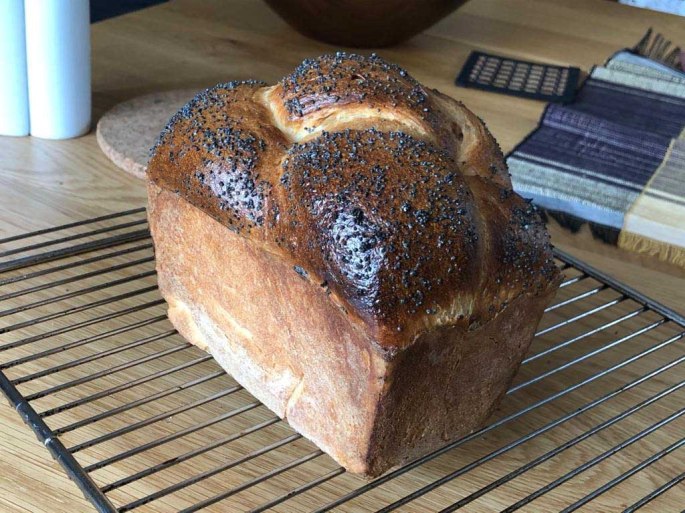
It couldn’t be easier or more reliable, and works equally well for all forms of the bread. Here, I’ve gone with a tinned challah – or bulka, as I knew it as a child. The advantage of bulka is that it slices easily (especially as it ages), and, after a day or two, makes superb toast. Good luck, and Shabbat shalom!

INGREDIENTS (for 1 loaf – double ingredients for 2 etc…):

  • 2 cups (about 500gm / 16oz) strong white bread flour, plus flour for dusting
  • 1½ packets of powdered (instant yeast – MUST BE FRESH)
  • 1 heaped tsp salt
  • 2 egg yolks and 1 egg white, lightly beaten
  • 1 egg white, lightly beaten and set aside
  • 2 tbsp corn, nut or rapeseed oil (NOT olive or sunflower)
  • 200ml (12½ fl oz) very warm water (so that you can just put your finger in)
  • 1 tbsp white sugar
  • several pinches of black poppy seeds

METHOD:

  • Chuck flour, yeast and salt into a large bowl and mix well
  • Make a deep crater in the middle of the flour with your fist
  • Pour beaten eggs, sugar, oil and water in crater
  • Using handle of a large wooden spoon (or similar) stir mixture until everything fully integrated, and mixture pulls away from side of bowl
  • Pull away dough stuck to spoon handle and start to knead mixture in bowl
  • Add flour if too moist and sticky
  • Tip dough onto a smooth, lightly floured surface
  • Knead dough – adding more flour as required – until smooth and elastic (anything from 3 to 10 minutes, though rarely more than 5)
  • Pour a teaspoon of oil into the mixing bowl and coat the bottom and sides
  • Place dough back in bowl, cover with a damp tea towel
  • Place bowl in a warm, still environment, like an airing cupboard, or near a radiator
  • After an hour or so the dough should have at least doubled in size
  • Grease a 2pint (1ltr) loaf tin with butter or oil and then dust thoroughly with flour
  • Tip dough back onto lightly floured surface and knock back two or three times (about 20 seconds)
  • Using a wooden dough slicer (a knife will do), cut dough into three equal pieces
  • Roll out each piece of dough into a strip, about a foot (30cm) long
  • Roughly plait the three dough strips (this really does not need to be perfect for a bulka)
  • Drop the plaited loaf into your prepared loaf tin.
  • Cover with the damp tea towel and place back in the warm, still environment to prove for about 40 minutes
  • After about 20 minutes set your oven at 250°c (480f).
  • Dough is ready when pushing up the tea towel above the level of the tin rim
  • Gently, brush all the exposed dough with the reserved egg white
  • Sprinkle generously with the poppy seeds
  • Place in the oven
  • After ten minutes, reduce oven to 190° (370f) and bake for about another 15 – 20 minutes
  • Remove loaf from oven and carefully tip out. If the base of the loaf sounds hollow when flicked with your finger it’s baked. If the base is a little too pale, gently put the loaf back in the tin upside down and bake for a further 5 minutes
  • Leave loaf to cool for about an hour. If not saving for shabbat supper or suchlike, slice off the end of the loaf, spread it with lashings of butter and a dollop of good quality jam or marmalade and enjoy the products of you labour!
A final few tips: For “loose” plaited or round challah, use a pizza stone, lightly dusted with corn flower (masa harina – NOT corn starch), for a crustier, better baked loaf. Stale challah makes the best bread pudding, and bread and butter pudding and delicious French toast. Very stale and finely crumbed (I use a coffee grinder), it makes a decadent coating for schnitzel!
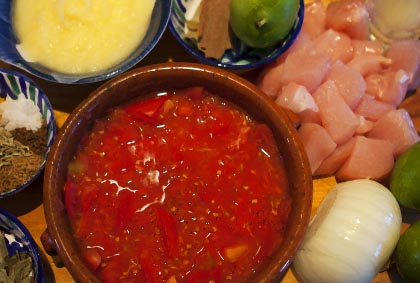
Ideal Beach Resort – LIME CHICKEN CURRY – recooked…

One morning, several years ago, I was pouring through my collection of Indian cookery books looking for something different to do with a chicken breast languishing in my fridge. As often happens on these occasions, after ten minutes or so of not finding quite what I was looking for,  I was about to revert to my trusty old Madhur Jaffrey butter chicken when a piece of paper being used as a bookmark caught my attention.  Frayed and food-stained, it turned out to contain a barely legible biro-scrawled recipe for a chicken curry. After further examination, I noted that it contained some unusual culinary bedfellows for an Indian chicken dish – things like  olive oil, ground caraway seed, lime juice, and most particularly, both bay and curry leaves. Then suddenly I remembered a swelteringly hot and sticky afternoon spent in a hotel kitchen in southern India in the autumn of 2003.

We were guests at the aptly named Ideal Beach Resort, in Mahabalipuram, on India’s Tamil coast, resting up for a few days before travelling inland to Coimbatore (where my wife Dido was to help in the establishment of a clinical education centre for children with autism).

I think it was on our first evening there, during supper, we got chatting with a very affable American couple at the next table who turned out to share our enthusiasm for the delicious local cuisine. At some point during the meal the four of us were invited by the maître d to visit the kitchen the following lunchtime to watch our food being prepared. Cathy – the lady of the American couple and a veteran of the Ideal Beach Hotel – chose the menu, including the lime chicken curry which turned out to be as delicious as it was unusual.

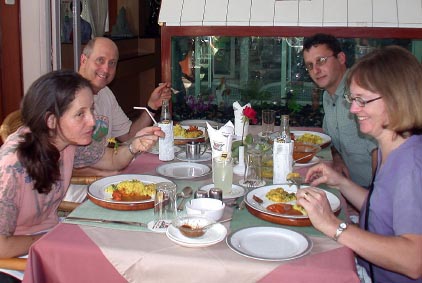
Cathy, Richard, Dido and yours truly enjoying our curry lunch

The rare blend of ingredients and spices was explained by the fact that our young head chef, although a Tamil, had been trained in Bengal and enjoyed fusing the two distinct culinary traditions.

Fortunately Dido had the presence of mind to record the preparation of the curry and – albeit thirteen years late – I was able to decipher the recipe and apply it to the chicken breast in my fridge.  And, it was absolutely delicious! The caraway, lime, bay and curry leaf are a group marriage made in heaven – a complex and unctuous harmony of savoury, fragrant bitter sweetness that transforms humble white chicken meat into a thing of olfactory delight.

There are two ways to sample this fabulous curry – either follow the recipe below, or better still, go and visit the Ideal Beach Hotel. I can recommend both.

(Chapatis and a hot lime pickle are excellent with this curry also, if using fresh curry leaves, add at the same time as the lime juice.)

RECIPE(serves 2):

INGREDIENTS
¼ cup:			olive or coconut oil
200gm / 8oz:		diced chicken breast

SPICE MASALA I 
5cm / 2” stick:		cinnamon 
2 – 3:			cloves
2 - 3:			cardamom pods
1:			bay leaf
1:			small brown onion – finely grated
5cm / 2” piece:		ginger – peeled and coarsely chopped
6 cloves:		garlic – peeled and coarsely chopped
2 tbsp:			water
1:			large, ripe tomato chopped

SPICE MASALA II
½ tsp:			turmeric
1 tsp:			chili powder
1½ tsp:			ground coriander seed
1 tsp:			garam masala
1 tsp:			ground caraway seed
1 tsp:			whole fennel seed
1 tsp:			salt
3:			curry leaves
½ ltr / 1 pint:		water
To taste:		salt
To taste:		lime juice


METHOD:

1.	Blend the ginger, garlic and water into a paste
2.	Heat the oil in a kadai or a heavy skillet on a medium high heat
3.	Brown the diced  chicken thoroughly, then remove from kadai and                           put aside (retaining the juices)
4.	Add masala I to the kadai and sweat for 5 minutes, stirring        constantly until well browned
5.	Add onion to kadai and stir-fry until browned
6.	Add the tomato to the kadai and fry for 2 minutes until oil separates from the masala, onion and tomato paste
7.	Add the ginger and garlic puree to the kadai and stir for 1 minute
8.	Return the chicken and its juices to the kadai and stir well
9.	Add masala II and the curry leaves to the kadai and stir well, making certain the chicken is well coated
10.	Add the water, making sure to deglaze (scrape) the bottom of the kadai 
11.	Bring to the boil, then cover and simmer for half hour
12.	Remove cover, add more salt (if necessary) and lime juice to taste, stir well and remove from heat
13.	Remove cinnamon, cloves and cardamom pods before serving
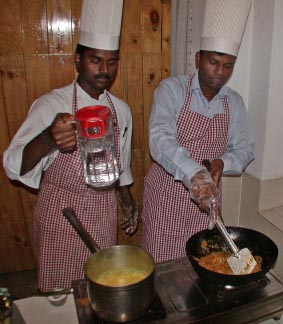
Our chef (right) and an assistant

AN ILLUSTRATED GUIDE TO MAKING THE ULTIMATE BEER-NUT…

…for beer nuts (and others)

ALMONDS FRIED IN OLIVE OIL WITH SEA-SALT

We grow three types of almond here on our finca in southern Spain, including the indigenous (earthy) “fina” , the (scented, sweet) “desmayo” (similar to the Californian nut, and what is typically seen on the shelves of north European and British supermarkets and fruit shops) and (the dry) “marcona“. With summer water so scarce here, Andalusian farmers, as a rule, do not irrigate their almond trees, which on the one hand means lower yields and smaller fruits, but on the other, ensures their fruits are intensely flavoured. All delicious in their different ways, we find that the marcona works best for most cooking purposes.

Before we spent so much time in Spain, I only knew the almond as something seen in the nut bowl at Hanukkah / Christmas time; and in its ground form, as a cake ingredient (my great aunt Fanny’s almond cake was my favourite), and as the famous Jewish party nosh, rozhinkes mit mandlen (raisins and almonds).

However, that all changed drastically, and much for the better once we discovered the local cuisine, here in Andalusia, and throughout the Iberian peninsular, where the humble almond (always known to be a “super-food” by the long-lived locals) is a key constituent of every cooks larder.

Of course, just about everyone around here, with a finca, like us, or just a small patio garden, has at least one almond tree, so that in addition to the ubiquitous sack of stored almonds in the pantry, or the bodega, there’s generally a proliferation of the fresh fruits from mid-July until the end of August. Whereas the older nuts will typically be used for such winter staples as Almond Chicken and Albondigas (meatballs) in Almond Sauce, in summer, the fresh, softer fruits, will be blended with stale bread, garlic, olive oil and spring water to produce, rich-yet refreshing ajo-blanco – garnished with halved moscatel grapes, perhaps the greatest of all chilled soups (commercial “almond milk” – eat your heart out!).

But undoubtedly the simplest of all our regular almond recipes, is also the most moreish and is equally good made with fresh or dried almonds. It even works quite well with the sort of (mostly American – heavily irrigated) almonds one has knocking about in plastic packets in British, European and American kitchen store cupboards. The only thing I would suggest doing differently from my recipe below, is to use a cheap, refined olive oil, rather than the first cold press oil I use. Unless one has a Spanish finca like ours, with our own olives and copious amounts of the finest oil, or is extremely wealthy, the taste benefit of using extra virgin oil over refined olive oil is minimal.

Whatever olive oil you use, if you’ve had a packet of almonds hanging around for too long, this recipe is a simple and delicious way to use them up. Salud y buen provecho!

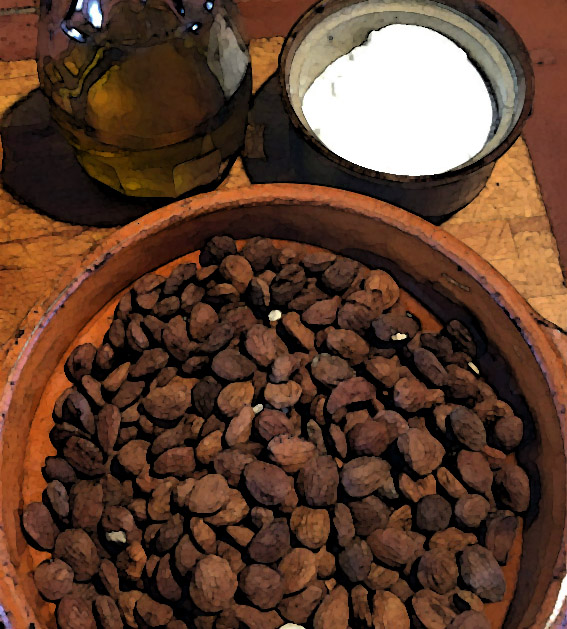
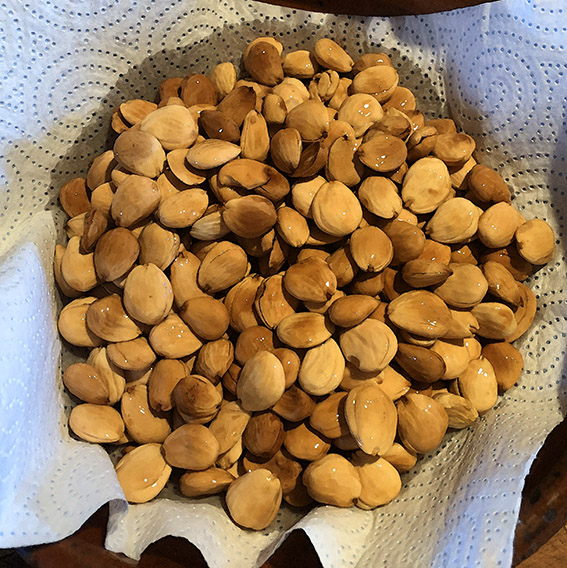
Just the three ingredients; almonds, olive oil and sea salt…
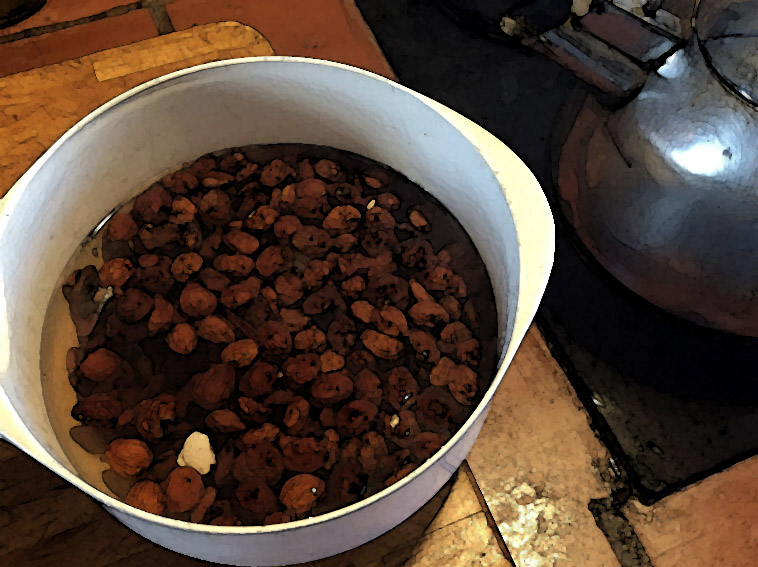
Blanch the nuts in a deep bowl of boiling-hot water, then skin them…
Set sufficient olive oil to comfortably deep-fry the almonds, over a high heat…
Stir the almonds constantly to prevent them sticking and ensure they cook evenly as possible…*
When all the almonds are at least a deep honey colour (some will be darker), lift them out of the oil with a slotted spoon, and place in a shallow dish lined with generous amounts of kitchen role. Toss well to remove as much excess oil as possible. It’s better to slightly over-do the almonds than under cook them and have them bland and oddly “milky” – rather like the tasteless “roasted” almonds in those little bags one gets given on aeroplanes with a drink…
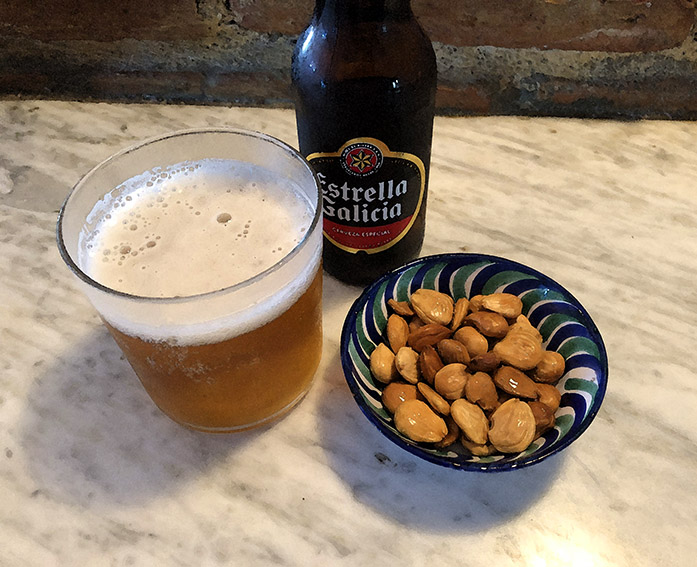
Toss the almonds in a generous pinch (or two) of sea-salt, to taste. Do not be sparing with the salt, and remember, that this is not a low-sodium snack. Better to restrict oneself to just a couple of well-seasoned nuts than to spoil the dish by using too little salt, or foregoing it altogether…
The almonds are fabulous with an ice cold beer, though equally delicious with just about any aperitif, spirit, or cocktail.
*Be sure to keep the used olive oil for further cooking (unlike sunflower oil, but in common with nut and rapeseed oil, olive is safe to reuse  many times). It adds a subtle almond note to things like chips (fries) and even deep fried fish...