CHILE – OUR REAL CARTOON ADVENTURE (part 9 of 11)

(SEE PART 8 HERE)

25

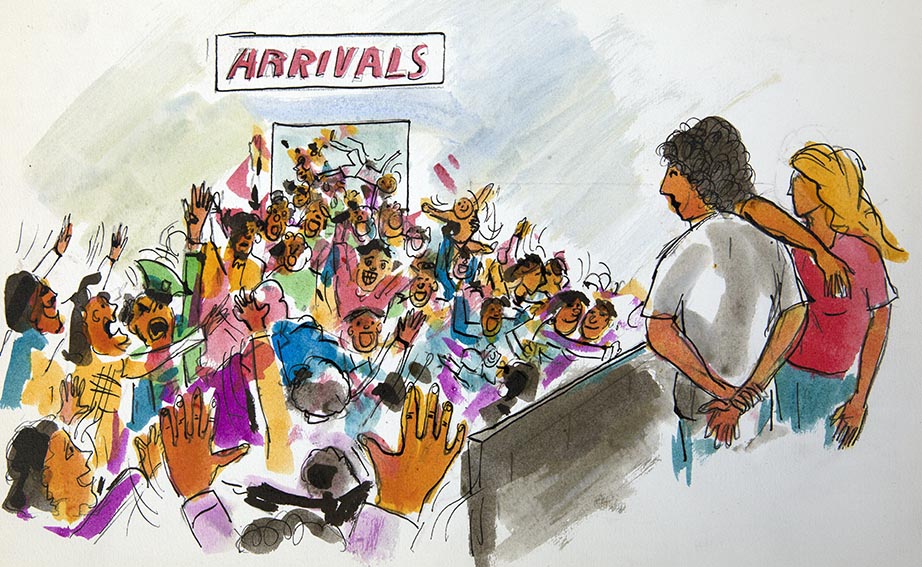
One of Dido’s most onerous tasks during our Chile trip entailed her working with a group of mentally and emotionally handicapped teenage boys, several of whom had what these days we euphemistically refer to as “challenging behaviours”; in truth, one or two of the lads turned out to be downright psychotic. To help her share some of the organisational and practical load Dido enrolled the assistance, for two weeks, of a former ballet colleague whom she had flown down from Los Angeles. But however difficult the forthcoming days with the boys would be, nothing could have been more “challenging” than the act of merely meeting said-colleague at Santiago Airport.

I wonder how many people reading these adventures remember the delirious scenes of joy and celebration on the tarmac at Ben Gurion Airport in Tel Aviv following the dramatic rescue of the hostages from Entebbe by Israeli commandos in 1976? Well, the arrivals hall at Santiago was that scene, but on steroids, and was happening when we arrived to meet our friend, and continued without abatement until the time we left – some three hours later – having failed in our endeavour. Fortunately, our friend – another seasoned traveller – on failing to meet up with us in the melee, used her initiative and made her own way to our hotel. As for why the arrivals hall was in such a state of continuous delirium, we never discovered…

.
25 Arrivals

26

Before the three of us began what would be an intense five days of work with the kids, we hired a car and drove up north to the small coastal town of Tongoy. Set on broad sands at the south tip of a spectacular bay it seemed like an excellent place for enjoying a few days by the South Pacific. But as with just about every feature of our Chilean adventure whatever our preconceptions or expectations had been before we arrived at a given location, the reality always had surprises in store for us. In Tongoy, as with so many of our previous destinations, it was our hotel which offered the biggest shock to the system. But in this case at least, it wasn’t a detrimental shock – no Nazis, no squalor, no shared butter and no gravity defying showers – but rather a jolt to our visual senses: For our hotel was decorated to such a degree of kitsch, it was like walking into a cliché. Each and every surface was coated, draped, carpeted or covered in garish, luridly decorated flower motifs – every facade clashing dramatically with its neighbour; Every chair, table and bed, painted, lacquered or otherwise coated in every colour, shade and tone of the spectrum and beyond; Each and every shelf and windowsill densely “adorned” with myriad pieces of chintz and fake ivory, such that if “ivorine” came from “real” plastic elephants, then plastic elephants would surely have been as an endangered a species as their actual living-breathing inspirations. And to cap it all there was the owner of the hotel: A movable temple of kitsch in her own right, who, as she strolled proudly through her establishment: With her stiffly set blue-rinse; down through her heavily painted, rouged and lipsticked face; to her violent-pink, be-flowered, polyester dress to her spangle-encrusted, patent turquoise stilettos, she resembled a chameleon in a psychedelic forest…

26 The Lady of Kitsch

27

As we had a car for a few days we decided to explore the Coquimbo region. At one stop we received a lesson in “car-parking vigilantism” Chilean-style. We’d parked up by some roadside cafe miles from anywhere and were about to go inside for a snack when three boys – of disparate age and stature – appeared from behind the building. Before we had a chance to get out of the car they had positioned themselves around the vehicle in a manner that I can only describe as casually menacing. The largest and oldest of the three boys leaned against my side of the car and tapped on the window. Nervously, I wound the window down and in my best Spanish asked him what he wanted. He asked me if we intended to park the car here, to which I replied, yes. He then asked me; ‘But who’s going to protect your car while you’re in the cafe?’ to which I ingenuously replied; ‘Why do we need the car protected? There’s nobody here!?’ He then smiled wryly at me, with an expression far too cynical for a lad of his tender years, and said knowingly; ‘Well my friend, you never know do you? You never can tell what could happen, even in a place like this…’ then he revealed – as if by magic – a long piece of wood, an old bat of some kind, with a jagged nail protruding from its tip. He swung it nonchalantly by his side with his wrist then added; ‘But of course, with three trusty guys like us guarding your car, I can assure you that nothing will happen to it…but if not’ he continued, waving the bat more vigorously now, ‘I would be very concerned…’

We wanted to just drive on, but the next stop was over three hours further down the road, so with a mixture of repressed rage, fear and frustration I dug out a handful of pesos from my jeans pocket and placed it in the open palms of the smallest boy whose hands were reaching up towards me. 

To be fair, the big lad was as good as his word, and they did indeed guard the car for the entire time we were in the cafe, and nothing bad happened to it…

27 We can take care of your car...

SEATTLE – WIDESCREEN 1992

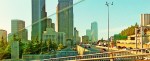
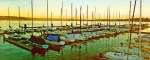
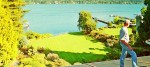
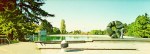
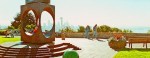
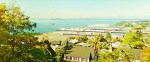
Typical! My first ever visit to the States and as I was about to take my first shot of the trip the shutter jammed on my old Nikon FE . I know! Nikon FE’s don’t (or didn’t at least) jam – yet somehow mine did, and the only thing I could afford as back-up was a disposable Kodak. To add to my irritation, it turned out I had inadvertently purchased a wide-angle disposable Kodak. Never having used any kind of disposable camera I was ignorant of the fact that there was a choice of lens configurations and had just picked up the first one I saw on the shelf of the corner shop. Looking at theses images now however, more than 20 years later, I think that it was a happy set of accidental circumstances. There’s something appealingly technicolor and fresh about this basic Kodak film, and the wide views of fabulous Seattle and its environs have an almost Robert Burks-like cinematographic quality (Burks created the look of most of Alfred Hitchcock’s American-made movies). Ultimately I think they capture a sense of vivid “Americana” which I’ve struggled to repeat on all my subsequent visits to the US, with far superior cameras…

CHILE – OUR REAL CARTOON ADVENTURE (part 8 of 11)

(SEE PART 7 HERE)

22

Germans had been colonizing the Lake District of Chile since the mid 19th century but somehow we were totally unprepared for just how much their presence influenced the region.

This was a break for us from Dido’s work and represented a chance to have a few days r&r and for that reason we decided to splash the cash and stay at a decent hotel. Our Lonely Planets guide suggested a timber-faced  chalet-style establishment on the edge of Villarica Lake, but what it omitted to describe was the intensity of the Teutonic atmosphere within the building. As our luck would have it, the day we arrived was some sort of German related  holiday and the entire staff together with all the German guests were donning national (Bavarian) dress, with all the men resplendent in lederhosen and feathered hats, and their “wenches” in dirndl. I’d ski-id as a youth in Austria, so I was used to this festive sartorial tradition. But what I wasn’t used to and hadn’t expected – at least not quite so overtly – was the proud and brazen identification of the hotel management with their Fatherland’s recent military past. Of course, I knew all about Nazis fleeing to South America at the end of the war, and about Eichmann and Mengele, but somehow I’d always connected this sort of thing with Argentina, Brazil and Uruguay. I was rudely disabused of my ignorance however, just after we had checked-in and the bellhop took us into the elevator, which, instead of the usual mirrors was decorated with numerous photographs of Panzer crews posing on and about their tanks. Amazed and naively thinking that this was some sort of retro decorative gimmick – albeit in alarmingly poor taste, but essentially innocent – I asked the bellhop who these soldiers were?

‘Ach!’ he exclaimed, putting our bags down on the the floor, obviously thrilled that I had shown an interest; ‘This vas mine faater’s Panzer groupen”  he said in an accent which was all German without a trace of Spanish,

‘Das man here’  pointing at the largest of the photos at a black-uniformed soldier leaning nonchalantly against his vehicle, ‘das man here ist mine grandfaater. A hero ov ze Eastern front!’

‘Oh gosh’ I replied limply.

‘Ya! A great hero – unt all his camaraden – all heroes!’ he added, gesturing expansively  about the elevator. ‘Such gut fellows – yah…’ he suddenly tailed off in sombre contemplation.

‘He was a great man for sure’ I said trying not to betray my total insincerity.

‘But no! Nicht vas my friend!’ he responded.

‘What do you mean?’ I queried, fearing the answer.

‘Nicht vas‘ he repeated. ‘You just met him – zer olt man at zer reception…’

As he walked us down the corridor to our room I pondered what was worse: That I had just shaken the hand of a Nazi “war hero”, or that he had our passports in his possession…

22 The Boremann Suite

23

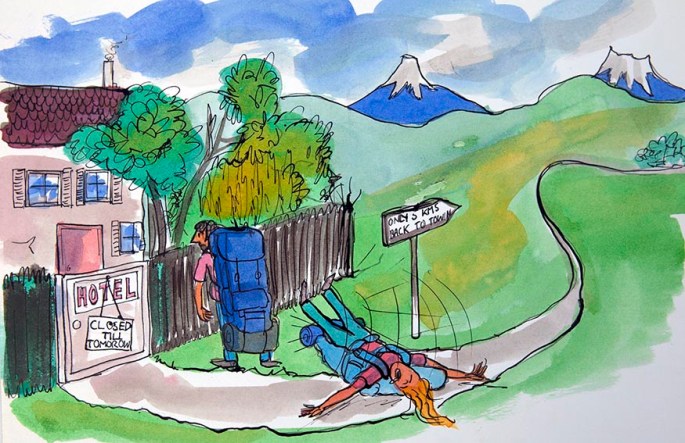
The Chile trip was our first and last experiment with Lonely Planet travel guides.  While most of gripes with the book could be regarded as somewhat subjective – e.g. our constant disagreement with the guide’s descriptive terminology, such as “basic”, when they really meant “squalid”; “faded” when they really meant “decrepit” and; “comfortable” when they really meant “incredibly uncomfortable” – the several times they got essential facts wrong were far more serious. The worst example was when we decided to hike the five miles from our old hotel on Lake Villarica to another hotel out in the country. We knew it would be a long hard yomp, carrying our rucksacks and that was fine, because we wanted the exercise and most importantly, because we also “knew” – from our Lonely Planet Guide – that the hotel was open and that because this was the beginning of the season there was absolutely no need to phone first to reserve a room. Sadly for us, the hotel didn’t in fact open until the following day. The picture tells only half the story as we had to walk all the way back too!

23 Lonely Planets - we hate you!!

24

We decided to end our visit to the Lakes region of Chile with a day-trip to the famous Island of Chiloe – famous among other things for being the original home of the potato. However, when we’d planned the excursion we hadn’t realised that the ferries which conveyed people and their motor vehicles from the mainland to the island were converted military landing craft – apparently of 1940’s vintage. As our bus rolled onto the craft we were perturbed when we noticed no safety gear of any kind – no life-jackets, no life-rings and certainly no life-craft. Our anxiety was increased by the fact that even with the front part of the boat on the landing ramp we were already being buffeted by an extremely rough sea. Once again, with our recent flirtations with mortality still fresh in the memory, after a mere exchange of looks we were off that bus, and off that boat before you had time to say “Herald of Free Enterprise”! Chiloe would have to wait for another time…

24 Chiloe - not quite

YAHWEH’S ANVIL – SINAI “THE GREAT AND TERRIBLE WILDERNESS”

In 1978, my oldest friend Simon and I spent the summer as volunteers on a kibbutz in northern Israel. Although our labour was voluntary we were paid a weekly amount to cover basic needs such as cigarettes, booze and staples from the kibbutz general store. Fortunately, we didn’t smoke; the beer was cheap, and we were sufficiently content with the food produced in the members’ dining room that we’d spent relatively little, and by the end of the stay had a reasonable amount of money saved up. We decided to pool our savings with another couple of English guys, Tim and Ben, hire the cheapest car available (which happened to be a typical 70’s yellow Fiat 127) and drive down south to spend a week in the Sinai Desert.

The Sinai was still under Israeli rule in those days and free to roam almost all the way to the edge of the Suez Canal. Little did we appreciate then, that a uniquely peaceful era in the modern history of the Sinai was nearing its end and that we were about to enjoy privileged access to virtually the entire peninsula.

These days, most travellers associate the Sinai primarily with its exotic beach resorts and scuba diving and snorkelling. And little wonder, as the peninsula is blessed with a sublime coastline both above and beneath the waves. Even now, the beach at Dahab remains the most beautiful I have ever seen, and the Sinai’s coral reef―as regards accessibility, scale and quality―is more than a match for any other in the world.

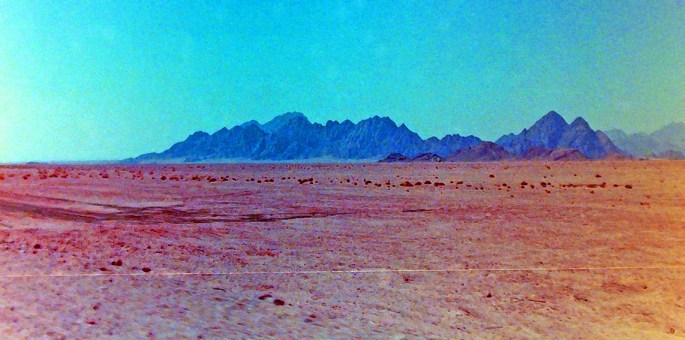
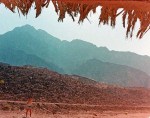
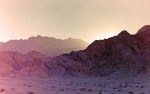
But for me, from the moment we passed through Eilat and entered the peninsula its superlative watery attractions notwithstanding, the feature which most grabbed my attention was the equally extraordinary landscape. The combination of desert plains and craggy mountains in a myriad of different colours; from white, to golden ochre through deep umbers and sienna, and culminating in blues and purples, was simply astonishing. The changing light; the chromatic sunrises; the intense sapphire of the day and the copper-tone sunsets reacted with the multi-surfaced sand and rock, presenting an optical feast of shifting tones and colouration.

In the south of the Sinai Peninsula in particular it was easy to see how its awesome visual dramatics gave birth to Yahweh―the eventual supreme divinity of the Israelites, and which would gradually evolve into the monotheistic Judeo-Christian concept of “God”. And funnily enough, of all the many remarkable aspects of the Sinai, the one which struck me most had an appropriately biblical reference: I recalled, even back then, the passage (Exodus 19:12) where Yahweh warns the Children of Israel not to touch the sacred mount (Mount Sinai / Horeb) “or they shall certainly die”. Until witnessing for myself the “biblical wilderness”―familiar then, only with the mountains of Europe which have nothing like defined parameters, but rather evolved from their neighbouring foothills which themselves slowly emerged from undulating plains―I had always found that to be an odd warning. I even recalled as a child in Synagogue on a Saturday morning, when first reading the relevant passage, asking my grandfather how the poor Israelites were supposed to know where the sacred mount began. But now, looking at the actual mountains of southern Sinai, thrusting forth from ironing-board-flat plains like dark icebergs on a gravelly, sandy ocean, I could immediately attest to the voracity of the biblical author’s knowledge of the geography he was describing. And it sent a shiver down my spine.

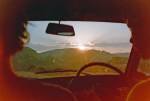
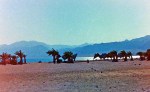
Presented here are a handful of the dozens of photos I took on that trip with my trusty old Cannonet 28 on high-speed Ektachrome film. Sadly, most of the transparencies were too damaged to convert, but I think these few―with the help of some digital enhancement―begin to convey to sheer wonder of what we saw on that wonderful trip to that “great and terrible wilderness”.

Finally, and on a lighter note, I recommend viewing these images to the sound of America and their iconic track The Horse With No Name . This song became a kind of unofficial anthem to our trip, and thus the adoptive name of our trusty little Fiat…

CHILE – OUR REAL CARTOON ADVENTURE (part 7 of 11)

(SEE PART 6 HERE)

19

The second of the two fruit checks took place on the border of the Atacama and Coquimbo regions. The bad thing, was that it was in the middle of the night and we were woken from our sleep, but the good news was that on this occasion we weren’t forced off the bus. For whatever reason the policemen concentrated this time on examining the luggage holds and it wasn’t long before their search paid fruit or, to be more precise, onions – a bloody-great crate of prime cooking onions. Now it was the coach driver who received the wagging finger treatment as he was asked to explain the presence of the contraband Allium bulbs. Somehow it was obvious to the carabineros that he was the guilty party and the poor chap was taken away to a little booth by the side of the road where he was interrogated for the next hour or so. Eventually, evidently chastened and downcast he was returned to us and permitted to continue driving us to Santiago…

19 Whose onions!!

20

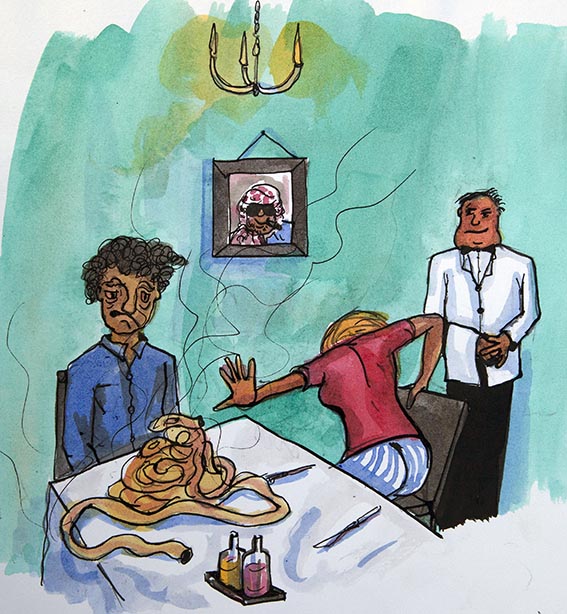
As much as were enjoying the Chilean diet, after several weeks in the country we felt the need for a change. Having spent a great deal of time in Israel we both had passion for Middle Eastern cuisine – Jewish and Arab. So one evening when we stumbled upon a Palestinian restaurant near our hotel in Santiago we thought we’d give it a go. So long as we observed Basil Fawlty’s wise dictum; not to “mention the war” – or wars in this case – we presumed that we could relax and enjoy some fine Arab cooking.  However, the meal we were served up had about as much relationship to the exquisite humus and salads of Abu Shukri in Jerusalem, or the sumptuous seafood and grilled meats of the Crusaders in Caesarea as a Birmingham balti chicken has to do with real Indian street food – i.e. not very much. The two memorable things about the meal was the fact that everything presented to us was grey in colour and utterly tasteless, from the cement-like humus and baba ganush to Dido’s choice of main course – supposedly braised, whole poussin, stuffed with cracked wheat and apricots (yes, grey apricots). But the piece de resistance for awfulness was my main course. What I was thinking when I ordered stuffed sheep’s intestine is one thing, but even allowing for my foolhardyness, nobody could have expected what was placed before me that evening – including all the other diners who used their menus to screen themselves from the revolting sight of my dish.  I suppose I was anticipating something along the lines of haggis or Balkan-style stuffed “kishke”, both of which I love. But this was, as depicted in the picture below, simply a steaming hot pile of sheep intestine in all its unadulterated gory, glory – somehow stuffed with rice (dried-out grey rice in keeping with the rest of the meal). Worse still was the smell; reminiscent of compost and dirty damp towels – it made Dido come close to retching. And the fact that the head waiter stood over me, oozing pride for his establishment’s signature dish, eager to see how much I liked it made this one of the most potentially awkward dining experiences of my life. But then fate smiled on us! The intestine, having the texture of tyre rubber meant that my knife couldn’t make the slightest impression on it. The waiter slapped his head as if to chastise himself for his remissness and went back to the kitchen to get me a sharper implement. At this, without needing to utter a word to each other, we stood up, slammed more than enough money on the table to cover the bill and marched full-speed to the exit…

20 Arafat's revenge

21

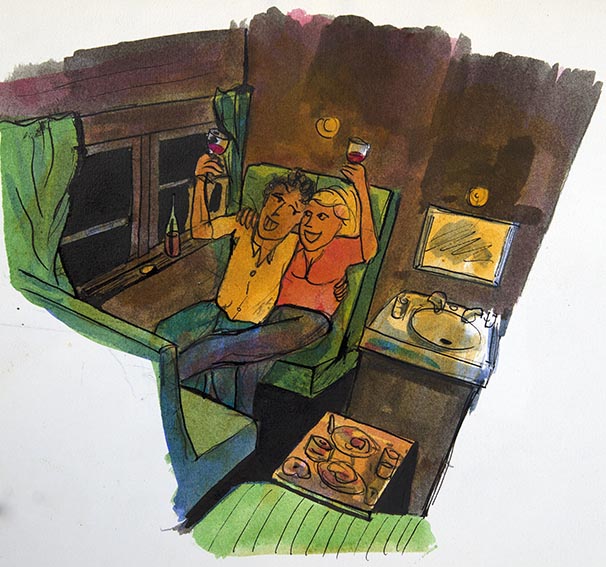
About halfway through our stay in Chile we decided to take a few days off and visit the lake district. We booked the train for the overnight journey from Santiago to Puerto Varas and believed we had reserved a compartment. However, we were disappointed to discover on boarding that we were in a couchette with half-dozen other people. A short time out of Santiago Dido went looking for the loo. She returned in an animated state saying that the next carriage comprised only compartments, and that they were all empty. When the porter then came to clip our tickets I asked him if it was possible to upgrade to a compartment to which he shrugged, smiled and muttered under his breath ‘perhaps’… Without thinking I reached into my pocket, and pulled out about $40.00 worth of Chilean Pesos from my wallet . Then, checking his expression and seeing that he was receptive I discreetly slipped the money into his hand. ‘Twenty minutes’ he said gesturing with his head back towards the next carriage; ‘I will prepare the first compartment for you’. And good to his word, the compartment was prepared. It was beautiful: Old British rolling stock from the age of steam, like a scene from From Russia with Love or Murder on Orient Express; only slightly faded, deep green velvet drapes and furniture and shimmering mahogany paneling. The porter had immaculately turned down the crisp Egyptian cotton sheets on the two broad bunk beds, in addition to his final touch – two expertly prepared pisco sours in old-style crystal cocktail glasses placed on the little pull out table. We were in romantic heaven, and needless to say we enjoyed one of the best nights of our trip…

21 Who says bribery doesn't pay!

LITTLE BIG LAND I – LAND OF GOLDEN GRASSES

THE ISRAELI PAN-HANDLE

9 images from the 80’s of Israel’s dramatic northern tip

CHILE – OUR REAL CARTOON ADVENTURE (part 6 of 11)

(SEE PART 5 HERE)

16

No stay in Chile’s northernmost city of Arica is complete without an excursion to the Lauca National Park – with its fabled lakes and volcanoes. Only problem was, the park sat at 4500 meters above sea-level, and altitude sickness was likely to be a serious issue. One of the ways of militating against the worst effects of this however was to make sure one traveled up to the park in the hands of expert guides with state-of-the-art oxygen and resuscitation equipment. But sadly, our limited budget made us forget the lessons of our near-disastrous trip the previous week to Atacama Giant and we opted for the cheapest guided tour we could find. We sensed the worst when we boarded the clapped-out minibus with hard wooden benches for seats and two broken windows on the right-hand side. However, there was a big oxygen canister on a shelf above the driver, and it was only a day-trip for goodness sake, we reassured ourselves – what could go wrong on such a short trip? There were about ten of us on the bus, and by the time our vehicle had crawled up past 3.500 meters the more elderly passengers were already beginning to feel the effects of the thinning air. Dido and I at least, felt fine during the entire drive up and it was only when we disembarked at Lake Chungara that the “puna” (the colloquial term for altitude sickness) hit us both – like a brick. The only way I can explain the sensation was that when I tried to walk it felt like one of those bad dreams, when one is trying to flee from some horror or other and one’s legs won’t move. And it wasn’t just the sluggishness; it was actually quite hard to think straight. To this day, I have barely any recollection of how I managed to fill an entire roll of film with some the most spectacular shots of the entire trip – of the lake itself, the surrounding volcanoes, the herds of grazing guanaco and the incredible candlestick cacti. Even Dido, who was super fit in those days, had to lie down after a few minutes of walking around, while I found the only way I could be comfortable at all was to adopt a kind of Muslim prayer position on the ground. Meanwhile, I recall seeing people chucking-up all over the place and one other poor old American guy pass out altogether. It was then that the guide told us that the oxygen canister was empty, resulting in another member of our party – a retired GP as it turned out – having to resuscitate the American gentleman in the manner illustrated in the picture below. Eventually, we all managed to clamber back onto the bus where the guide had brewed up a kettle of coca tea. Whether or not the tea had any effect, somehow we were all still alive by the time we got back to Arica…

16 Dizzy heights at Chungura

17

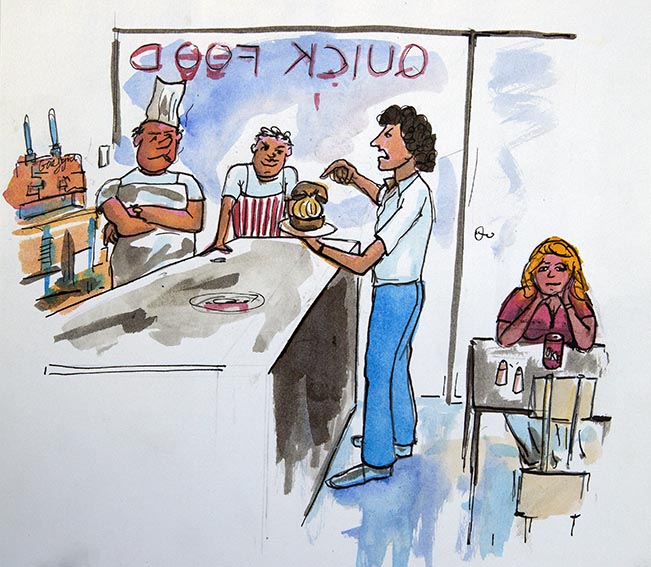
As I’ve implied earlier we liked most of the food we ate in Chile. While the cuisine is basic, there was a wide and exciting variety of raw material – animal and vegetable – and nearly everything was simply yet expertly prepared. This included the hamburgers, which, everywhere from Puerto-Varas in the south to Arica in the north, were always huge, freshly made prime-beef patties. Grilled over charcoal in the posher establishments, or on hotplates in the diners, they were reliably succulent and filling. The only problem I had with the Chilean hamburger was the choice of accompaniments with the burger within the bun. At first I found the ubiquitous slice of beef tomato, cos-lettuce and thick slab of avocado – yes, avocado – to be a novelty. A tasty and healthy change from cheese, bacon or salad onion say… But by the time we were in Arica the novelty – of the avocado in particular – had worn thin. I’d come to the conclusion that avocado and a beef patty just weren’t good bedfellows. They didn’t so much complement each other as vie for attention in the mouth. In simple terms, they just didn’t get on. But by removing the avocado, the burger then became somewhat plain and bare, and the local vinegary ketchup certainly didn’t help matters. Then one afternoon we were at our favourite eatery (where we’d already established a steady supply of good fresh coffee) and I asked the cook if I could have some onion with my burger in place of the avocado. First of all, he looked at me as if I were crazy, but then he shrugged his shoulders and accented. He asked me how I wanted the onion cooked? I tried to explain that I wanted it raw. More looks of incredulity and then another shrug of the shoulders…I went and sat down and waited for my burger, which came about five minutes later with an onion; with a raw onion no less; a bloody great onion, skin and all, perched precariously on top of my beef patty…

17 Too heavy on the onion...

18

For most non-European readers of these adventure, the next two episodes will not seem surprising at all. But for us, then, the whole concept of “fruit checks”seemed like a hangover from the Pinochet era – just a way of controlling the free movement of citizens. As it happens we were wrong and fruit-checks were / are a key method in preventing the spreading of potentially lethal agricultural pests. Nevertheless, the fact that in Chile, these checks were carried out by jack-booted carabineros with all the charm of a pack of pit-bulls on an enforced vegetable-only diet merely reinforced our misconceptions and resentments. Both of our fruit-check experiences occurred on the long bus ride back south from Arica to Santiago. The reason for this was that our luxury “cama” coach journey (we were feeling a bit more flush with our budget by now) crossed several regional (state) lines and the unlicensed movement of  fruit and vegetables was prohibited from one region to another. Our first check was on the Arica/Iquique border when we were all ordered off the bus while two officers searched the vehicle. We’d all been nervously standing around on the roadside for about five minutes when one of the carabineros slowly made his way down the steps of the coach. Holding up a half-eaten bunch of grapes in his right arm he glowered at us before demanding that the guilty party declare him or herself. After a few moments, during which we all exchanged anxious looks, a middle-aged man stepped forward with his head bowed in shame – like a naughty schoolboy being summoned to the front of the class by the teacher. The carabinero then read the poor man the riot act, threatening him with all sorts of sanctions and fines before eventually offering him a way to make amends – to finish the bunch of grapes then and there. This the man did, fairly gorging them down in his relief , and so allowing us to continue on our long journey…

18 Whose grapes!!

CHILE – OUR REAL CARTOON ADVENTURE (part 5 of 11)

(SEE PART 4 HERE)

13

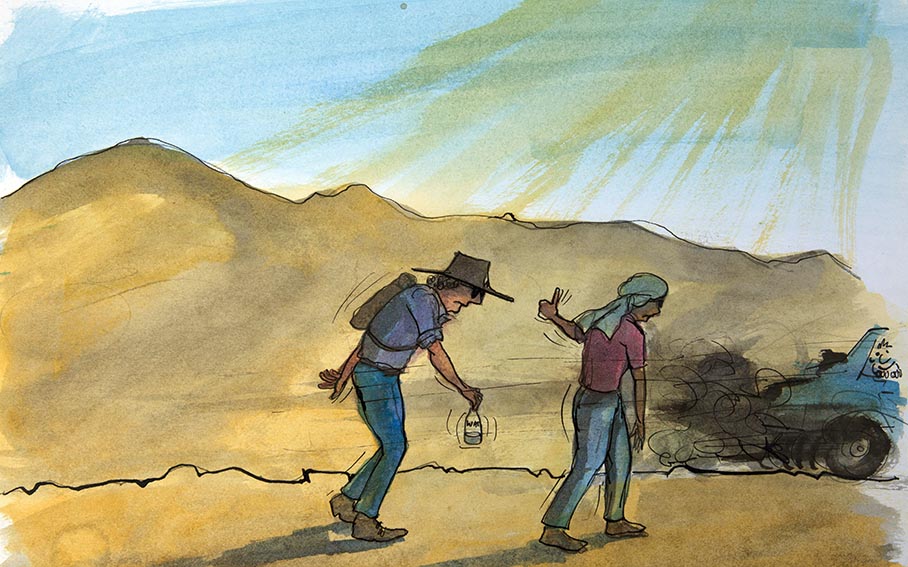
During our stay in Iquique we took a day trip to see one of Chile’s ancient man-made wonders, The Giant of the Atacama. We anticipated that getting to see the “largest anthropomorphic geoglyph in the world” with our own eyes would be one of the highlights of our entire visit to Chile, and so it would have been, if we hadn’t vastly overestimated the number of fellow travelers to the same site. We presumed The Giant would be a mecca for a whole host of visitors, including everyone from the millions of credulous believers in Von Daniken to the thousands of people with an interest in pre-Columbian civilization – and all those in between. Obviously, knowing the remoteness of the site we didn’t expect everyone to be there at the same moment, but we took it for granted that there would be dozens of people there at any one time. Thus it never entered our minds that we would have any trouble getting to and from The Giant without our own car. Even worse, we had misread the distance on our – by now very worn – map, from the Highway 5 bus stop to The Giant as being only 2 kilometers (easily walkable, even under the desert sun) when it was in fact 12! Nevertheless, when a car stopped and we were given a ride to The Giant almost before we had even begun to raise our thumbs, our original presumption seemed to have been correct. However, we had been at the site barely ten minutes when our kindly lift-givers got bored and decided to leave. So, when they offered to take us back to the highway bus stop (which we now realised was 12 ks and not 2) we had a decision to make. Ignore the significant fact that we and our ride buddies were the only people there and stay on a while longer at this amazing site, or do the sensible – “been there / seen it” – thing and accept the lift. Like the classic “Darwin Award” idiots we all read about everyday in the newspapers (who go fell walking in sneakers, or swimming in pools known to be infested with salt-water crocodiles or who light up a cigarette while standing over a cesspit) we decided to stay on “a while longer”… Needless to say, an hour passed and nobody came. So, we decided to walk the actual 2 kilometers back to the dirt track (marked as “minor-road 15) and see if we could at least get a lift from there. Problem was, by this time we were already down to the last few sips of water in our single 1/2 liter bottle and beginning to roast as the sun reached its highest point in the vast desert sky. By the time we made it onto the track we knew that we might be in serious trouble. There was no shelter of any kind, our water was gone, and our exposed arms were beginning to burn. At this point we didn’t know whether we should stay put or attempt the 10 k walk to the main road. After a ten minute rest we began to walk – or rather, stagger along the track, and then almost immediately we heard a vehicle approaching from behind, going in our direction. But our elation was only momentary, as the car sped past without even slowing down, it’s exhaust and dust adding mocking insult to injury. But then, after about another hour, a second vehicle – a small truck – emerged from the east, heading west and its driver , this time, took pity on us and dropped us at the bus stop. Now whenever we think of The Giant, or just about any other South American geoglyph our first reflex is to reach for a water bottle…

13 20 kilometers! Not 2!

14

From Iquique we made our way to Chile’s northernmost major city of Arica. The picture below is an exaggeration of what at the time, we feared might really happen when, during the drive north we passed a military airbase of some kind. One can imagine our fright when a light aircraft flew just a few feet over the roof of the bus before landing on the road in front of us causing our driver to make an emergency break. For some reason unbeknownst to us and our driver too, judging by his outburst of expletives – and presumably something to do with financial expedience  – it turned out that this particular section of road  doubled as a runway. Whatever, it certainly livened up what up until that point had been a particularly dull, desert drive…

14 Dual purpose highway

15

One of the few things that disappointed – not to mention surprised – us during our first weeks in Chile was the fact that wherever we went, and wherever we stayed (smart or shabby) we could only seem to get instant coffee. To make matters worse, this wasn’t even granulated coffee, but old fashioned, cheap and nasty powder coffee. But then, in Arica, we befriended a likable and knowledgeable young English couple taking their gap year in South America – let’s call them Susan and Bob – who explained to us where we had been going wrong. It turned out that if one wanted real coffee in Chile one had to ask for it twice. In other words, instead of asking for a “cafe” one asked for a “cafe, cafe”. When they told us this we thought that our new friends were teasing us, but when we went to dinner with them for the first time, at the end of the meal Bob asked for “Cafe, Cafe”. And hey presto! As if by magic, four cups of exceptionally good real coffee were delivered to our table…

15 Cafe, Cafe

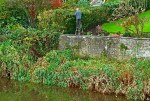
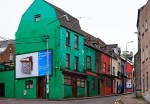
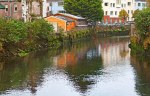
CORK – TONALITY ON THE LEE

A GALLERY OF IMAGES OF CORK CITY AND ITS RIVER

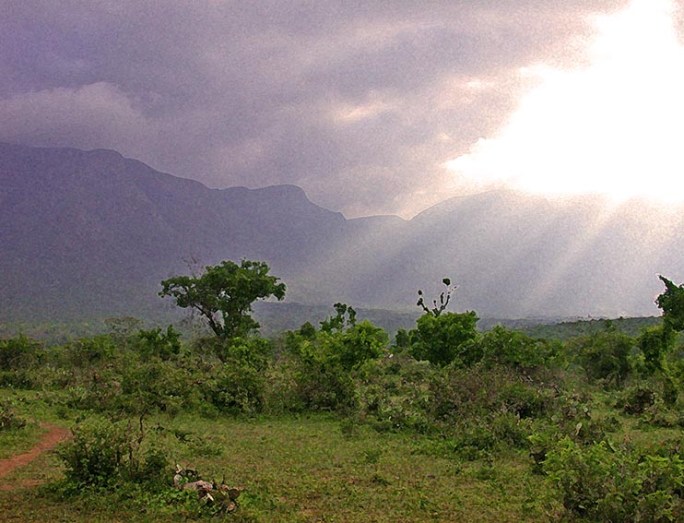
IN THE SOUTHERN GHAT FOOTHILLS

FIVE VIRTUAL “GOUACHES” OF SCENES IN INDIA’S SOUTHERN MOUNTAINS