THE ANSWER TO THE QUESTION/S WE ARE ASKED THE MOST…*
Well, not exactly, is the answer, in that they do all nearly end up as oil, but the oil is not made by us.
Olive presses, in all their forms, are serious pieces of machinery and far too ambitious and expensive for a small farm like ours. That is why, we, in common with all of our neighbouring growers take our harvests to one of the several local presses or factories.
Most of the larger growers will typically belong to a cooperative such as the one in our local village, and which has its own press. Smaller “independent” growers like us will head to one of the nearby commercial operations.
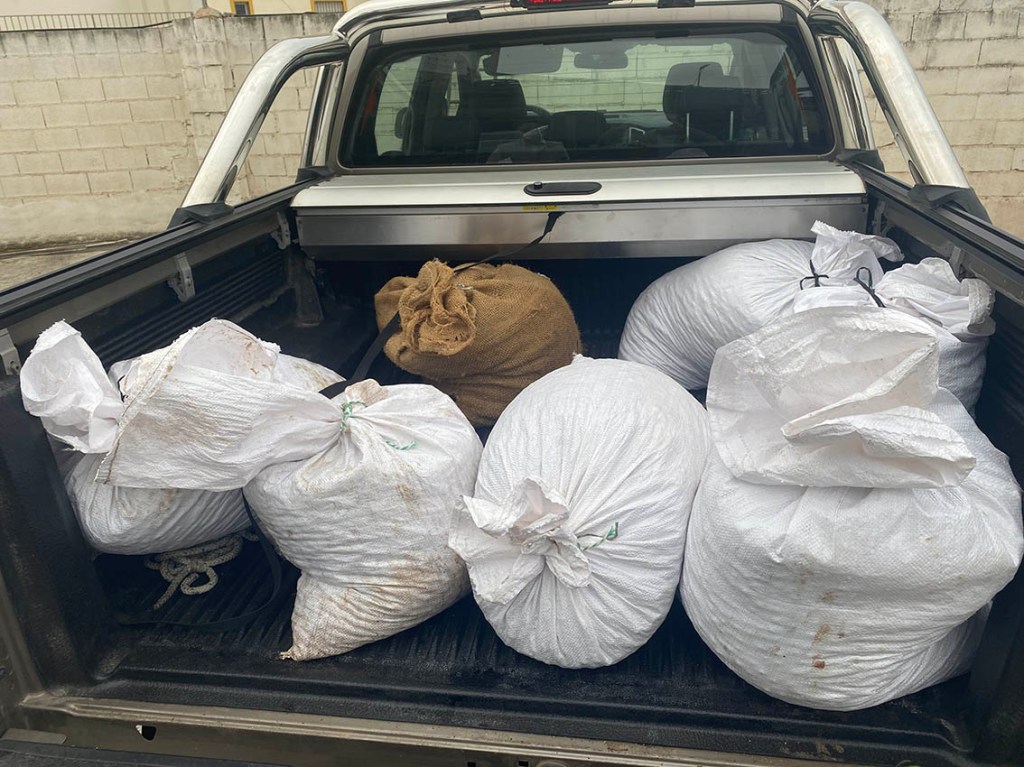
This year’s olive harvest on the back of our truck. Half an imperial ton, so not bad for two old codgers!
The larger growers will have hundreds of trees, sometimes thousands, producing several tons of fruit. Smaller growers like us, will have anything from half-a-dozen to a hundred trees, giving crops from a couple of sacks to a couple of tons. When we purchased our finca in 1993 it had only three young olive trees (the finca being then primarily turned over to almond and vines). Since then, we have planted around fifty more olive trees which is about as many we can handle on our own, vis-à-vis, annual pruning, burning off and harvesting.
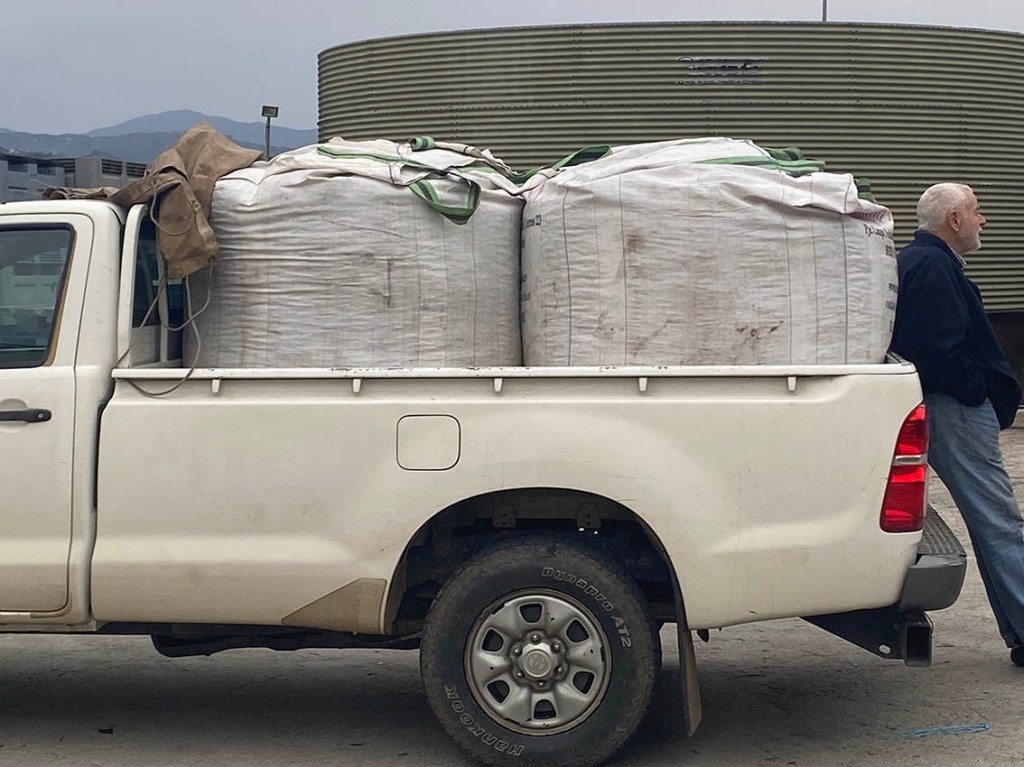
The guy before us at the press, with nearly a ton and a half of olives…
We normally harvest in late December/early January. The smaller trees we pick simply by hand, but the larger trees in heavy crop, require the setting up of nets and the use of whacking-sticks, and picking all the fruits often means quite a bit of climbing too. Fortunately, Dido and I both retain an almost childlike enthusiasm for tree-climbing!
Most of the local presses (including the cooperative) produce first cold-pressed extra-virgin oil. However, as a rule, to get a proportion of your own oil back, one’s load must exceed 500 kilos (half a metric tonne / about 1100 pounds). Although our crop is doubling each year, now that our trees are all “on-line”, we still only managed about 250 kilos this past harvest. This means that although we do get about 20 litres of fabulous oil in exchange (the press retains 50% of the oil yield), it is not actually ours. Hopefully, if this coming year is as fecund as the last, next year we will comfortably reach the 500 kilo target and receive oil from our own fruits for the first time.
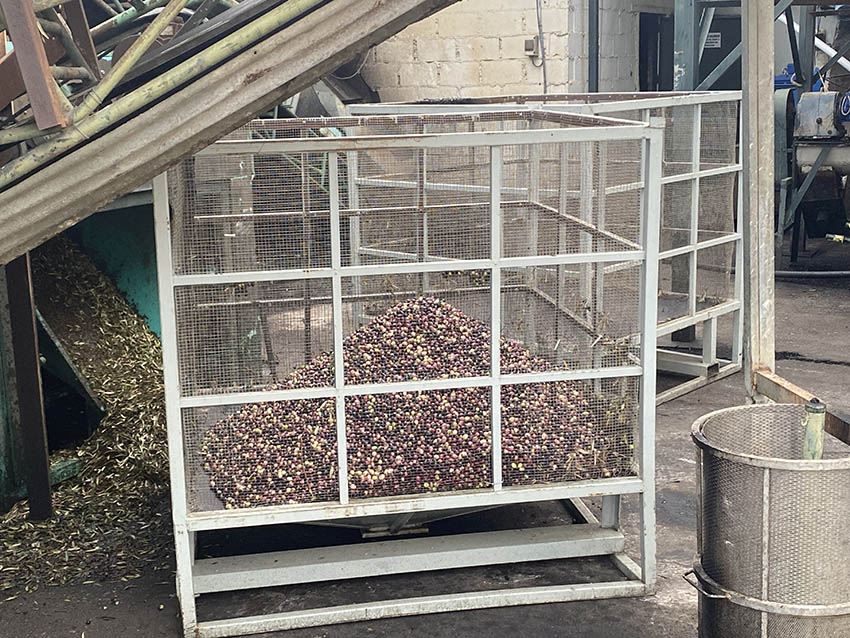
Our olives, ready for the press.
As for our local Axarquian oil, it is famed throughout Spain for its low acidity, and its smooth, slightly peppery apple flavours. Of course I am biased, but I far prefer it to most mainland-French and mainland-Italian oils, which tend to be too astringent for my taste. In style, our oil compares well with, and is very similar to those from Sicily, Corsica, Sardinia, Greece and the Levant. Fundamentally, the stronger the sun, the smoother and more buttery the olive oil.
* The header photo shows our main olive grove, about eight years ago, a year or two before they all began to yield significant amounts of olive.
Carl Jung famously referred to occurrences of synchronicity as “meaningful coincidences that cannot be explained by cause and effect.” He thought that there was something more profound going on than sheer coincidence, something to do with a “deeper order of the universe…”
While I can see the attractiveness of this line of reasoning I find it hard to agree with the great man. For one thing, he does not seem to consider the far larger number of non-coincidences that occur every day to everyone on the planet. The countless times that coincidences are not happening is in some ways even more remarkable than the few times they do occur, given the billions of lives being lived at any one time. Indeed, one could counter Jung’s hypothesis by stating that the very scarcity of synchronistic events is proof that they are simple – albeit often remarkable – happenstance.
In my own life, I have experienced three remarkable, apparently synchronistic episodes. The first, I recounted in an earlier post (here), and was merely charming. The second, which I describe below, was moving, and the third, to which I will devote a future post, was both powerful and disturbing.
The only common denominator in all three events was the fact that they all involved my wife Dido, and all happened within a two-year timeframe – more or less. The first; from slightly before I met her, the second; just after we met, and the third; about the time we were engaged to be married. No doubt Jung would have something to say about that too, but for boring old me, it was just another coincidence.
Anyhow, this is the second “happening” and please judge for yourselves whether or not something “deeper” was going on: It was early in 1989, and Dido and I had been dating a few weeks. She was then an occupational therapy student working on her first clinical placement at Northwick Park Hospital in Harrow (North West London). During her placement, most evenings, she would stop by my family home in West Hampstead for some supper, and sometimes to stay over.
Just to paint the scene – our home was inhabited by my mother Hannah, my recently-widowered grandfather Harry Pizan, and me. After supper, we would typically settle down in the sitting room to either watch some TV or play something like a game of Scrabble. I think it was on the very first day of Dido’s Northwick Park placement, when, in this relaxing setting, she said, looking at my grandfather, ‘I was allocated my first patient today – an elderly gentleman with cancer of the spine – and strangely, he has the same surname as you! Pizan. Didn’t you tell me that your family were the only Pizans* in England?’
To which my grandfather replied, “Yes, we are.” he then asked Dido, “Is this man called Rube?”
“Yes, Rubin Pizan!” Dido exclaimed.
“He’s my brother! You patient is Rube, my younger brother…”
Northwick Park Hospital – west wing building – watercolour – 1976
(“Pizan” was a name allocated to my great grandfather – Harry’s father – and his then-small family, when they landed at Irongate Wharf, London, in 1903, by an immigration officer who must have thought it approximated to whatever name my Polish and Yiddish-speaking “great zaida” had actually said. My cousin Bernard informs me that the name was originally PISEM and was changed to Pizan by deed poll by the family members. We (the surviving family) are not quite clear why the change was made – whether Pisem was a misreading by an immigration official, and the name really was originally Pizan, or something else perhaps? At any rate the name was changed, and thank goodness it was! “Pisem” just doesn’t do it for me! This sort of muddle was a common occurrence, wherever Jewish emigres landed up, from London to New York City.)
*The title illustration and the picture above are watercolours I made of Northwick Park Hospital when I was studying art next door, at Harrow School of Art.
It’s been quite a while since I published a “live” postcard-type piece, but this current trip to Coimbra, Portugal’s oldest (and Europe’s third-oldest) university city has drawn me to the keyboard.
Incredible to think, that we have been living on the Iberian Peninsula (on our finca in southern Andalusia and in Gibraltar) for well over thirty years and had never set foot in (mainland) Portugal. It was not for want of coming, but somehow the necessary stars never quite aligned, until now. It’s even more extraordinary, when one realises that our very first trip abroad together – our belated unofficial honeymoon, in effect, back in 1990, was to the island of Madeira, which we loved.
Anyway, we’re here now, and in the spirit of past “postcard” posts, without any more ado, here is a selection of captioned photos from a town that combines elegant charm and faded shabbiness with nonchalant ease – one might even say, with Portug-ease…
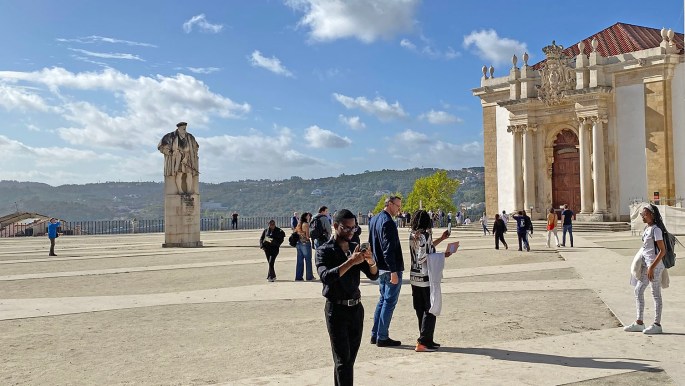
The “Tricana” statue, depicts a working-class girl with her water pitcher. Back in the day, before the advent of running water, this was how the poor collected their water from the town wells. The streets of the old town are narrow and steep, and presumably the girl is taking a well-earned rest…
The old Cathedral of the town, set in a small square, about two-thirds up the hill upon which most of the central old town is perched…
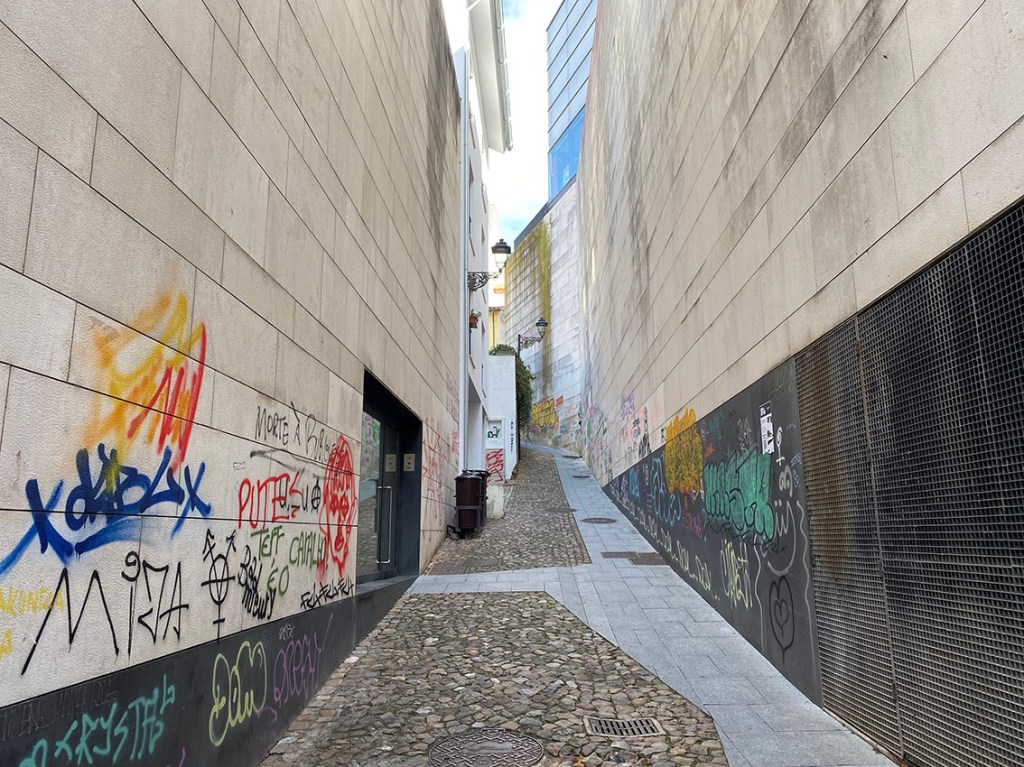
Most of the upper hill, and virtually all of the top plateau comprises the large university campus, old and new. Fortunately, the not very artistic graffiti was restricted to the new…
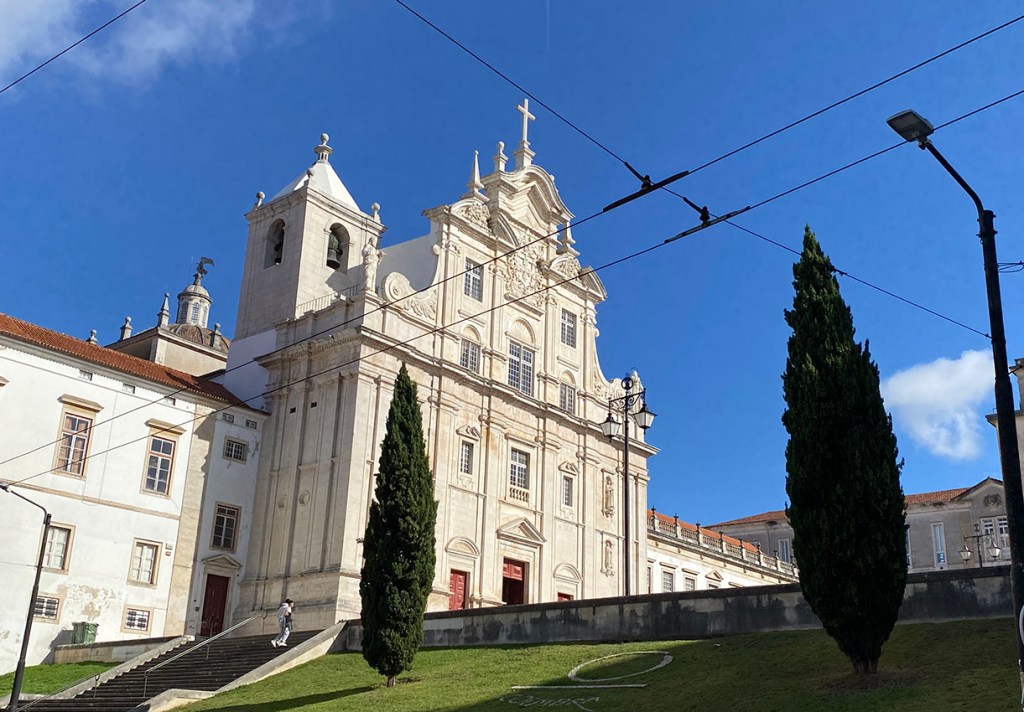
The new cathedral, integrated into the university campus on top of the hill…
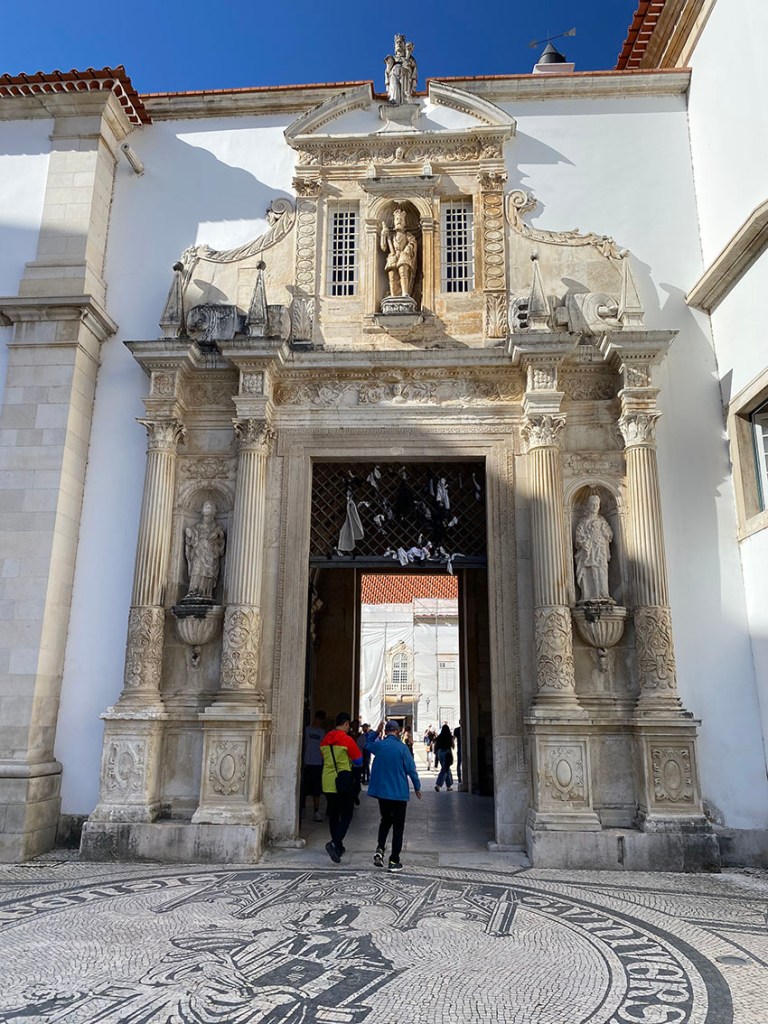
One of the several highly ornate gateways spread across the campus…
Undoubtedly, one the most elaborate campuses I have ever visited and this is its Royal Palace – presumably for regal students?
Coimbra University’s Academic Prison, for badly behaved students –The way things are going these days, most of our elite academic institutions could do with one of these…
An impressive view of the Mondego River (the largest / longest river contained within Portugal’s border), from the university plateau…
Leaving the main campus on the plateau, one passes the charming Capela de Santo António…
The old cathedral, from a different angle…
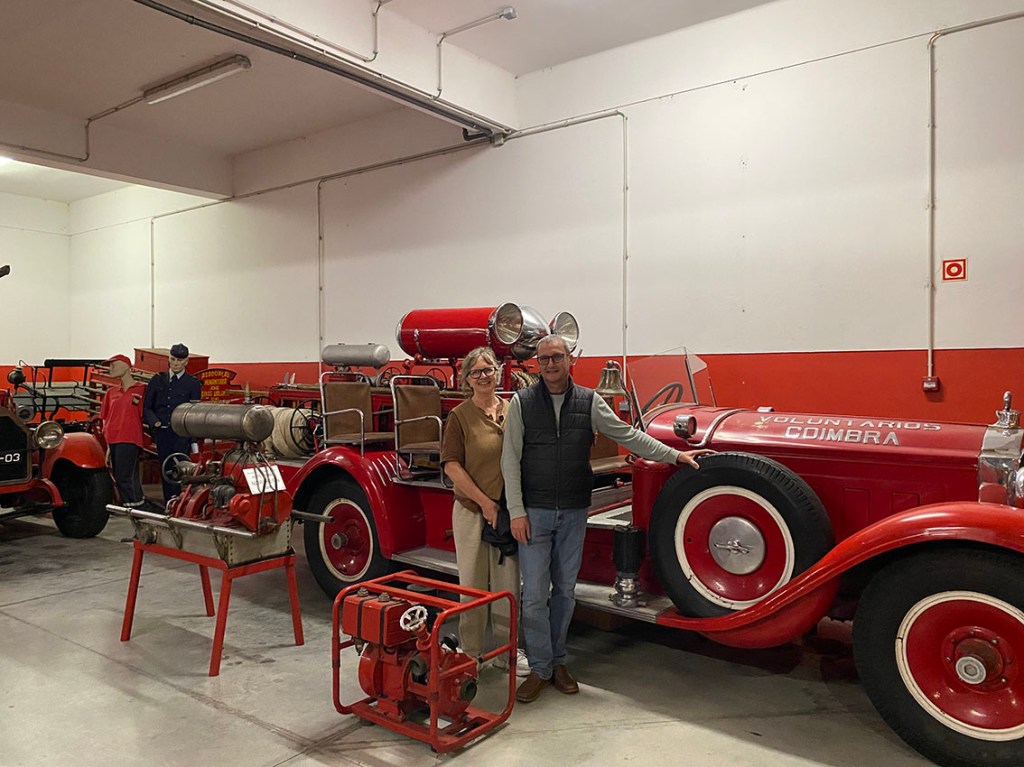
On a different note completely, on our last evening in Coimbra, we passed the volunteer fire station (there are three levels of firefighter in Portugal). The old engines were so enticing we sneaked in for a closer peak, only to be met by an amiable young fireman who gave us a guided tour of the station and the engines. This one, an old Mercedes, dated from the 1920’s and was our favourite. If Keystone Firemen had existed, this would have been the perfect vehicle for them. Dido even got to ring the bell! Coimbra was full of pleasant surprises.
Last month we sold our little flat in Hampstead, North London. In and of itself, not exactly an earth-shattering event, but in the context of my life, an extraordinary moment. The reason being, that for the first time in my then-64 years and 11 months I no-longer had even a toe-hold in the city of my birth.
Regular readers of these posts will know that I have always endeavoured to keep my blog as free from controversial subjects as possible, despite the fact – as those who know me well can testify – I am highly politically aware with a range of opinions, some strongly held.
Given the recent and current state of the world, this policy has not always been easy, but this blog, originally intended to publicise my books and my art, is not a forum I wish to use for expressing my views on putting the world to rights. Ultimately, from my own experience of sampling and following other people’s politicized sites, one inevitably ends up with a corrosive and destructive clash of echo chambers. Thus, our reasons for leaving London will remain known to only our intimates.
Presented here is a photo-record of the first 30 years of my own personal London life (several suitably grainy and scarred), from times past, when I could never have dreamed that I would ever cut my ties with my once-beloved city “north of the river”.
I was born in Edgware, in the county of Middlesex in 1960, strictly speaking, before it became part of Greater London. Famous for its eponymous Roman road, as the composer Handel’s temporary home, and being at the end of the Northern Line Tube, it was where I grew up. This picture shows me as a baby, with my mum, Hannah, older brother Michael and my great auntie Ray at my grandparents flat…
My final day at nursery in 1963 with my mum (left) and a friend. I seem to be clutching a postcard though I have no idea who from…
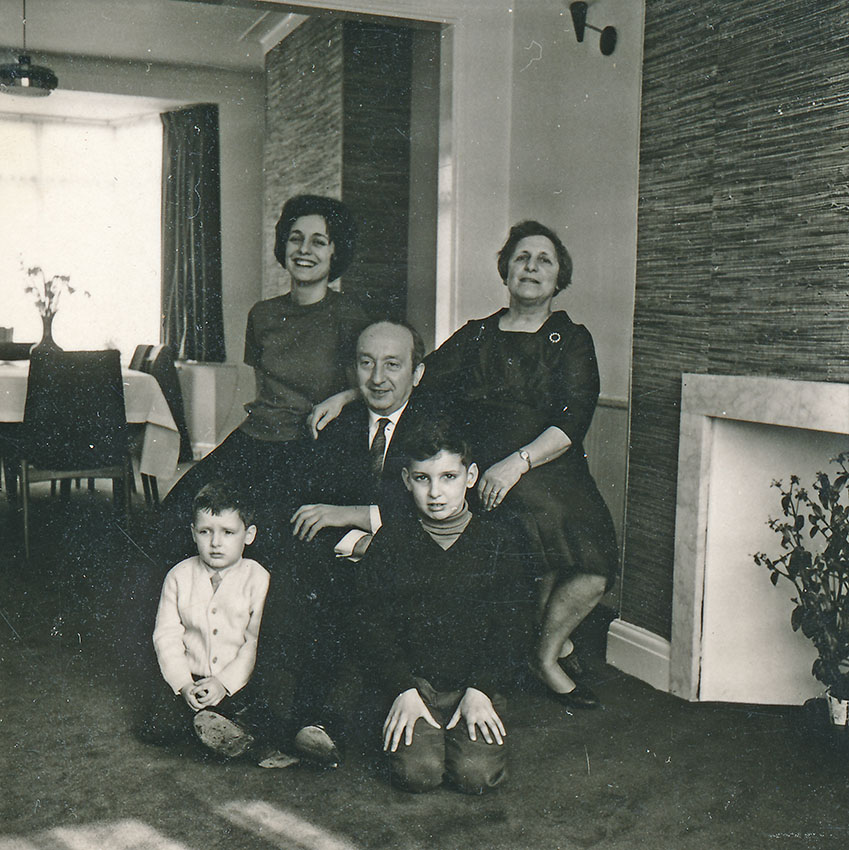
Apart from a bout of glandular fever when I was six, my childhood was exceptionally happy. Although my father had departed the scene when I was a babe-in-arms, my little family was a more than adequate compensation for his absence. Here we have Hannah and her parents, Becky and Harry, me and my brother Michael (my uncle Sidney took the picture), in my first home…
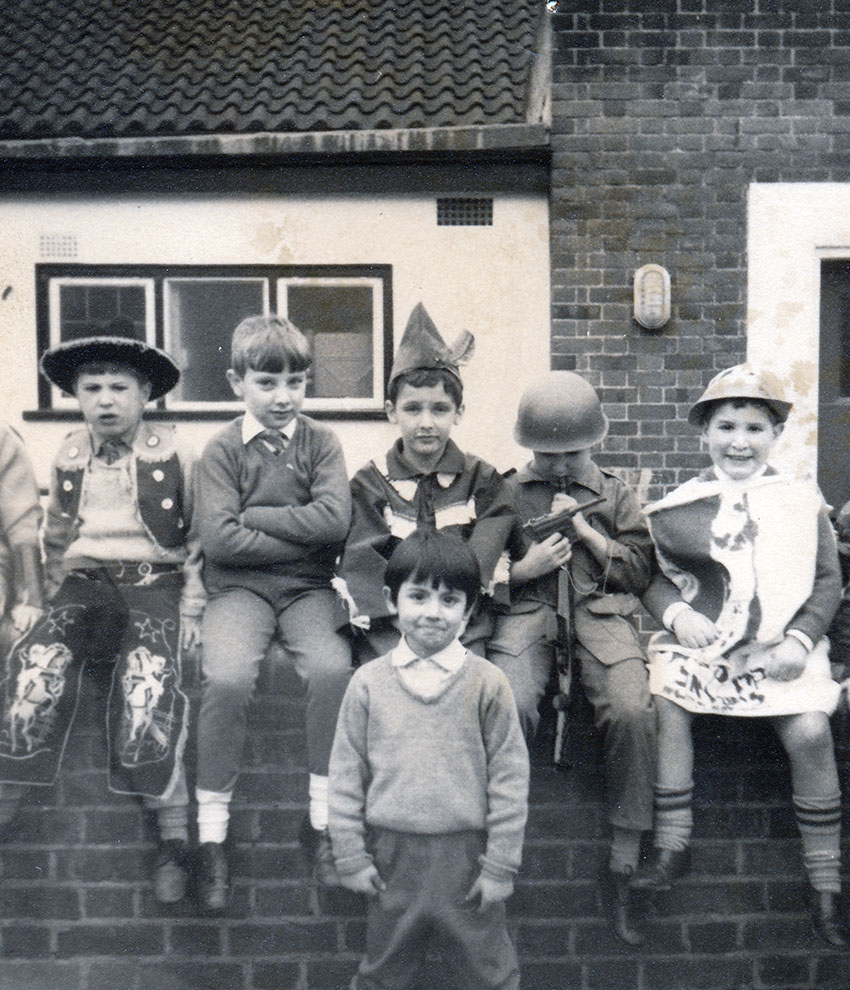
Purim at my primary school. I’m a rather lame-looking Robin Hood sat between cowboys and GI’s…
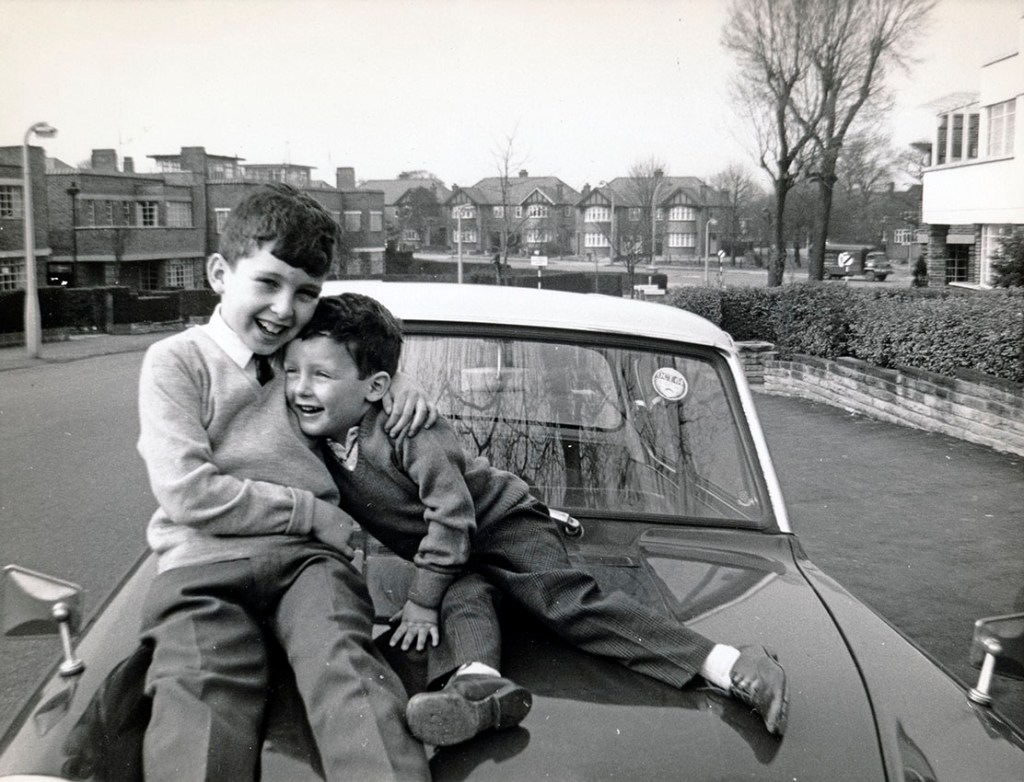
Between the War and my birth, my mum’s family lived in Hendon. Many of our closest family friends remained there, and this is Michael and I during a visit to one of them. We’re sitting on the bonnet of mum’s first Ford Anglia – eat your heart out, Harry Potter!
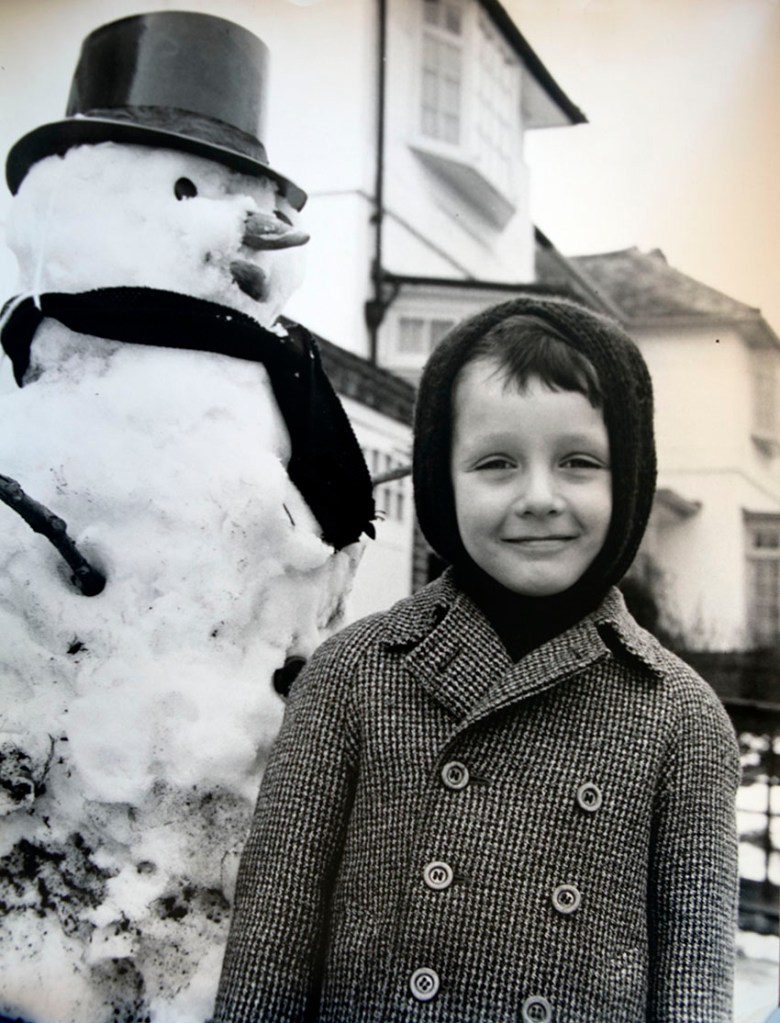
We took our snowmen very seriously back then…
Our second house in Edgware had a large back garden and by “London-clay” standards, half-decent soil. Sidney and I were both keen gardeners, something I remain to this day…
My studio space at Saint Martin’s, with friends and fellow students. The guy on the far left is my lifelong friend Simon – not an artist, just visiting. Next to him, looking at the camera is Robert, a hugely gifted portraitist, and the girl is Piyawan, another very talented painter and cartoonist. Judging by the coats, this was at the end of the day and when we would typically be preparing for a visit to one of the many local Soho pubs…
My final act at St. Martin’s was to undertake this temporary mural commission (I describe the story here) in James Street, Covent Garden…
My grandparents were moderately observant Jews (outside the Haredi communities – and even they differ from one another – there are as many nuances and degrees of “observant” as there are Jews who observe), and the traditional Shabbat supper was always partaken of. Here I’m “making Kiddush” (the blessing over wine) on one such occasion. By this time we had left Edgware and moved to West Hampstead, also North London, but closer to the centre…
I lived at home (in West Hampstead) well into my late 20’s, and this was my painting studio, which we built at the end of the garden…
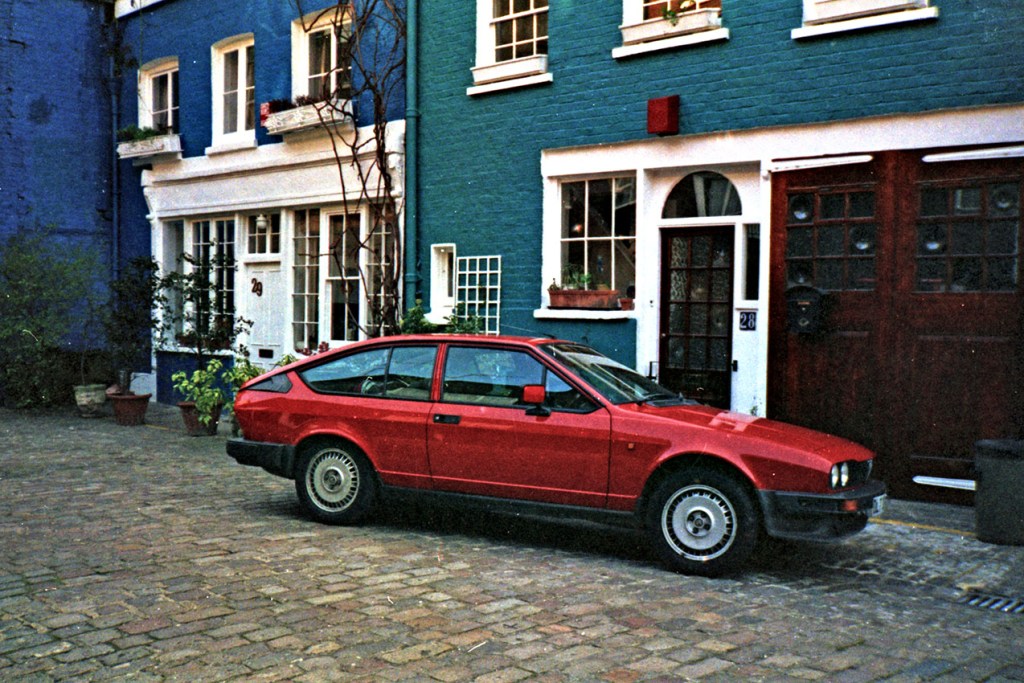
I met my future wife, Dido Nicholson, in 1988 and we married two years later. This was her cute little mews house in Lancaster Gate, close to Paddington Station and Hyde Park. She inherited the Alfa GTV from her uncle Leonard, who sadly died while playing real tennis at Lords (the “HQ” of world cricket)...
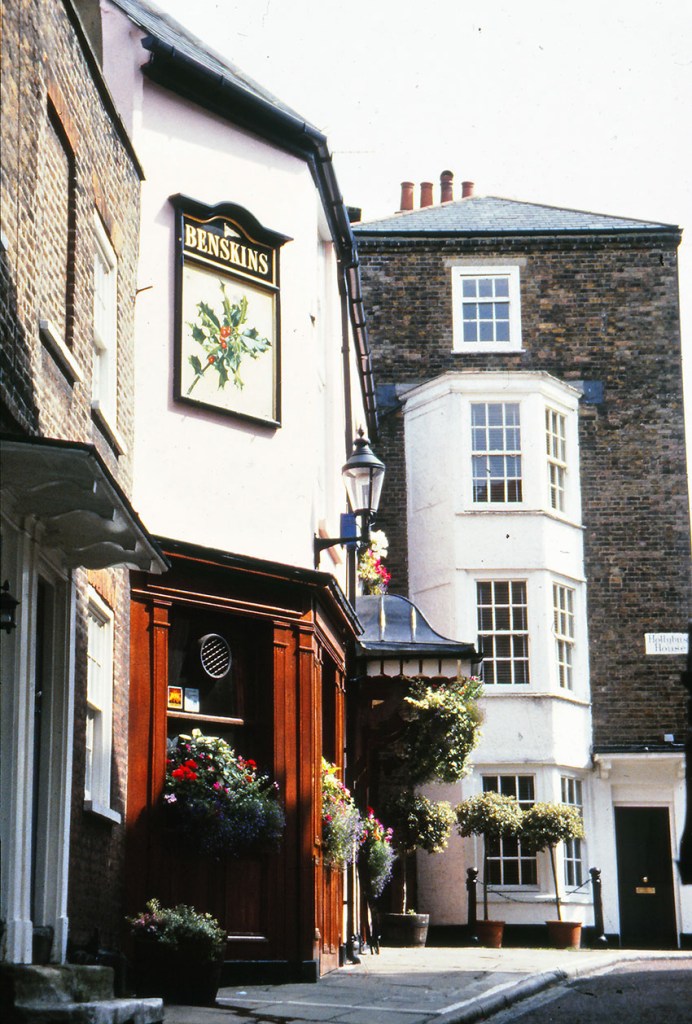
Like most Londoners, I was rarely happier than when visiting one of my local pubs, like the Holly Bush, here in Hampstead, which has turned out to be our final London Address…
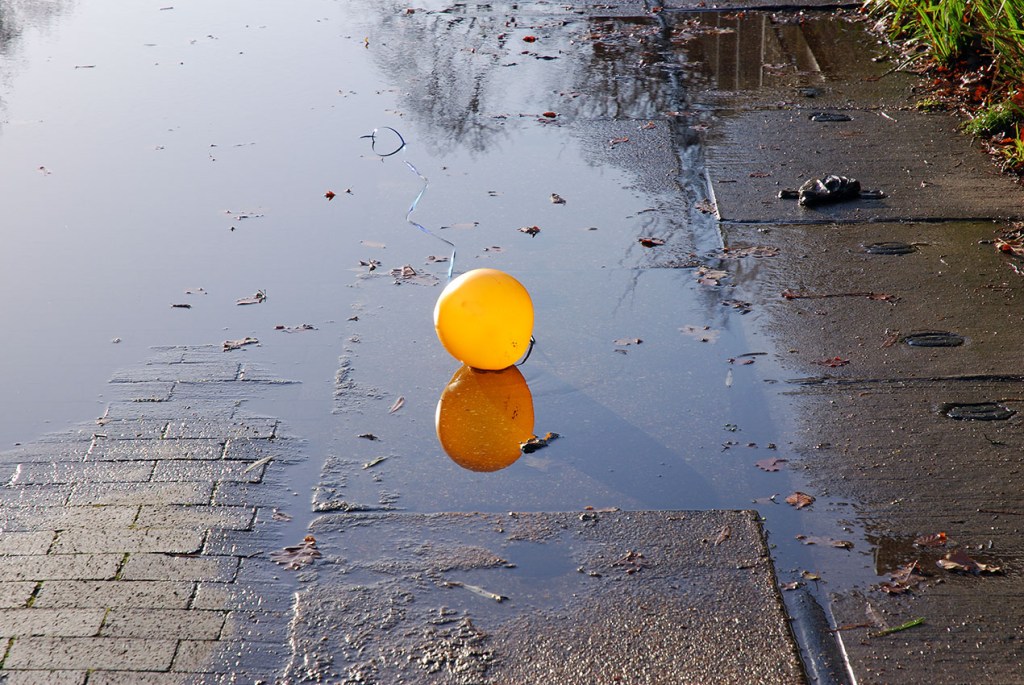
A melancholic New-Years-Day scene on the tow-path of the Regent’s Park, one of our favourite regular walks, and a fitting image to end this homage to a lost city.
The title picture is the top of Primrose Hill. It offers, arguably, the best view of London from north-west of the city. I always found the scene somehow reassuring, and no more so than one misty autumn morning in 2010, when my mother had just left for the airport on her way to Dignitas.
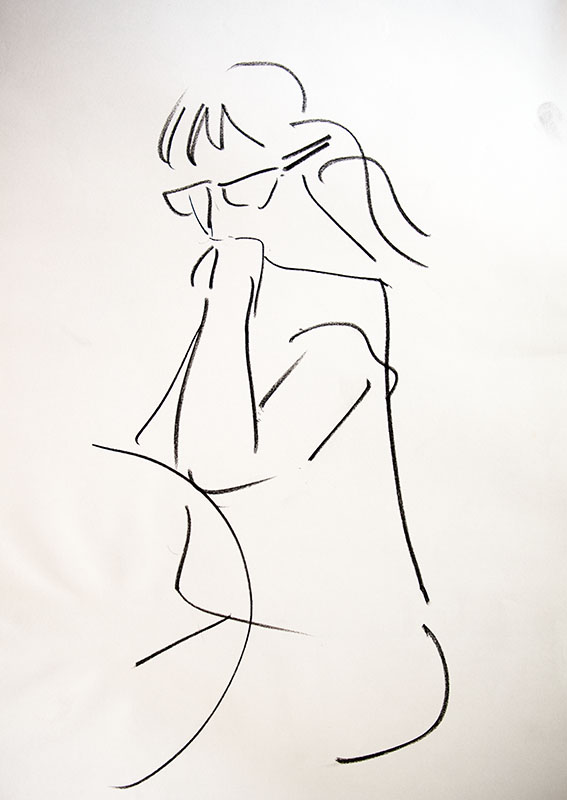
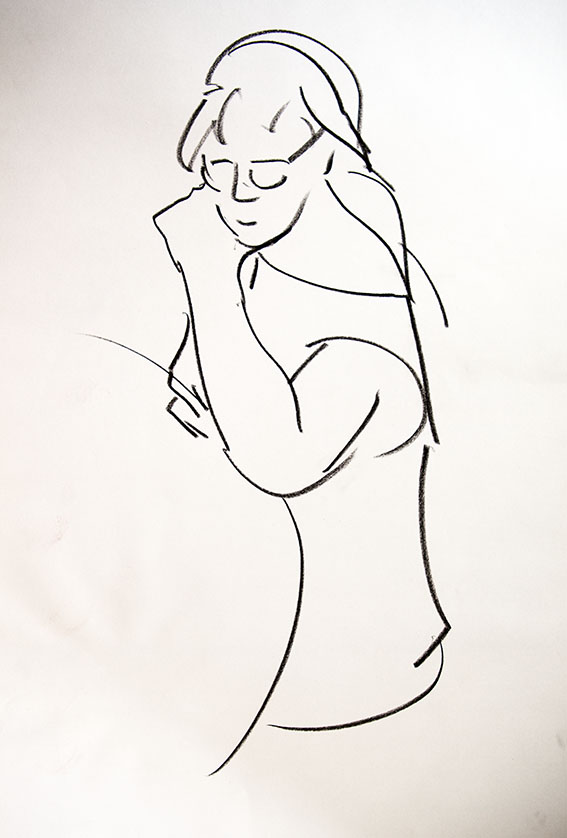
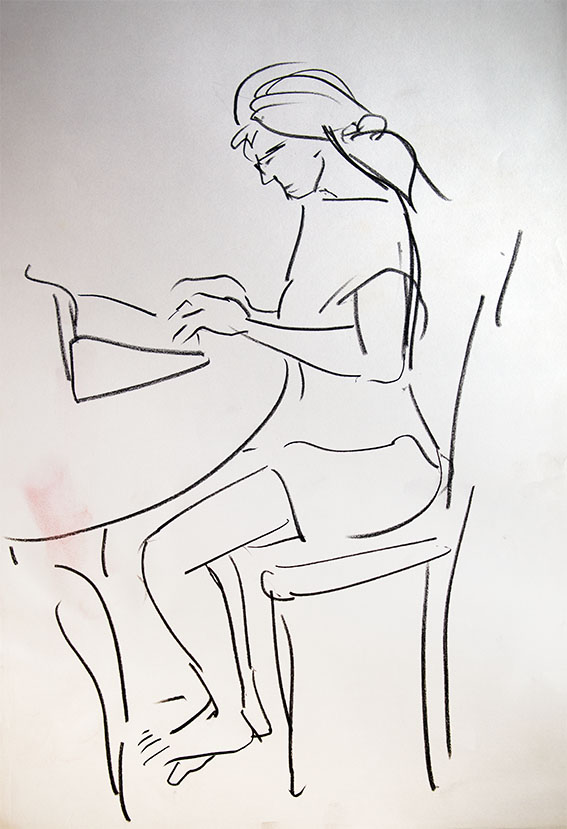
Yet more house tidying, yet more exciting discoveries of my ancient artwork. This time, of long-lost simple line figure studies, of my then-young wife Dido and of her friend and former ballet colleague, Frin.
Both, were natural and highly sketchable models as the images here attest, plus, I seem to have been in unusually relaxed with the old charcoal stick and conte crayon. My muses’ unaffected air and my good drawing form was a happy combination which I now look back upon, some 30 years later, with a deal of pride and not a little amazement.
Sadly, modernism and later, abstract expressionism (admittedly with a few glorious exceptions – from Modigliani to Rothko), inadvertently gave free license for non-drawers to thrive, resulting in the often talentless gimmickry that infests so much of today’s “art world”.
Ho hum…
Fortunately, my utter disillusionment expressed above, came after I had time to make my own joyous-if-modest contribution to the corpus of half-decent picture-making, as these humble sketches bear evidence…
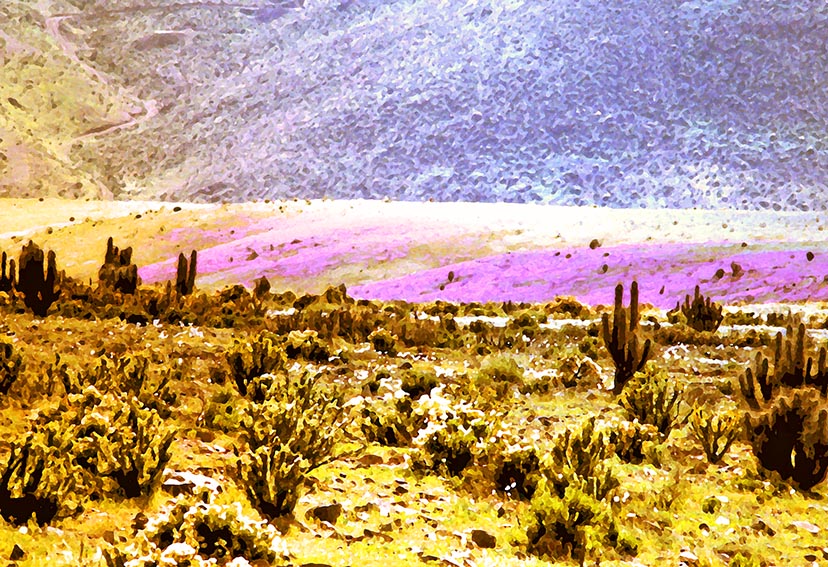
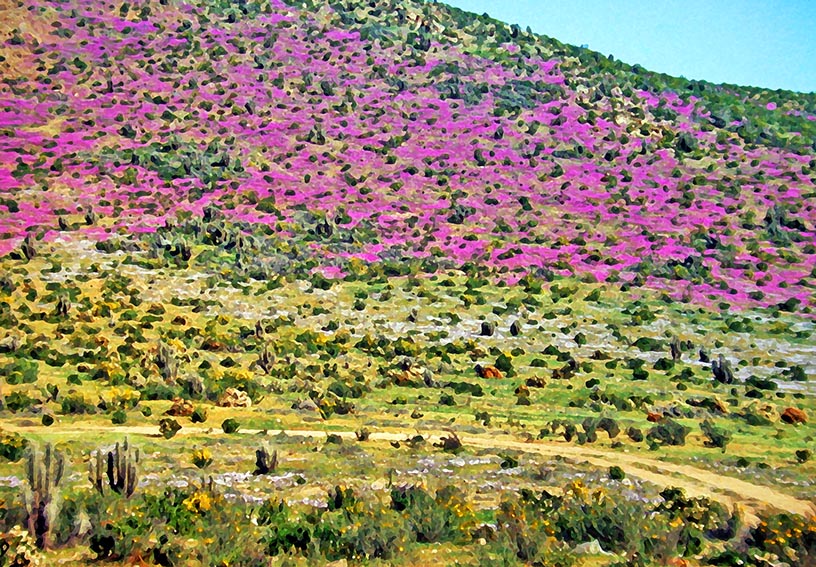
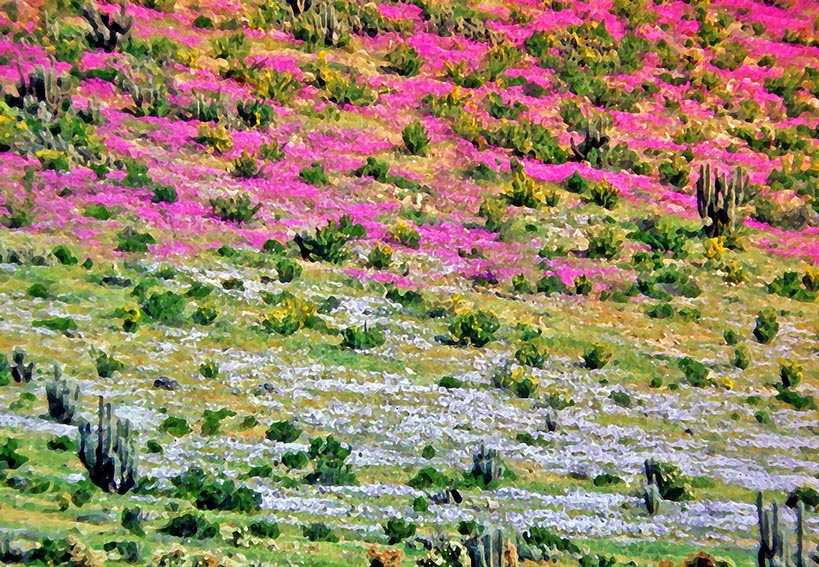
Followers of this site will already be familiar with many of the details of our remarkable trip to Chile back in 1991, just several months after the demise the Pinochet regime.
As if to mark this new era of democracy, freedom and hope, the month we arrived, the southern Atacama Desert experienced – what we were assured by the locals – were the first meaningful rains in forty years, and so, as if in celebration, exploded in a riot of colour. It was as if a vast technicolor carpet had been laid atop the normally monochromatic desert floor as every cactus, every succulent and every dormant seed erupted into vivid flower.
Even in normal circumstances Chile’s many disparate landscapes offer a stunning smorgasbord for the visual senses, but this was simply wondrous. Rarely have we experienced, before or since, such good luck being in the right place at the right time.
The dozen or so images presented here give a taste of what we were so privileged to witness with our own eyes…
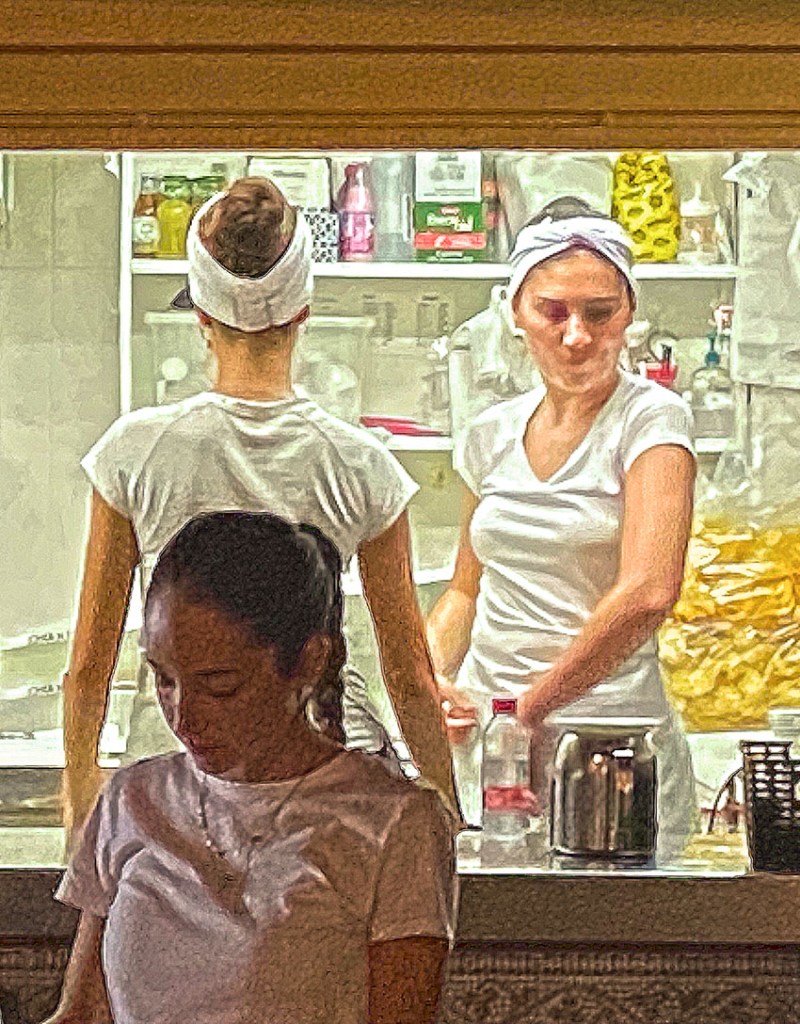
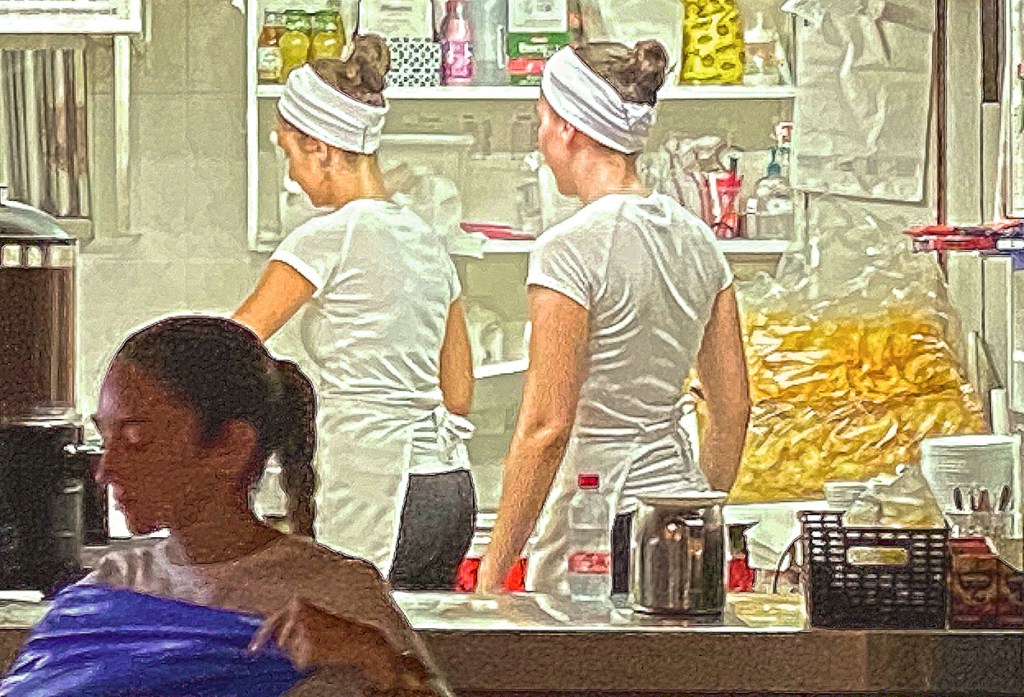
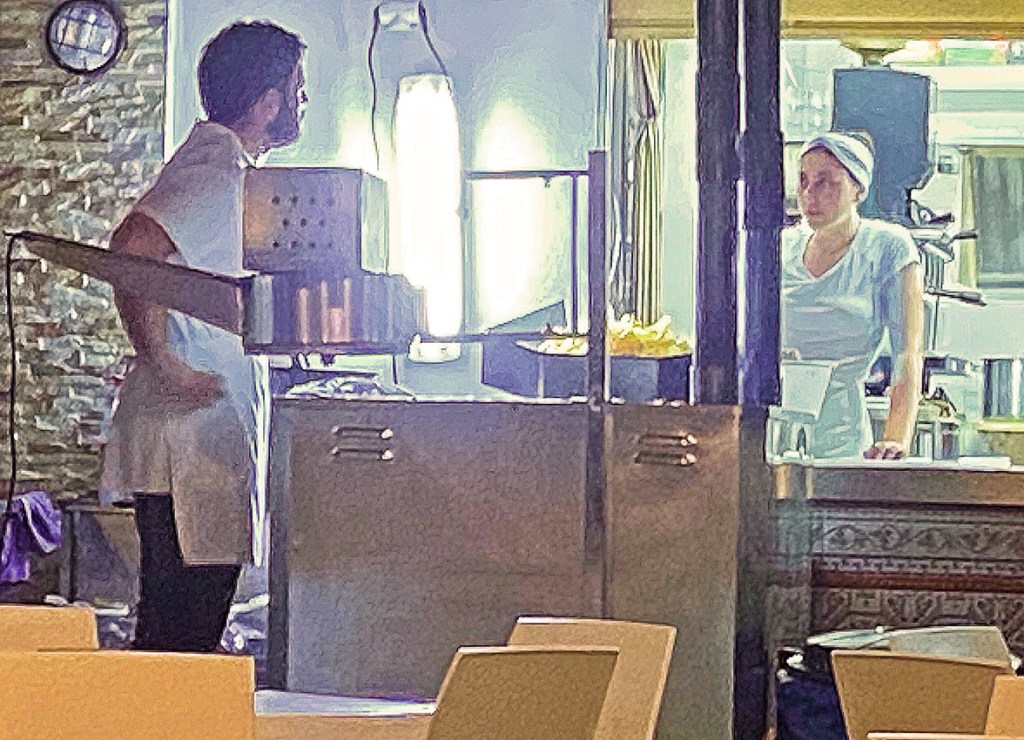
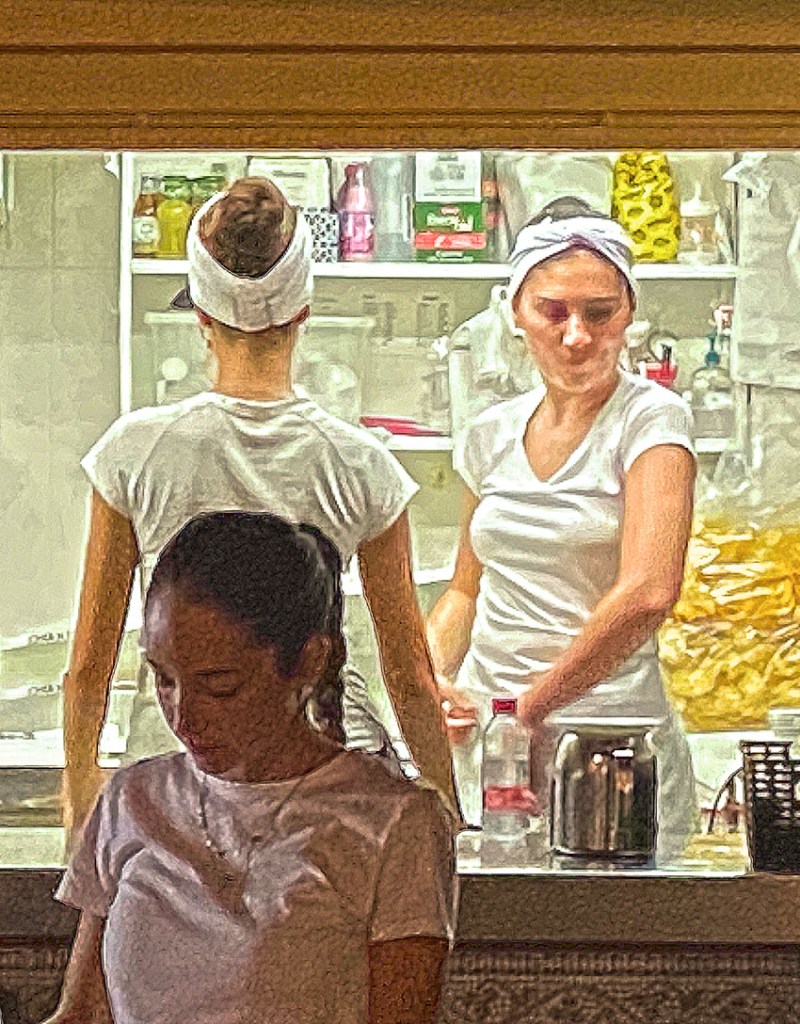
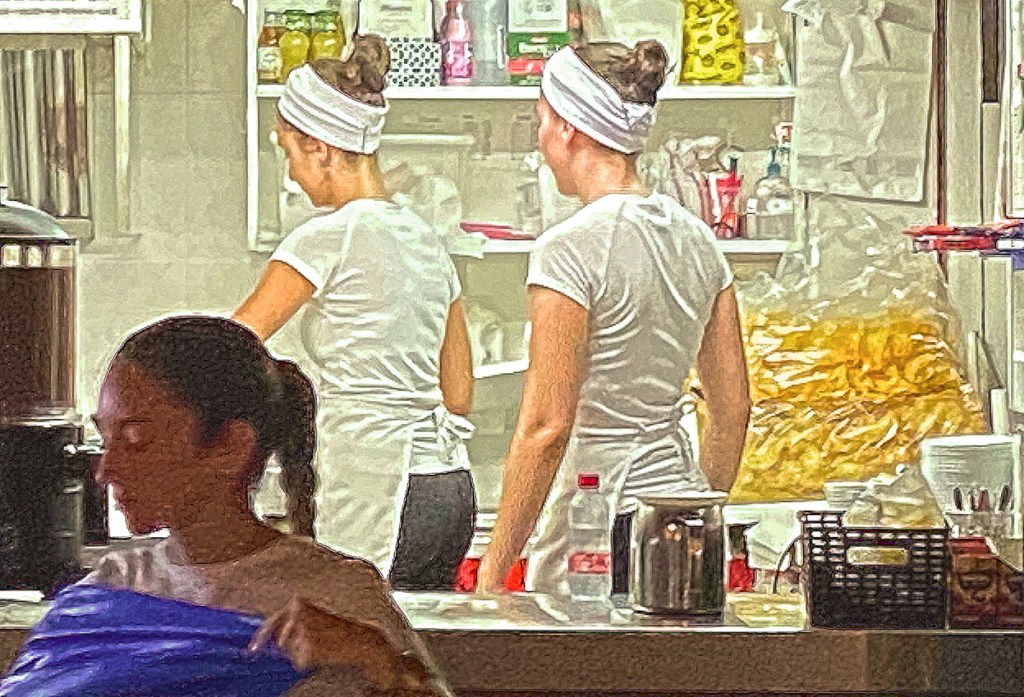
In my previous post I described several instances of discovering wonderful food in the plainest of locations, and since I published that piece, I have also discovered human beauty in an unexpected location.
It happened in Almuñécar, a seaside town on the Granada coast. We were there for the annual “Jazz en la Costa” music festival, when we were enjoying a late post concert beer at an all-night churreria and crisp (chip) frying shack on the beach.
Dido, our friend Pepa and I were feeling a bit down having just witnessed a hugely disappointing performance by the legendary jazz pianist, Abdullah Ibrahim. Unfortunately the elder statesman of South African jazz had a very bad night indeed, constantly hitting off-notes and missing his queues. And that, compounded by the hapless attempts of his sax and double bass accompaniasts to occasionally play jazz riffs on piccolo and cello respectively! So embarrassingly awful was the performance, that we upped and left early to seek solace in some liquid refreshment, and so found ourselves at the churreria.
Within seconds of sitting down at the table I became captivated by a scene of such elegant industry and confident movement, the recent memory of Mr Ibrahim’s faltering piano playing drifted away on the Mediterranean night breeze.
These images are my photoshopped fun attempt to turn a few hastily snapped iPhone photos of that effortlessly stylish scene into a modern-day Vermeer-esque tableau. I hope they please…
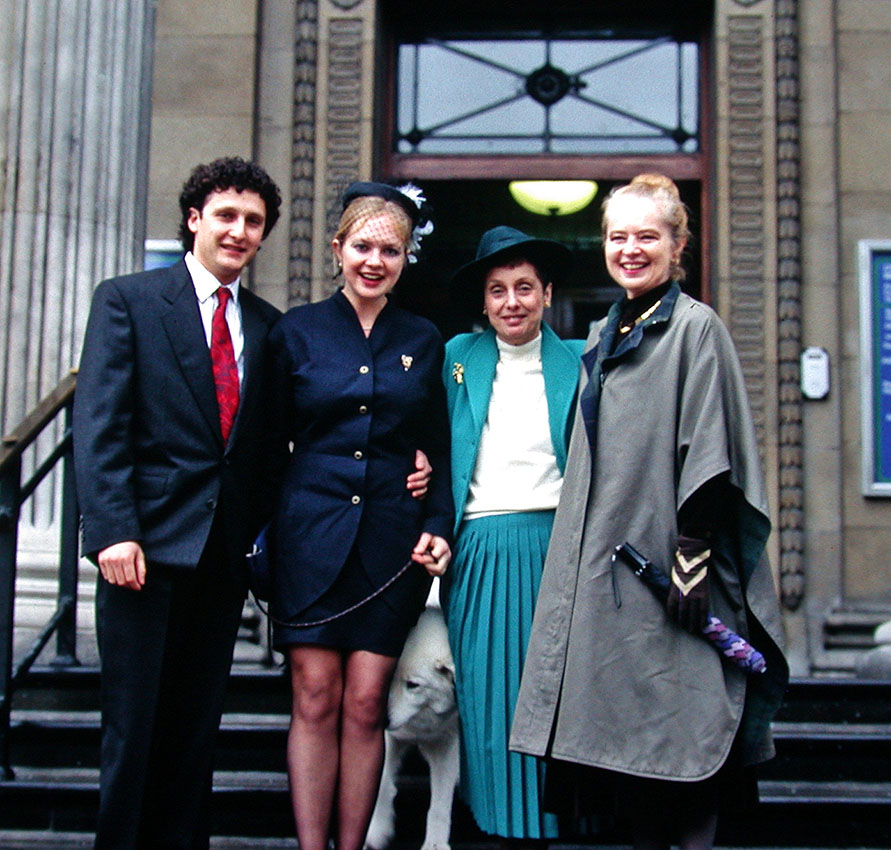
Dido and I met on New years Day 1989, and two years later, considering my appaling memory for cellebratory dates, we decided to get married on New Year’s Eve, to ensure I would never forget our anniversary. So far, thank goodness, it’s worked, and so today, I remember fondly, that at about noon Gibraltar time we will have been wed for 32 years (our lapis lazuli wedding no less – who knew?).
This post is really by way of a Happy New Year greetings card to all our family and friends, and any other readers of these pages.
Let’s all hope that 2023 passes and ends better than 2022 and provides us all with joyous memories to rival those displayed here!
We had a small, civil wedding at Marylebone Town Hall (in the West End of London – famous for celebrity weddings)with just my mum (in turquoise), Dido’s parents (her father taking this photo) and our dog Aura in attendance. Given our two years of being together, Dido opted for a dark blue wedding! Following a light pub lunch with the parents, Dido and I watched a video of Cassablanca (our favourite film) over a bottle of fine champaigne before heading to a half-decent nearby french restaurant for our celebratory supper with a small group of friends and family. Being New Year’s Eve, things got pretty rioutous, and this is where we learned that Beaumes de Venise is not suitable for quenching table fires…
The gorgeous bride…
Still just about compos mentis. Little if any sleep was had that night, as we had an early morning ferry to catch from Dover to drive to our two-night honneymoon at a romantic chateau hotel in northern France. A week later, and fully recovered, we gave a reception to all our friends and family at our home in London. Golden, if slightly hazy memories…
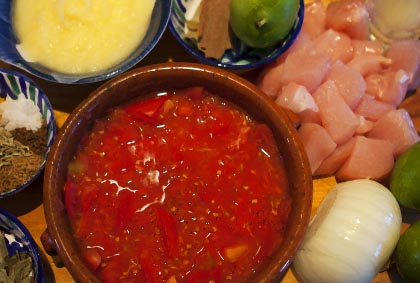
One morning, several years ago, I was pouring through my collection of Indian cookery books looking for something different to do with a chicken breast languishing in my fridge. As often happens on these occasions, after ten minutes or so of not finding quite what I was looking for, I was about to revert to my trusty old Madhur Jaffrey butter chicken when a piece of paper being used as a bookmark caught my attention. Frayed and food-stained, it turned out to contain a barely legible biro-scrawled recipe for a chicken curry. After further examination, I noted that it contained some unusual culinary bedfellows for an Indian chicken dish – things like olive oil, ground caraway seed, lime juice, and most particularly, both bay and curry leaves. Then suddenly I remembered a swelteringly hot and sticky afternoon spent in a hotel kitchen in southern India in the autumn of 2003.
We were guests at the aptly named Ideal Beach Resort, in Mahabalipuram, on India’s Tamil coast, resting up for a few days before travelling inland to Coimbatore (where my wife Dido was to help in the establishment of a clinical education centre for children with autism).
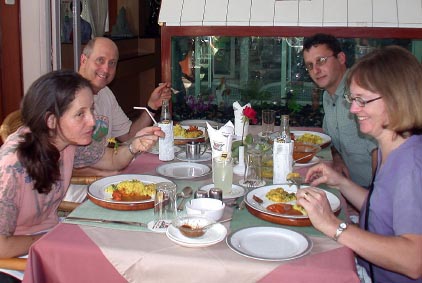
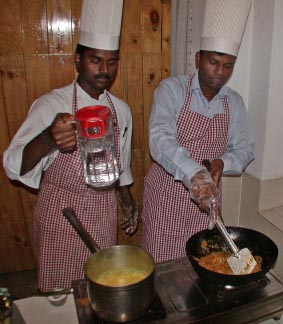
I think it was on our first evening there, during supper, we got chatting with a very affable American couple at the next table who turned out to share our enthusiasm for the delicious local cuisine. At some point during the meal the four of us were invited by the maître d to visit the kitchen the following lunchtime to watch our food being prepared. Cathy – the lady of the American couple and a veteran of the Ideal Beach Hotel – chose the menu, including the lime chicken curry which turned out to be as delicious as it was unusual.
Cathy, Richard, Dido and yours truly enjoying our curry lunch
The rare blend of ingredients and spices was explained by the fact that our young head chef, although a Tamil, had been trained in Bengal and enjoyed fusing the two distinct culinary traditions.
Fortunately Dido had the presence of mind to record the preparation of the curry and – albeit thirteen years late – I was able to decipher the recipe and apply it to the chicken breast in my fridge. And, it was absolutely delicious! The caraway, lime, bay and curry leaf are a group marriage made in heaven – a complex and unctuous harmony of savoury, fragrant bitter sweetness that transforms humble white chicken meat into a thing of olfactory delight.
There are two ways to sample this fabulous curry – either follow the recipe below, or better still, go and visit the Ideal Beach Hotel. I can recommend both.
(Chapatis and a hot lime pickle are excellent with this curry also, if using fresh curry leaves, add at the same time as the lime juice.)
RECIPE(serves 2):

INGREDIENTS
¼ cup:			olive or coconut oil
200gm / 8oz:		diced chicken breast

SPICE MASALA I
5cm / 2” stick:		cinnamon
2 – 3:			cloves
2 - 3:			cardamom pods
1:			bay leaf
1:			small brown onion – finely grated
5cm / 2” piece:		ginger – peeled and coarsely chopped
6 cloves:		garlic – peeled and coarsely chopped
2 tbsp:			water
1:			large, ripe tomato chopped

SPICE MASALA II
½ tsp:			turmeric
1 tsp:			chili powder
1½ tsp:			ground coriander seed
1 tsp:			garam masala
1 tsp:			ground caraway seed
1 tsp:			whole fennel seed
1 tsp:			salt
3:			curry leaves
½ ltr / 1 pint:		water
To taste:		salt
To taste:		lime juice


METHOD:

1.	Blend the ginger, garlic and water into a paste
2.	Heat the oil in a kadai or a heavy skillet on a medium high heat
3.	Brown the diced  chicken thoroughly, then remove from kadai and                           put aside (retaining the juices)
4.	Add masala I to the kadai and sweat for 5 minutes, stirring        constantly until well browned
5.	Add onion to kadai and stir-fry until browned
6.	Add the tomato to the kadai and fry for 2 minutes until oil separates from the masala, onion and tomato paste
7.	Add the ginger and garlic puree to the kadai and stir for 1 minute
8.	Return the chicken and its juices to the kadai and stir well
9.	Add masala II and the curry leaves to the kadai and stir well, making certain the chicken is well coated
10.	Add the water, making sure to deglaze (scrape) the bottom of the kadai
11.	Bring to the boil, then cover and simmer for half hour
12.	Remove cover, add more salt (if necessary) and lime juice to taste, stir well and remove from heat
13.	Remove cinnamon, cloves and cardamom pods before serving
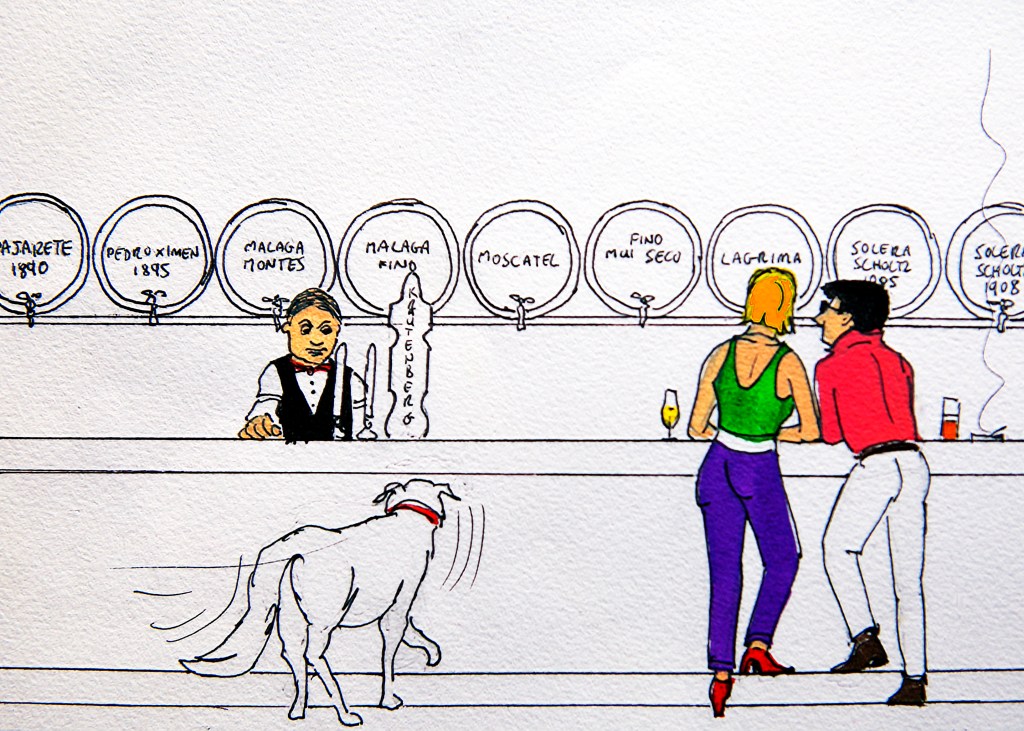
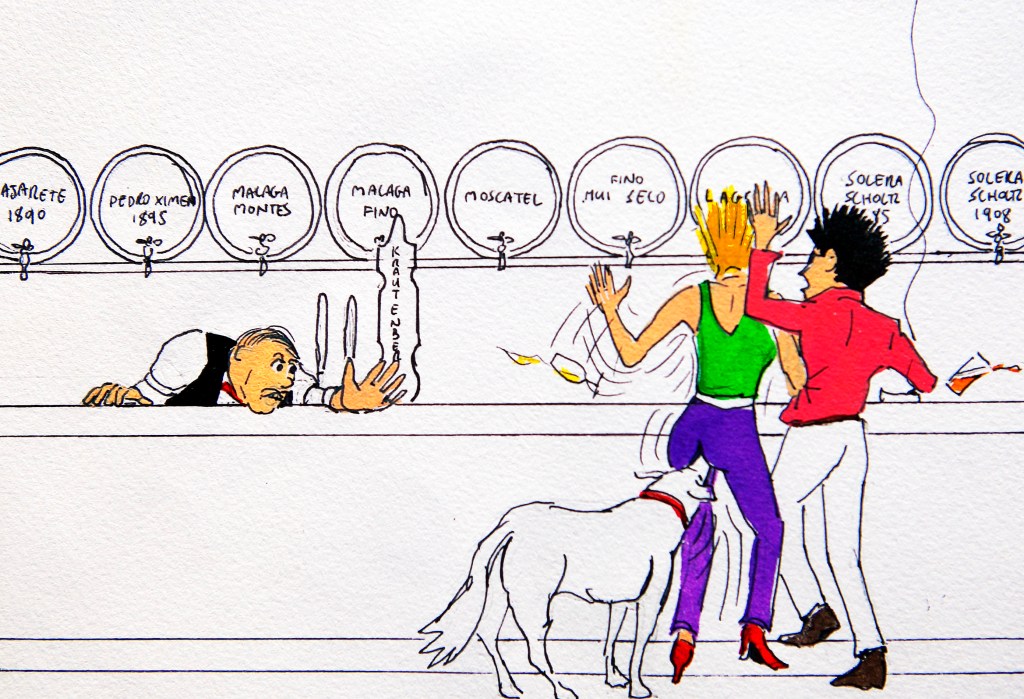
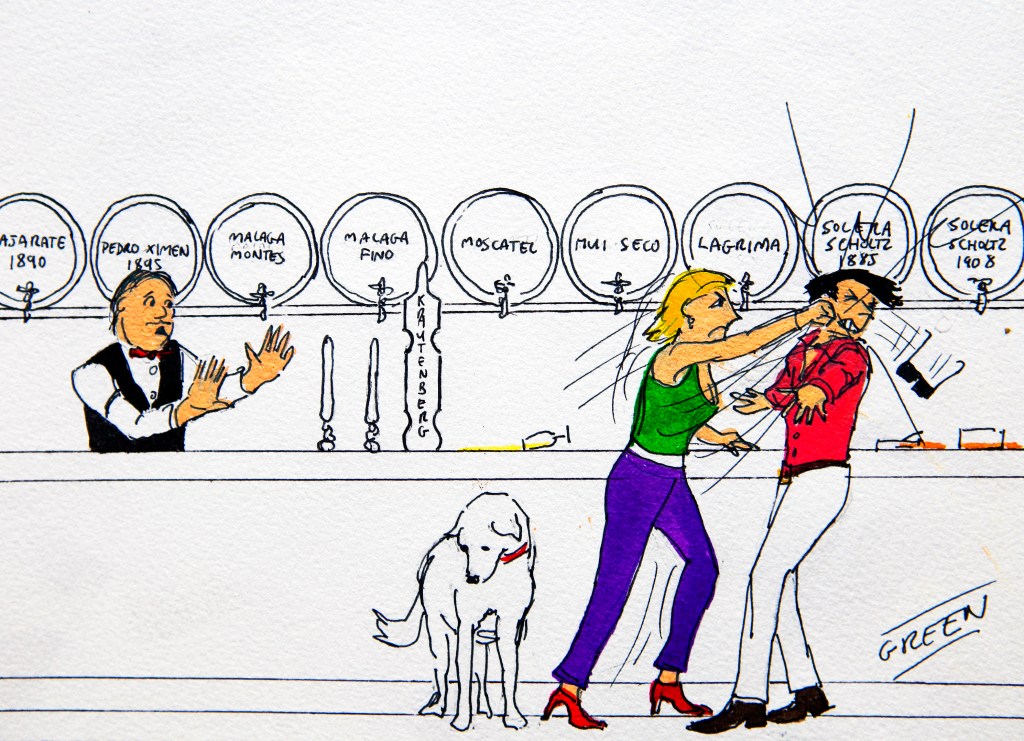
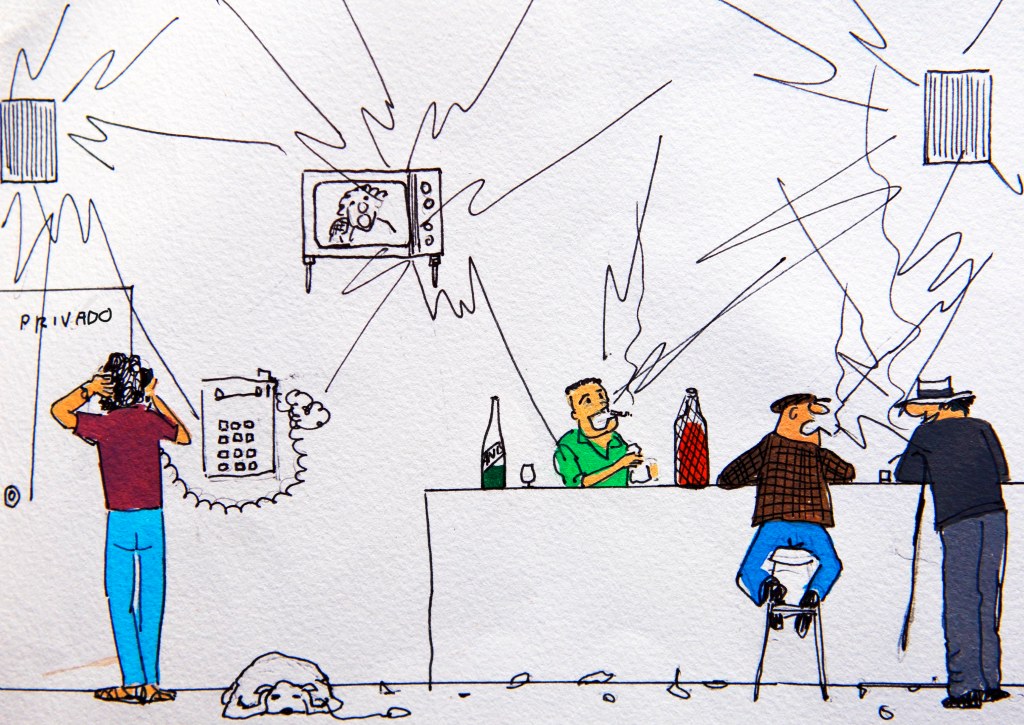
Sometime around the mid 90’s of the last century, for some reason I can’t remember now I decided to make a series of 6-box comic strips describing amusing experiences that had had happened to us – “us” being my wife Dido, our Maremma Sheepdog Aura, and yours truly – on our travels. Thus, while all of them are based upon actual events, some are more close to actuality than others.
1: Aura’s Big Sniff
I’m starting this series off with one of the less exaggerated episodes. In fact this is true in every detail, except that it happened in London, in The Alexander Fleming Pub in Paddington and not in the famous old wine bar in Malaga (La Antigua Casa de Guardia) in which the drawings are set. In addition, the barman at the pub was so amused by what happened that he gave Aura a Cumberland sausage as a thank you for making his day!
Again, do please click on the images to follow the comics in all their glory…
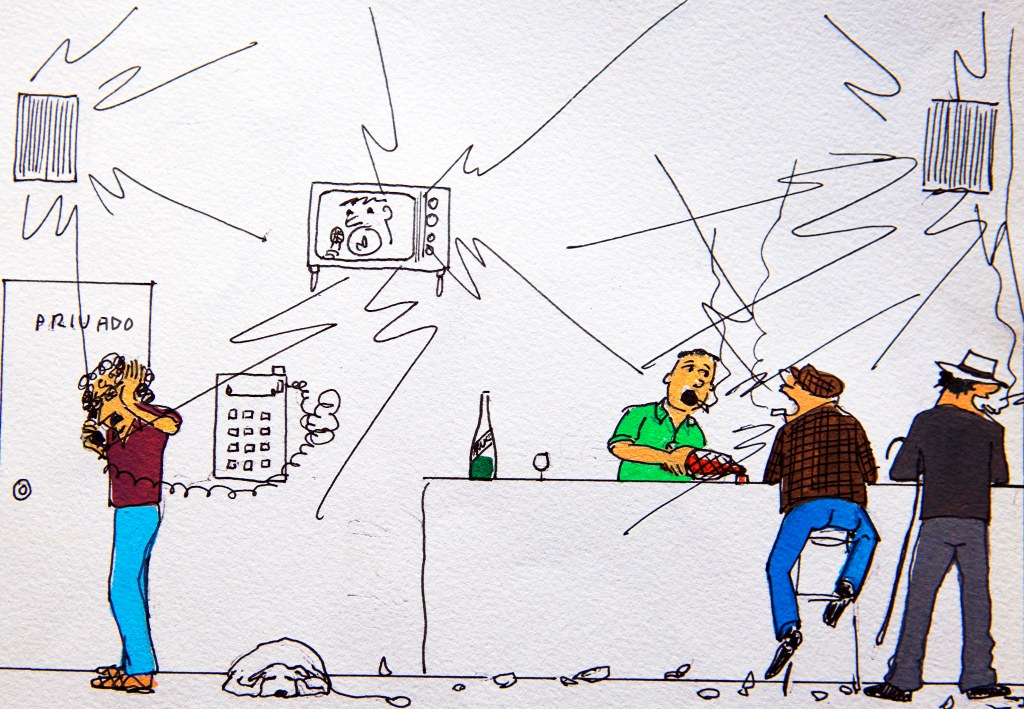
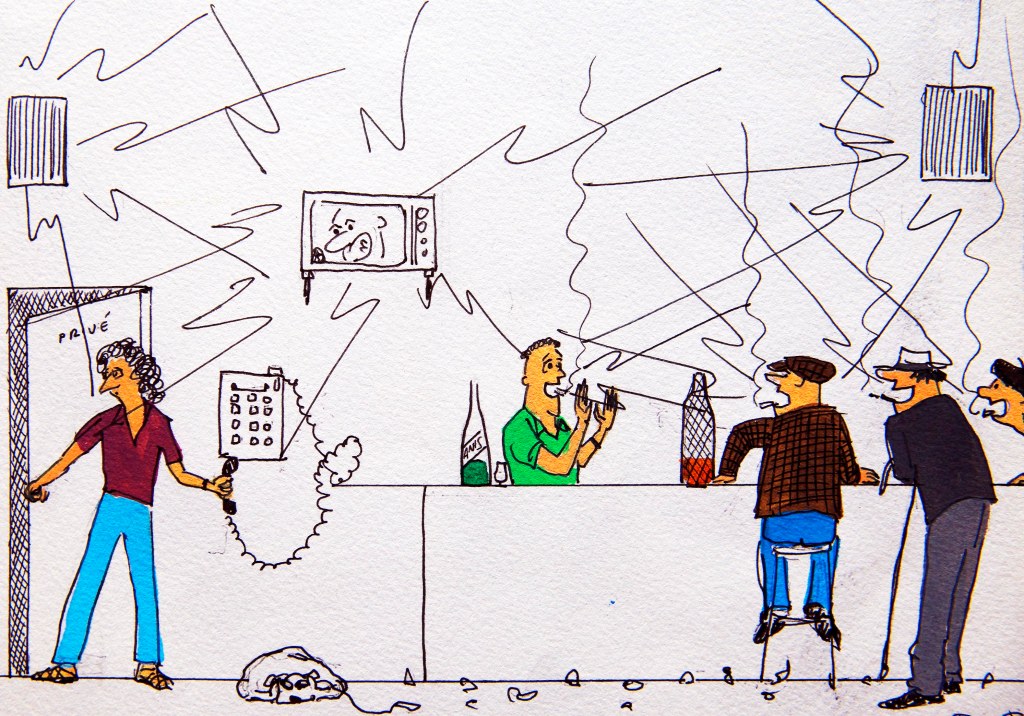
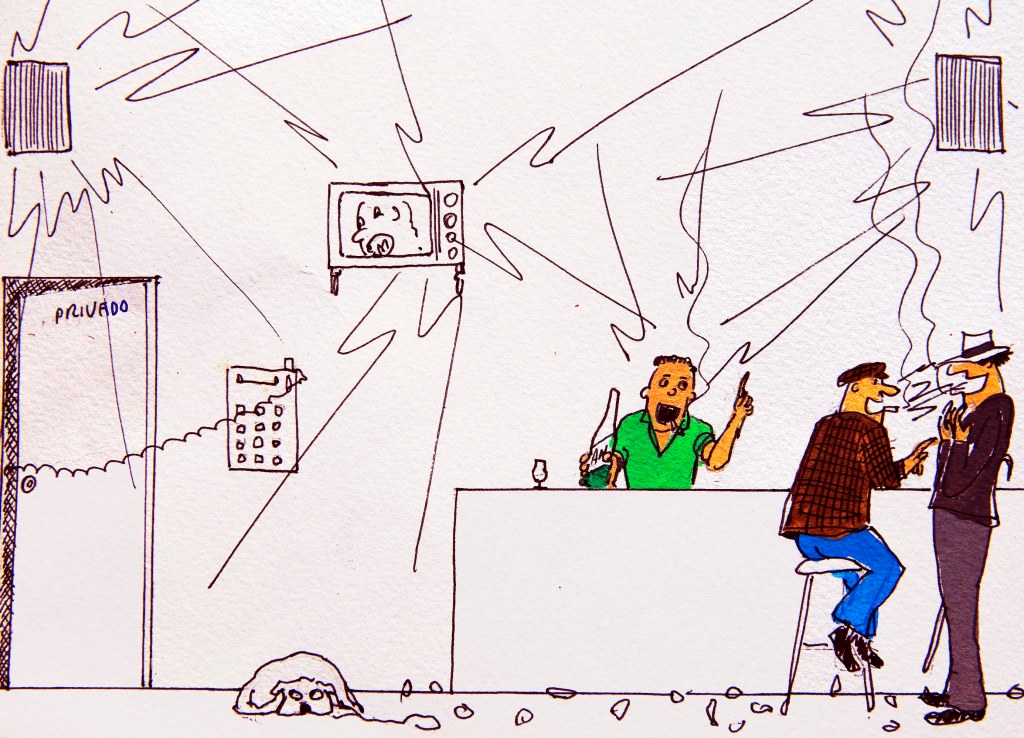
2: Phoning From Bar Angel
As with the previous episode, this too actually happened as described, but at the location depicted. Bar Angel was one of a handful of bars and restaurants located in our local mountain peublo blanco (white village), and in the days before mobile phones had taken on here in Andalusia, provided one of the few pay-phones in the area…
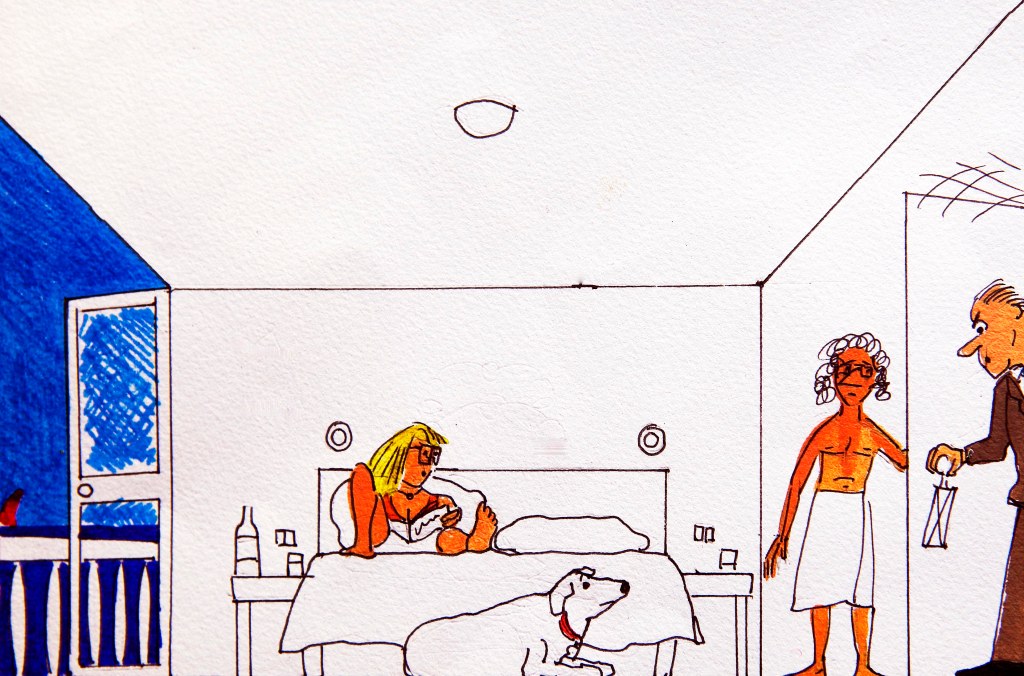
3: A Dog in the Room
This is the first in the series where I stretched the truth somewhat, insomuch as the last box is a slight exaggeration – in reality, Dido merely manhandled the hotel manager out of the room. This happened on our drive down through Spain on the journey when we actually moved here – in the early summer of 1993. The most amazing element of the episode was how passive Aura remained throughout the contretemps – which was fortunate for all concerned!
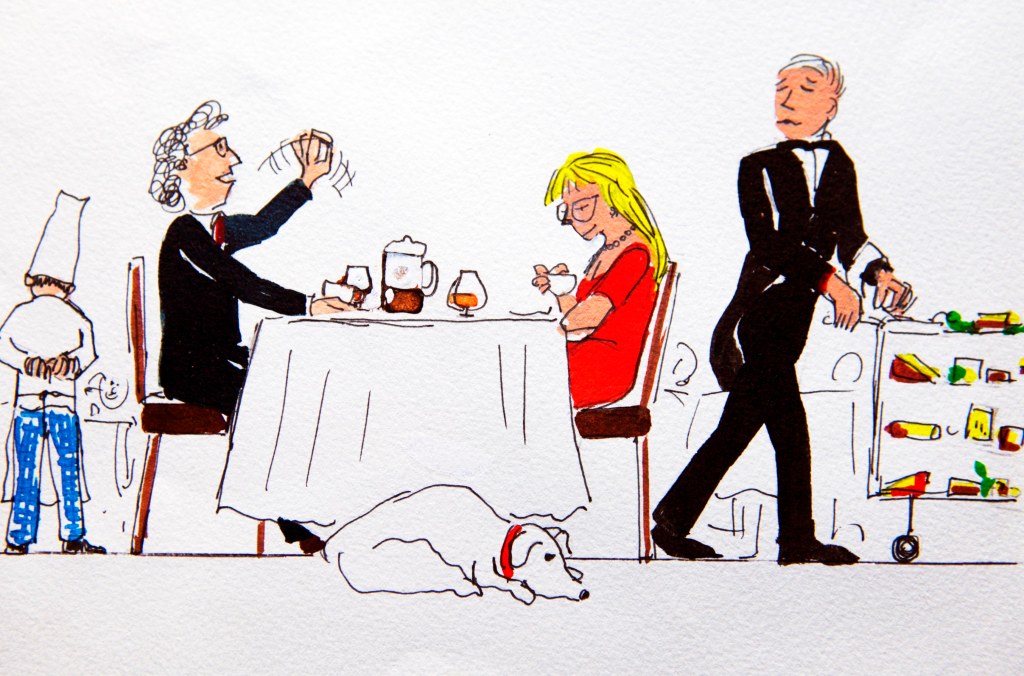
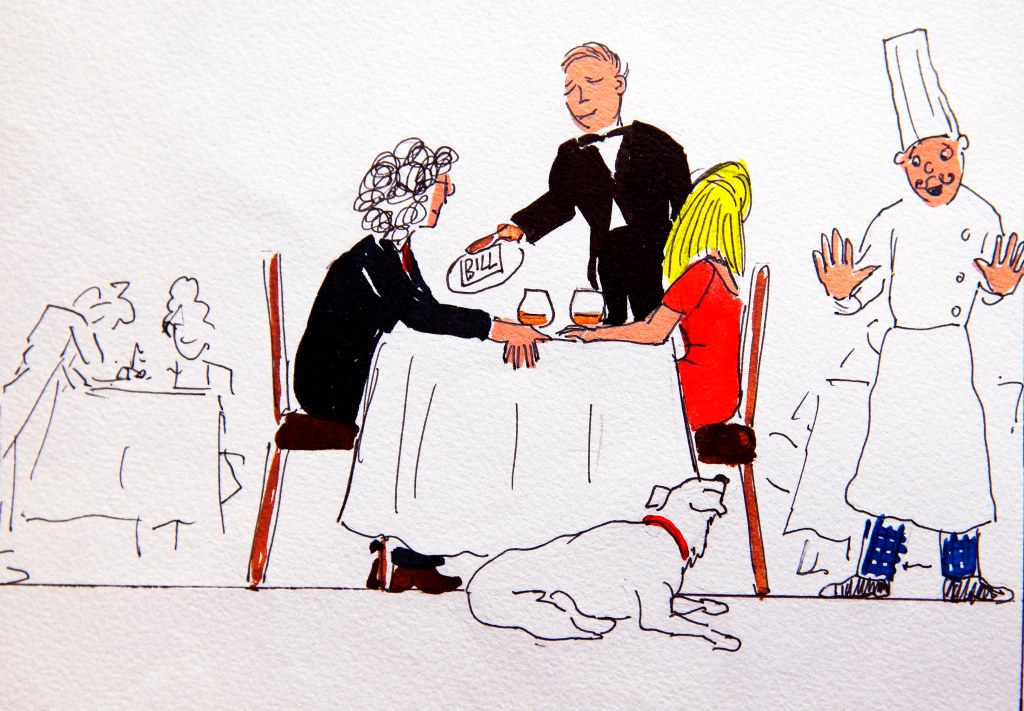
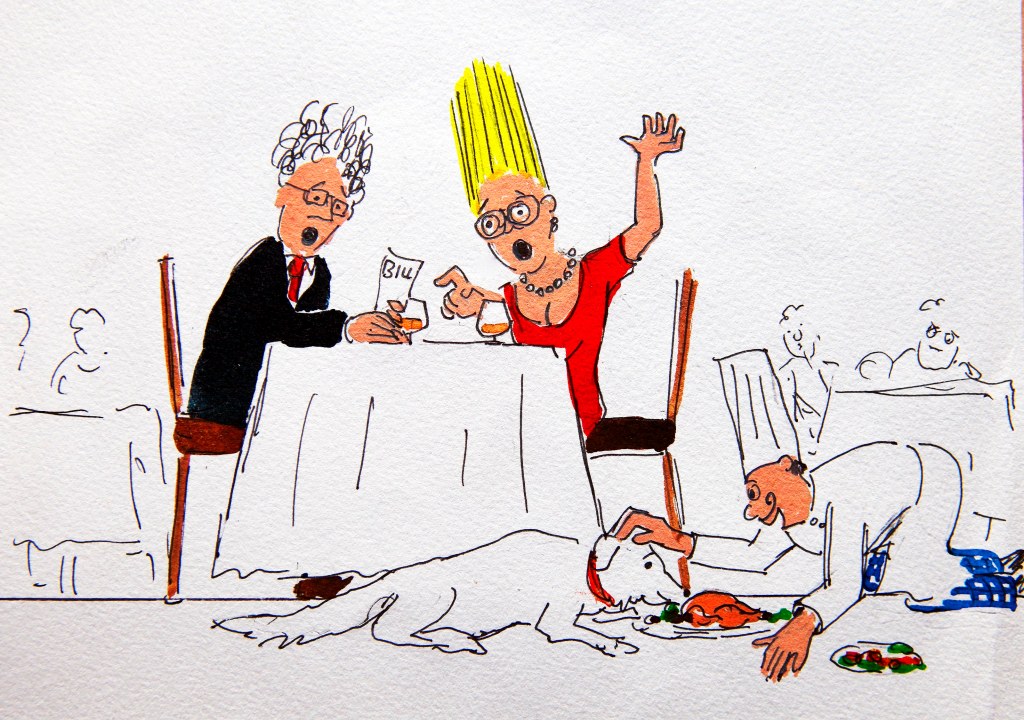
4: Michelin Maremma
This episode also occurred during our 1993 move trip down to Spain in a 2 Michelin Star establishment in the French Pyrenees. There are just two “slight” exaggerations in this strip: Firstly; we didn’t really exchange places with Aura – as much as we wanted to, and secondly; all the chef actually gave to Aura was merely a plate of duck carpaccio followed by sautéed calves liver in butter. There’s also one priceless thing which I failed to get across in this strip, and that was the horrified expressions of the mostly-American patrons at the neighbouring tables!
And a PS: Aura really did often eat reclining, true to her ancient Roman heritage…
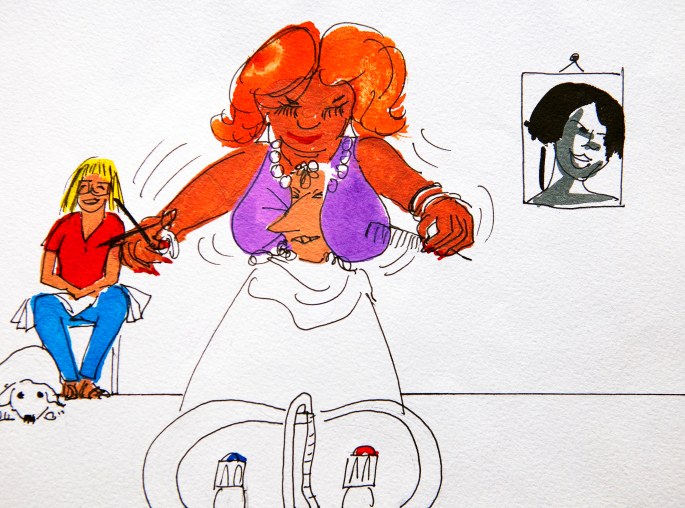
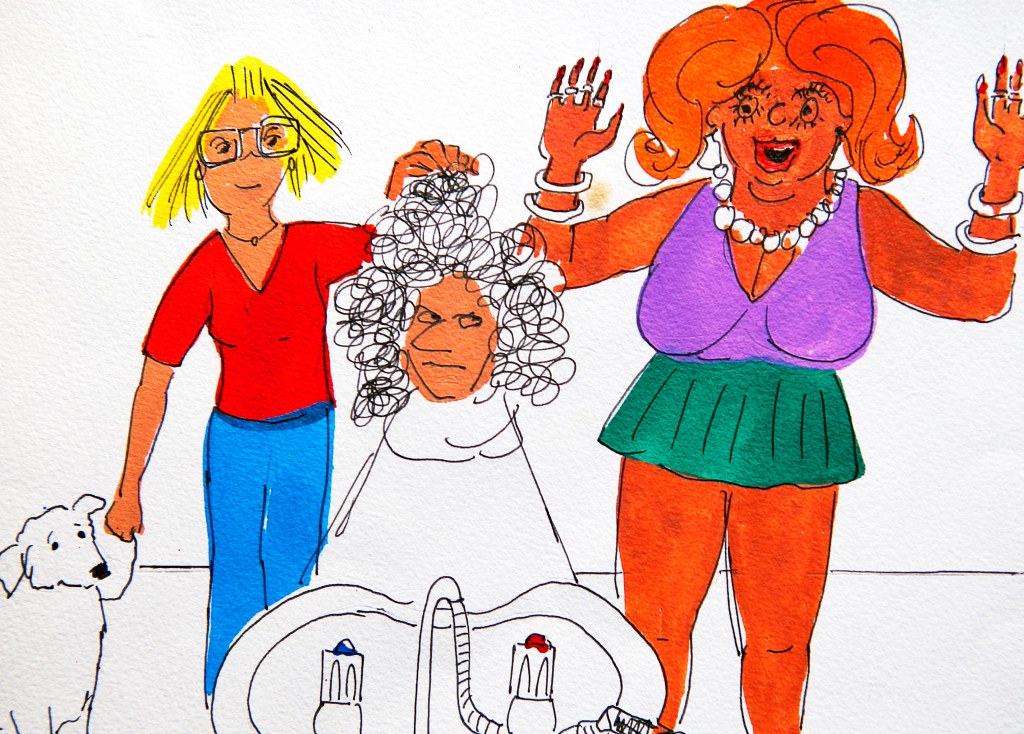
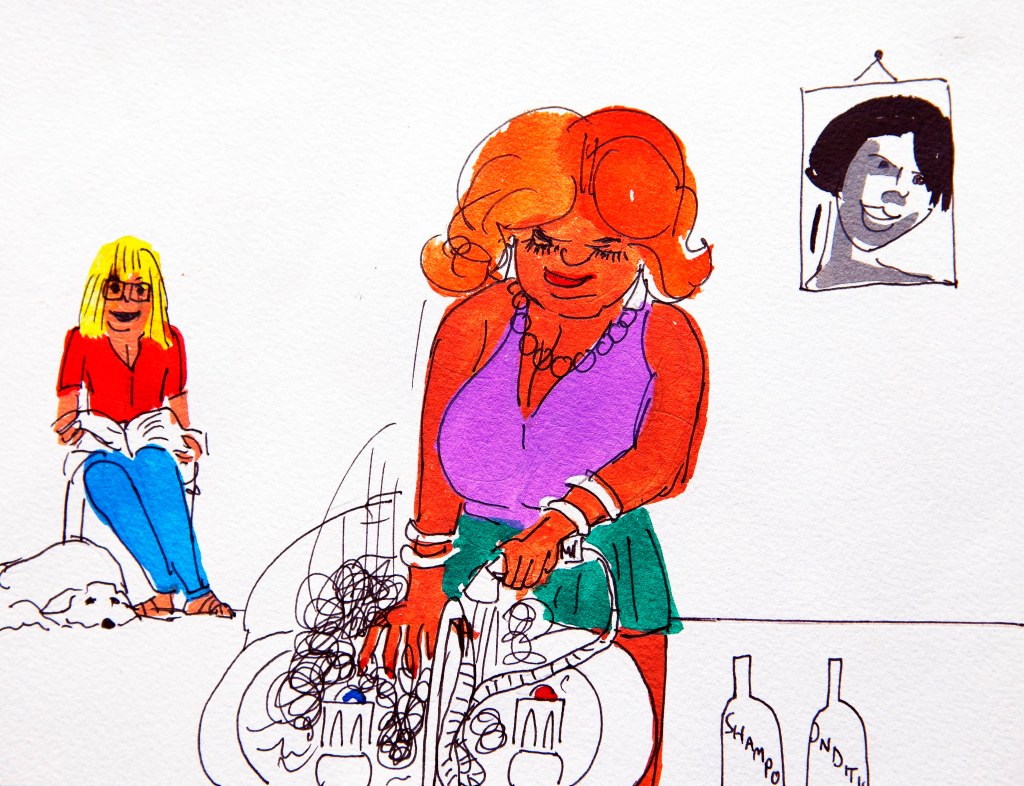
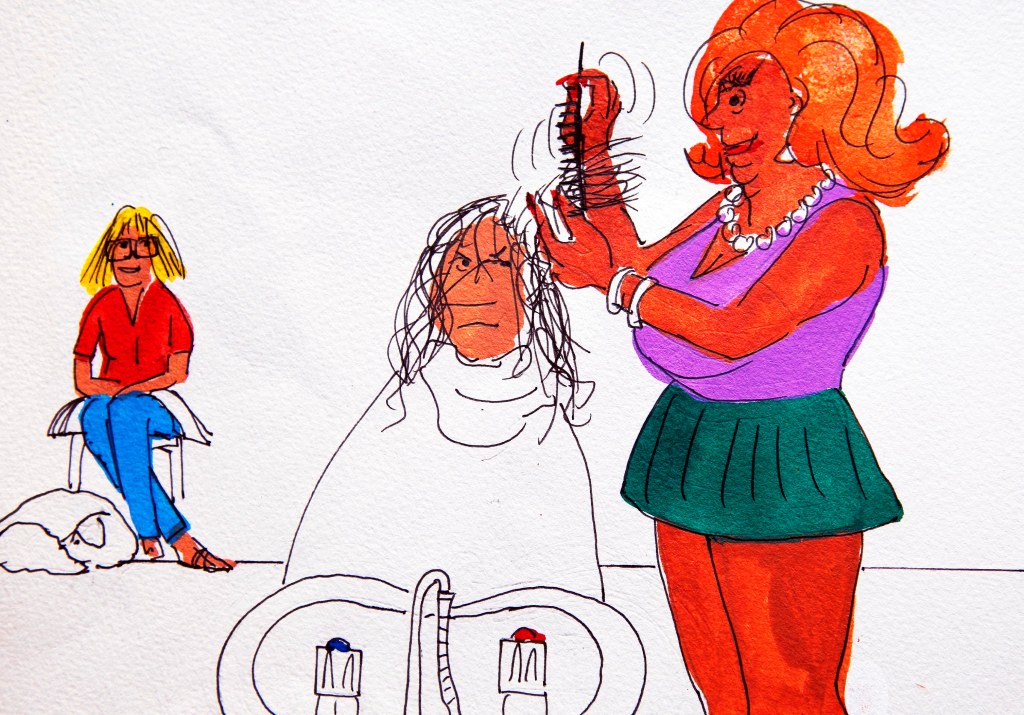
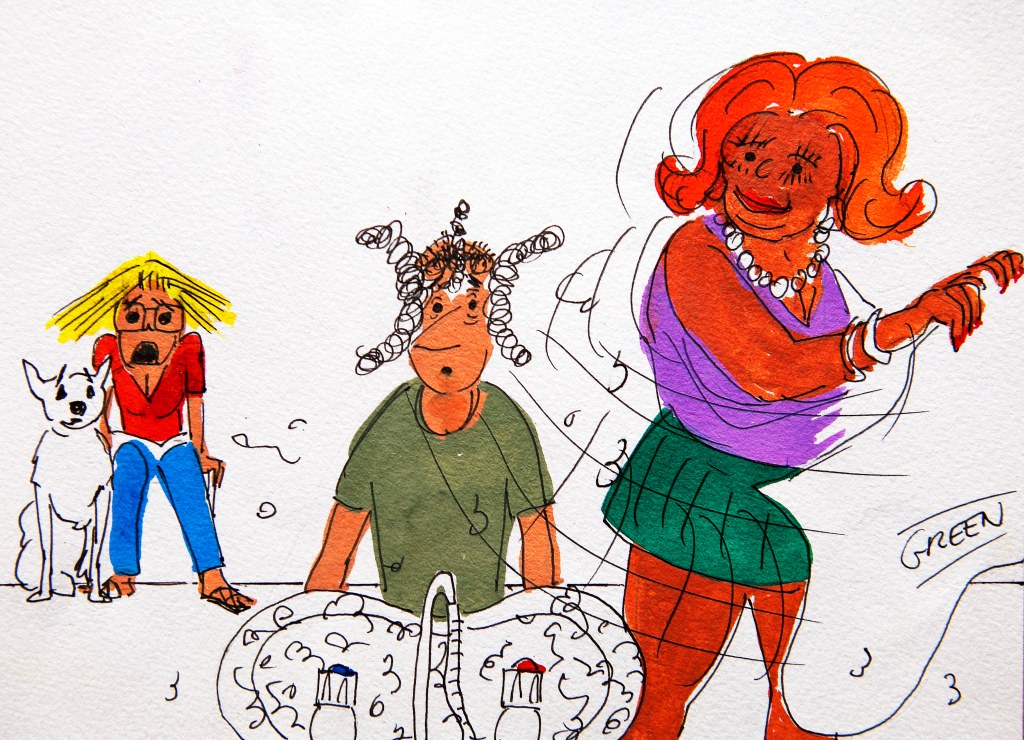
5: Short-Back-and-Boobs!
This is almost totally true except for the fact that the lady cutting my hair had two girlfriends in the salon with her, and for much of the time my head was compressed by three sets of boobs rather than just merely one as they passed the time of day over my poor noggin!
The “salon” was situated in our local pueblo blanco, where, back in the 90’s “men were men” and never entered – let alone got their hair cut in such a “feminine” establishment. Thus, the hairdresser’s surprise and thrill at getting her hands on a head like mine was extreme.
Fortunately, Dido took pity on me and immediately raced me down to our local town on the coast for a remedial styling…
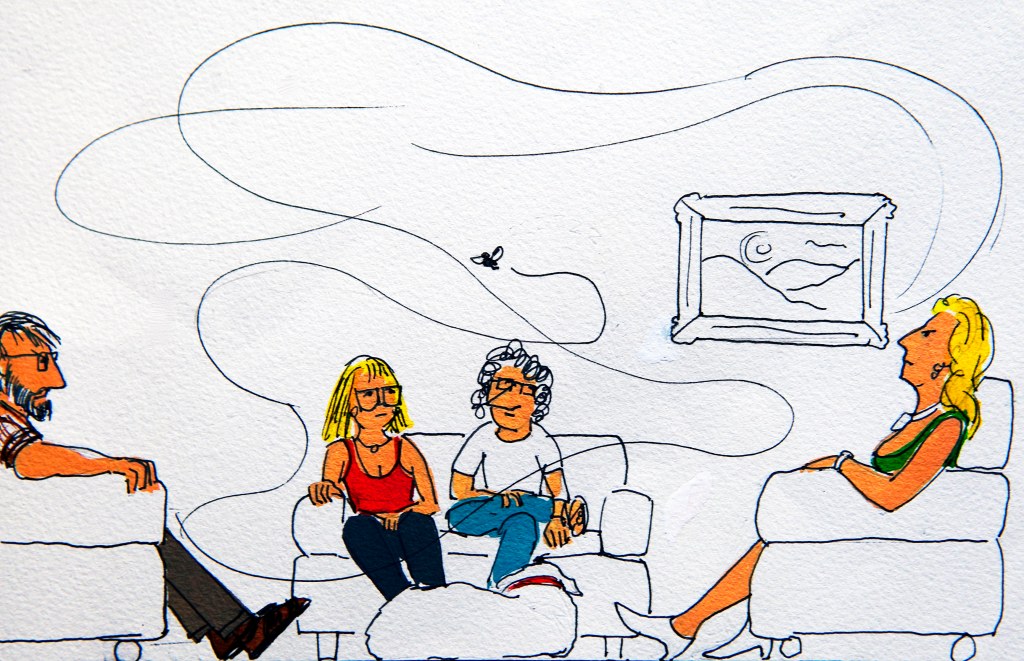
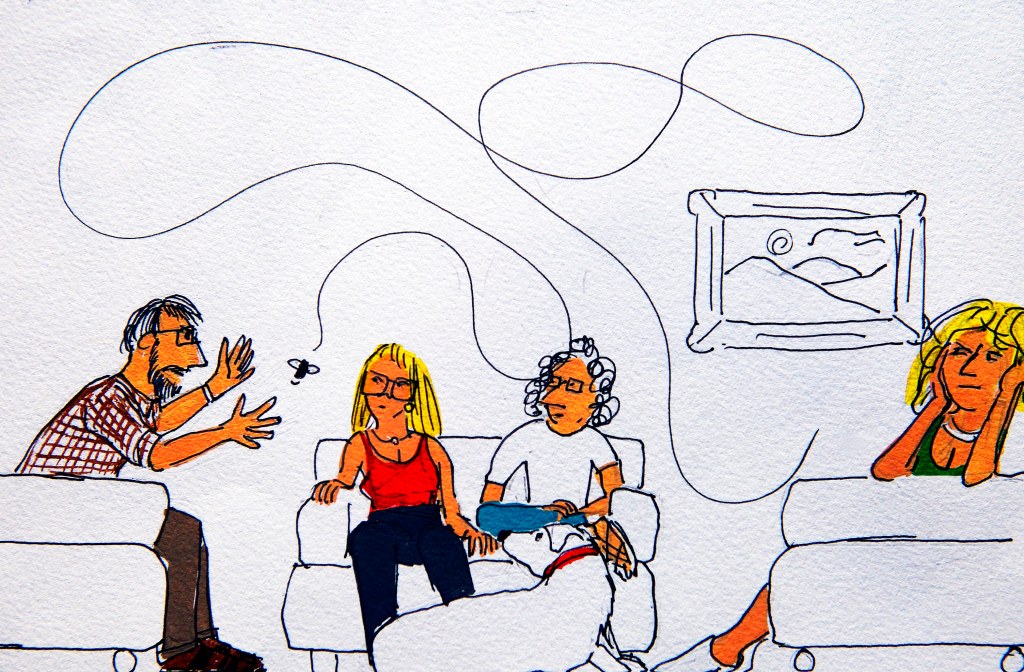
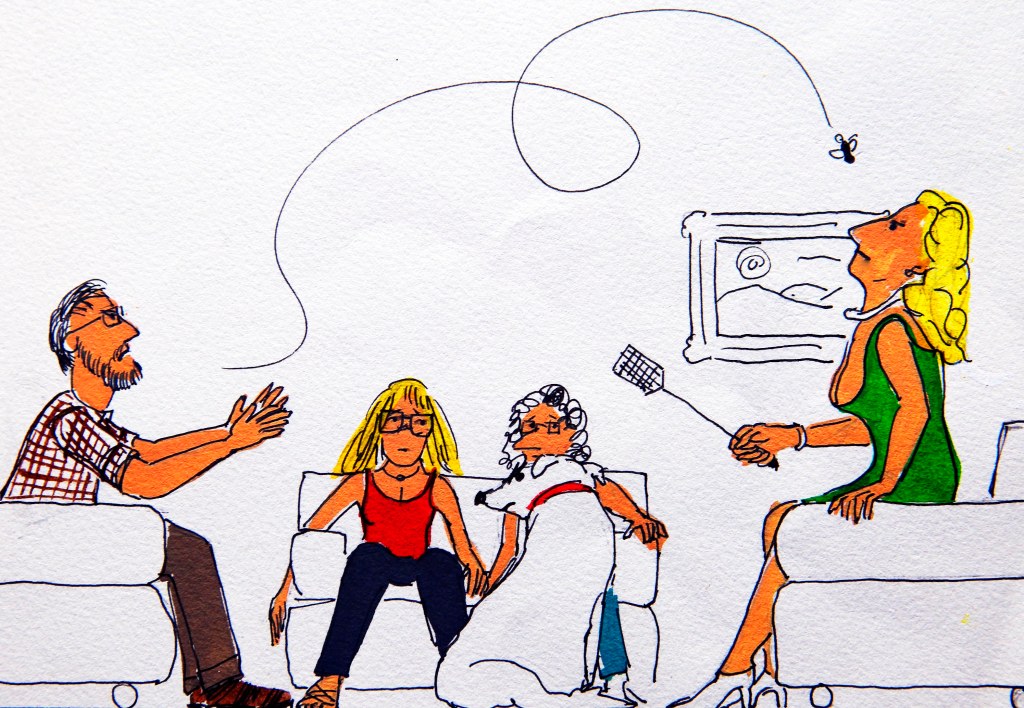
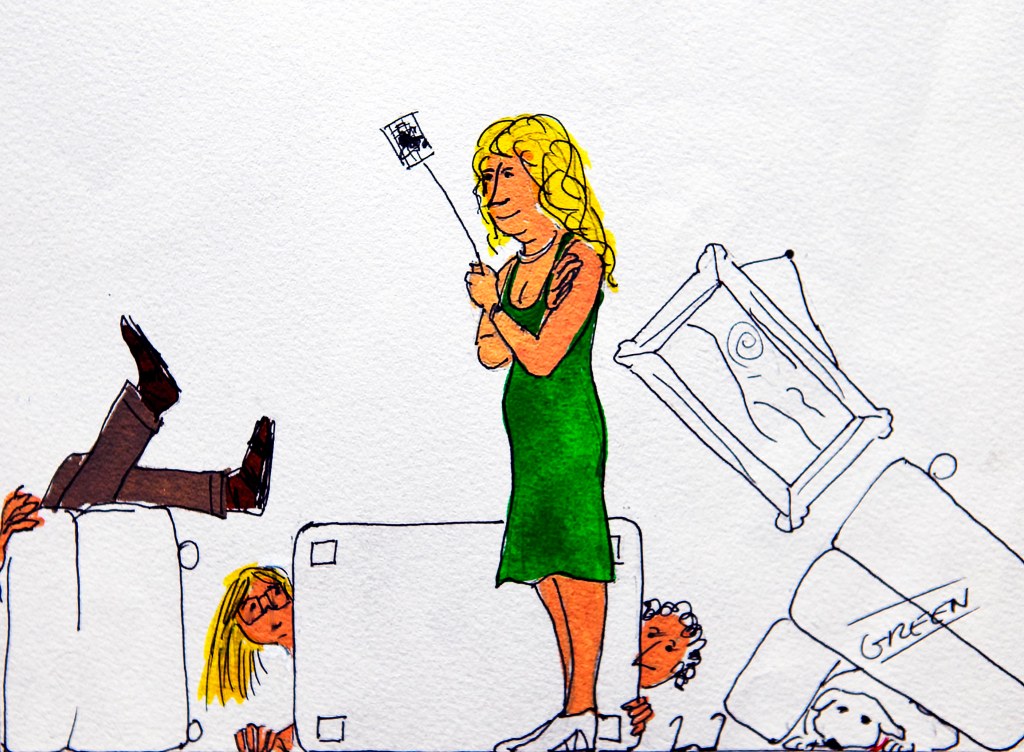
6: Swatting the Fly…
This one speaks for itself…needless to say, we avoided further visits to this couple.
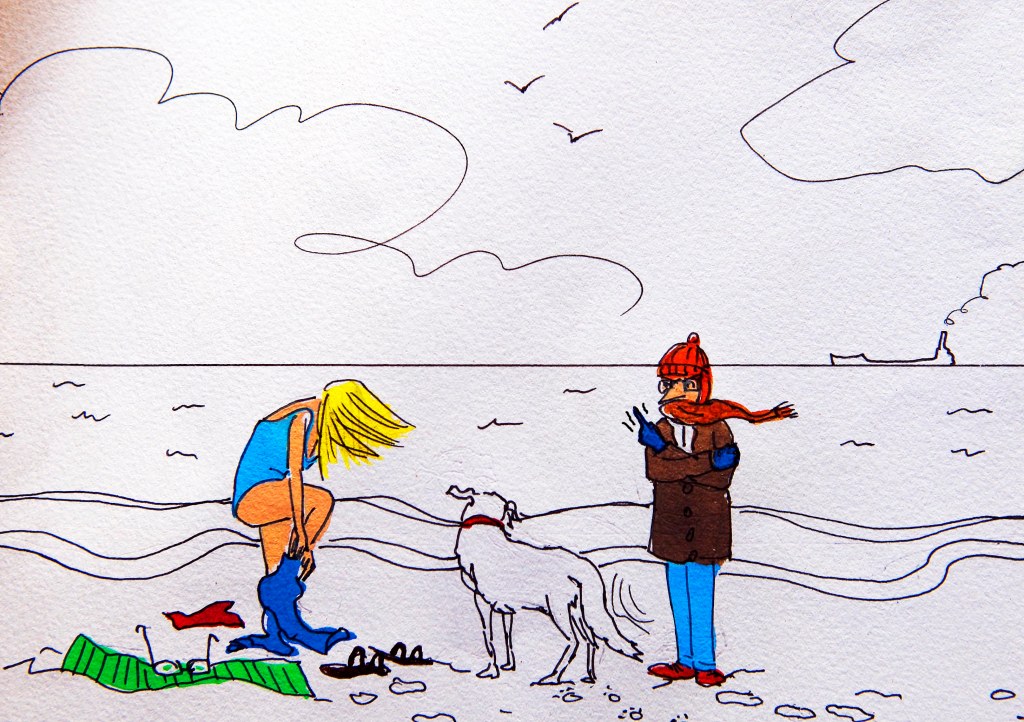
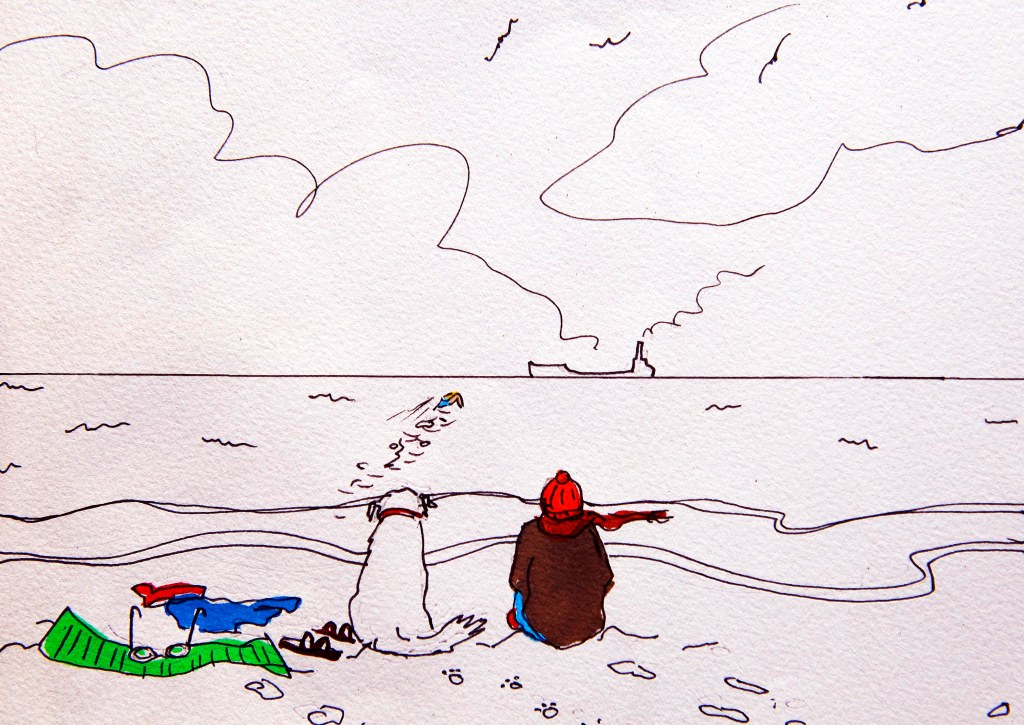
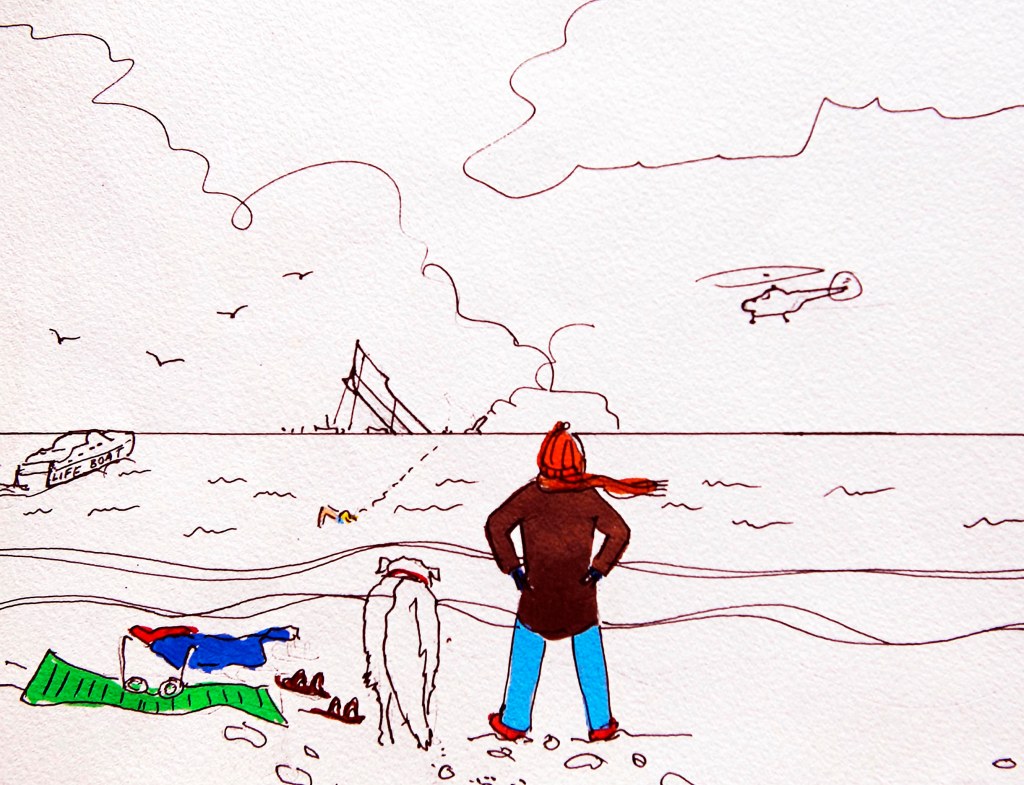
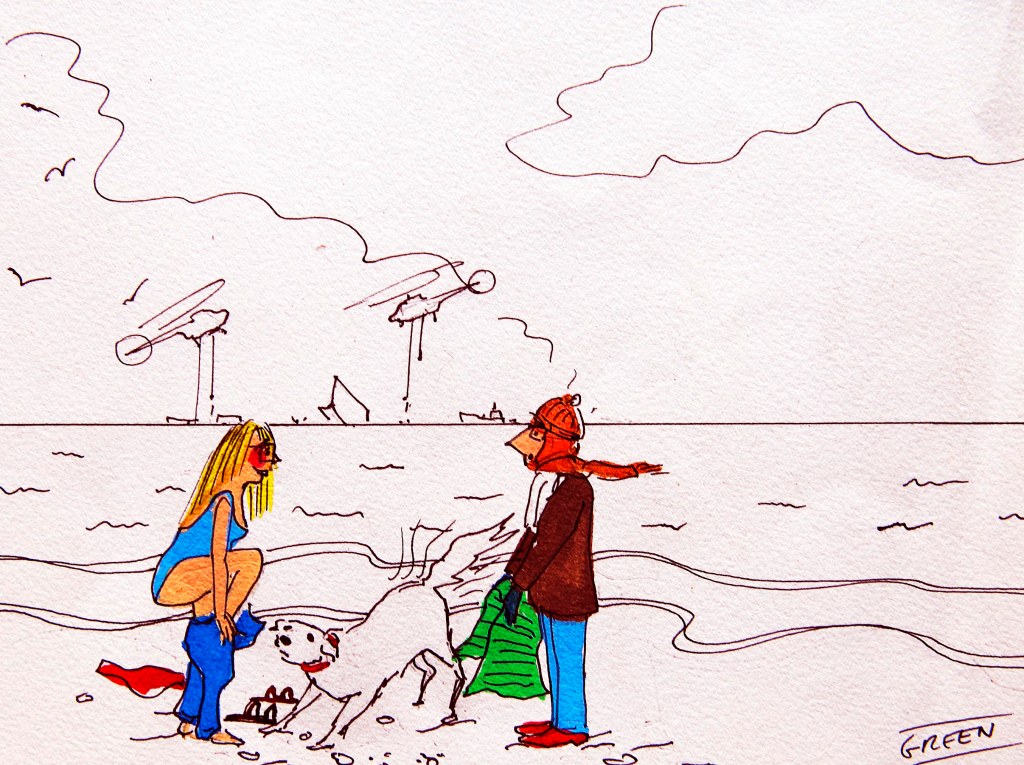
7: Dido’s Strong Swim…
The parable contained here is obvious; that a love of long distance, wild-water swimming and extreme myopia are a dangerous combination.
Those of you who know my wife Dido will be aware that this combination exists strongly within her person and the strip below tells the tale of what once nearly happened because of it. Just a couple of things to point out; firstly, the actual swim happened at La Serena on the Pacific coast of Chile, and not on a cold winter’s day in the UK – my point at the time (I made these comics in 1994) was to highlight Dido’s love of freezing conditions. She was one of those strange people who used to break the ice of the Serpentine Lake in London’s Hyde Park on New Year’s Day, and once, she even managed to shock a load of hardy Swedes by going for an inter-Island swim near Stockholm, in mid-winter. And secondly (and also obviously), she didn’t actually crash into the oil tanker (let alone sink it), but merely swam far too close to it, causing a crew-member to warn her away using a megaphone.
Aura and I spent many a terrifying hour, just as depicted in the strip, staring out to sea, waiting for Dido to return, which thank goodness, she always did, eventually, though often landing up a mile or so up the coast because of currents and her appalling eyesight.
These days, with the mellowing of age, and out of compassion for me, she only swims “laterally” so that I can keep an eye on her at all times…
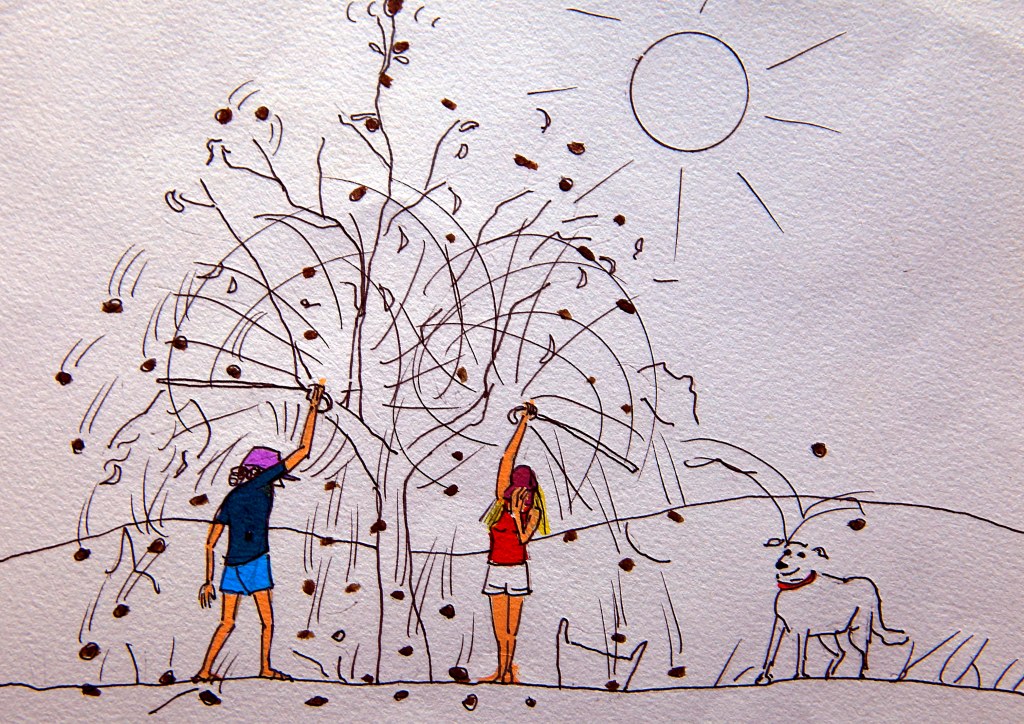
8: The Last Almond
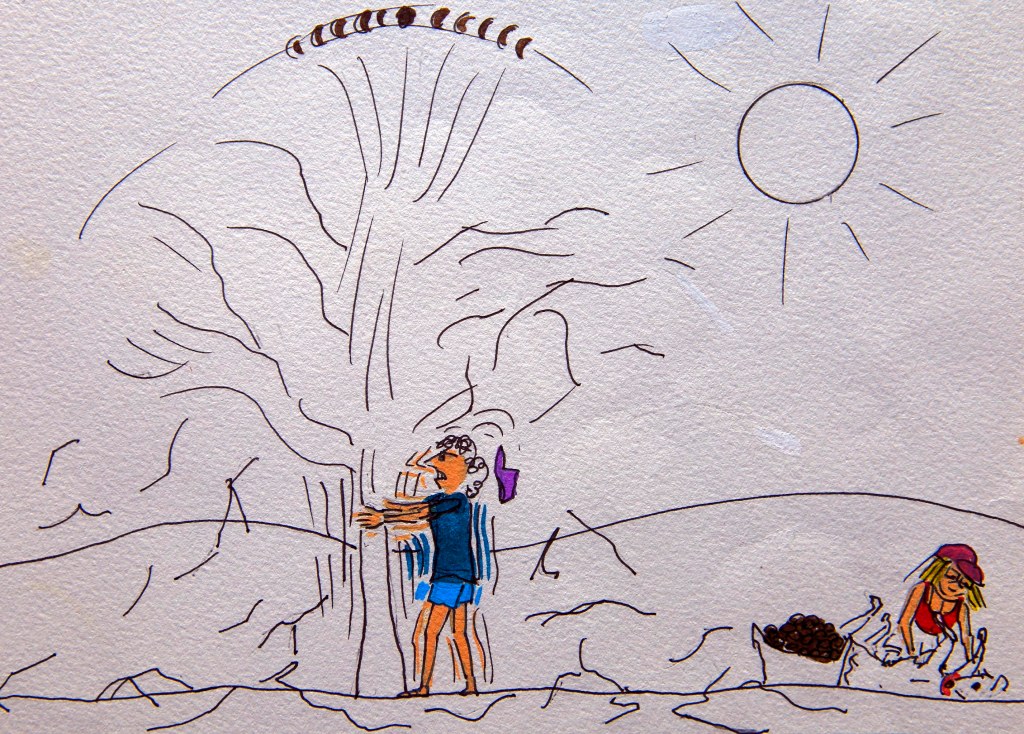
I’ve saved the most prosaic of my 1994 “Dog Days” comic strips for last. Prosaic in the sense that this is an experience, that to one degree or another almost everyone viewing this site will have gone through themselves – that infuriating feeling of the last, biggest, juiciest fruit being just out of reach. Perhaps, the only difference with almond trees though, from say apple, cherry or even blackberry picking, is that one does not customarily shake and whack the bejesus out of the host plant to acquire every last fruit. Professional farmers even have specially designed, automated tree-shaking machines for doing the job.
However, down here at least in the Axarquia region of Andalusia, almond trees are not irrigated during the drought season, and while this ensures the almonds have a richer more intense flavour, it also makes the trees highly resinous, thus causing many of the nuts to cling stubbornly to the branches.
Basically, the work is hot, sticky, scratchy, itchy, back-breaking and in the past, financially unrewarding. So, about six years after I made this comic we replaced our main almond orchard with a vineyard, the planting of which was also back-breaking, but with the promise of greater fulfillment – through the act of wine-making – and a hugely greater income. But, as our luck would have it, the market for traditional Malaga wines collapsed about the time I planted our last vine, with the almond price (due to the fruit’s recent elevation to “super-food” status) rising exponentially in the last ten years.
Still, at least we have enough Malaga wine for six lifetimes…



















































 ARKS, ADAM AND AXARQUIA