THE ANSWER TO THE QUESTION/S WE ARE ASKED THE MOST…*
Well, not exactly, is the answer, in that they do all nearly end up as oil, but the oil is not made by us.
Olive presses, in all their forms, are serious pieces of machinery and far too ambitious and expensive for a small farm like ours. That is why, we, in common with all of our neighbouring growers take our harvests to one of the several local presses or factories.
Most of the larger growers will typically belong to a cooperative such as the one in our local village, and which has its own press. Smaller “independent” growers like us will head to one of the nearby commercial operations.
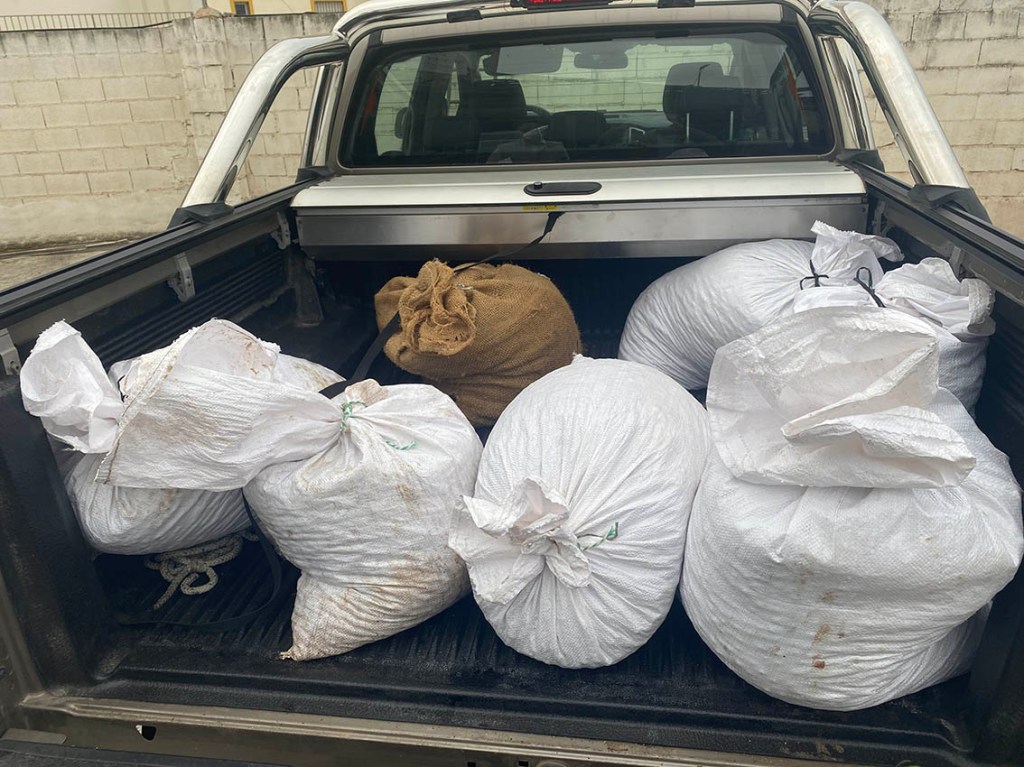
This year’s olive harvest on the back of our truck. Half an imperial ton, so not bad for two old codgers!
The larger growers will have hundreds of trees, sometimes thousands, producing several tons of fruit. Smaller growers like us, will have anything from half-a-dozen to a hundred trees, giving crops from a couple of sacks to a couple of tons. When we purchased our finca in 1993 it had only three young olive trees (the finca being then primarily turned over to almond and vines). Since then, we have planted around fifty more olive trees which is about as many we can handle on our own, vis-à-vis, annual pruning, burning off and harvesting.
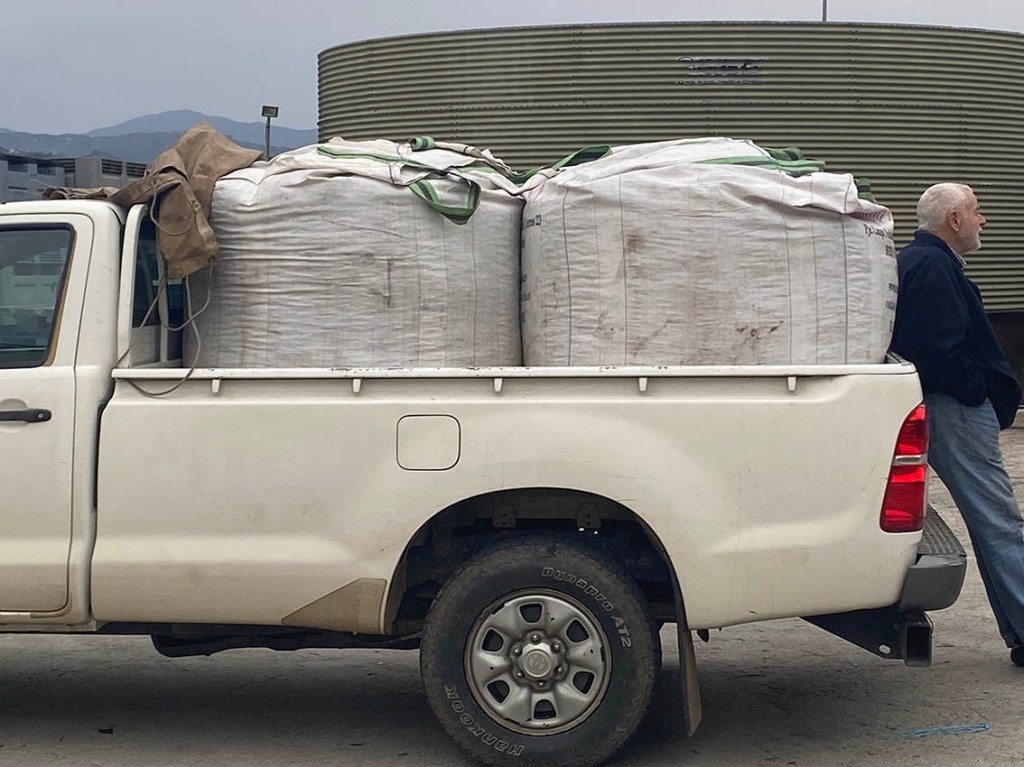
The guy before us at the press, with nearly a ton and a half of olives…
We normally harvest in late December/early January. The smaller trees we pick simply by hand, but the larger trees in heavy crop, require the setting up of nets and the use of whacking-sticks, and picking all the fruits often means quite a bit of climbing too. Fortunately, Dido and I both retain an almost childlike enthusiasm for tree-climbing!
Most of the local presses (including the cooperative) produce first cold-pressed extra-virgin oil. However, as a rule, to get a proportion of your own oil back, one’s load must exceed 500 kilos (half a metric tonne / about 1100 pounds). Although our crop is doubling each year, now that our trees are all “on-line”, we still only managed about 250 kilos this past harvest. This means that although we do get about 20 litres of fabulous oil in exchange (the press retains 50% of the oil yield), it is not actually ours. Hopefully, if this coming year is as fecund as the last, next year we will comfortably reach the 500 kilo target and receive oil from our own fruits for the first time.
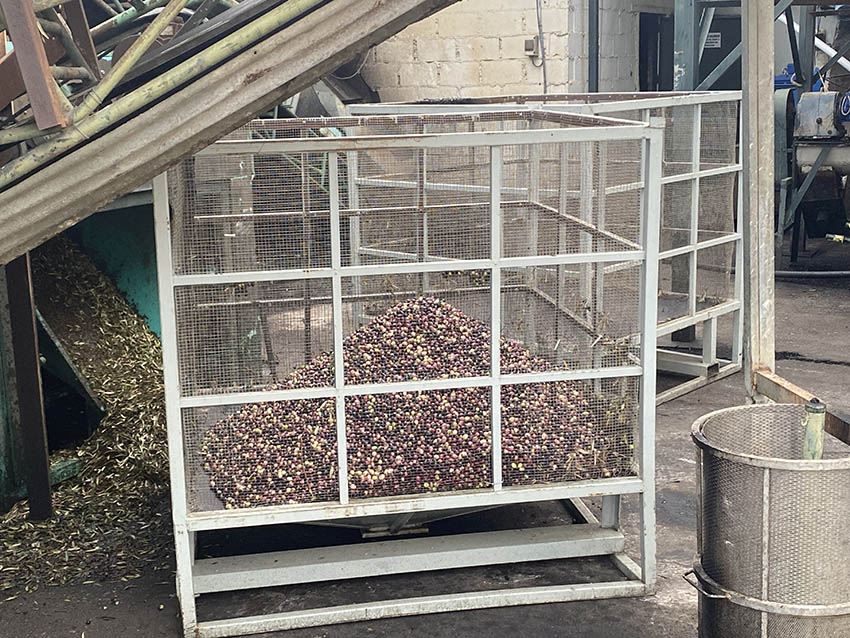
Our olives, ready for the press.
As for our local Axarquian oil, it is famed throughout Spain for its low acidity, and its smooth, slightly peppery apple flavours. Of course I am biased, but I far prefer it to most mainland-French and mainland-Italian oils, which tend to be too astringent for my taste. In style, our oil compares well with, and is very similar to those from Sicily, Corsica, Sardinia, Greece and the Levant. Fundamentally, the stronger the sun, the smoother and more buttery the olive oil.
* The header photo shows our main olive grove, about eight years ago, a year or two before they all began to yield significant amounts of olive.
Carl Jung famously referred to occurrences of synchronicity as “meaningful coincidences that cannot be explained by cause and effect.” He thought that there was something more profound going on than sheer coincidence, something to do with a “deeper order of the universe…”
While I can see the attractiveness of this line of reasoning I find it hard to agree with the great man. For one thing, he does not seem to consider the far larger number of non-coincidences that occur every day to everyone on the planet. The countless times that coincidences are not happening is in some ways even more remarkable than the few times they do occur, given the billions of lives being lived at any one time. Indeed, one could counter Jung’s hypothesis by stating that the very scarcity of synchronistic events is proof that they are simple – albeit often remarkable – happenstance.
In my own life, I have experienced three remarkable, apparently synchronistic episodes. The first, I recounted in an earlier post (here), and was merely charming. The second, which I describe below, was moving, and the third, to which I will devote a future post, was both powerful and disturbing.
The only common denominator in all three events was the fact that they all involved my wife Dido, and all happened within a two-year timeframe – more or less. The first; from slightly before I met her, the second; just after we met, and the third; about the time we were engaged to be married. No doubt Jung would have something to say about that too, but for boring old me, it was just another coincidence.
Anyhow, this is the second “happening” and please judge for yourselves whether or not something “deeper” was going on: It was early in 1989, and Dido and I had been dating a few weeks. She was then an occupational therapy student working on her first clinical placement at Northwick Park Hospital in Harrow (North West London). During her placement, most evenings, she would stop by my family home in West Hampstead for some supper, and sometimes to stay over.
Just to paint the scene – our home was inhabited by my mother Hannah, my recently-widowered grandfather Harry Pizan, and me. After supper, we would typically settle down in the sitting room to either watch some TV or play something like a game of Scrabble. I think it was on the very first day of Dido’s Northwick Park placement, when, in this relaxing setting, she said, looking at my grandfather, ‘I was allocated my first patient today – an elderly gentleman with cancer of the spine – and strangely, he has the same surname as you! Pizan. Didn’t you tell me that your family were the only Pizans* in England?’
To which my grandfather replied, “Yes, we are.” he then asked Dido, “Is this man called Rube?”
“Yes, Rubin Pizan!” Dido exclaimed.
“He’s my brother! You patient is Rube, my younger brother…”
Northwick Park Hospital – west wing building – watercolour – 1976
(“Pizan” was a name allocated to my great grandfather – Harry’s father – and his then-small family, when they landed at Irongate Wharf, London, in 1903, by an immigration officer who must have thought it approximated to whatever name my Polish and Yiddish-speaking “great zaida” had actually said. My cousin Bernard informs me that the name was originally PISEM and was changed to Pizan by deed poll by the family members. We (the surviving family) are not quite clear why the change was made – whether Pisem was a misreading by an immigration official, and the name really was originally Pizan, or something else perhaps? At any rate the name was changed, and thank goodness it was! “Pisem” just doesn’t do it for me! This sort of muddle was a common occurrence, wherever Jewish emigres landed up, from London to New York City.)
*The title illustration and the picture above are watercolours I made of Northwick Park Hospital when I was studying art next door, at Harrow School of Art.
It’s been quite a while since I published a “live” postcard-type piece, but this current trip to Coimbra, Portugal’s oldest (and Europe’s third-oldest) university city has drawn me to the keyboard.
Incredible to think, that we have been living on the Iberian Peninsula (on our finca in southern Andalusia and in Gibraltar) for well over thirty years and had never set foot in (mainland) Portugal. It was not for want of coming, but somehow the necessary stars never quite aligned, until now. It’s even more extraordinary, when one realises that our very first trip abroad together – our belated unofficial honeymoon, in effect, back in 1990, was to the island of Madeira, which we loved.
Anyway, we’re here now, and in the spirit of past “postcard” posts, without any more ado, here is a selection of captioned photos from a town that combines elegant charm and faded shabbiness with nonchalant ease – one might even say, with Portug-ease…
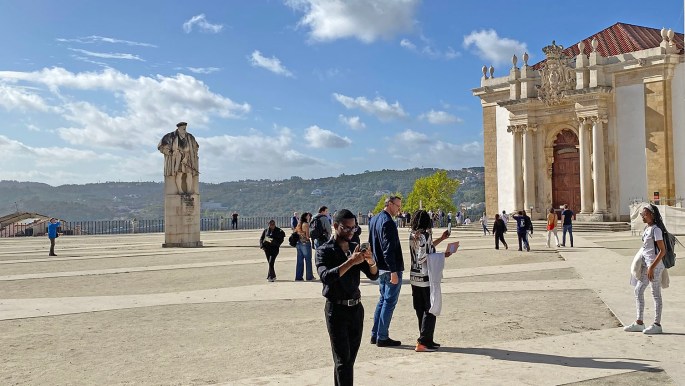
The “Tricana” statue, depicts a working-class girl with her water pitcher. Back in the day, before the advent of running water, this was how the poor collected their water from the town wells. The streets of the old town are narrow and steep, and presumably the girl is taking a well-earned rest…
The old Cathedral of the town, set in a small square, about two-thirds up the hill upon which most of the central old town is perched…
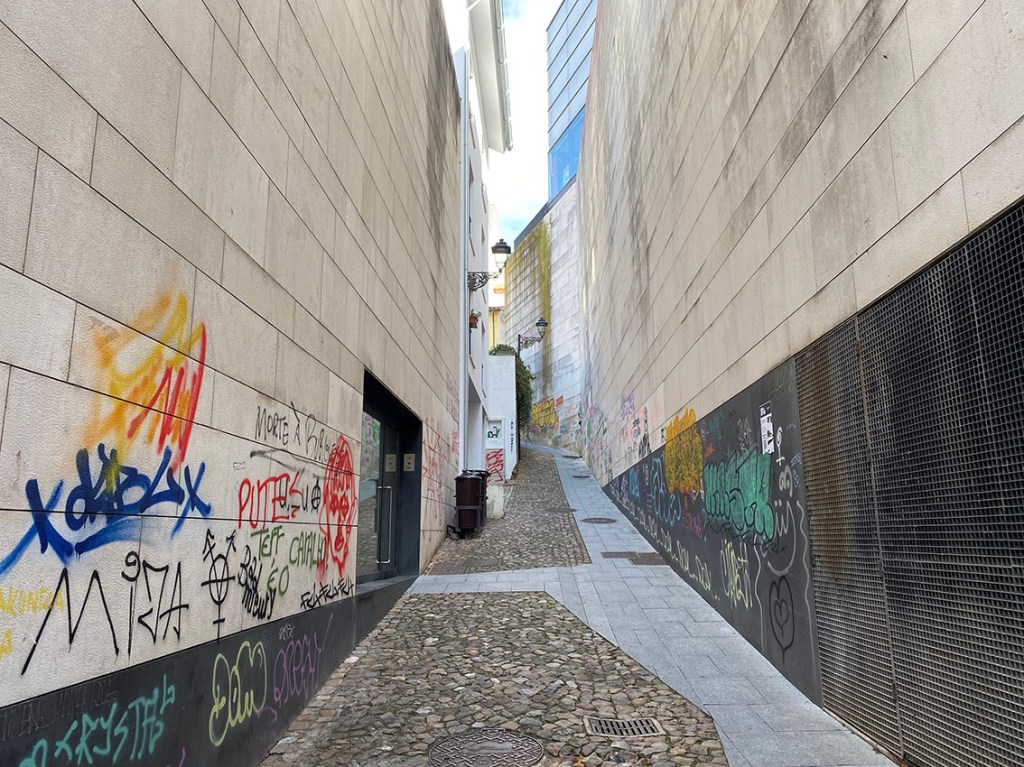
Most of the upper hill, and virtually all of the top plateau comprises the large university campus, old and new. Fortunately, the not very artistic graffiti was restricted to the new…
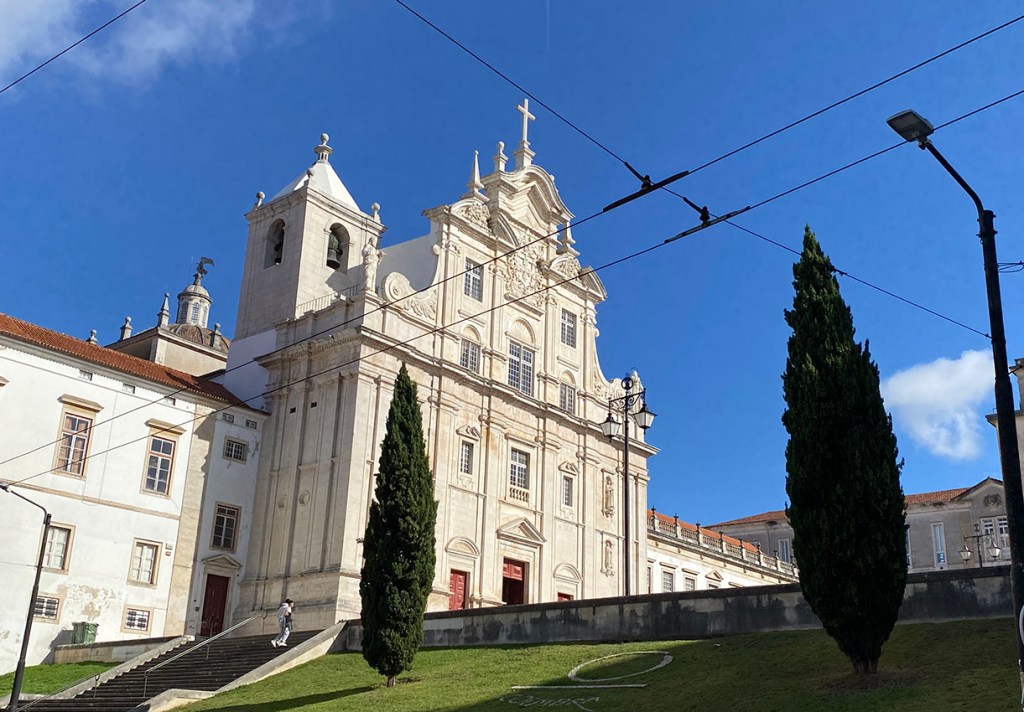
The new cathedral, integrated into the university campus on top of the hill…
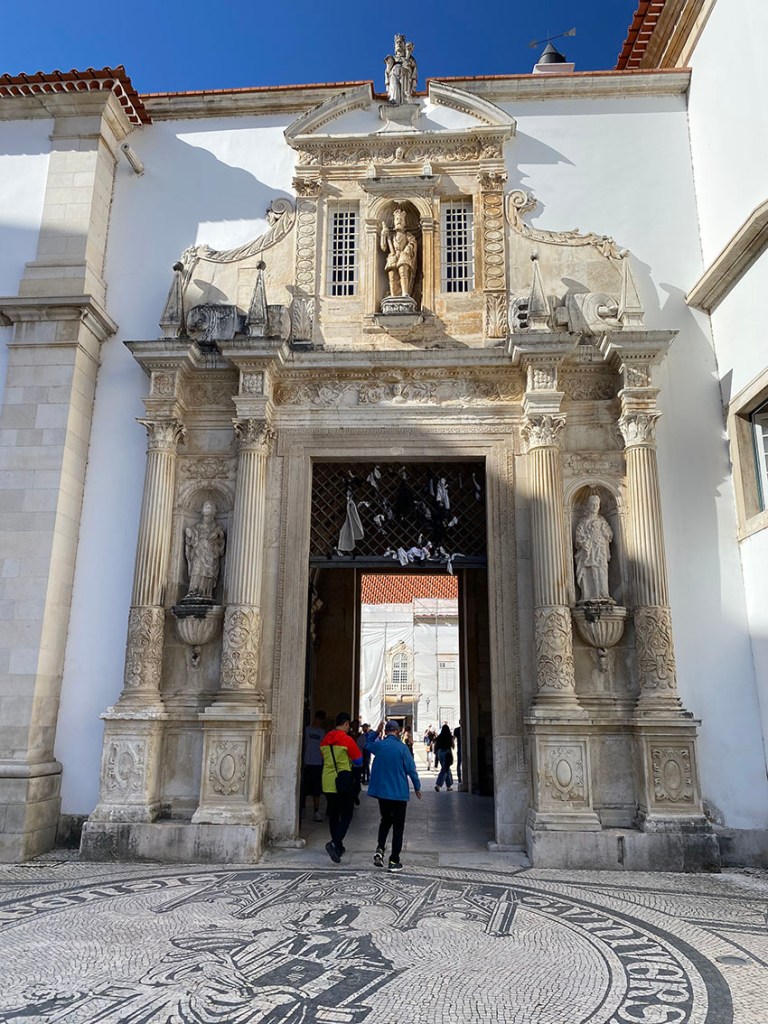
One of the several highly ornate gateways spread across the campus…
Undoubtedly, one the most elaborate campuses I have ever visited and this is its Royal Palace – presumably for regal students?
Coimbra University’s Academic Prison, for badly behaved students –The way things are going these days, most of our elite academic institutions could do with one of these…
An impressive view of the Mondego River (the largest / longest river contained within Portugal’s border), from the university plateau…
Leaving the main campus on the plateau, one passes the charming Capela de Santo António…
The old cathedral, from a different angle…
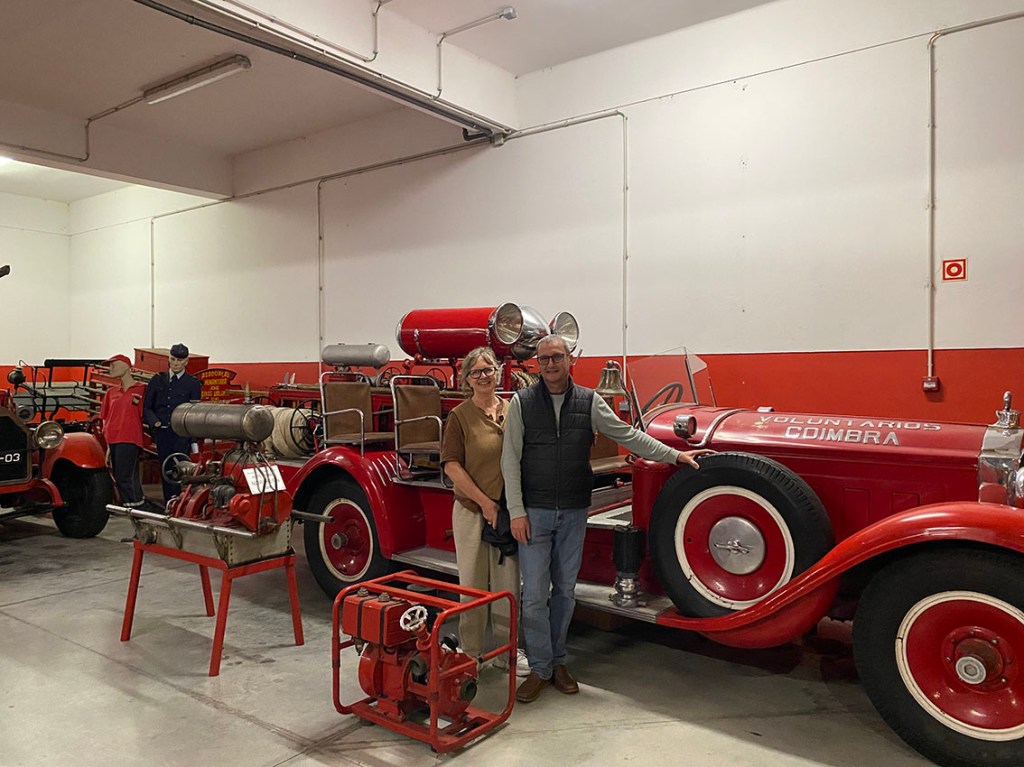
On a different note completely, on our last evening in Coimbra, we passed the volunteer fire station (there are three levels of firefighter in Portugal). The old engines were so enticing we sneaked in for a closer peak, only to be met by an amiable young fireman who gave us a guided tour of the station and the engines. This one, an old Mercedes, dated from the 1920’s and was our favourite. If Keystone Firemen had existed, this would have been the perfect vehicle for them. Dido even got to ring the bell! Coimbra was full of pleasant surprises.
If you ever wondered what all those dots and dashes are for on Scandinavian words then the name of the town in Sweden Dido and I are soon to move to might help.
Jönköping without its umlauts (or “umplaghs” as Dido refers to them) looks fairly straightforward to the English eye. Jonkoping instinctively, phonetically looks like it should be pronounced “John-coping”, but the presence of the umlauts immediately sets alarm bells ringing. You just know that “John-coping” is wrong with the result that you find yourself instinctively “accenting” the word. However, unless you are familiar with “Northern Germanic” languages the chances are that instinctive accenting will be wide of the mark.
In my case for instance, before I knew better, I found myself pronouncing it something like “Jern-kerping” whereas after being corrected by a helpful Swede I was told to pronounce it more like “John-shopping”. Of course, “John-shopping” is only an approximation of the correct Swedish pronunciation, but it does at least indicate the effect of the umlauts. Moreover, since I’ve been using it, the constant stream of polite corrections from dismayed Swedes has ceased.
The one thing all our new Swedish acquaintances have told us is that our ability to pronounce Swedish words correctly, including Jönköping will improve over time.
Whether or not we have sufficient time in Sweden to master Swedish enunciation will depend upon how well Dido’s new tenure at Jönköping University works out. As things stand she’s planning on this being her professional swansong, but even at 57 this still leaves us with plenty of time – potentially…
Far more accessible than Jönköping’s correct pronunciation is its pleasant geography. The town is situated on the banks of Sweden’s second largest lake, Vättern (yes, another umlaut, and no, I haven’t been informed yet and all guidance welcome) and during our recent visit I manged to get some striking images of it, and the natives enjoying themselves along its beach.
One of the things that I’m falling in love with in Sweden, and something I already miss when I’m not there is the astonishing crystalline light and the startlingly vivid colours and tones it produces on everything it touches. These pictures illustrate this pretty well…
Last month we sold our little flat in Hampstead, North London. In and of itself, not exactly an earth-shattering event, but in the context of my life, an extraordinary moment. The reason being, that for the first time in my then-64 years and 11 months I no-longer had even a toe-hold in the city of my birth.
Regular readers of these posts will know that I have always endeavoured to keep my blog as free from controversial subjects as possible, despite the fact – as those who know me well can testify – I am highly politically aware with a range of opinions, some strongly held.
Given the recent and current state of the world, this policy has not always been easy, but this blog, originally intended to publicise my books and my art, is not a forum I wish to use for expressing my views on putting the world to rights. Ultimately, from my own experience of sampling and following other people’s politicized sites, one inevitably ends up with a corrosive and destructive clash of echo chambers. Thus, our reasons for leaving London will remain known to only our intimates.
Presented here is a photo-record of the first 30 years of my own personal London life (several suitably grainy and scarred), from times past, when I could never have dreamed that I would ever cut my ties with my once-beloved city “north of the river”.
I was born in Edgware, in the county of Middlesex in 1960, strictly speaking, before it became part of Greater London. Famous for its eponymous Roman road, as the composer Handel’s temporary home, and being at the end of the Northern Line Tube, it was where I grew up. This picture shows me as a baby, with my mum, Hannah, older brother Michael and my great auntie Ray at my grandparents flat…
My final day at nursery in 1963 with my mum (left) and a friend. I seem to be clutching a postcard though I have no idea who from…
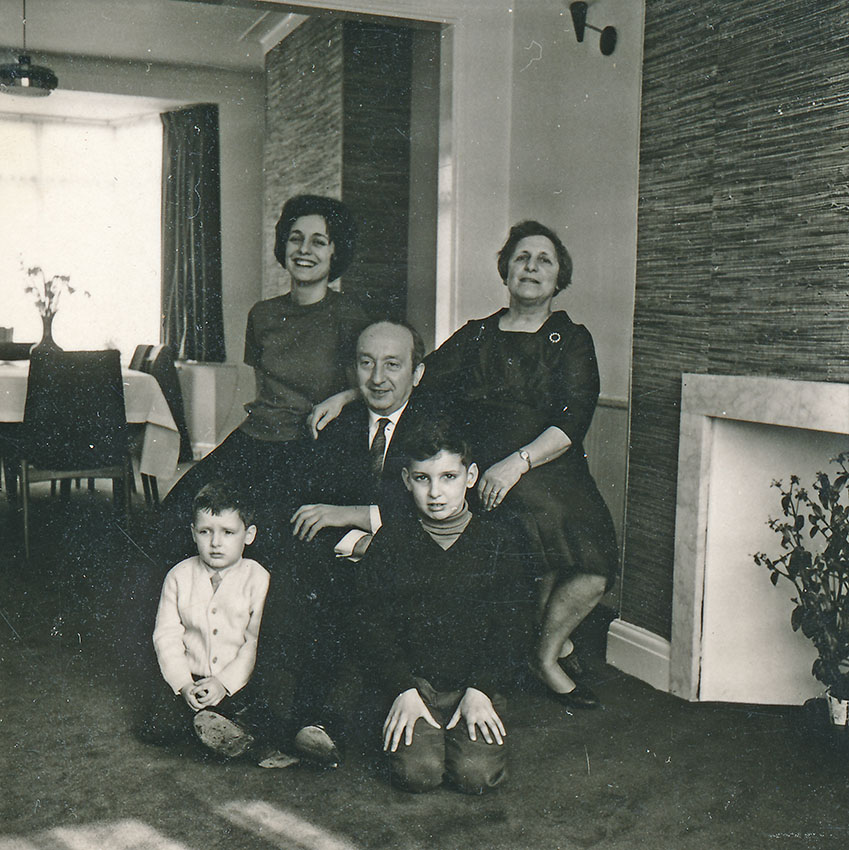
Apart from a bout of glandular fever when I was six, my childhood was exceptionally happy. Although my father had departed the scene when I was a babe-in-arms, my little family was a more than adequate compensation for his absence. Here we have Hannah and her parents, Becky and Harry, me and my brother Michael (my uncle Sidney took the picture), in my first home…
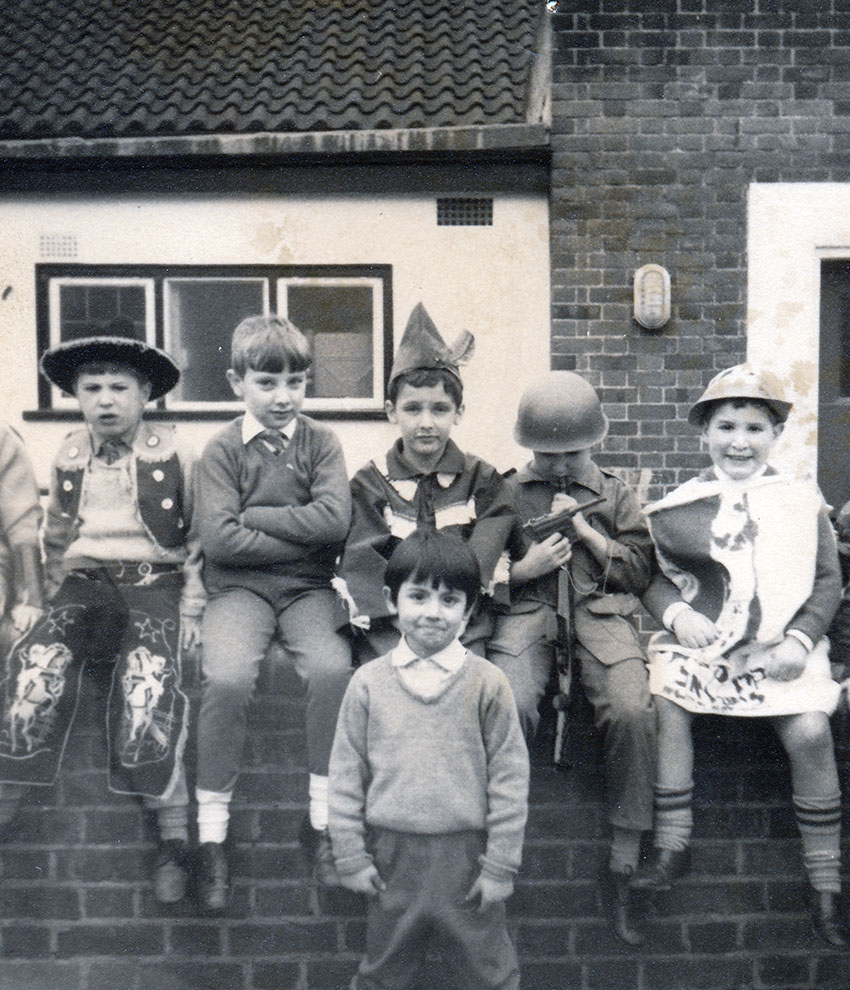
Purim at my primary school. I’m a rather lame-looking Robin Hood sat between cowboys and GI’s…
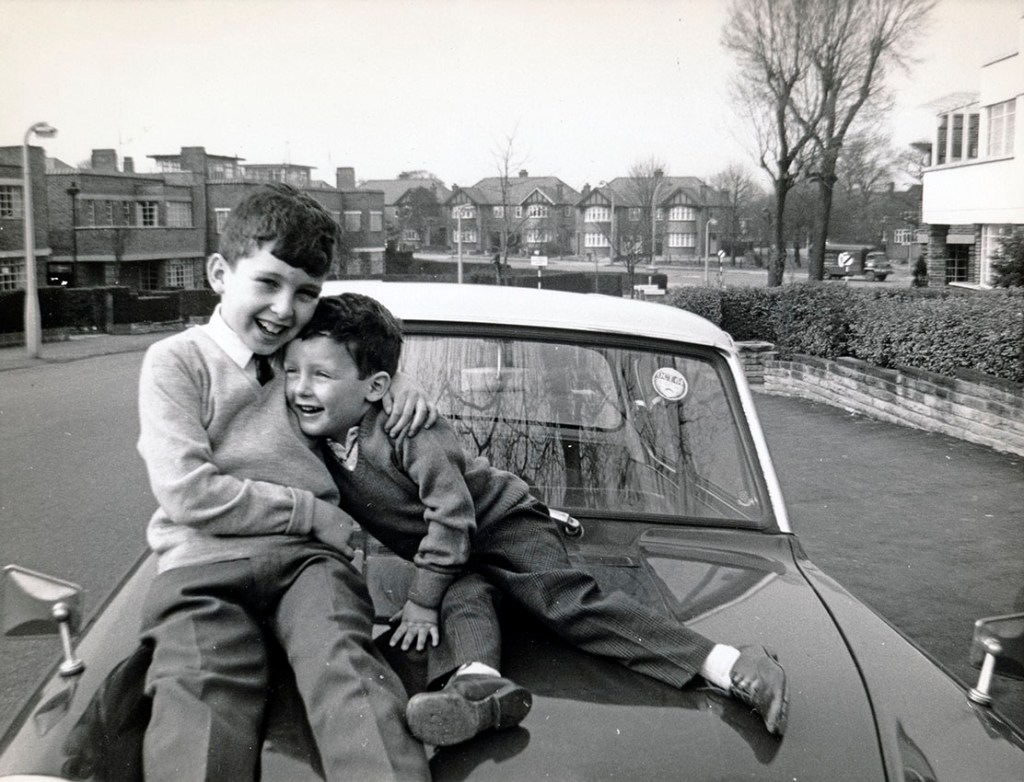
Between the War and my birth, my mum’s family lived in Hendon. Many of our closest family friends remained there, and this is Michael and I during a visit to one of them. We’re sitting on the bonnet of mum’s first Ford Anglia – eat your heart out, Harry Potter!
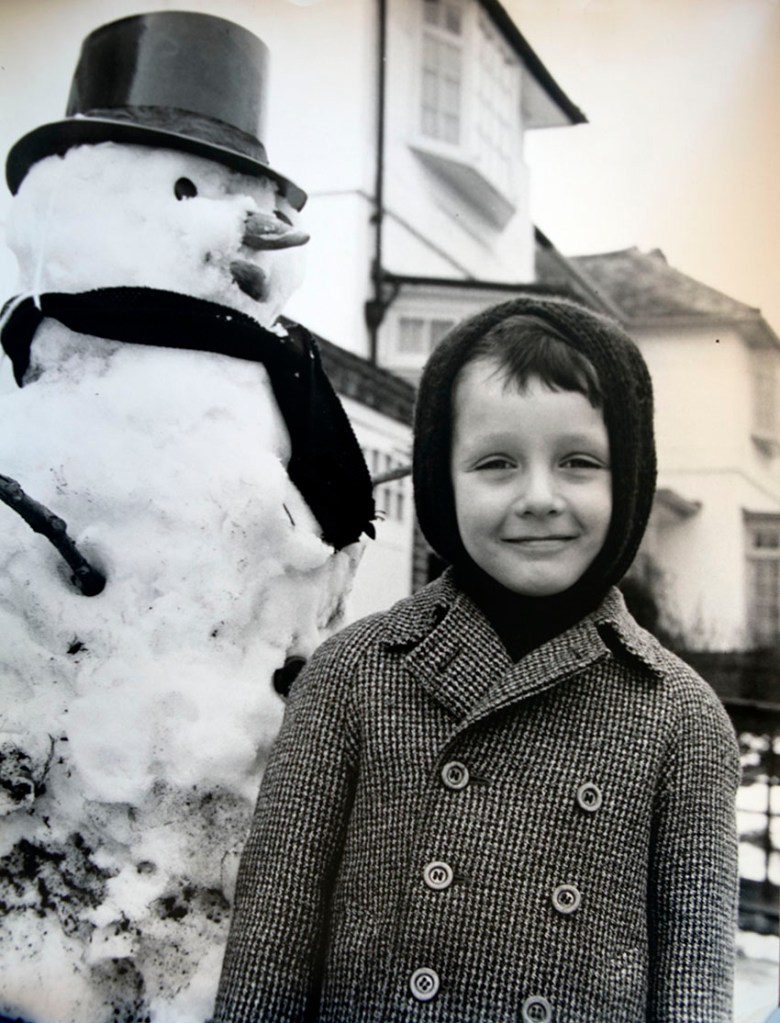
We took our snowmen very seriously back then…
Our second house in Edgware had a large back garden and by “London-clay” standards, half-decent soil. Sidney and I were both keen gardeners, something I remain to this day…
My studio space at Saint Martin’s, with friends and fellow students. The guy on the far left is my lifelong friend Simon – not an artist, just visiting. Next to him, looking at the camera is Robert, a hugely gifted portraitist, and the girl is Piyawan, another very talented painter and cartoonist. Judging by the coats, this was at the end of the day and when we would typically be preparing for a visit to one of the many local Soho pubs…
My final act at St. Martin’s was to undertake this temporary mural commission (I describe the story here) in James Street, Covent Garden…
My grandparents were moderately observant Jews (outside the Haredi communities – and even they differ from one another – there are as many nuances and degrees of “observant” as there are Jews who observe), and the traditional Shabbat supper was always partaken of. Here I’m “making Kiddush” (the blessing over wine) on one such occasion. By this time we had left Edgware and moved to West Hampstead, also North London, but closer to the centre…
I lived at home (in West Hampstead) well into my late 20’s, and this was my painting studio, which we built at the end of the garden…
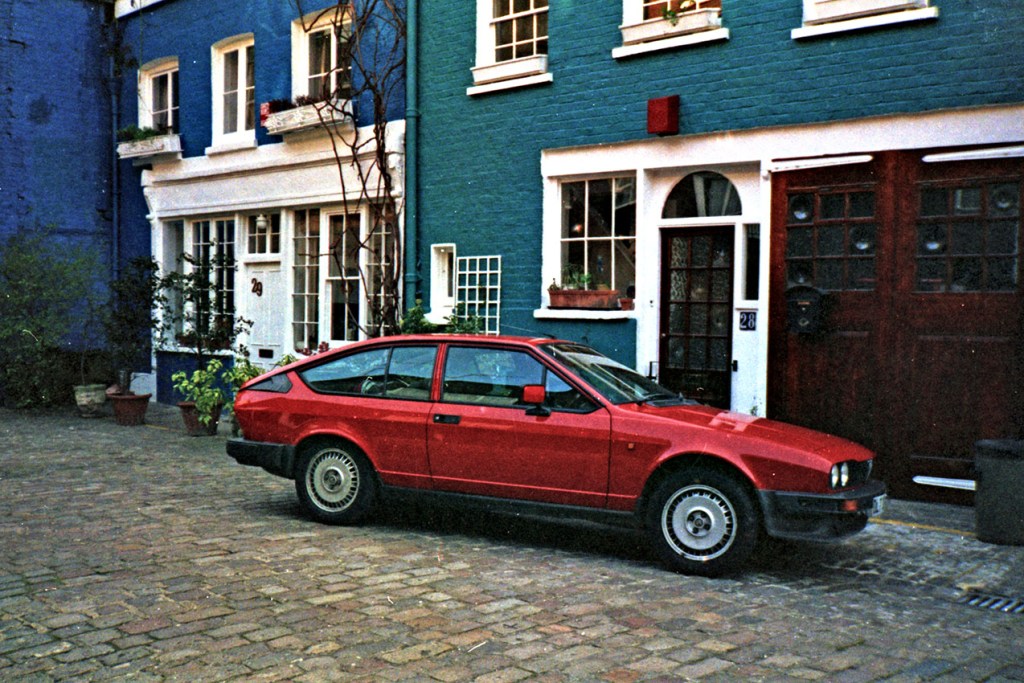
I met my future wife, Dido Nicholson, in 1988 and we married two years later. This was her cute little mews house in Lancaster Gate, close to Paddington Station and Hyde Park. She inherited the Alfa GTV from her uncle Leonard, who sadly died while playing real tennis at Lords (the “HQ” of world cricket)...
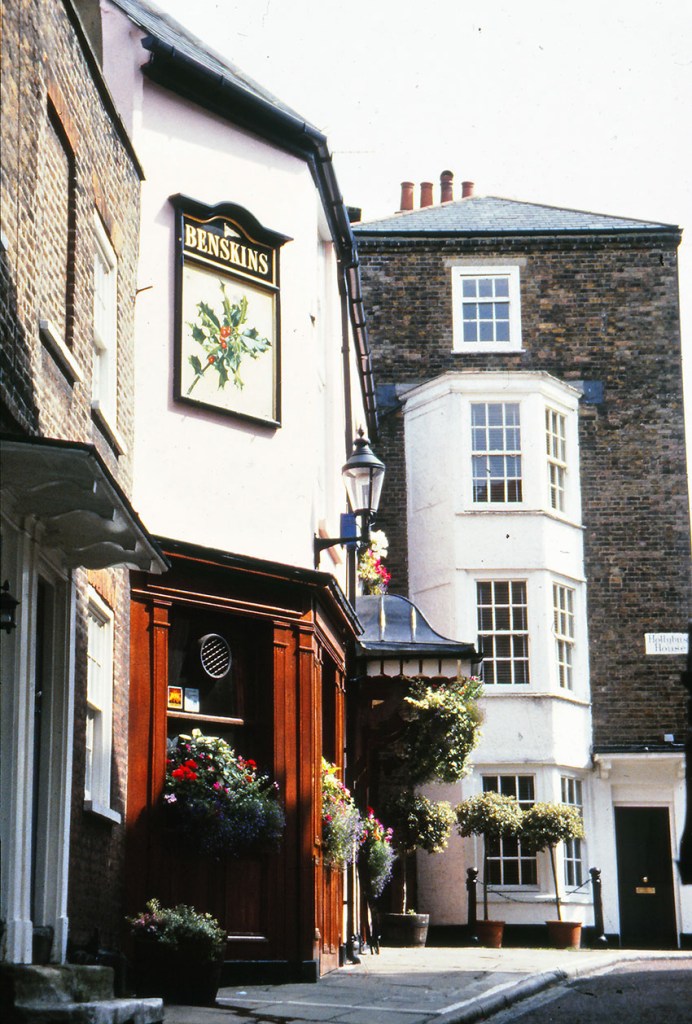
Like most Londoners, I was rarely happier than when visiting one of my local pubs, like the Holly Bush, here in Hampstead, which has turned out to be our final London Address…
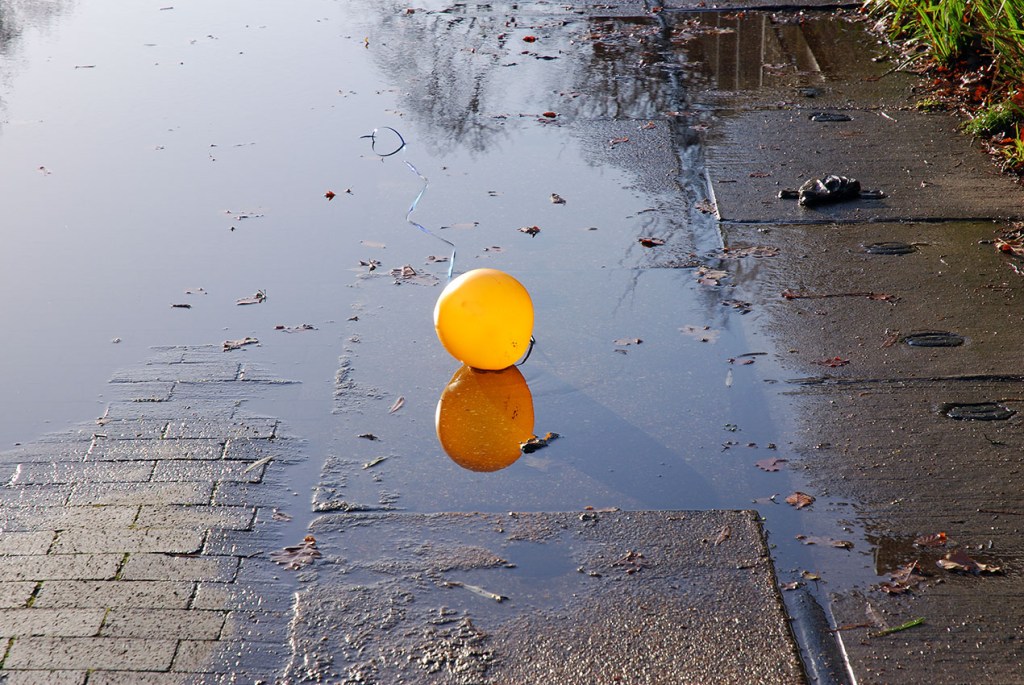
A melancholic New-Years-Day scene on the tow-path of the Regent’s Park, one of our favourite regular walks, and a fitting image to end this homage to a lost city.
The title picture is the top of Primrose Hill. It offers, arguably, the best view of London from north-west of the city. I always found the scene somehow reassuring, and no more so than one misty autumn morning in 2010, when my mother had just left for the airport on her way to Dignitas.
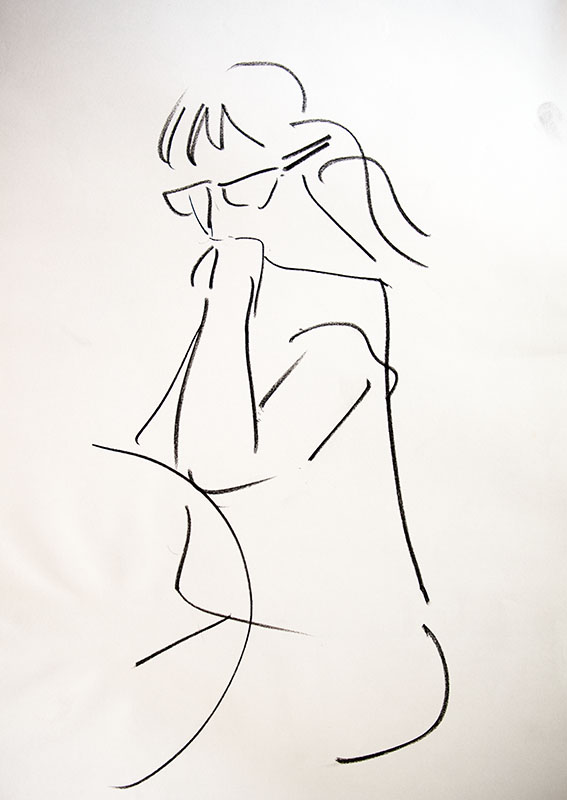
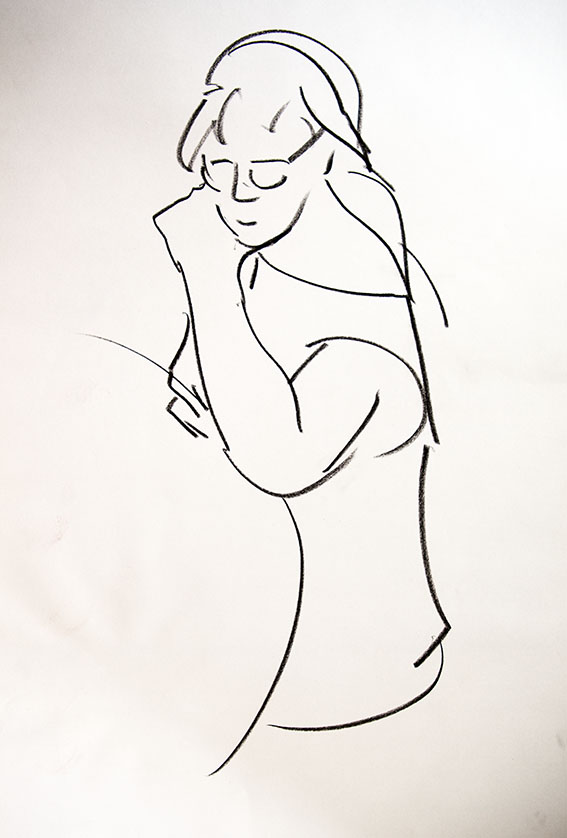
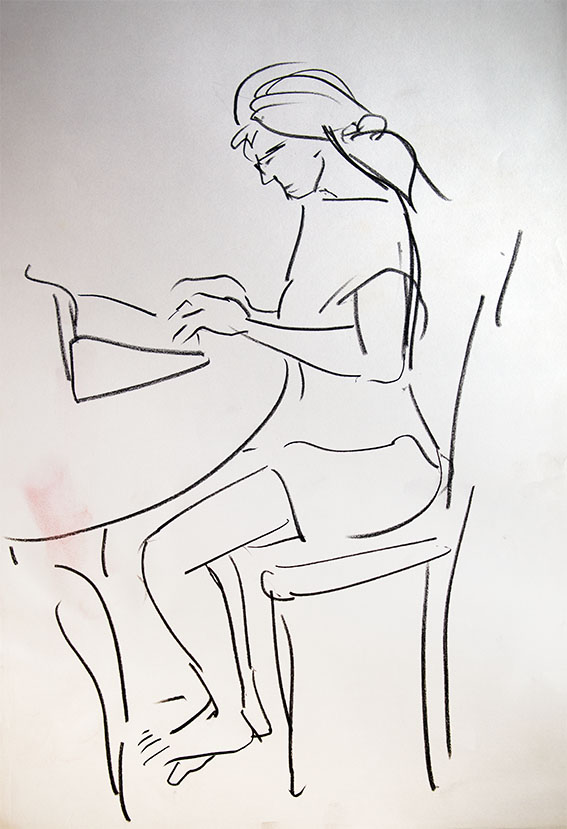
Yet more house tidying, yet more exciting discoveries of my ancient artwork. This time, of long-lost simple line figure studies, of my then-young wife Dido and of her friend and former ballet colleague, Frin.
Both, were natural and highly sketchable models as the images here attest, plus, I seem to have been in unusually relaxed with the old charcoal stick and conte crayon. My muses’ unaffected air and my good drawing form was a happy combination which I now look back upon, some 30 years later, with a deal of pride and not a little amazement.
Sadly, modernism and later, abstract expressionism (admittedly with a few glorious exceptions – from Modigliani to Rothko), inadvertently gave free license for non-drawers to thrive, resulting in the often talentless gimmickry that infests so much of today’s “art world”.
Ho hum…
Fortunately, my utter disillusionment expressed above, came after I had time to make my own joyous-if-modest contribution to the corpus of half-decent picture-making, as these humble sketches bear evidence…
Many winters ago, Dido and I found ourselves sheltering from a -10°c Prague night in a cozy, smokey jazz club just off Wenceslas Square. The place was full and we had to share a table with a Viennese couple who fortunately turned out to be more interesting than the hapless wannabe Charlie Parker murdering his sax on the stage.
The fact that the couple were a similar age to ourselves, and both handsome and charming, with perfect English was pleasant enough, but it was when we exchanged names that we all almost fell off our seats. We introduced ourselves first with the customary, “I’m Dido”, “and I’m Adam”, to which they replied through wide-eyed grins, “and I’m Eve”, and after a short dramatic pause, “and I’m Aeneas…”
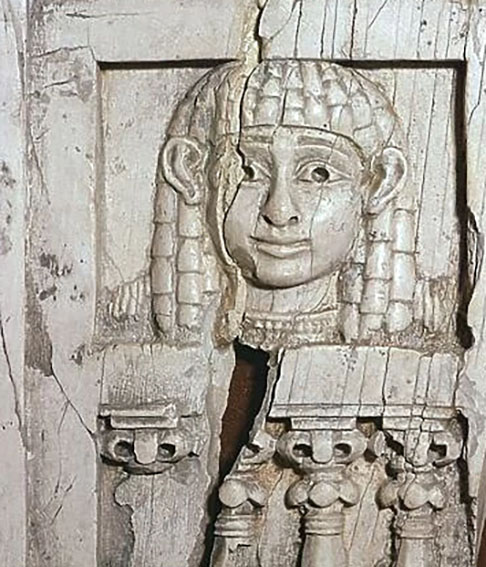
A Phoenician ivory of a noblewoman looking over a balcony from Sidon, very close in date to the historical Queen Elissa / Dido
Not only was this a delightful and highly amusing coincidence (it was the only time we ever joked with another couple about the concept of partner swapping – purely in the interests of onomastic correction of course!!) it was also the diametric opposite to the normal response of people upon first hearing Dido’s name.
For one glorious instance no explanations were required, nor any brief lessons in classical mythology and ancient history, nor having to smile away the increasingly tedious “Ah! Like the singer?” (actually born Florian Cloud de Bounevialle Armstrong eleven years after “my” Dido). Instead, just an interesting exchange about why Aeneas, and why Dido: The former, it transpired, because his father was a classics professor in Vienna who specialized in the Roman poet Virgil, and the latter; because her parents had been expecting a boy (long before the days of ultrasound), they had no girl’s name prepared. As they were listening to Henry Purcell’s opera, Dido and Aeneas when her mum’s water broke, the name seemed apposite.
I repeat this story here because it is sweet and pleasant to recollect, but also to hopefully encourage all our friends and acquaintance, past, present and future, who may be ignorant of the facts behind the name to take five minutes and click on this link to learn about Dido (mythic and historic). It’s not only informative, it’s also genuinely fascinating with contemporary resonance (like much myth and history).
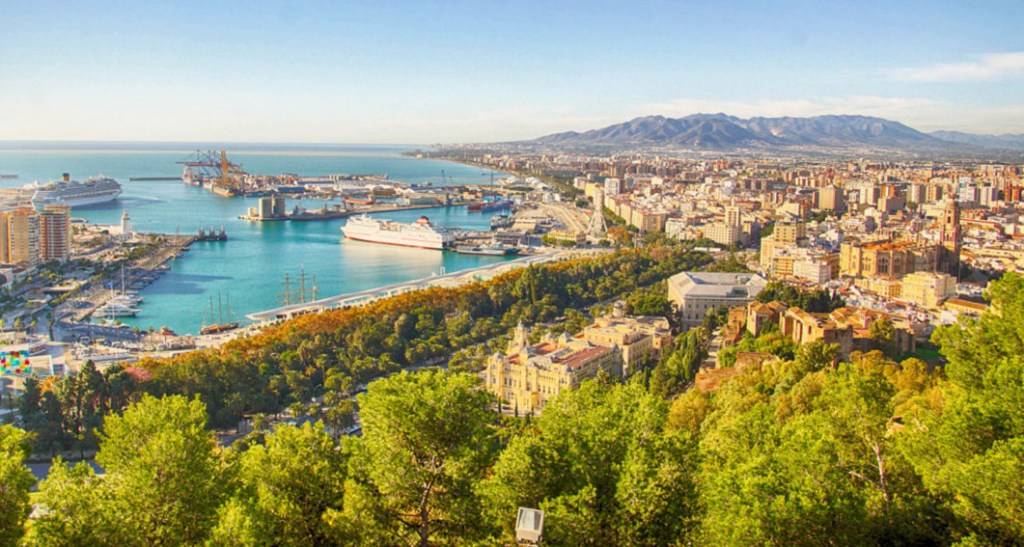
For instance, how many of the people reading this, including my Spanish readers. know that the city of Malaga was founded by Queen Dido’s Phoenician compatriots (and probable subjects) about 2,800 years ago as Málaka (the same time as the founding of Carthage itself). Phoenician was a Semitic sister language of ancient Hebrew, with many close similarities (see this earlier post). Málaka could mean a place where fish was preserved in salt , or it could have something to do with “sailors”. However, given that the Phoenician for queen, is Malgah/Malkah, a more likely meaning is the Queen’s city. And if so, the most likely queen to have a new colony dedicated to her by Phoenician settlers would be their-then queen and sponsor, Dido (more properly, Elissa in her Phoenician form).
In other words, it is quite possible, that my wife Dido, has a home in the province titled for her ancient namesake, and I at least, find that possibility pretty damn cool.
Modern day Malaga, some 2800 years after its founding by Phoenicians, who knew a good harbour when they saw one.
Our local mountain, Maroma, snow capped this April, for the first time in several years. A welcome wintery scene, guaranteeing this year’s water supply to the pueblos and springs.
We purchased our finca and moved to the Axarquia region of Andalucia in 1993. Like many people unfamiliar with the region and its seasons, we were surprised by the severity of our first winter, both with regards to its length and its chilly dampness. 93/94 was particularly harsh, with heavy rains beginning in late August and continuing off and on until mid April. The tops of the sierras were regularly blanketed in snow, and shrouded in dark cloud, and for much of the time our own hills felt more like those of Cumbria than of southern Iberia.
The Axarquian locals have a distinctly ambivalent attitude to their winters; on the one hand, many being farmers or related to farmers, they celebrate the breaking of the summer droughts and the first rains, but on the other hand; being true Andalusians they quickly tire of the cold and the damp and long for the return of the Spring sunshine.
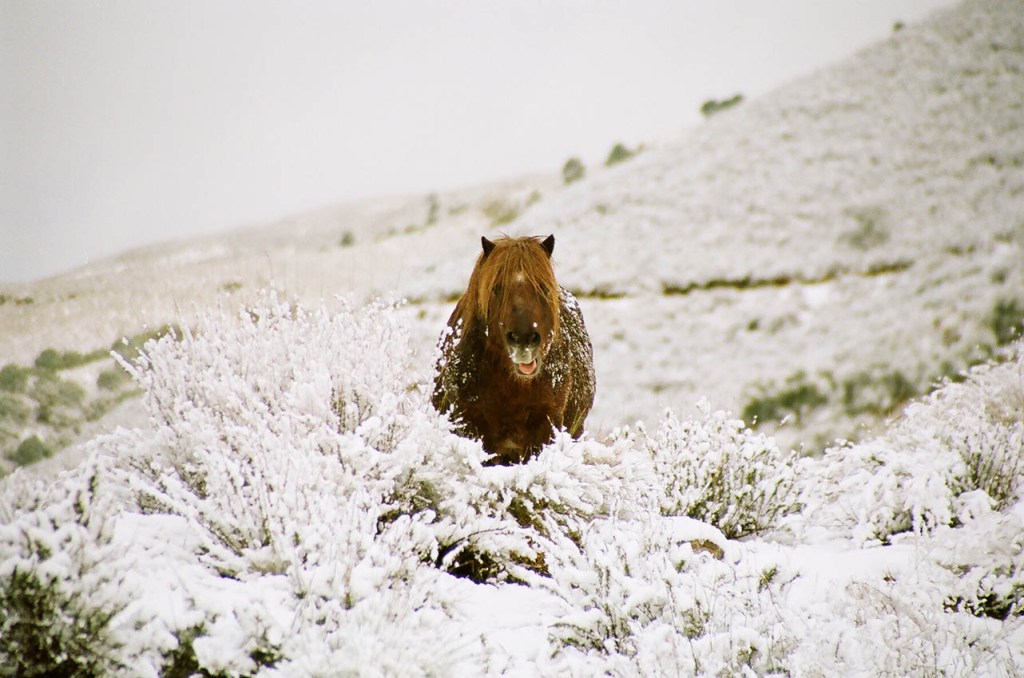
In the winter of 2006it wasn’t only the sierras that got a covering of snow . This was at our late friend and neighbour, Edgar’s place, and one of his two rescued Shetland ponies looking as happy as Larry in the wintery conditions.
The summer of our arrival in 1993 marked the end of about seven years of overly dry winters for much of the Mediterranean rim, with several climate scientists confidently predicting that our part of Spain “would resemble the Sahara by 2003”. Fortunately, the predictions proved wildly incorrect, both with that winter’s appropriately biblical rains, and then the following six or seven being equally long, wet and often very cold. One year, for example, about 30% of the Rio Velez Valley avocado and mango orchards were destroyed by a harsh early-winter frost. Subsequent to those first 14 years, we’ve experienced smaller runs of wet and then dryish winters, the latest such dryish run being the last four years which thankfully broke this winter, with long periods of rain, filling reservoirs and the reassuring sight of snow-peaked sierras.
However accurate or not the predictions of the climate scientists have proven, or will prove for this corner of Europe, the coming of the Sahara still feels a long way off.
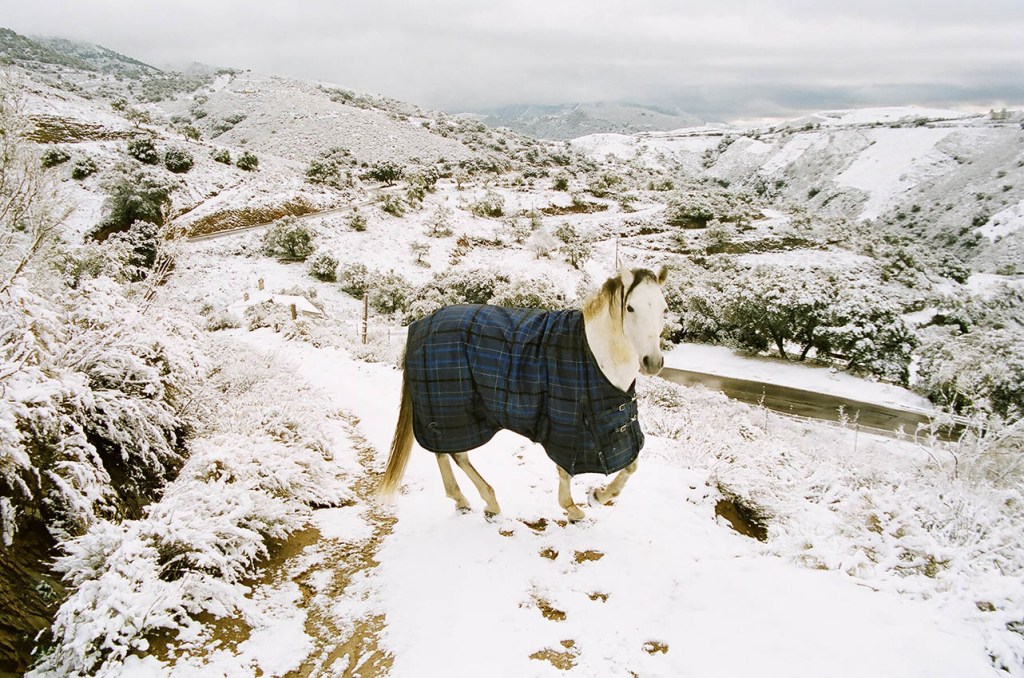
Edgar’s stallion Ned however looking a little less certain with his first experience of the white stuff, even if wearing the appropriate tartan. And remember, this was three years after climate scientists had predicted that this would be a Saharan scene…
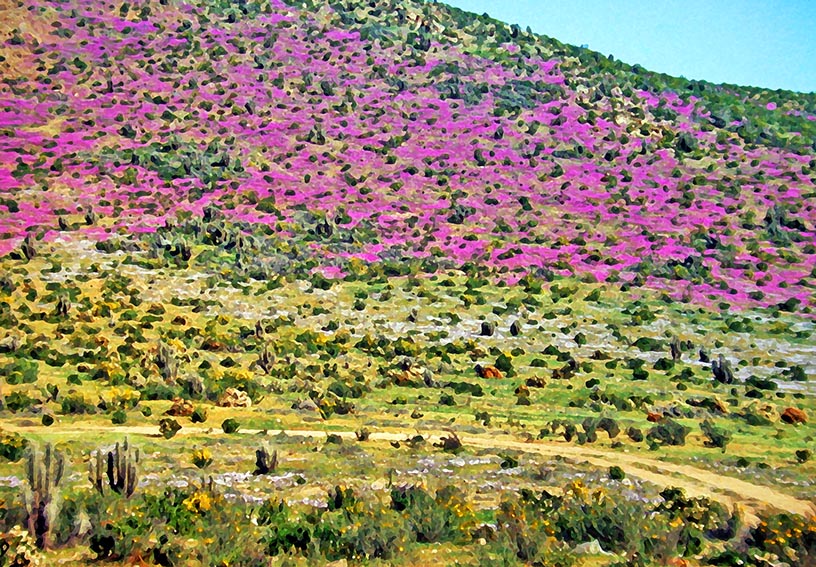
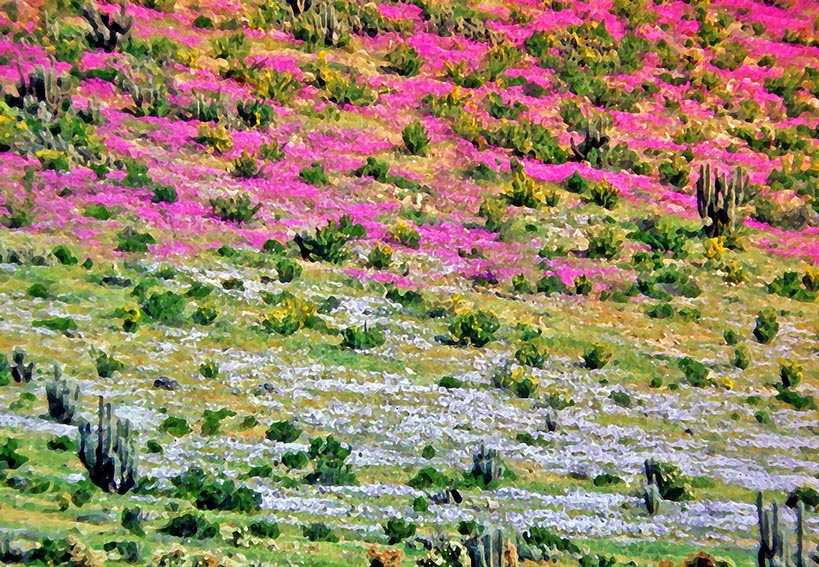
Followers of this site will already be familiar with many of the details of our remarkable trip to Chile back in 1991, just several months after the demise the Pinochet regime.
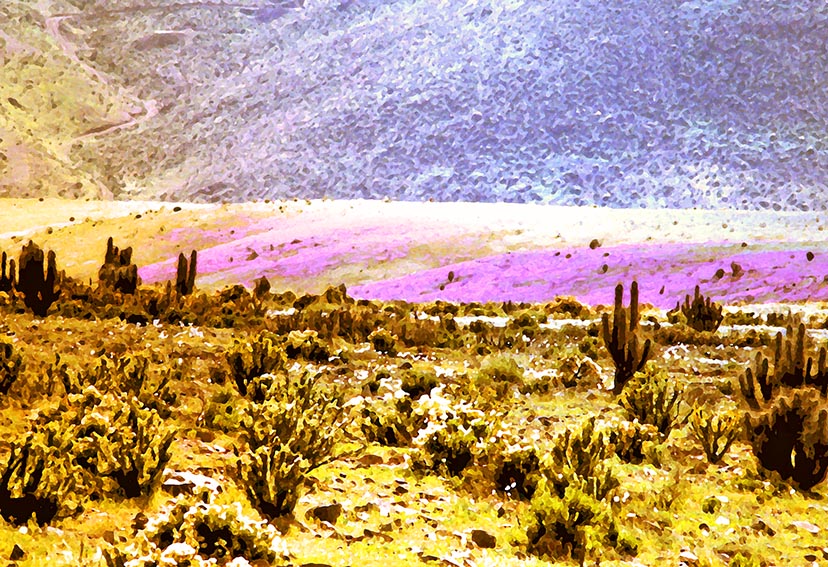
As if to mark this new era of democracy, freedom and hope, the month we arrived, the southern Atacama Desert experienced – what we were assured by the locals – were the first meaningful rains in forty years, and so, as if in celebration, exploded in a riot of colour. It was as if a vast technicolor carpet had been laid atop the normally monochromatic desert floor as every cactus, every succulent and every dormant seed erupted into vivid flower.
Even in normal circumstances Chile’s many disparate landscapes offer a stunning smorgasbord for the visual senses, but this was simply wondrous. Rarely have we experienced, before or since, such good luck being in the right place at the right time.
The dozen or so images presented here give a taste of what we were so privileged to witness with our own eyes…
Having just returned from another fortnight stint working our finca in the Axarquian mountains, sporting our latest collection of cuts, bruises and aching muscles, I was reminded of the wise words that head this post, uttered by the late lamented Fred, an early, fellow British, expatriate neighbour.
A neighbour proudly showing off the succulent fruits of his labours…Moscatel grape has been grown in the area since the time of the Phoenician settlers, and used for both raisins and sweet, strong wine. The grape constitutes the main ingredient of Malaga wine (which predates Sherry by many centuries), and was hugely popular across the Europe of the Elizabethan age.
Fred, a taciturn Yorkshireman, when he did offer his rare nuggets of wisdom, had an uncanny way of getting right to the heart of the matter under discussion, and never were his few words wiser or truer than when he coined the now famous phrase (famous in our neighbourhood at least!), “Spain ‘urts”.
What many tourists and visitors to the region might not appreciate, in awe as they are of the stunning landscape of Andalucía, is that the agricultural land itself is mostly rocky, jagged, prickly and generally unforgiving for those who have to work it. Moreover, while the soil is often fertile, it is a fecundity requiring arduous effort to extract, and if Andalucía in general, is hard country to farm, then the mountainous slopes of the Axarquia often verge on the impossible.
A man trudges back to his finca with a snack for his mule…There were few metalled roads in 1993, and most campesinos used mules and donkeys, for both transportation and ploughing their land.
This is why most of the agriculture of the region was for centuries, the exclusive domain of those both sufficiently hardy, and expediently motivated – or, in other words, the local peasant citizenry of the dozens of pueblos blancos (white villages) which dot the countryside like so many bleached apiaries. And like bees, these small, tough, resourceful workers would leave their village hives for the summer months and move into their finca homes, to tend their vines, pick their crops of grapes and nuts, dry their raisins, and finally, before returning to their pueblos, make their strong, sweet, fortifying mountain sacs.
A goatherd takes a rest…Goats and sheep, and their keepers were a mixed blessing in the campo; while providing good cheese and excellent meat they could be incredibly destructive if not guarded carefully, forcing many of us to reluctantly fence off our land.
Finca’s (privately owned small farms, or small-holdings) are dotted across the countryside in a seemingly random and chaotic, ill-fitting jigsaw of orchards and vineyards, that reflects the interminable division of parcels down the generations, from fathers to sons and mothers to daughters. In 1991, when we (and Fred) moved to the area, fincas were still a major source of self-employment and income for much of the Spanish agrarian working class, and being a “bueno campesino” (a good peasant farmer) earned one a measure of respect within the tight-knit pueblo communities.
But as Fred implied, this might have been an honourable life, but it was also painful and unforgiving. Hence, and quite understandably, as Spain softened and modernised, the attraction of the “campo life” dramatically decreased for the children of the pueblos whose gaze strayed hungrily to the newly flourishing cities and towns, with their universities, and their opportunities of well-paid work and rewarding careers.
Our neighbour “Curro” – not only a fine and proud campesino, but also a skilled ploughman.
This changing demographic is nowhere more starkly illustrated than in our own locality, where the vineyards, raisin-drying beds and almond groves are steadily disappearing, and the old finca cottages are either left to crumble back into the landscape from which they emerged, or are converted into tourist b&bs. Dido and I, together with an aging and dwindling generation of mostly 60-somethings are rapidly manifesting as living relics, as we continue to brave the constant cuts and bruises, the back-breaking tending of vines and trees, wasp stings, and extremes of weather (hot and cold, dry and wet).
What happens when we are all gone is already being mapped out, as the valleys, and easier lower slopes, are all being transformed into fashionable, low maintenance and lucrative plantations of avocado and mango. (The fact that these new “super crops” require hugely greater volumes of water to flourish than the traditional crops and that they are a disaster waiting to happen, is whole other story…)
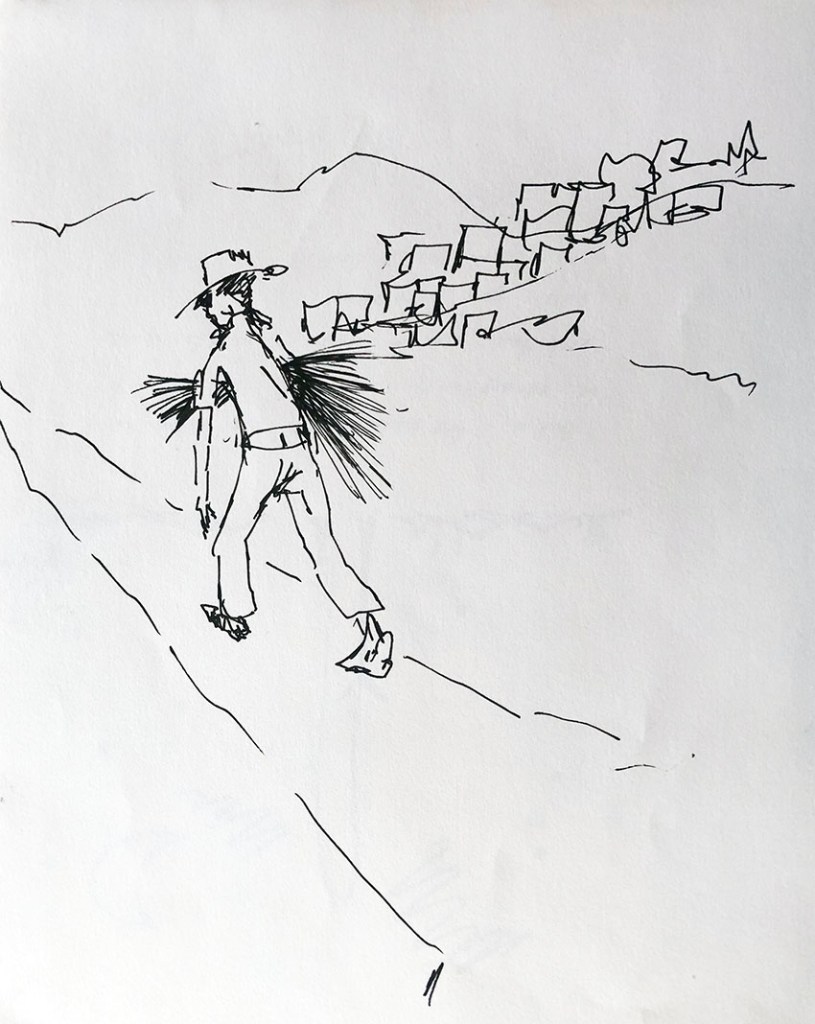
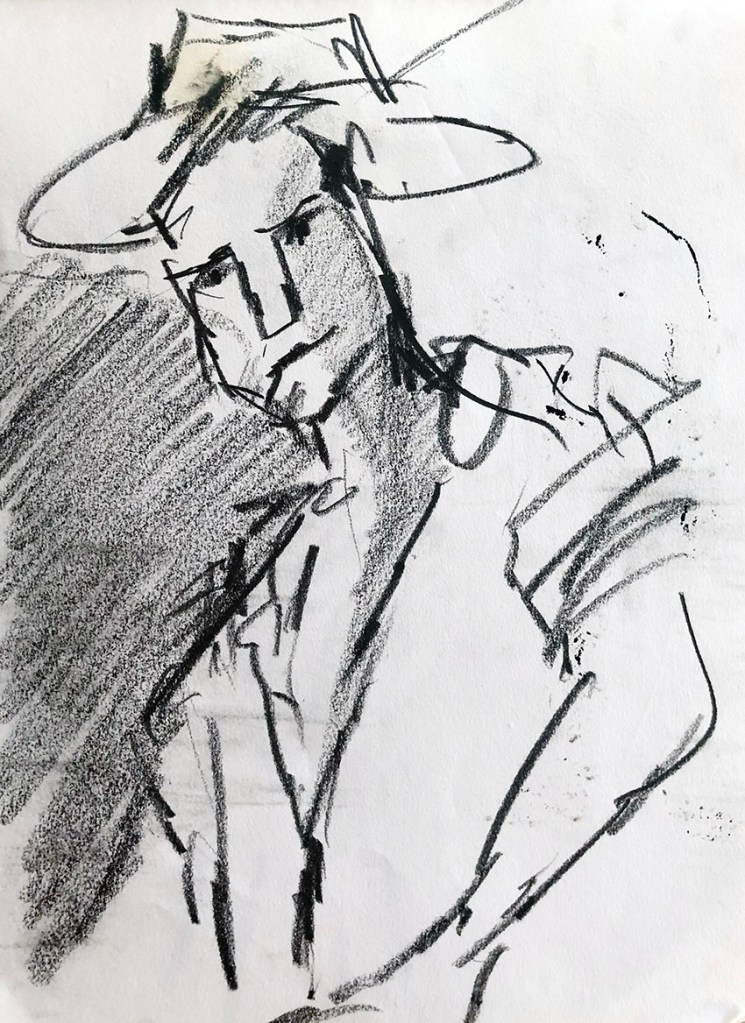
My drawings of campesinos displayed here were done during our first summer at our new home, in 1993, and are a reminder of how things used to be, when Spain (at least our part of Spain) really ‘urt…
“Old Juan” – another neighbour, and typically long-lived. It’s interesting to note that our local village is full of noctogarians like Juan, who swear by their daily shot of brandy or anis at breakfast, and a glass or three of their own wine in the evening. Other factors, such as their active lifestyles and diets must also be taken into account. In common with all Iberians, our locals are fanatics for fresh fish, with inexpensive anchovies and squid (brought up daily to the villages by mobile fish mongers) being central to their daily diets. This, in conjunction with the fact that meat consumption was often confined to what people grew themselves – the family pig, rabbits and chickens, always accompanied by mountains of their homegrown vegetables and legumes which must also contribute to their general longevity.
Header photo is a panoramic view of the campo as viewed from our finca – looking south-east – in 1993.




























 ARKS, ADAM AND AXARQUIA