“A light unto the nations”* like it or not…

an optimistic new year message

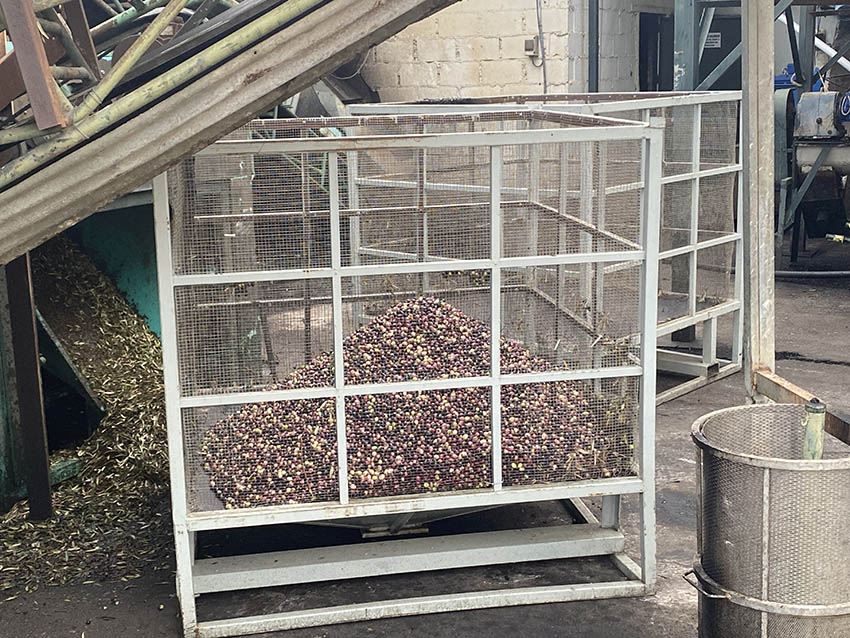
This year we have a bumper olive harvest – the biggest, since we planted our new grove twenty years ago. The work of picking, pruning and burning off is the most intense of the year.

The large crop feels somehow auspicious, as do the copious rains and the unusually crisp temperatures. When we first arrived on these rugged hills, some 33 years ago in 1993, we remember hearing a climate scientist assuring us that due to global warming this region of Spain would resemble the Sahara by 2003. We heard this on the BBC World Service program “Science in Action” on our short wave radio, our only form of communication back then with the outside world. Having just settled here, and having absolute faith in the reliability of the BBC you can imagine how this highly confident prediction alarmed and depressed us.

Well, since then, many things have happened, both predictable and unpredictable from the continued veridian fecundity of the Andalusian countryside, to the increasing unreliability of the once-great BBC.

New years have a funny way of making us reflect on all of these things. They are times of rejoicing but also of deep, and often sad reflection. We are reminded of those we have lost and of our own mortality and of those we love, and of those we do not – and of those who love us, and of those who do not.

All of which brings me to the Hanukkah story: The story centres around the miracle of the olive oil for the Jerusalem Temple Menorah – sufficient only for one day’s illumination, but miraculously lasting the eight days required for new oil to be made and sanctified (hence the eight stemmed candlesticks lit in the windows of most Jewish homes). As an olive farmer, whose crop is exchanged for oil, the story has become increasingly resonant and moving with each successive harvest, and never more so than this year, following the horrific events on Bondi Beach.

As many of you reading this know, I am not religious, but I am nevertheless deeply moved by the symbolism and central message of Hanukkah on a fundamental human level; that message being one of enduring light and of steadfast hope despite the worst efforts of all those who oppose our existence.

Thus, at the risk of contradicting/upsetting “omni-causers” everywhere, my predictions for 2026 and many more years to come, are repeated Andalucian olive harvests, the continued and uncowed thriving of the Jewish People, and the assured reoccurrence of the light of the Hanukkiah – itself, a metaphor for Isaiah’s famous dictum, that our credo was, is and forever will be, “as a light unto the nations “.

Happy New Year, and a hearty l’chaim!

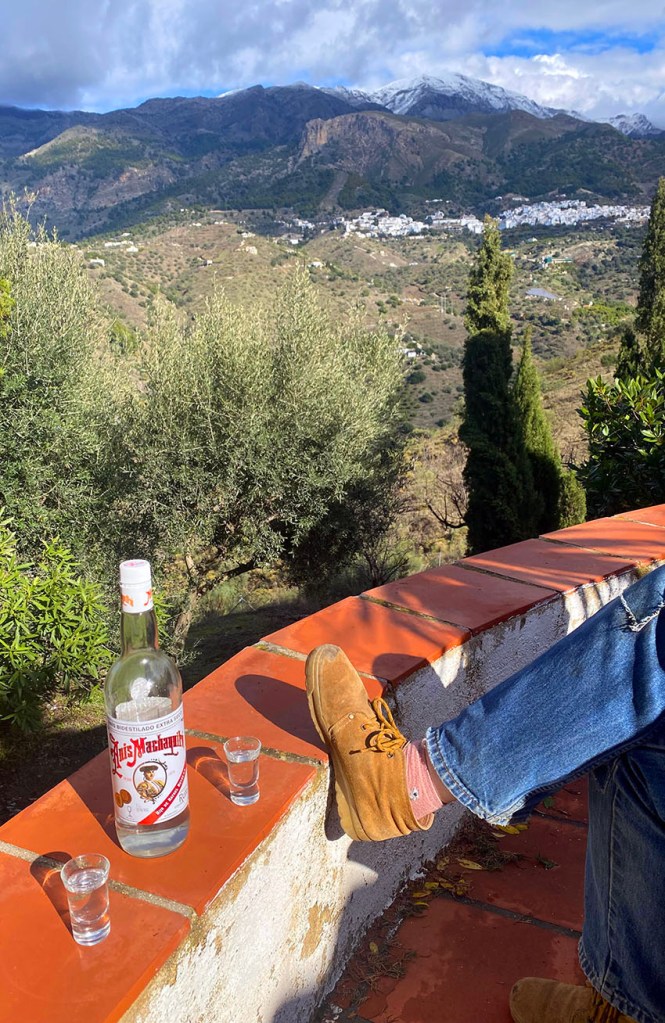
A sustaining mid-morning tipple with a snow-capped Mount Maroma in the background.

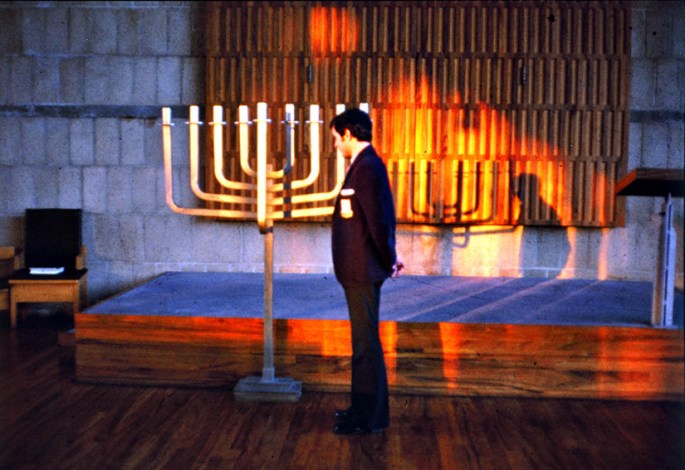
*Isaiah 42:6. Header photo shows the large Hanukkiah (the Hanukkah candelabra) in the synagogue at my old school, Carmel College.

THE MYSTERIOUS CASE OF THE TWO PIZANS – And more synchronicity?*

Hannah and Harry – 1980 – tempera

Carl Jung famously referred to occurrences of synchronicity as “meaningful coincidences that cannot be explained by cause and effect.” He thought that there was something more profound going on than sheer coincidence, something to do with a “deeper order of the universe…”

While I can see the attractiveness of this line of reasoning I find it hard to agree with the great man. For one thing, he does not seem to consider the far larger number of non-coincidences that occur every day to everyone on the planet. The countless times that coincidences are not happening is in some ways even more remarkable than the few times they do occur, given the billions of lives being lived at any one time. Indeed, one could counter Jung’s hypothesis by stating that the very scarcity of synchronistic events is proof that they are simple – albeit often remarkable – happenstance.

In my own life, I have experienced three remarkable, apparently synchronistic episodes. The first, I recounted in an earlier post (here), and was merely charming. The second, which I describe below, was moving, and the third, to which I will devote a future post, was both powerful and disturbing.

The only common denominator in all three events was the fact that they all involved my wife Dido, and all happened within a two-year timeframe – more or less. The first; from slightly before I met her, the second; just after we met, and the third; about the time we were engaged to be married. No doubt Jung would have something to say about that too, but for boring old me, it was just another coincidence.

Anyhow, this is the second “happening” and please judge for yourselves whether or not something “deeper” was going on: It was early in 1989, and Dido and I had been dating a few weeks. She was then an occupational therapy student working on her first clinical placement at Northwick Park Hospital in Harrow (North West London). During her placement, most evenings, she would stop by my family home in West Hampstead for some supper, and sometimes to stay over.

Just to paint the scene – our home was inhabited by my mother Hannah, my recently-widowered grandfather Harry Pizan, and me. After supper, we would typically settle down in the sitting room to either watch some TV or play something like a game of Scrabble. I think it was on the very first day of Dido’s Northwick Park placement, when, in this relaxing setting, she said, looking at my grandfather, ‘I was allocated my first patient today – an elderly gentleman with cancer of the spine – and strangely, he has the same surname as you! Pizan. Didn’t you tell me that your family were the only Pizans* in England?’

To which my grandfather replied, “Yes, we are.” he then asked Dido, “Is this man called Rube?”

“Yes, Rubin Pizan!” Dido exclaimed.

“He’s my brother! You patient is Rube, my younger brother…”

Northwick Park Hospital – west wing building – watercolour – 1976

(“Pizan” was a name allocated to my great grandfather – Harry’s father – and his then-small family, when they landed at Irongate Wharf, London, in 1903, by an immigration officer who must have thought it approximated to whatever name my Polish and Yiddish-speaking “great zaida” had actually said. My cousin Bernard informs me that the name was originally PISEM and was changed to Pizan by deed poll by the family members. We (the surviving family) are not quite clear why the change was made – whether Pisem was a misreading by an immigration official, and the name really was originally Pizan, or something else perhaps? At any rate the name was changed, and thank goodness it was! “Pisem” just doesn’t do it for me! This sort of muddle was a common occurrence, wherever Jewish emigres landed up, from London to New York City.)

*The title illustration and the picture above are watercolours I made of Northwick Park Hospital when I was studying art next door, at Harrow School of Art.

A POSTCARD FROM COIMBRA

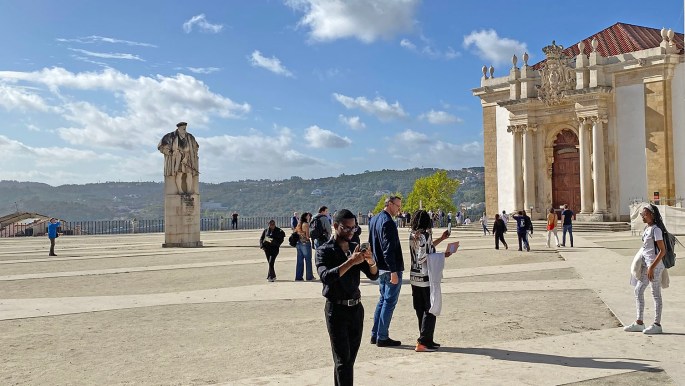
It’s been quite a while since I published a “live” postcard-type piece, but this current trip to Coimbra, Portugal’s oldest (and Europe’s third-oldest) university city has drawn me to the keyboard.

Incredible to think, that we have been living on the Iberian Peninsula (on our finca in southern Andalusia and in Gibraltar) for well over thirty years and had never set foot in (mainland) Portugal. It was not for want of coming, but somehow the necessary stars never quite aligned, until now. It’s even more extraordinary, when one realises that our very first trip abroad together – our belated unofficial honeymoon, in effect, back in 1990, was to the island of Madeira, which we loved.

Anyway, we’re here now, and in the spirit of past “postcard” posts, without any more ado, here is a selection of captioned photos from a town that combines elegant charm and faded shabbiness with nonchalant ease – one might even say, with Portug-ease…

The “Tricana” statue, depicts a working-class girl with her water pitcher. Back in the day, before the advent of running water, this was how the poor collected their water from the town wells. The streets of the old town are narrow and steep, and presumably the girl is taking a well-earned rest…
The old Cathedral of the town, set in a small square, about two-thirds up the hill upon which most of the central old town is perched…
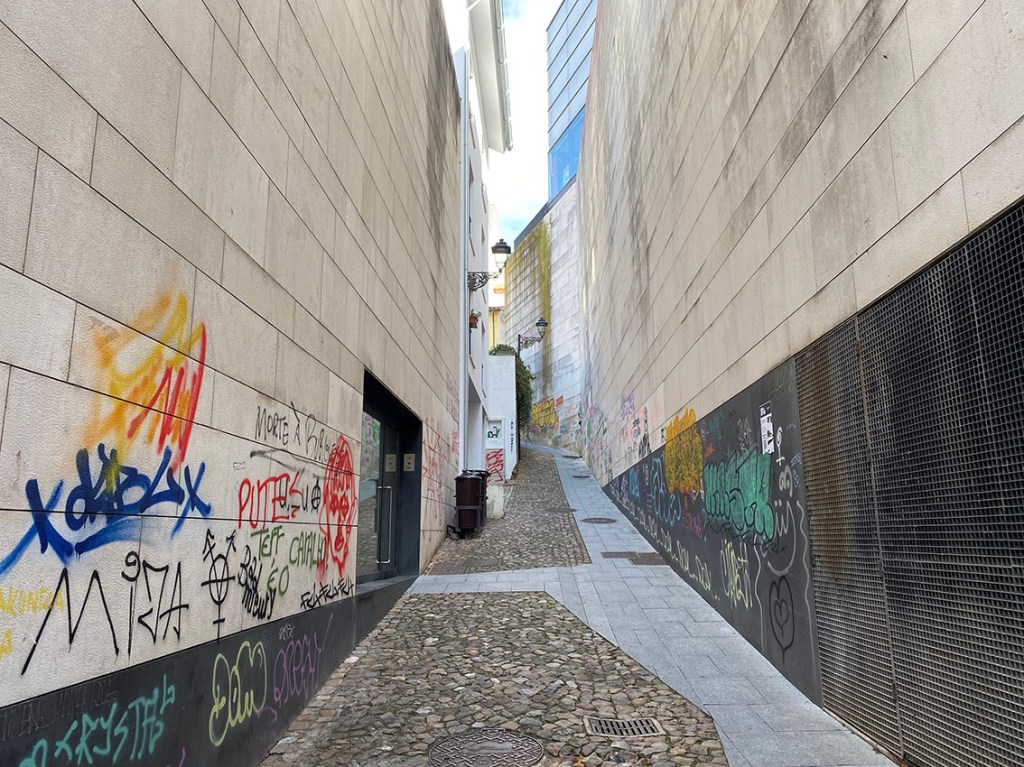
Most of the upper hill, and virtually all of the top plateau comprises the large university campus, old and new. Fortunately, the not very artistic graffiti was restricted to the new…
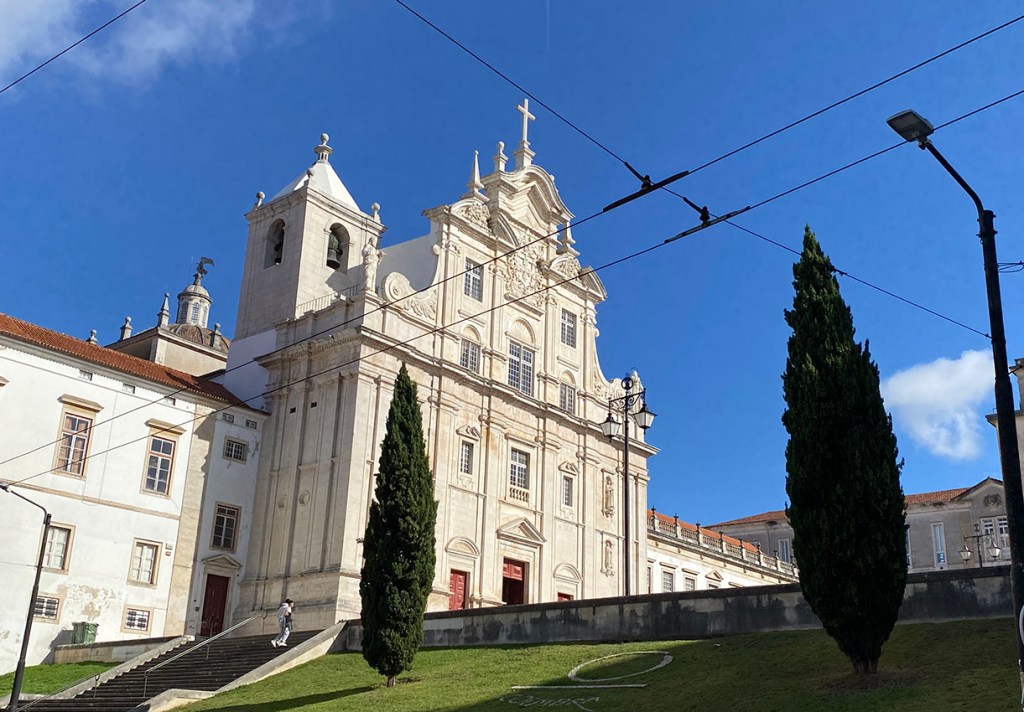
The new cathedral, integrated into the university campus on top of the hill…
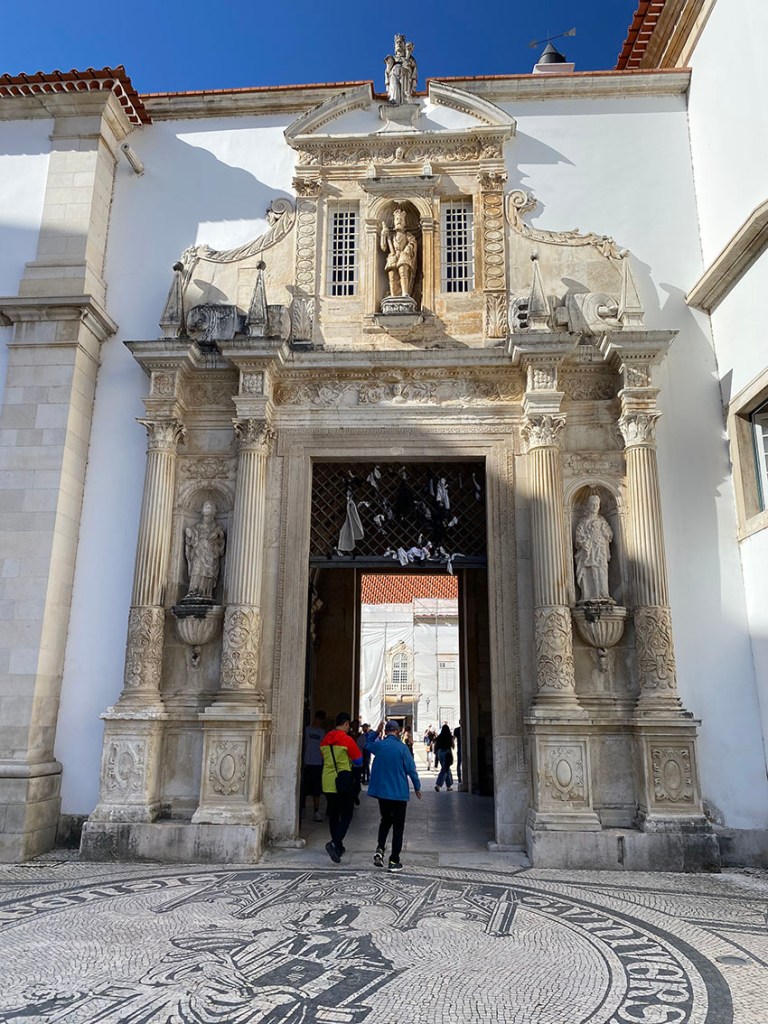
One of the several highly ornate gateways spread across the campus…
Undoubtedly, one the most elaborate campuses I have ever visited and this is its Royal Palace – presumably for regal students?
Coimbra University’s Academic Prison, for badly behaved students – The way things are going these days, most of our elite academic institutions could do with one of these…
An impressive view of the Mondego River (the largest / longest river contained within Portugal’s border), from the university plateau…
Leaving the main campus on the plateau, one passes the charming Capela de Santo António
The old cathedral, from a different angle…
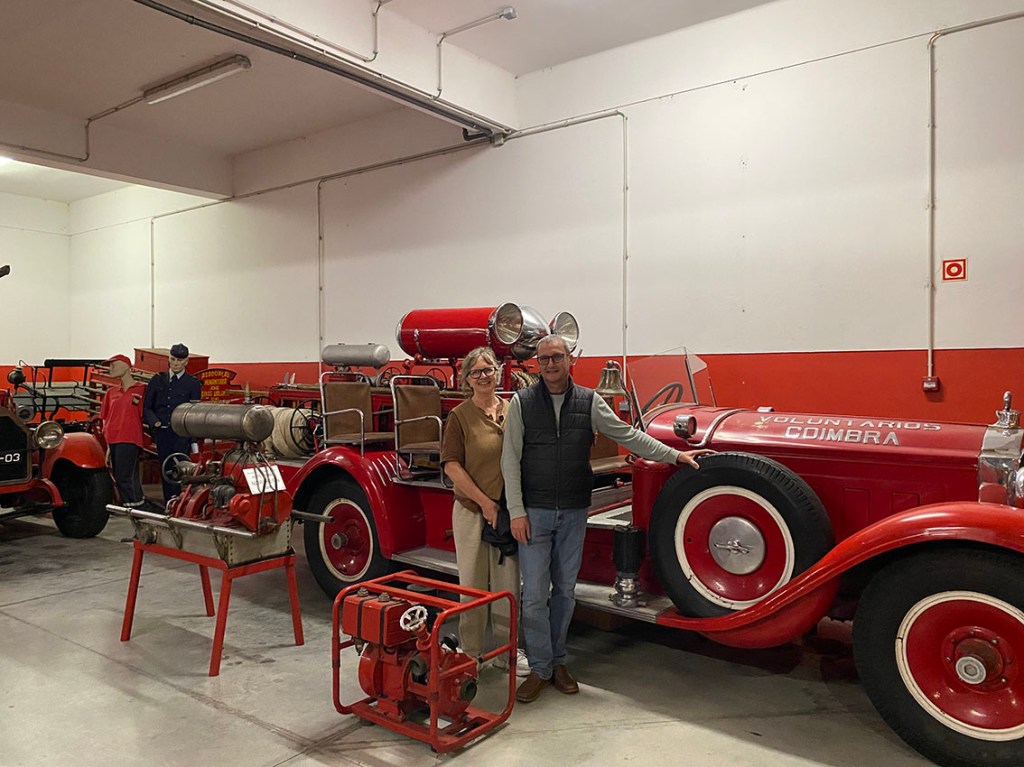
On a different note completely, on our last evening in Coimbra, we passed the volunteer fire station (there are three levels of firefighter in Portugal). The old engines were so enticing we sneaked in for a closer peak, only to be met by an amiable young fireman who gave us a guided tour of the station and the engines. This one, an old Mercedes, dated from the 1920’s and was our favourite. If Keystone Firemen had existed, this would have been the perfect vehicle for them. Dido even got to ring the bell! Coimbra was full of pleasant surprises.

GOUACHE – the most forgiving medium

In my four decades or so as a professional artist, fine and commercial, my most successful medium, from a financial perspective was gouache.

For those who may not know, gouache (also called body-colour) is a form of watercolour paint, but with a denser, “gummier” pigment and more body and opacity. All of which makes it a highly versatile medium. Add more water, and it’s virtually watercolour, use less water, or none, it can be applied almost like acrylic or even oil-paint.

These days, gouache is mostly the go-to medium for commercial artists, especially poster designers requiring large areas of flat, uniform colour on stretched papers.

I was unusual as a late 20th century artist, in that for the first part of my career I used gouache extensively for making “serious” fine art images, which turned out to be advantageous in two ways. Firstly; I found that my “serious” gouache paintings were highly commercial in themselves – in that they sold well, and secondly; when I made the transition to commercial art and illustration, I had developed all the requisite familiarity with this most commercial of paints.

Several past posts have already been devoted to the pictures I made during the latter, commercial part of my career. So, presented here for the first time is a selection of “fine-art” gouaches, painted mainly after I left art school until the late 1980’s. All but the most “watercoloury” one of these were sold, which reflects the relative success I had regarding the gouache versus watercolour.

Lace Ladies of Lindos (Rhodes) – 1985 (59 x 84cm / 23 x 33″). This was one of my very successful images and I repeated it in several forms and media.
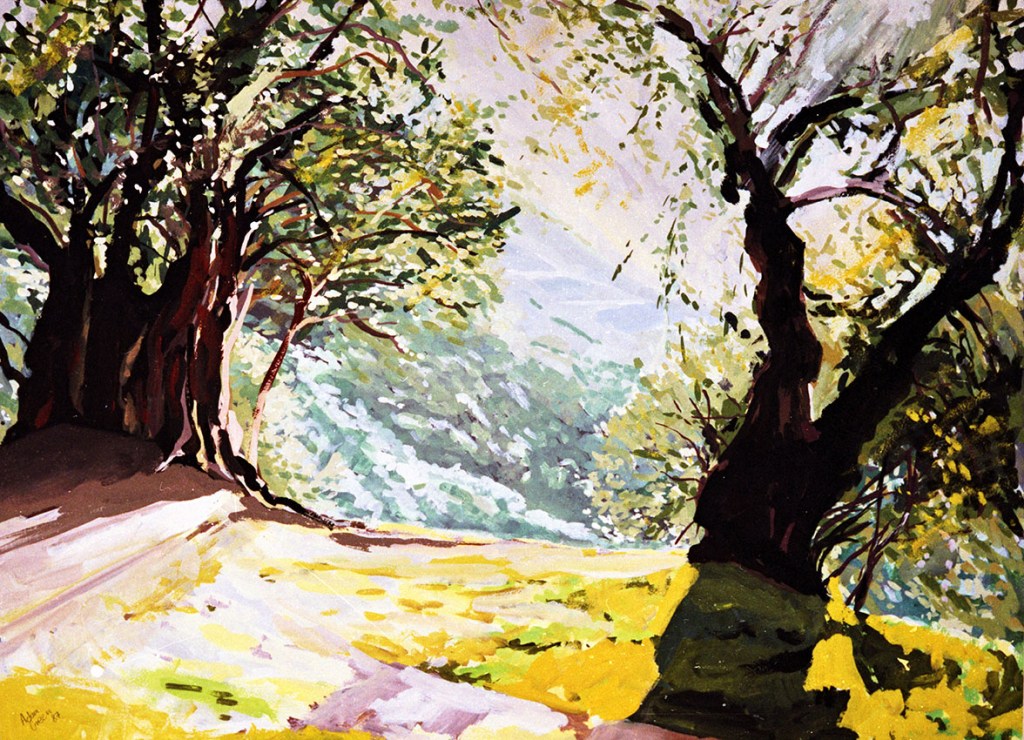
Olive Trees at Delphi – 1987 (59 x 84cm / 23 x 33″). I’ve always held olive trees in a kind of awe. I think this picture describes both their hardiness and their beauty. Little did I know when I made this picture, that just six years later I would have olive trees of my own.
Jerusalem Pines near Jerusalem – 1987 (84 x 59cm / 33 x 23″). Another tree-themed picture, derived from the only trip abroad I devoted entirely to painting. Together with my friend from Saint Martin’s, Danny Gibson, we spent three weeks walking and sketching in the hills west of Jerusalem above the picturesque village of Ein Kerem. The reams of sketches I did there (mostly in coloured pen and ink) provided me with excellent source material for years to come.
“SHOT!” – 1989 (84 x 59cm / 33 x 23″). I’m not by nature sensationalist or morbidly voyeuristic, but there was something about this image of man being shot in El Salvador that I found fascinating, powerful and strangely graceful . it was copied from a photo in a newspaper, and I have not done anything like it before or since.
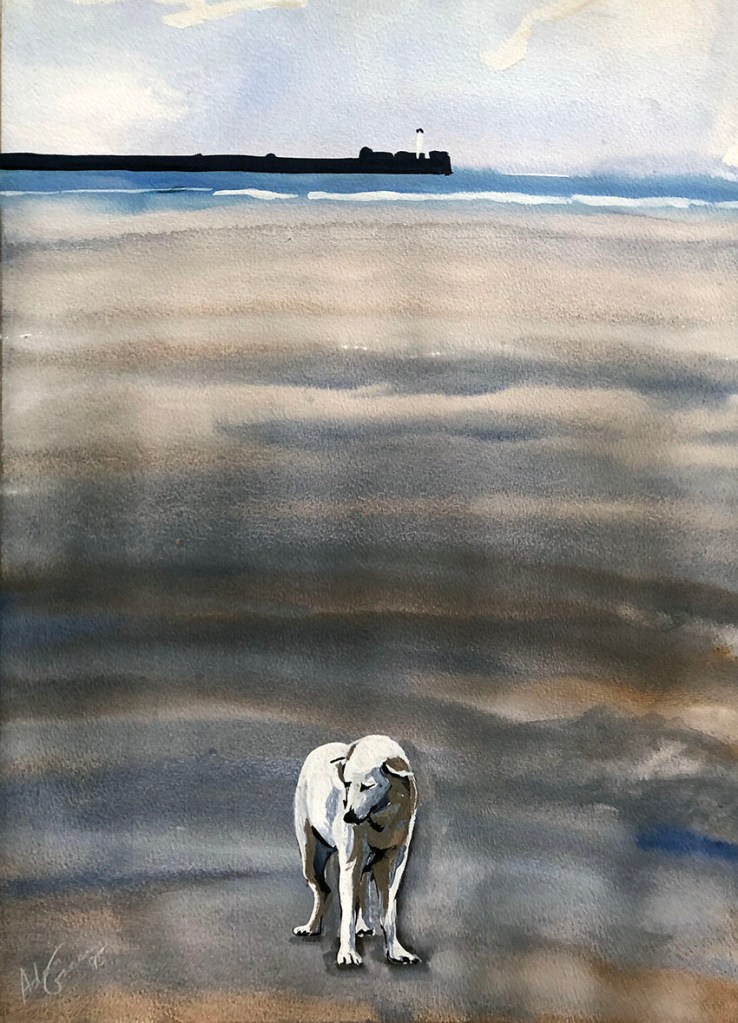
Aura on Boulogne Beach – 1995 (84 x 59cm / 33 x 23″). The most watercolour-like of the painting presented here, a sponged wash. However, the subsequent contrast in texture of the dog (our late beloved Maremma Sheepdog, Aura), in thickly applied Titanium white would be harder to achieve in pure watercolour. This picture dates from a later period than the others, when I had moved into commercial art. This was a spur of the moment (note the rippled, unstretched paper), somewhat emotional testament to our miserable , enforced sojourn in Boulogne-Sur-Mer.

You Chorelywood? I surely wouldn’t!

And my failsafe recipe for delicious bulka (and/or challah)…

Although I am not at all religious now I retain a fondness for the Ashkenazi/mid-east European food of my semi-observant north-London childhood. And fortunately, a non-kosher kitchen is no impediment to recreating some of my favourite Jewish foods and dishes. Growing up in 1960’s and 70’s suburban London, one of the advantages of a typical Jewish diet over that of my non-Jewish neighbours, was the quality of the bread we ate. While many of our non-Jewish neighbours were eating exclusively “Chorleywood” and other mass-produced batch-processed loaves, we had a more varied selection of far finer breads.

From Polish and Russian influenced light rye breads and bagels to the biblically derived (descendent of the sacred temple “shewbread”) twin challahs of the shabbat (sabbath) table, our excellent Jewish bakeries sold them all. Moreover, the fact that bakers like Grodzinski used brick ovens, well into the 1970’s meant that even their everyday white bloomers and wholemeal loaves were always perfectly baked.

Grodzinski in particular, produced superb challah in four forms; traditional plaited, round (in the form of a spiral plait) and tinned “bulka”. Their fourth offering, “egg challah” only differed in having more egg, and thus being a richer dough. The use of brick ovens ensured a well-baked, crusty loaf with a delicate dough, that aged rather that went stale. Sadly, from the late 70’s Grodzinski, in common with all their rival bakers moved over to modern steel ovens, and their challah, likewise, became the ubiquitous cottonwool most people eat today.

I don’t think it’s a coincidence that the emergence of the cottonwool variety coincided with a rise in the production of homemade challah as people yearned for a return to the genuine article that was no longer available at their local bakery.

These days, there are literally thousands of recipes available in print and on line for the “perfect challah” and I must have tried a hundred of them. But in the end, I always return to a very simple recipe a friend of my late mother’s (thank you very much Roberta, if you’re reading this), scribbled hurriedly on a piece of scrap paper about 40 years ago.

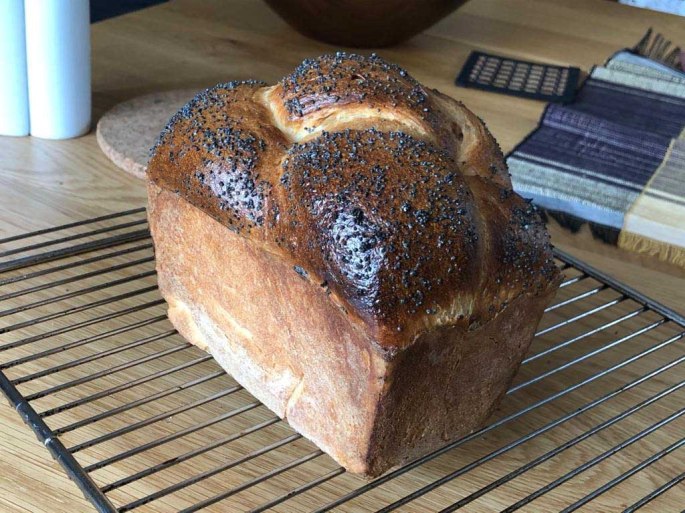
It couldn’t be easier or more reliable, and works equally well for all forms of the bread. Here, I’ve gone with a tinned challah – or bulka, as I knew it as a child. The advantage of bulka is that it slices easily (especially as it ages), and, after a day or two, makes superb toast. Good luck, and Shabbat shalom!

INGREDIENTS (for 1 loaf – double ingredients for 2 etc…):

  • 2 cups (about 500gm / 16oz) strong white bread flour, plus flour for dusting
  • 1½ packets of powdered (instant yeast – MUST BE FRESH)
  • 1 heaped tsp salt
  • 2 egg yolks and 1 egg white, lightly beaten
  • 1 egg white, lightly beaten and set aside
  • 2 tbsp corn, nut or rapeseed oil (NOT olive or sunflower)
  • 200ml (12½ fl oz) very warm water (so that you can just put your finger in)
  • 1 tbsp white sugar
  • several pinches of black poppy seeds

METHOD:

  • Chuck flour, yeast and salt into a large bowl and mix well
  • Make a deep crater in the middle of the flour with your fist
  • Pour beaten eggs, sugar, oil and water in crater
  • Using handle of a large wooden spoon (or similar) stir mixture until everything fully integrated, and mixture pulls away from side of bowl
  • Pull away dough stuck to spoon handle and start to knead mixture in bowl
  • Add flour if too moist and sticky
  • Tip dough onto a smooth, lightly floured surface
  • Knead dough – adding more flour as required – until smooth and elastic (anything from 3 to 10 minutes, though rarely more than 5)
  • Pour a teaspoon of oil into the mixing bowl and coat the bottom and sides
  • Place dough back in bowl, cover with a damp tea towel
  • Place bowl in a warm, still environment, like an airing cupboard, or near a radiator
  • After an hour or so the dough should have at least doubled in size
  • Grease a 2pint (1ltr) loaf tin with butter or oil and then dust thoroughly with flour
  • Tip dough back onto lightly floured surface and knock back two or three times (about 20 seconds)
  • Using a wooden dough slicer (a knife will do), cut dough into three equal pieces
  • Roll out each piece of dough into a strip, about a foot (30cm) long
  • Roughly plait the three dough strips (this really does not need to be perfect for a bulka)
  • Drop the plaited loaf into your prepared loaf tin.
  • Cover with the damp tea towel and place back in the warm, still environment to prove for about 40 minutes
  • After about 20 minutes set your oven at 250°c (480f).
  • Dough is ready when pushing up the tea towel above the level of the tin rim
  • Gently, brush all the exposed dough with the reserved egg white
  • Sprinkle generously with the poppy seeds
  • Place in the oven
  • After ten minutes, reduce oven to 190° (370f) and bake for about another 15 – 20 minutes
  • Remove loaf from oven and carefully tip out. If the base of the loaf sounds hollow when flicked with your finger it’s baked. If the base is a little too pale, gently put the loaf back in the tin upside down and bake for a further 5 minutes
  • Leave loaf to cool for about an hour. If not saving for shabbat supper or suchlike, slice off the end of the loaf, spread it with lashings of butter and a dollop of good quality jam or marmalade and enjoy the products of you labour!

A final few tips: For “loose” plaited or round challah, use a pizza stone, lightly dusted with corn flower (masa harina – NOT corn starch), for a crustier, better baked loaf. Stale challah makes the best bread pudding, and bread and butter pudding and delicious French toast. Very stale and finely crumbed (I use a coffee grinder), it makes a decadent coating for schnitzel!

SIDNEY – A Tribute: part 5*

the master of anecdote…

In addition to his many talents, Sidney was a fine raconteur and a master of the anecdote. I related one of his most amusing military national service stories in an earlier post, but the Studio also offered up many hysterical moments, none of which my uncle enjoyed relating more than the story of the prize ram…

About 1969/70, British Woolmark (now Woolmark Company) hired Sidney to do a campaign for them. In his wisdom, the director of the first shoot decided that it would be a good idea to position a prize ram between two pretty models wearing the latest woollen clothes. This might have been a good idea, had it been a pastoral location, but he wanted it to be a studio piece. So, one prize Merino ram, and his farmer were summoned from deepest Sussex to Arkwright Road NW3. Even then things might have worked, had not the ram been brought straight from the muddiest, rain-sodden pasture, it’s fleece – the focal point of the shoot – caked in thick mud.

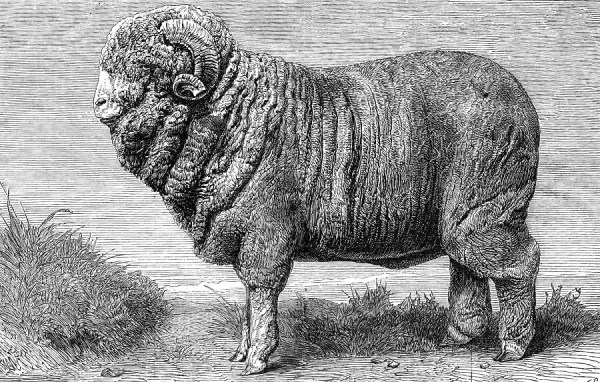
An old engraving of a Merino ram.

Sidney and his team had no option but to attempt to wash the ram, and with the farmer’s assistance, they managed to get the animal into the bathtub in Sidney’s flat – attached to the rear of the studio. However, the resulting bathe resulted in a drenched, grey woollen mat, rather than the snow-white, fluffy, pristine Merino fleece required by the director. Then someone suggested using a hairdryer to dry the sheep, which, after an hour or so actually worked but it still left the wool looking too dull. Then someone else had the brilliant idea to cover the ram with talcum powder. At this point, the farmer leant over to Sidney and warned him in his rich Sussex tones, “I should warn ye, that e do like to pass a bit o’wind…”.

The resulting photo session was a farcical nightmare: The ram was maneuvered onto the backing paper between the two models, donning their woolen finery. The talc, having got up the animals nose, caused it to sneeze and then fart. Every time it sneezed, a great cloud of talc filled the room like a fog. Every time it farted, a rich, pungent stench accompanied the fog, all of which caused the models to flee the room, choking and gagging. Then, the inevitable happened when the farting culminated in the ram evacuating its bowels – massively.

Somehow, eventually, the shoot was completed, with typically excellent pictures, of serenely smiling, elegantly attired girls, either side of a majestic, pristine and proud ram.

Unfortunately, I don’t have photos from the shoot to show here, but I do have another image which shows that The Studio could also be a place of intentional fun…

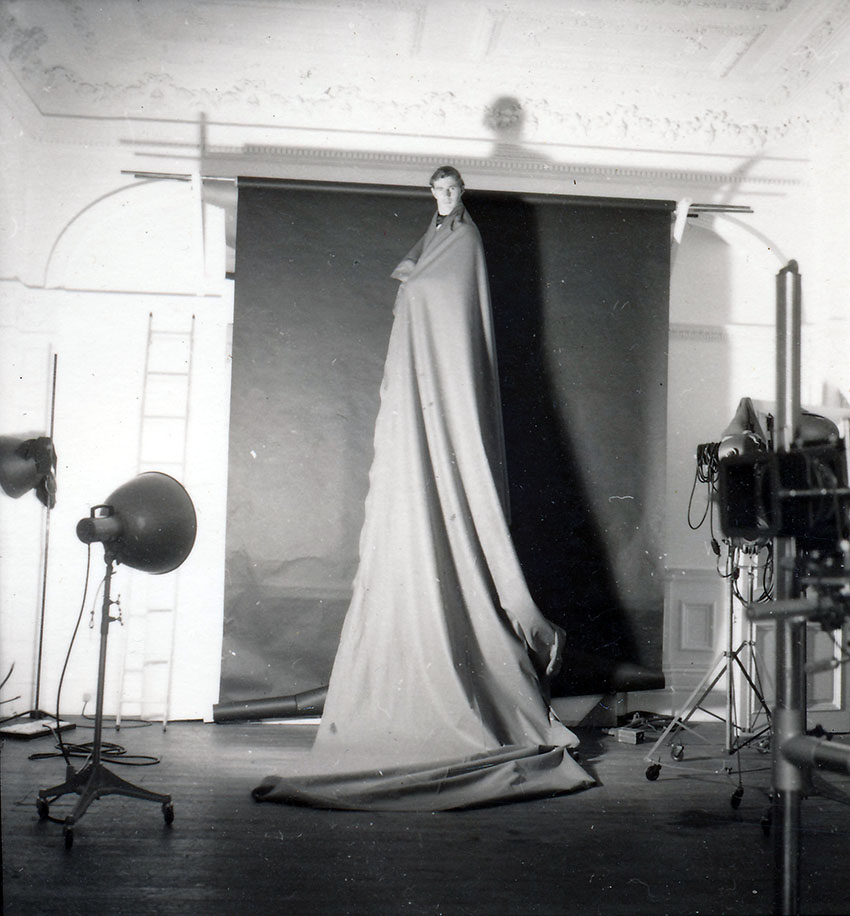
One of Sidney’s first assistants at the Studio was David Hendry. He was a tall man, but not quite this tall. This photo dates from around 1960.

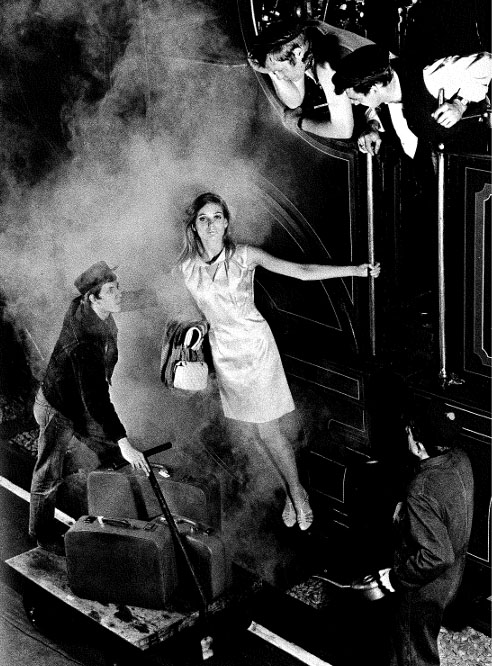
* The title picture of a typical location shot product of Sidney’s Studio of the stagier variety, from The Art Director’s Index to Photographers, 1970 edition. Sadly, I am unable to identify the model (all suggestions welcome!) or the brand. Even more sadly, I am unable to gain access to a whole load of Sidney’s and his colleagues material to share on this site, including many famous and culturally important images. Hopefully, one day they will get the exposure they deserve, if not here, on some other platform where their contribution to British and international advertising can be fully appreciated and even perhaps inspire future generations of photographers and advertisers. I feel sure that this is what Sidney himself would have wanted and it is the legacy he deserves…

SIDNEY – A Tribute: part 4*

From 1960 until 1975 “The Studio” was a hive of photographic activity. A seemingly unremarkable corner of NW3 (where Arkwright Road meets Frognal, to be precise) became the scene of remarkable commercial and artistic creativity. Some of the UK’s, Europe’s and even some of America’s most iconic advertising images of the era emerged from this most unflashy and unpretentious of locations. Sidney and his gifted, happy team produced a stream of pictures that encapsulated Britain’s mood shift away from dull, post-war straight-lace to swinging 60’s cool and verve.
My older brother Michael in a magazine ad for a-then-state-of-the-art Creda clothes dryer. We can imagine the caption that went with the picture

Moreover, their work didn’t merely reflect the prevailing trends but often set the tone of the times with a stream of iconic (a massively overused word, but not in this case), highly innovative and enduring images.

Sidney the model for once, at his dental practice, with Michael in the chair. My father Gerald Green was the art director of the shoot, and he probably took the photo. In the early days of the studio, Sidney got a lot of work through Gerry (as he was known then) and his partner Bill Young’s agency (Crane Advertising), which in turn received a lot of government sponsored commissions. This was part of a campaign to promote dental health in children…

Famous female faces to grace the Studio included Pattie Boyd (future wife to George Harrison, then Eric Clapton) Nancy Edgerton, Sandra Paul (now Howard), Joanna Lumley,  Celia Hammond, Julie Bishop, Adele Collins, Ann Kerr, Paula Heyworth, Jeanette Harding, Anya Sonn, Tammi Etherington, Davina Taylor, Biddy Lampard, Christine Williams, Julie Bishop, Pat Knight and Margaret Lorraine. Among the male models were Ken Swift, Geoff Wooten, George Lazenby (later 007), Pip Perkins, wrestler, Jackie Pallo and Norman Lambert .

The Green family in another government sponsored ad for family planning, and The London Rubber Company (through the use of Durex). The poignant story behind this photo can be found in an earlier post…

In addition to Sidney and Co’s classic fashion shots, they gave 1960’s Britain an original and often defining glimpse of everything from Danish Bacon, Guinness, Heineken Lager, Paxo Turkey Stuffing, Carr’s Water Biscuits to Max Factor roll-on deodorant (and dozens of other products besides).

An ad for Selfridges boys shirts – in addition to all his many other activities, Sidney was staff dentist at Selfridges for over 30 years. This resulted in him doing much of their ad campaigns in the 60’s and 70’s, and, best of all, being given a lifetime 33⅓% discount card on all products – including sale goods. Being leant Sidney’s card was one of the most sought after perks by all those who worked with him and for him (including his family members such, as Michael and I in this shot)…

Apart from being a seriously good fashion photographer, Sidney was a master of head-shots and a genius with still-life. Long before “food styling” was a thing, Sidney’s food and drink ads in particular were masterpieces of light, colour, depth and shade, often setting benchmarks for all those that followed.

Hannah standing in for a model on a Max Factor shoot on the left, in 1964. The photo on the right dates from 1967, but I can’t recall what it was for. From my recollection models were often late for work, and I think mum was pulled in on at least three occasions for headshots like these…

Unfortunately, I do not have access to much of Sidney’s professional portfolio, and much of the material I do have, I do not have the rights to reproduce here. Nevertheless, I am fortunate to own all of Sidney’s work for which I, and other family members were the models. And, while some of these images will be familiar to regular readers of these posts, there are also one or two charming surprises which give at least a flavour and the atmosphere of the Studio’s output in the early-to- mid 1960’s.

I think this was the final time I modelled for Sidney, about 1967. I know the baseball boots were mine, so I’m presuming that it was for the clothes.

JOHN’S SHOPPING, BUT NOT COPING…

If you ever wondered what all those dots and dashes are for on Scandinavian words then the name of the town in Sweden Dido and I are soon to move to might help.

Jönköping without its umlauts (or “umplaghs” as Dido refers to them) looks fairly straightforward to the English eye. Jonkoping instinctively, phonetically looks like it should be pronounced “John-coping”, but the presence of the umlauts immediately sets alarm bells ringing. You just know that “John-coping” is wrong with the result that you find yourself instinctively “accenting” the word. However, unless you are familiar with “Northern Germanic” languages the chances are that instinctive accenting will be wide of the mark.

In my case for instance, before I knew better, I found myself pronouncing it something like “Jern-kerping” whereas after being corrected by a helpful Swede I was told to pronounce it more like “John-shopping”. Of course, “John-shopping” is only an approximation of the correct Swedish pronunciation, but it does at least indicate the effect of the umlauts.  Moreover, since I’ve been using it, the constant stream of polite corrections from dismayed Swedes has ceased.

The one thing all our new Swedish acquaintances have told us is that our ability to pronounce Swedish words correctly, including Jönköping will improve over time.

Whether or not we have sufficient time in Sweden to master Swedish enunciation will depend upon how well Dido’s new tenure at Jönköping University works out. As things stand she’s planning on this being her professional swansong, but even at 57 this still leaves us with plenty of time – potentially…

Far more accessible than Jönköping’s correct pronunciation is its pleasant geography. The town is situated on the banks of Sweden’s second largest lake, Vättern (yes, another umlaut, and no, I haven’t been informed yet and all guidance welcome) and during our recent visit I manged to get some striking images of it, and the natives enjoying themselves along its beach.

One of the things that I’m falling in love with in Sweden, and something I already miss when I’m not there is the astonishing crystalline light and the startlingly vivid colours and tones it produces on everything it touches. These pictures illustrate this pretty well…


ADAM’S NORTH LONDON…

the end of a close 65-year relationship*

Last month we sold our little flat in Hampstead, North London. In and of itself, not exactly an earth-shattering event, but in the context of my life, an extraordinary moment. The reason being, that for the first time in my then-64 years and 11 months I no-longer had even a toe-hold in the city of my birth.

Regular readers of these posts will know that I have always endeavoured to keep my blog as free from controversial subjects as possible, despite the fact – as those who know me well can testify – I am highly politically aware with a range of opinions, some strongly held.

Given the recent and current state of the world, this policy has not always been easy, but this blog, originally intended to publicise my books and my art, is not a forum I wish to use for expressing my views on putting the world to rights. Ultimately, from my own experience of sampling and following other people’s politicized sites, one inevitably ends up with a corrosive and destructive clash of echo chambers. Thus, our reasons for leaving London will remain known to only our intimates.

Presented here is a photo-record of the first 30 years of my own personal London life (several suitably grainy and scarred), from times past, when I could never have dreamed that I would ever cut my ties with my once-beloved city “north of the river”.

I was born in Edgware, in the county of Middlesex in 1960, strictly speaking, before it became part of Greater London. Famous for its eponymous Roman road, as the composer Handel’s temporary home, and being at the end of the Northern Line Tube, it was where I grew up. This picture shows me as a baby, with my mum, Hannah, older brother Michael and my great auntie Ray at my grandparents flat…
My final day at nursery in 1963 with my mum (left) and a friend. I seem to be clutching a postcard though I have no idea who from…
Apart from a bout of glandular fever when I was six, my childhood was exceptionally happy. Although my father had departed the scene when I was a babe-in-arms, my little family was a more than adequate compensation for his absence. Here we have Hannah and her parents, Becky and Harry, me and my brother Michael (my uncle Sidney took the picture), in my first home…
Purim at my primary school. I’m a rather lame-looking Robin Hood sat between cowboys and GI’s
Between the War and my birth, my mum’s family lived in Hendon. Many of our closest family friends remained there, and this is Michael and I during a visit to one of them. We’re sitting on the bonnet of mum’s first Ford Anglia – eat your heart out, Harry Potter!
We took our snowmen very seriously back then
Our second house in Edgware had a large back garden and by “London-clay” standards, half-decent soil. Sidney and I were both keen gardeners, something I remain to this day…
My studio space at Saint Martin’s, with friends and fellow students. The guy on the far left is my lifelong friend Simon – not an artist, just visiting. Next to him, looking at the camera is Robert, a hugely gifted portraitist, and the girl is Piyawan, another very talented painter and cartoonist. Judging by the coats, this was at the end of the day and when we would typically be preparing for a visit to one of the many local Soho pubs…
My final act at St. Martin’s was to undertake this temporary mural commission (I describe the story here) in James Street, Covent Garden
My grandparents were moderately observant Jews (outside the Haredi communities – and even they differ from one another – there are as many nuances and degrees of “observant” as there are Jews who observe), and the traditional Shabbat supper was always partaken of. Here I’m “making Kiddush” (the blessing over wine) on one such occasion. By this time we had left Edgware and moved to West Hampstead, also North London, but closer to the centre…
I lived at home (in West Hampstead) well into my late 20’s, and this was my painting studio, which we built at the end of the garden…
I met my future wife, Dido Nicholson, in 1988 and we married two years later. This was her cute little mews house in Lancaster Gate, close to Paddington Station and Hyde Park. She inherited the Alfa GTV from her uncle Leonard, who sadly died while playing real tennis at Lords (the “HQ” of world cricket)...
Dido and I were married at Marylebone Registry office, attended by her parents, my mum and Sidney, and of course, our maid of honour, our best friend Aura, looking unusually sheepish for a large sheepdog…
Like most Londoners, I was rarely happier than when visiting one of my local pubs, like the Holly Bush, here in Hampstead, which has turned out to be our final London Address…
A melancholic New-Years-Day scene on the tow-path of the Regent’s Park, one of our favourite regular walks, and a fitting image to end this homage to a lost city.
  • The title picture is the top of Primrose Hill. It offers, arguably, the best view of London from north-west of the city. I always found the scene somehow reassuring, and no more so than one misty autumn morning in 2010, when my mother had just left for the airport on her way to Dignitas.

SIDNEY – A Tribute: part 3

the team behind the scenes…

When I began this series of posts on Sidney, I had originally planned to do just three, but since then I have had the privilege and the joy of reconnecting with several of his old colleagues, assistants and models, from the days when he ran one of London’s top advertising photography studios. Subsequently, I now have far more material – anecdotal and pictorial, than when I started out on this mission, and so this will now be number 3 of 5 posts in total.

The most striking – not to mention moving element of this process has been how each and every person I have been in contact with has had nothing but warm memories and kind words about Sidney and their time working at “The Studio”.

This post offers a small, illustrated, behind-the-scenes record of those exciting and pioneering times…

An early publicity shot of Sidney and his team (1964 – taken using a timer): Edgar Asher (TL), Henry Sudwarts (TR), Doreen Dahl (CL), Sidney (C), Faith Hollings (CR), Lawrence Sackman (F). Edgar was extremely tall and thin, and is the only person I know to break their leg playing the violin. He was a fine photographer in his own right and went on to work for the Israel Press and Photo Agency. Lawrence – the youngest of the group – learnt his craft well, and went on to a successful career in art and erotic photography, working with Guy Bourdin and Helmut Newton. More on the others below…
Probably taken by my father, Gerald Green (1960), this shows Sidney with Bill Young and my mother Hannah (far left – Sidney’s sister – and I’m presuming that the two other ladies were accompanying Sidney and Bill). Bill was my father’s partner and became good friends with Sidney. In addition to being an add-man he was also a darn good artist. Two of his gorgeous large oil landscapes adorned my childhood home and strongly influenced my own painting style…
Sidney with Henry Sudwarts, who contributed this and several others of the photos shown here and has some interesting recollections from his time at the Studio. Not only did he get to drive Sidney’s prized Alvis motor car, he also remembers a “Dell Boy”* -like handyman who used Sidney’s basement to stash away contraband cigarettes and radios off the back of a lorry! Henry too branched out on his own in fashion photography before moving into TV in Israel. Having married a South African in 1980 he then moved to Cape Town, where after 30 years working in things as diverse as jewelry and tourism, he picked up a camera again and became an acclaimed wildlife photographer . .
Doreen (left) and Faith from a mid-1960’s shot for BEA (British European Airlines) taken at Sagres on the southern Algarve of Portugal. The main purpose of the trip was a job for Women’s Own Magazine, and the girls were both assisting with the shoot. Faith, whose memories and information have been invaluable to me in compiling these posts, was one of Sidney’s photographic assistants. She has something interesting to say that “to his credit Sidney employed me as a photographic assistant even though I am a woman. Women of my age had to fight to earn a place in a male dominated profession and I had spent three years learning my craft at Guildford School of Art under the the wonderful Ifor Thomas, who was head of the Photographic Department.” Faith now lives in Portugal where she works for an animal charity
Henry with Doreen . Doreen was Sidney’s secretary (or PA in today’s terminology), and also an aspiring classical timpanist. Faith and Doreen became friends, and she would sometimes help Faith with photographic duties, including setting up a darkroom on travelling shoots, such as the one above in Sagres. My mother, who did additional secretarial work for Sidney, also became very fond of Doreen. Sadly, I haven’t yet discovered what has become of her or her timpani playing?
One of Sidney’s later assistant photographers was Peter Watkins, pictured here on a shoot at the London Transport Museum in London’s Covent Garden. Peter also went on to have a successful career as a fashion photographer. The young chap seated is yours truly. During school holidays I often got to watch shoots, but this one stood out for the fact Peter drove me there in his open topped MGB GT – my first time in a convertible sportscar. Other notable photographers and set technicians who worked for and/or with Sidney from 1960-1975 and who also helped me with my research, included Brian Jaquest, Derek Berg and David Hendry.

*For those reading this not acquainted with the long-running British sitcom, “Only Fools and Horses”, Del Boy was a spiv (someone who deals in dodgy and black-market goods), and the program’s main protagonist.