In my four decades or so as a professional artist, fine and commercial, my most successful medium, from a financial perspective was gouache.
For those who may not know, gouache (also called body-colour) is a form of watercolour paint, but with a denser, “gummier” pigment and more body and opacity. All of which makes it a highly versatile medium. Add more water, and it’s virtually watercolour, use less water, or none, it can be applied almost like acrylic or even oil-paint.
These days, gouache is mostly the go-to medium for commercial artists, especially poster designers requiring large areas of flat, uniform colour on stretched papers.
I was unusual as a late 20th century artist, in that for the first part of my career I used gouache extensively for making “serious” fine art images, which turned out to be advantageous in two ways. Firstly; I found that my “serious” gouache paintings were highly commercial in themselves – in that they sold well, and secondly; when I made the transition to commercial art and illustration, I had developed all the requisite familiarity with this most commercial of paints.
Several past posts have already been devoted to the pictures I made during the latter, commercial part of my career. So, presented here for the first time is a selection of “fine-art” gouaches, painted mainly after I left art school until the late 1980’s. All but the most “watercoloury” one of these were sold, which reflects the relative success I had regarding the gouache versus watercolour.
Lace Ladies of Lindos (Rhodes)– 1985 (59 x 84cm / 23 x 33″). This was one of my very successful images and I repeated it in several forms and media.
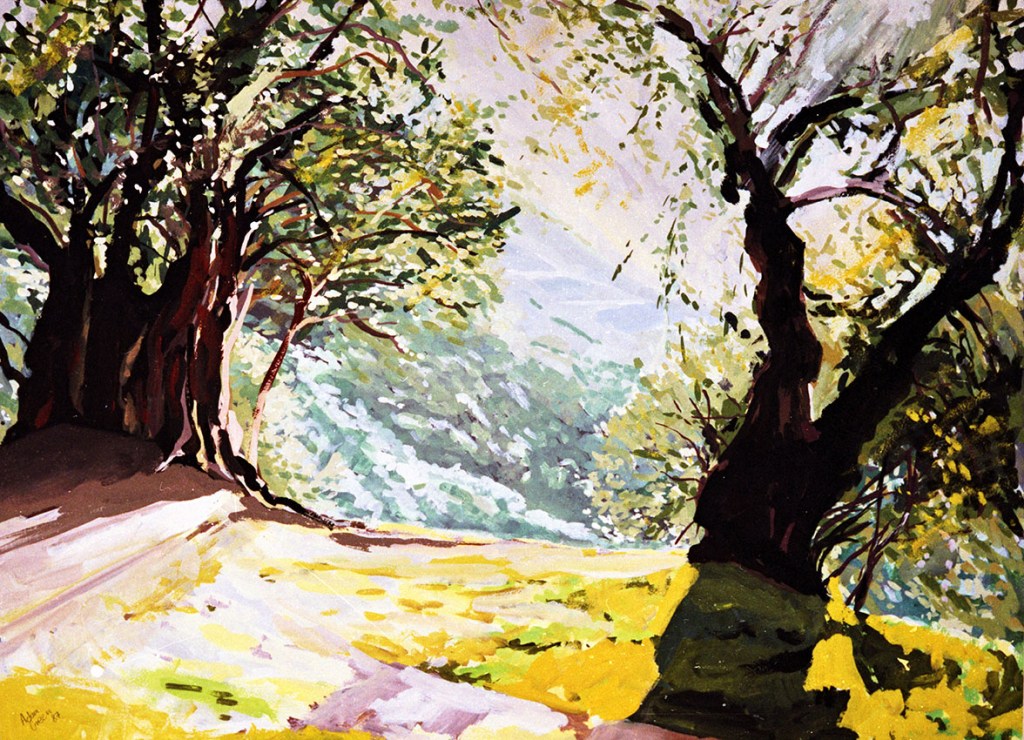
Olive Trees at Delphi – 1987 (59 x 84cm / 23 x 33″). I’ve always held olive trees in a kind of awe. I think this picture describes both their hardiness and their beauty. Little did I know when I made this picture, that just six years later I would have olive trees of my own.
“SHOT!” – 1989 (84 x 59cm / 33 x 23″). I’m not by nature sensationalist or morbidly voyeuristic, but there was something about this image of man being shot in El Salvador that I found fascinating, powerful and strangely graceful . it was copied from a photo in a newspaper, and I have not done anything like it before or since.
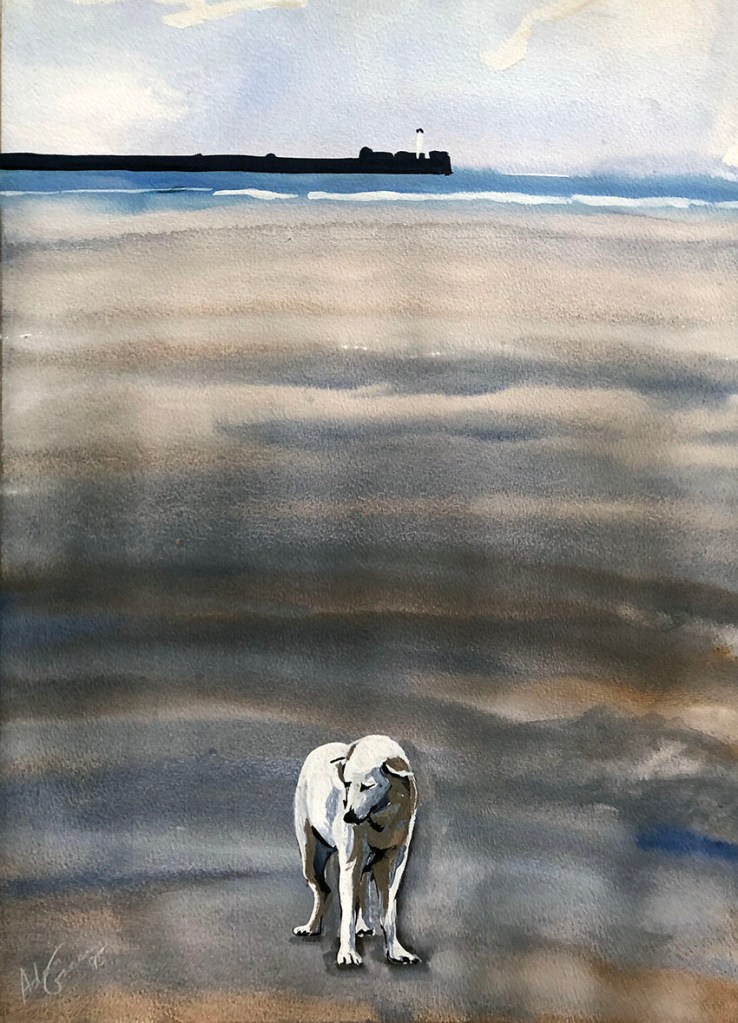
Aura on Boulogne Beach – 1995 (84 x 59cm / 33 x 23″). The most watercolour-like of the painting presented here, a sponged wash. However, the subsequent contrast in texture of the dog (our late beloved Maremma Sheepdog, Aura), in thickly applied Titanium white would be harder to achieve in pure watercolour. This picture dates from a later period than the others, when I had moved into commercial art. This was a spur of the moment (note the rippled, unstretched paper), somewhat emotional testament to our miserable , enforced sojourn in Boulogne-Sur-Mer.
My phase of painting large epic landscapes in oils happened to coincide with a period in my life when I spent most summers in Israel. From around 1978 until about 1986 I went there every year, partly out of idealism and partly because I just loved making paintings of the place.
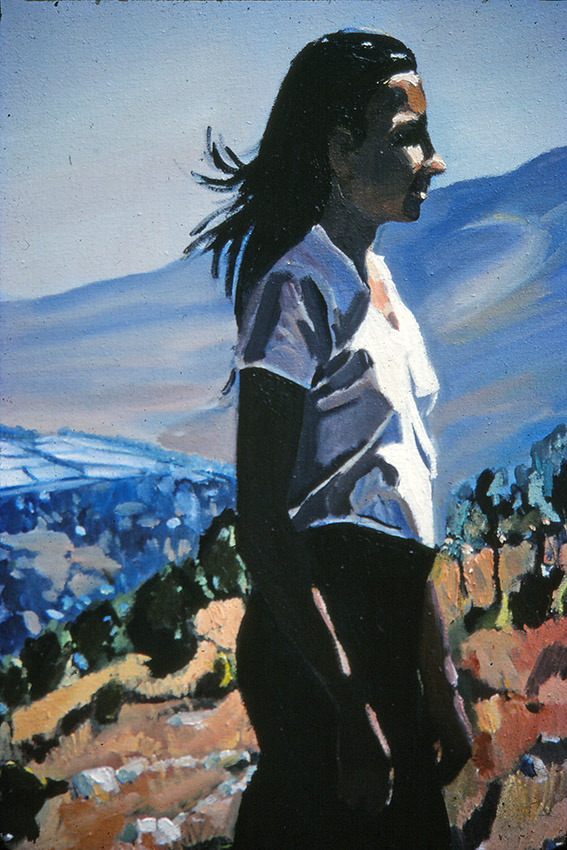
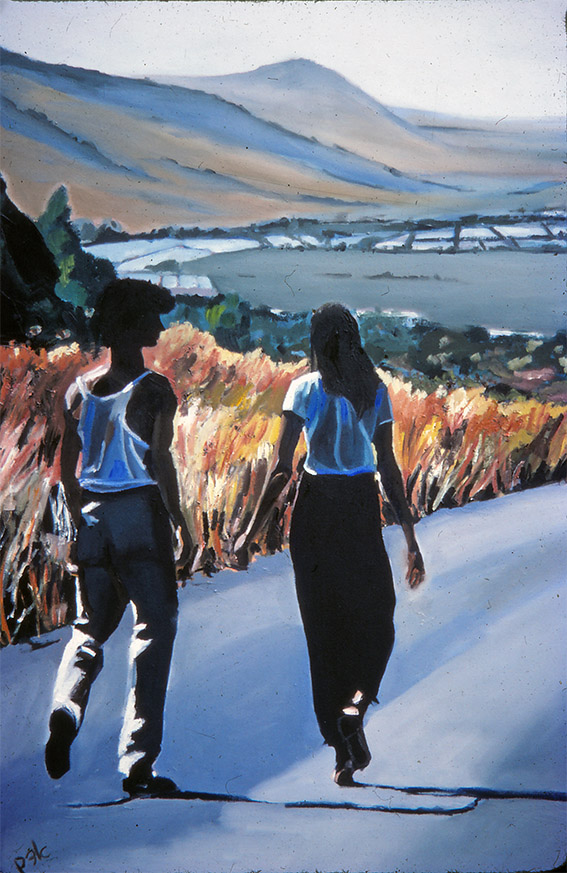
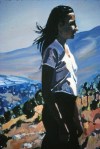
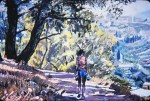
“Walking Away at Ein Kerem” (120 x 170cm∗) – In the Jerusalem Hills – southwest outskirts of the city…
Looking back on that time now I can see that the two motivations were part of the same “condition” and fed an inner yearning to find expression for my youthful optimism and romanticism.
“Astrud at Tel Hai” detail (150 x 100cm) – At the south-western entrance to the northern “pan-handle”…
As I think I’ve said before on these pages, Israel, although geographically a tiny country, can often feel vast to the naked eye. Among the hills and valleys of the “pan-handle” of the northern Galilee, and especially in the arid canyons of southern Judea and the Negev Desert, the landscape creates an illusion of almost infinite enormity.
“Pickers at Rest” (153 x 213cm) – Hired Druze pickers enjoying ice-lollies during a break from apple picking on the northern border kibbutz of Yiftach…
My initial efforts were okay as paintings but they failed to transmit the epic quality of the scenes I was depicting. But then I remembered a device often used by my favourite painters of “sublime” landscape, such as Claude Lorraine, William Turner and John Martin, which was to offset the vista against a peopled foreground. This not only gave scale to the views beyond, but also created a feeling of depth and a sense of “moment” with the human figures caught in time.
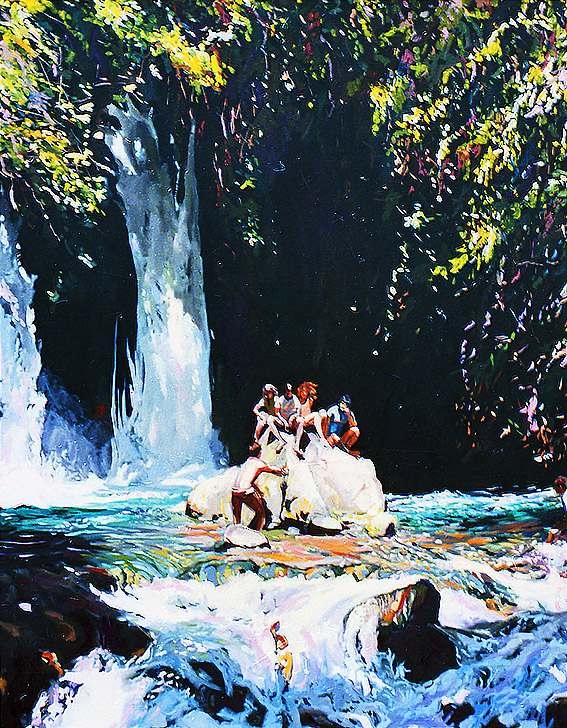
“The Banyas Falls” (180 x 120cm) – The source of the River Jordan, at the north-western edge of the Golan Heights, and thought by the Macedonian conquerors of 332 BC to be the birth place of the god Pan – hence: the Greek “Panias”, now “Banyas” in modern Hebrew via the previous “Banias…”
So, from about 1981 I began to inhabit my Israeli landscapes with people, normally young people like me, walking away, down a track or road toward some distant horizon. And for me, then, it did the trick, seeming to offer a message of future hope into the bargain.
“The Coach Party” detail (180 x 240cm) – On a roadside cliff edge overlooking the Hula Valley in the north western pan handle…
Sadly (or perhaps fortunately) I failed to record most of the “Walking Away” series (I think I did around ten of them over the course of that year) on camera. In fact, I have very little photographic record of any of my people-in-landscape pictures from that phase of my career.
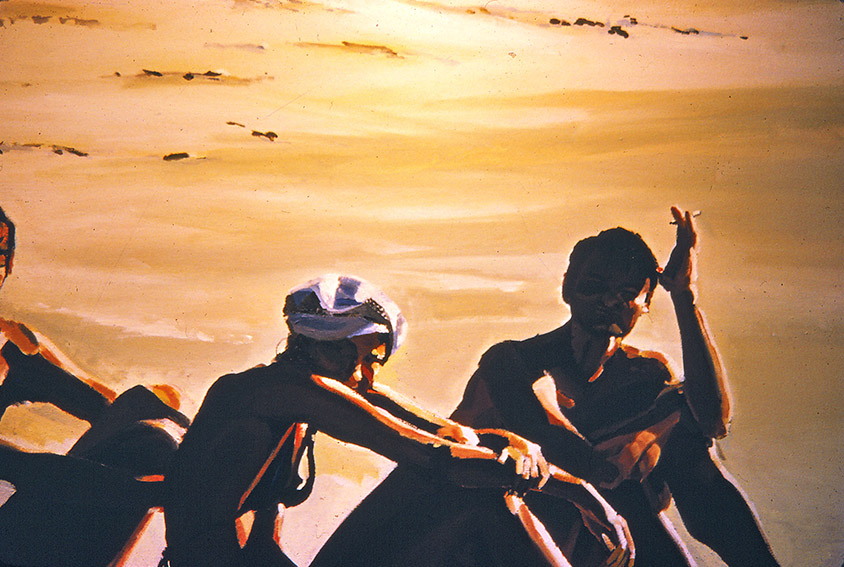
“On the Beach” detail (120 x 180 cm) – A group of my friends on Ashkelon beach on Israel’s southern Mediterranean coast…
However, I have managed to cobble together what you see here, including two from the Walking Away series (one complete and a detail from another) and the rest, mostly details and sections from other pictures.
“Resting at Montfort” detail (120 x 180cm) – Our tour party taking a break on the ruins of the Crusader castle of Montfort just south of the Lebanon border. Hence the need for the M16…
Despite the incompleteness presented, I still think one can sense the romance, and the optimism of the mostly-unseen whole paintings.
“The Wanderers” detail (130 x 190cm) – The first of the “Walking Away” themed series, set on the road down from Tel Hai south, towards Lake Kinneret (The Sea of Galilee).
In the summer of 1979 I spent two weeks with a friend in his apartment on the south western outskirts of Jerusalem. My host shared a studio with me at art school (in London) and had been whetting my painterly appetite with descriptions of the scenery in the hills close by his apartment. Although I was already developing into a studio-based artist, the thought of walking out into the Jerusalem forest, portable easel on shoulder and painting box in hand seemed exotic and enticing. And so it proved to be.
Every day for around a week we rose at the crack of dawn and walked across ancient pine-wooded terraces to a shaded clearing perched dramatically above the picturesque village of Ein Kerem and sketched madly from morning to sunset. The combination of the dappled light, the changing colours and tones as the sun traversed the sky, the constant humming of the cicada and the aroma of pine needles intoxicated our spirits. And as we ate our rustic picnic lunches, washed down with wine and then dozed, we dreamed we were reincarnations of Gauguin and Van Gogh.
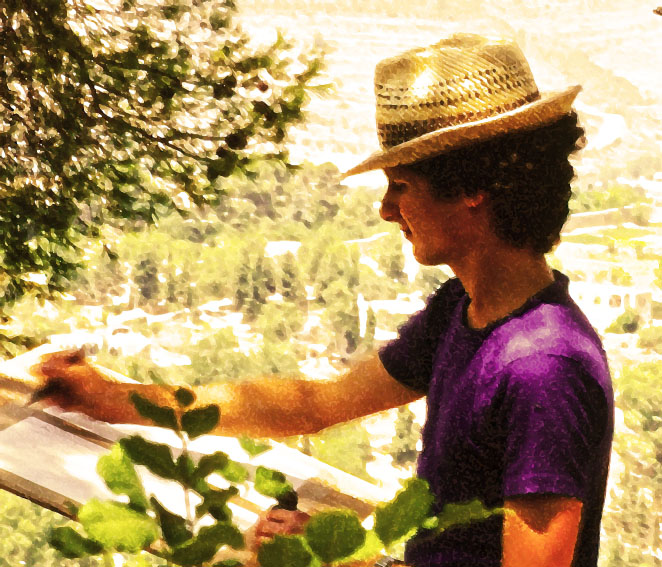
A nineteen-year-old me, hard at work in the Jerusalem hills in August, 1979
I did all my sketching in pen and coloured ink. I found the intensity and the fluidity of the ink perfect for expressing the colours of the landscape and capturing the immediacy of the given moment. Then later, early the following year, back in my studio in London I found I could use the ink sketches to transfer that sense of moment onto canvas – thus capturing the moment and giving it both permanency and with expanded depth and breadth.
Presented here is one of the original ink sketches, and the culminating oil painting I made from them. I felt that the device of a triptych would give me the scope to represent not just the colours, and flow of the landscape, but also its altering mood across the course of a single day. This was my first attempt at a triptych and looking back at it now, although far from fully resolved,the sheer unadulterated joy of it does nevertheless bring a smile to my face. Whether or not Paul or Vincent would smile or smirk is another question altogether.
















 ARKS, ADAM AND AXARQUIA