Did God Workout? (Part 4 – Destiny)

The artistic shaping of visual perceptions of, and sensibilities  towards biblical events and personalities from Bible times to the present day.

Destiny – Israel’s destiny in particular and mankind’s in general, is not merely the dominating theme of the entire biblical canon, but arguably, and naturally the most discussed and examined topic down through the ages. And thus, not only does destiny constitute the central theme of the two most seminal pieces of biblical-inspired literature in the shapes of Dante’s Inferno and Milton’s Paradise Lost, but they in turn, prompted a vast outpouring of visual artistic creativity that is distinct from everything we have considered up until now, for rather than being drawn directly from the biblical text these images are in fact twice-removed from the source material.

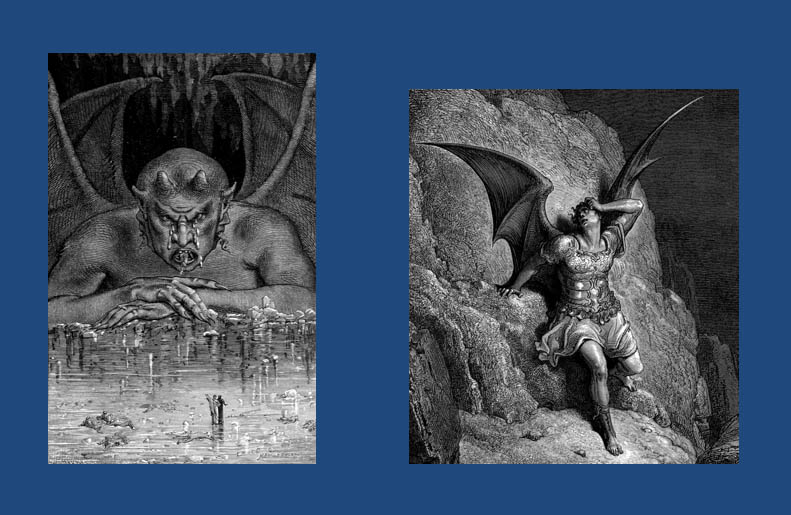
Thus, when Yan Dargent and Gustav Dore portray Satan (below), are they portraying what they themselves imagined from their own familiarity with the Bible or were they only considering Dante’s or Milton’s vision. Moreover, how much was the more recent Dargent Satan (left) informed by the earlier Dore depiction (right)?
Regardless, perhaps the most important factor – even more so than in the three previous topics we’ve been discussing – is the socio-political context of the given artist’s lifetime. If we go back to time of Micah the prophet for example, for him, the end of the world was signified by great armies of chariots and foot soldiers bristling with iron tipped spears coming down upon Israel and Judah from the north accompanied by plague and earthquake. By contrast, when I was growing up, during the Cold War, the end of the world meant great mechanised armies invading from the east, followed by nuclear bombs and then nuclear fallout. For Assyria, read Soviet Union – and for plague read radiation sickness etc. etc…

The biblical artists of Mica’s time – had there been any – and those of my youth would therefor reflect what is fundamentally the same apocalypse, but with different contextual devices and symbols.

When we then look at what I regard as the golden age and golden location of apocalyptic art – a sadly much overlooked movement of fabulous British painting – we can see how another set of powerful contextual contemporaneous factors, driven by the Industrial revolution, influenced the visions of painters like William Blake and John Martin.

For the visionary Blake, the Industrial Revolution was, in his own famous words, Satanic. The mills and factories sprouting up throughout the land were an ever-growing stain upon the beautiful English countryside. Their bristling chimney stacks spewed out evil smoke casting a black shroud across the heavens and upon the land. His biblical paintings, even when not directly concerned with the end of days nearly all reflect a feeling of imminent doom, such as his painting of Elohim / God creating Adam, where everything, from the tonality and colouration to the expression upon his (heavily Michelangelo-influenced) God’s face is leaden and bleak…
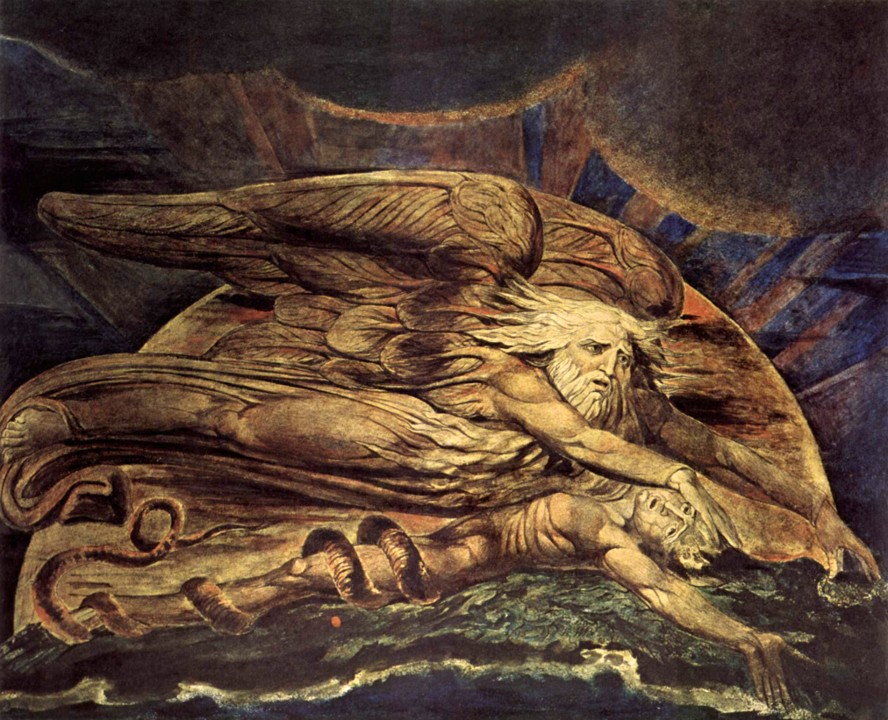
Blake is as much a prophet as an artist, and his entire output, in writing and on canvas is a mixture or warnings and guidance, and a plea to change paths before it is too late. In style and mood, Blake is closer to an Ezekiel than a Jeremiah, unhappy with the present, but offering a promise of a bright future if man – English-man in particular – changes his ways before all is lost. Like Dore, Blake also illustrated the respective hells from The Divine Comedy and Paradise Lost, but unlike Dore’s literalistic approach, Blake took the two themes and filtered them to his own visionary purpose. Thus, whereas Dore gave us his interpretation of Dante’s description of the biblical afterlife, Blake gave us his own nightmarish vision of a sort of post-industrial winter…
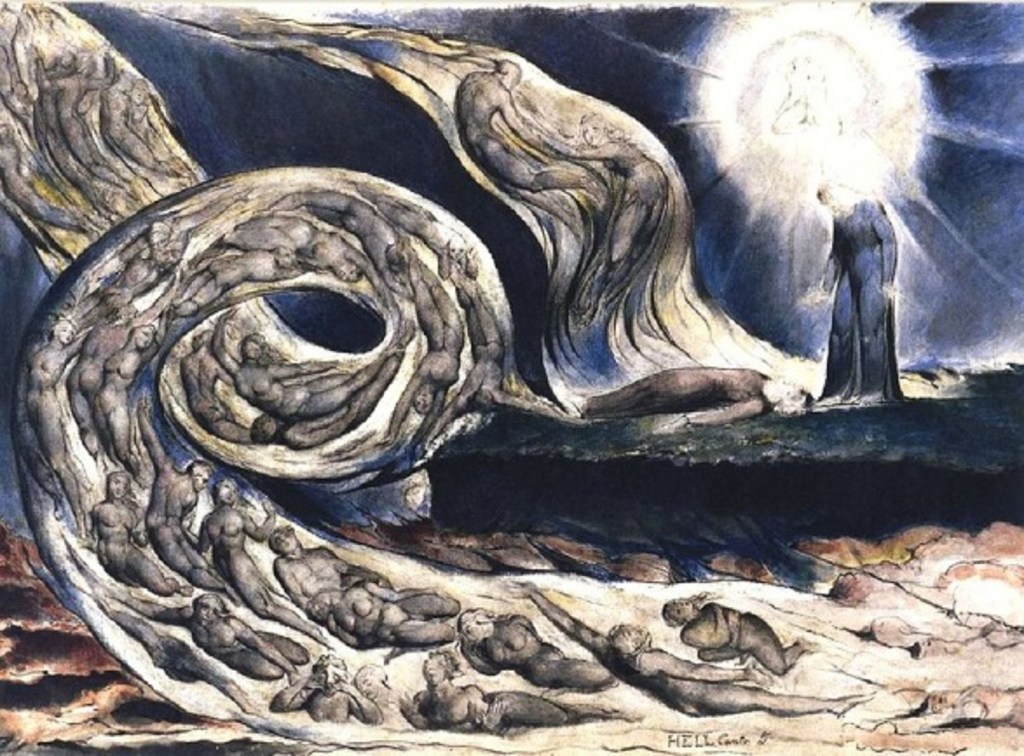
In stark contrast to Blake, pious Christian and believer in natural religion, John Martin’s visions of the apocalypse contained an overriding sense of sublime inevitability.

For those unfamiliar with Martin and his work, he was a younger contemporary of Blake who ended his days as one of England’s most successful Victorian painters, whose fame was only equalled by his friend William Turner, and by John Constable. In relative terms, Martin was the most successful and famous English artist who ever lived. At the height of his career his latest canvas could elicit the sort of excitement and public hysteria we associate with the Beatles seven generations later. Cordons of burly policeman were employed to keep the adoring masses back from his paintings, and thousands of people would pre-book, weeks in advance to make sure they could get to see his latest masterpiece. Long before the likes of the Beatles and the Rolling Stones blazed a trail for popular British cultural imports across the Pond, more than a century before the Fab Four landed in New York, over a million New Yorkers flocked to see John Martin’s Last Judgement triptych during its extensive world tour – part of an estimated eight million people in total during the entire trip.

His vast, painstaking and technically superb epic biblical scenes were his most popular works and seemed to have touched something deep within the sensibilities of his contemporaries. And whereas Blake’s surrealism seemed strange and uncomfortable to the average viewer, Martin’s work was obvious and intellectually undemanding. Unlike Blake, Martin, an acceptor of Darwinism, embraced the Industrial Revolution which he saw as simply an inevitable stage in mankind’s evolution, and a crucial part of God’s grand scheme. Ideas he advanced practically moreover, with his own revolutionary designs for London’s drainage, sewerage and his early ideas for underground railway tunnels – all of which strongly influenced London’s city planners and engineers a few years later.

Although Martin shared Blake’s sense of foreboding by the Industrial developments going around them, his fatalistic attitude towards the end of days apocalypse was diametrically opposed to Blake’s concept of avoidable doom. And while for Blake, a return to a spiritual state was synonymous with a return to nature and natural ways, for Martin, nature, for all its beauty and wonder is ultimately another tool in God’s ultimate plan for mankind’s destruction.
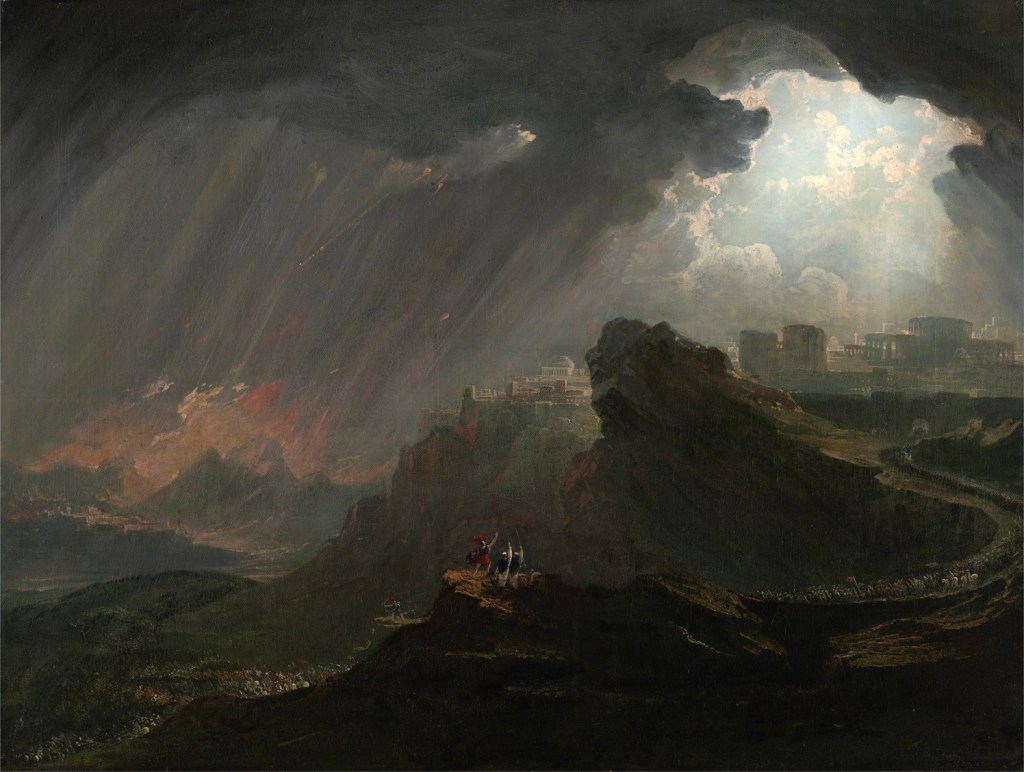
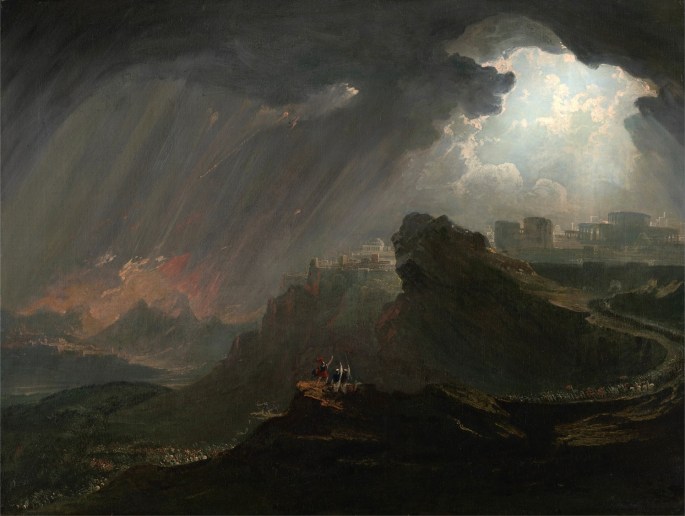
In this painting above for example, Joshua Commanding the Sun to Stand Still, the composition, just as revolutionary in its day as Blake’s surrealism, is a figure of eight, with the left-hand tunnel containing the doom-laden distance and the right the city of Ai. For Martin, tunnels and iron smelting were the two most potent symbols of his age and he uses them repeatedly as compositional motifs in his epic compositions, including in his greatest work; His final set of paintings, the aforementioned triptych, The Last Judgement, based upon Revelation…
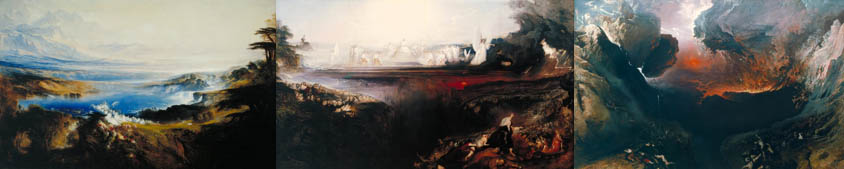
If you’ve ever been fortunate enough to stand before these three huge canvases (in the old Tate Gallery in London) as I did many times, then you might agree with me, that as “impact” picture viewing experiences go its right up there with the Sistine Chapel ceiling or being in room full of Rothko’s, such is their overwhelming presence.

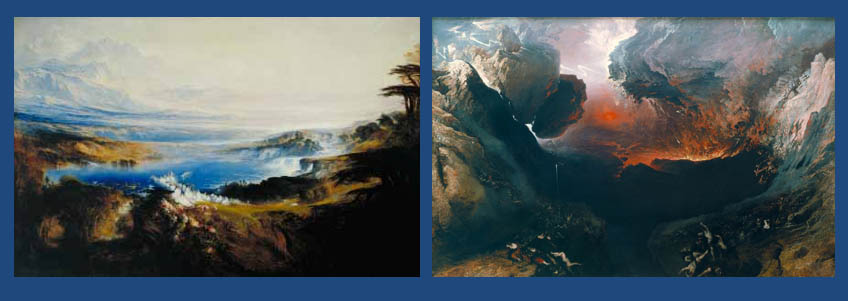
For me, from my first viewing as boy of eight or nine years of age, it was always the right hand panel, The Great Day of His Wrath, that captivated me the most. Of course I didn’t know then, that this was the ultimate expression of Martin’s tunnel symbolism or that the central volcanic fires are based upon his impressions of iron smelting. It was actually another five or six years before I even knew that the destruction was based upon the words of John the Evangelist. Little Jewish lad that I was at the time of my first viewing, I had never heard of this mysterious figure from the New Testament, nor his remarkable description of the end of the world. In fact, I had no knowledge of the host of theories, both sensible and downright wacky, that exist around this masterpiece and its alleged influences. But the one certain thing, had I known it at the time, was that this was an amazing expression by a devout-yet–modern thinking Christian artist, about Industrial Man’s destiny at the hands of nature.

Unlike Blake, Martin’s vision is not at all preachy or aspirational. It is the apocalypse presented as inevitable, and as entertainment for a mid-Victorian audience. While Blake’s longed-for spiritual nirvana hearkens back to a mythological past, the route to Martin’s Plains of Heaven is through the unavoidable chimney smoke and smelting fires of his contemporary world. Unlike Blake, with his surreal, unattainable imagery that left the masses cold and confused, Martin, from the very start had a natural ability to entertain and thrill his Victorian audience, even when presenting them with a vision of their own doom.

I would argue that with these paintings by John Martin, biblical-inspired painting reached its zenith — certainly with regard to how influential fine art was, and ever would be again upon the conditioning of our imaginations.
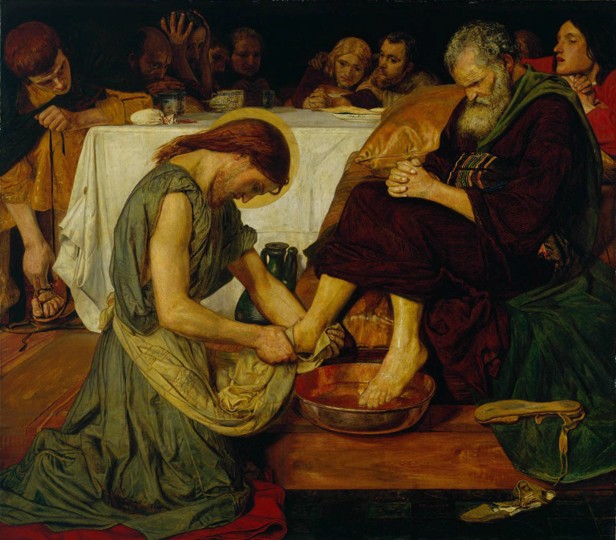
This is not to discount the work of later artists, from Pre-Raphaelites like Ford Maddox Brown…
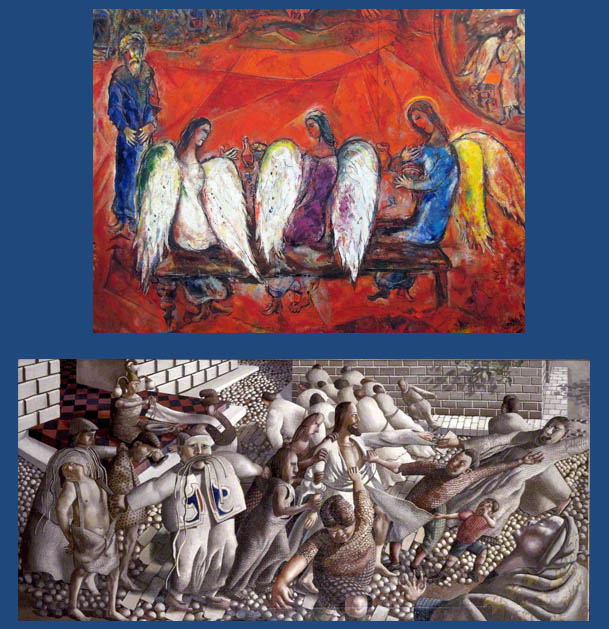
Nor surrealists, cubist and fauvists like Chagall and Spencer…
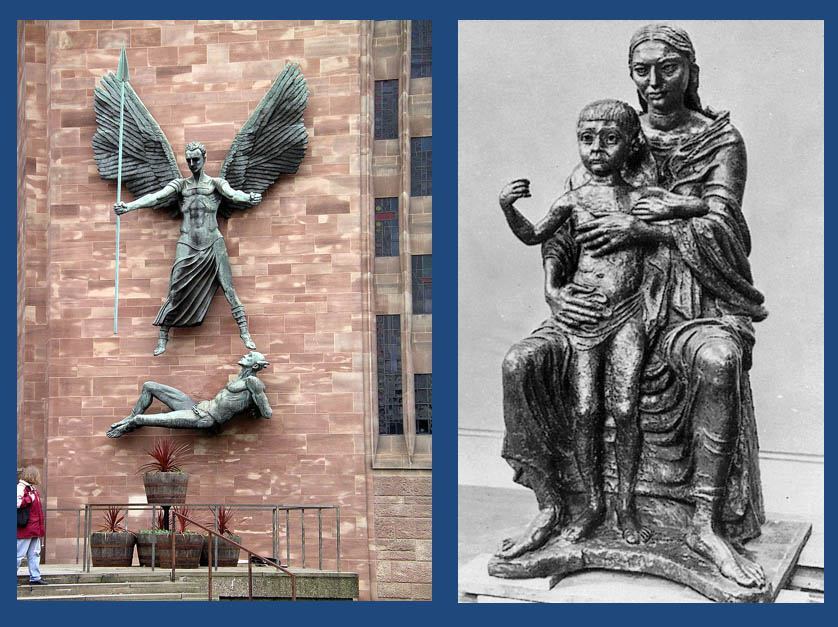
Or monumental sculptors like Jacob Epstein…
But despite the undoubted originality and genius of many of these artworks none of them succeeded in implanting universal, and durable images in the consciousness’s of the masses. It was only with the emergence and development of cinema, and Hollywood in particular that visual art can be said to have resumed the shaping of visual and intellectual Bible-related ideas for a mass audience.

THE DUKE, THE DUCHESS, THE LOO AND THE BATHROOM (and me) (part II)

THE AMUSING TALE OF HOW I ACQUIRED MY MOST ILLUSTRIUS PATRON, CONCLUDED (part I here)…

I arrived at the imposing front door of the Duke of Devonshire’s red brick Mayfair house in Chesterfield Street a few minutes early. Because I was carrying two 3×2 foot canvases my mother had kindly offered to drive me into town from our home in Edgware (north London), rather than have me negotiate the tube or a bus with my awkward burden. With just a polythene sheet to protect them, I was terrified of presenting two dented paintings.

Mum offered to try and find a parking space and wait for me, but I told her not to bother. For one thing, I had no clue how long I would be with the Duke, and for another, I’d either be returning with one or two “rejected” pictures, or hopefully, emptyhanded. In any case, I would be happy to risk some form of London transport.

Tel Hai – oil on canvas – 1983 – The painting which was kept at Chesterfield Street

Within moments of me ringing the door bell, for the first and (thus far) last time in my life, I was greeted by a butler, who with a mixture of firmness and politeness guided me up a flight of stairs to the “drawing room”. After I carefully set down the paintings against an armchair, the butler, who could have been the role model for Jeeves himself, informed me that “His Grace” would be down “presently”, then, gesturing toward a well stocked eponymously-named tray, asked me if I would like a drink while I waited. Thinking a stiff scotch might be just the thing to calm my slightly frazzled nerves I answered in the affirmative. Then, after having served me a large, heavy, cut glass highball, filled to the brim with Dimple Haig and ice, the butler left me alone to contemplate my extraordinary surroundings.

The fine regency and early Victorian furnishings were typical of such an environment, but what was less expected was the array of modern artwork hanging on all the walls. It comprised a comprehensive collection of pictures by nearly all the major painters of the 20th Century – from Picasso to Rothko, and from Matisse to Miro. While I knew the Duke was a keen collector of contemporary art, nothing could have prepared me for such a superlative display.

The Hula Valley (from Tel Hai) – oil on canvas – 1983 – The painting destined for Chatsworth.

As I shifted my gaze from an unexpectedly vivid and jolly early portrait by Munch to my own two modest canvases, I found myself taking an extra large slug of the Dimple. Then, fortunately, before I had time to terrorise myself further, the door opened and the Duke entered, walked toward me, a welcoming smile on his face, and arm outstretched. He was taller and leaner than I expected, and similarly to his butler, drawn straight from the pages of a Wodehouse novel, almost as if I was being approached by Lord Emsworth. “What a great pleasure to meet you Mr Green!” he said, with disarming warmth and charm, gently but firmly shaking my hand. “How kind of you to come!” Then, noticing the state of my glass, and no-doubt sensing my agitated state he suggested I go and top myself up, which I gratefully did.

“If you would be so kind, I think we had better take a look at what you’ve brought, don’t you?” he said, then added, “Why don’t you unwrap them and put them up on the couch.” I did as he requested, and then stood back, by the Duke’s side while, chin in hand, he contemplated my two humble landscapes. “From the north of the country, if I’m not mistaken?”

Impressed with his knowledge of Israeli geography, I confirmed he was correct and then explained a little about the paintings. “I think they are both terrific Mr Green! Sadly, one doesn’t see many competent landscapes like this of Israel – at least not done by Israeli artists. They capture the essence of the place so precisely! I would love to add them to my collection!”

With that, he went over to a sideboard, opened a drawer, withdrew a large chequebook and a pen, handed me both and asked me to write a cheque for the value of the two pictures. Having done as requested, the Duke then signed the cheque, tore it out of the book and handed it to me. “Now” he said, “let’s go and see where we can hang the one staying here…”

Chatsworth House – arguably, the greatest stately home and palace in Britain, with an art collection to rival that of the Queen herself.

He then led me on a remarkable tour of the Chesterfield Street house, from the cellar to the upper bedrooms, stopping from time to time, to give me some fascinating anecdote about this or that amazing picture, the artist who made it and how he came to purchase it. About ten minutes into the tour, we were half way down a staircase, when he pointed out a space between two small oil paintings. “I think we could put your Tel Hai painting here? What do you think Mr Green?” he asked. The painting on the right of the space was a very early Lowry painting of a street scene, dating from before he developed his stick-figure style – and all the better for it – while the painting on the right was a colourful still-life by Mathew Smith. I was speechless for a moment or two, then mumbled my approval. “In case you were wondering, I thought we’d take the other one of the Hula Valley back to Chatsworth. I think it would be lovely to have a picture of Israel in our bedroom. I hope that’s okay?”

A few minutes later, with me still in a kind of euphoric daze, we walked into a bathroom, and there, leaning over the sink, putting on her lipstick, dressed only in a black silk and lace negligee, was the most beautiful sexagenarian lady I had ever seen. “Excuse us Debs darling” said the Duke, “this is that brilliant young artist I told you about, Adam Green, and I just wanted to show him that little Henry Moore by the bath”. “Don’t mind me you two” replied the Duchess (and the youngest and last surviving of the famous and infamous Mitford sisters). “A pleasure to meet you” she added, glancing at me in the mirror, still applying the finishing touches of lipstick, “but do hurry Andrew dear, we can’t be late for the reception”.

The Moore was a miniature, or possibly a sketch piece for a far larger work I thought I recognised, but my main impression from that fleeting visit to the Ducal bathroom was the blemish-less, glowing skin, and youthful form of the Dowager Duchess of Chatsworth, not to mention her lack of inhibition.

If the Duke reminded me of a more together version of Lord Emsworth, the Duchess, even in her underwear, oozed that peculiar type of serene confidence that is the birthright of the British upper class.

The tour lasted about 45 minutes in all, and I was shown to the door by the Duke himself. As we shook hands for the second time, he said in parting, “Do be sure to keep me informed about your progress Mr Green, and do let me know if I can ever be of service…” As I sat on the top of the 113 bus back to Edgware, I felt as if I was waking slowly from a dream.

It wasn’t a dream however, and several years later, the Duke, true to his word, generously opened my one and only West End one-man-show with a typically kind and charming address.

Looking back at it all now, my abiding memory isn’t of walls laden with modern masterpieces, nor of my own pictures being among them, nor even of the sweet and kindly old Duke; but of the beautiful Debs, in her negligee, and her stick of crimson lippy…

I THINK MARC CHAGALL WAS A LOUSY OIL PAINTER…

There, I said it…

…I also think Marc Chagall was arguably the greatest stained-glass artist of the 20th century, and he was a dab hand at lithography, but as a painter in oils – average to poor.

Not that it is any bad thing, to be the greatest exponent in one artform, brilliant at another, while being massively overrated in a third. If my own gravestone epitaph were to read, “Here lies Adam Green…writer of the seminal biography of King Saul, and an alright painter…” I’ll take that, thank you very much.

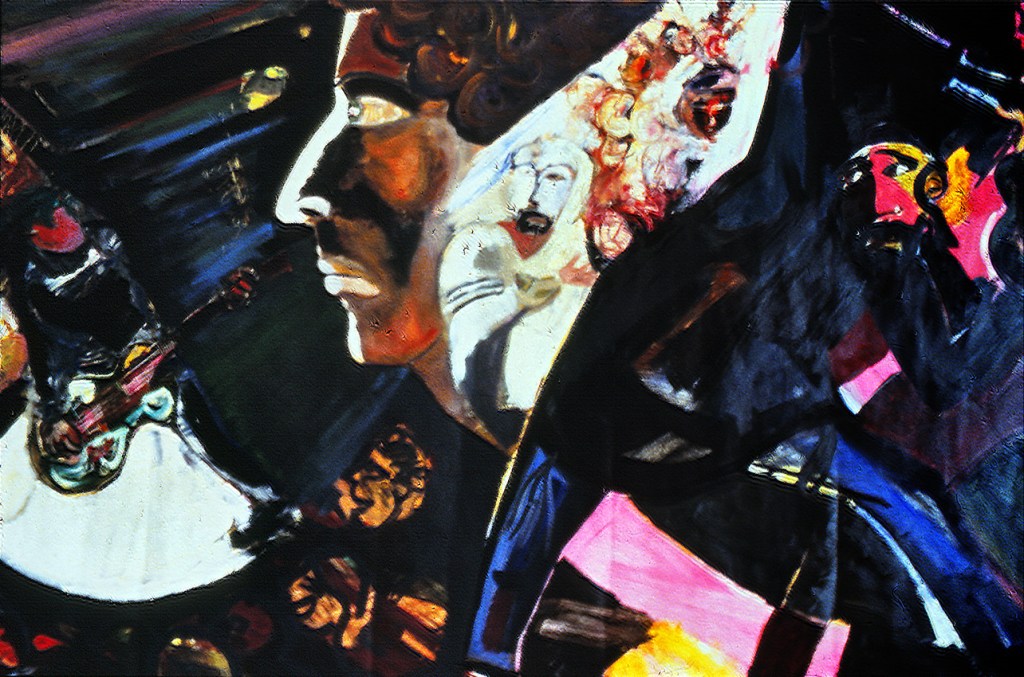
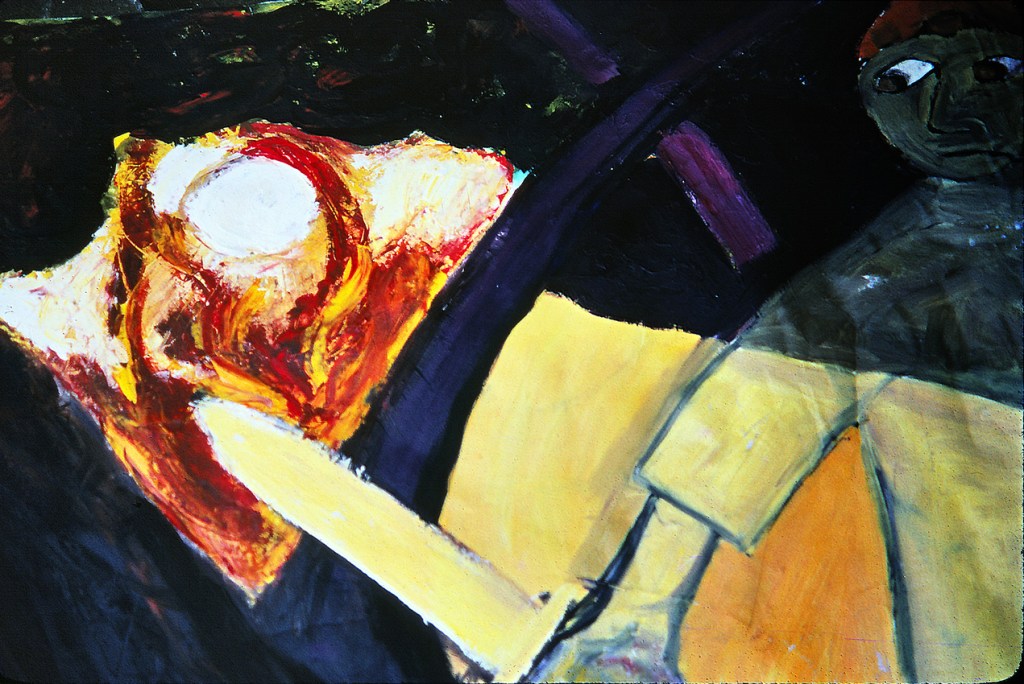
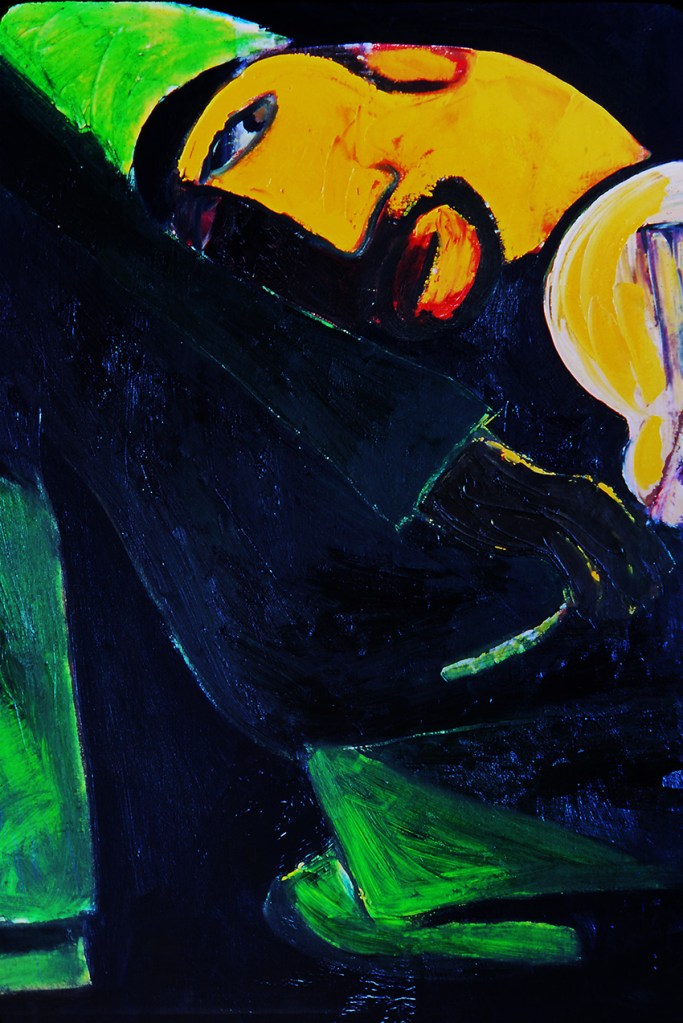
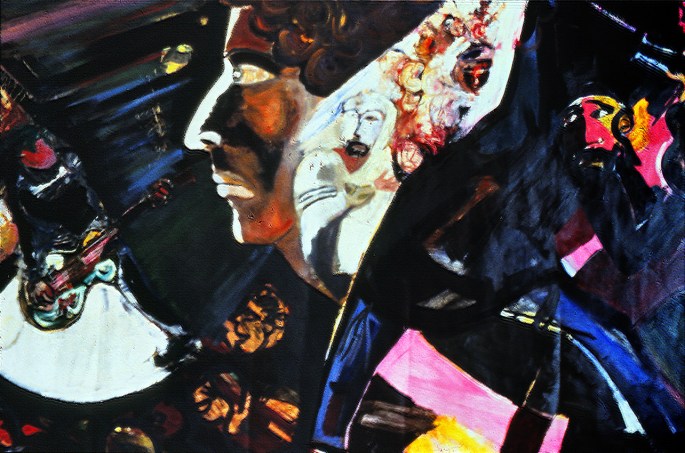
However the reason I mention this is that most of the pictures below (which also featured in an earlier post) are all, to a certain degree, Chagall-influenced, and although I was no huge fan by that time, I was yet to come to the conclusion which heads this piece. That happened during the following decade or so, when the veil dropped from before my eyes regarding the alleged greatness of Marc Chagall and his even more illustrious contemporary, Henri Matisse. It was during those ten years or so that I came to understand that their genius lay not so much in the distinct styles and aesthetic they developed, but in the way those styles developed to mask their severe limitations as draughtsmen. For the stark fact is, that neither of these two artists, both obsessed with the narrative qualities of the human form, could reliably draw the human body and especially hands and feet.

With this in mind it is fascinating to ponder what might have become of these two giants of 20th century art if they had been born a hundred years earlier, before modernism liberated artists from the shackles of academic rigour.

Nevertheless, they were both undoubtedly brilliant picture makers, with a formidable sense of image and design, and thus genuinely artistically important and enduringly influential. Hence, my own dalliance with Chagallesque themes and style as an impressionable young painter at the outset of my professional career. The reason I’m re-presenting them now is because since that original post I have discovered higher quality slides , much truer to their actual colours and textures…

The Choice – 1979 – oil on paper: I think this tale of teenage angst and identity crisis is pretty self-explanatory. Sadly for the fiddler, (as much as I dearly love him, especially in the form of Isaac Stern playing John William’s stunning cadenza at the start of the movie version of Fiddler on the Roof), and “the God of my fathers”, they didn’t stand a chance against the siren riffs of James Page and co…
The Seder – 1979 – oil on paper: Long after I had stopped believing in a god, I retained a warm affection for several Jewish rituals, and none more so than the seder, which in our house at least, was always loads of wine and food infused fun. I think this highly symbolised image of the prophet Elijah actually turning up to enjoy his specially set-aside goblet of wine, with the Children of Israel walking between the parted waters expresses some of the fun I felt…
My Brother’s First wedding – 1979 – oil on paper: The story behind my older brother Michael’s first wedding is far too sordid to go into here, but this most Chagall-influenced of all my paintings from this period, captures something of the atmosphere. That’s me, bottom left, trying hard not to show my well placed cynicism at the proceedings. Michael and his bride were separated within weeks of the celebration, which was no surprise to anyone standing beneath the chupa …
The Eviction and the Angel (detail) – 1979 – oil on paper: The eviction from Eden was a theme which I returned to many times, but this was the only version I attempted during my brief Chagall phase…
Jacob and the Angel – 1979 – oil on canvas: This picture and the one below were virtually a diptych and even sold to the same person. They were the final two paintings I made in this style, and I think they are the most resolved too…
Fiddler in Green – 1979 – oil on canvas: Like Jacob and the Angel, my fiddler is reassuringly sanguine with his lot, even though contained and constrained within his canvas. In addition, the bright reds and greens and solid designs I think were intended to project a feeling of optimism.