GOUACHE – the most forgiving medium

In my four decades or so as a professional artist, fine and commercial, my most successful medium, from a financial perspective was gouache.

For those who may not know, gouache (also called body-colour) is a form of watercolour paint, but with a denser, “gummier” pigment and more body and opacity. All of which makes it a highly versatile medium. Add more water, and it’s virtually watercolour, use less water, or none, it can be applied almost like acrylic or even oil-paint.

These days, gouache is mostly the go-to medium for commercial artists, especially poster designers requiring large areas of flat, uniform colour on stretched papers.

I was unusual as a late 20th century artist, in that for the first part of my career I used gouache extensively for making “serious” fine art images, which turned out to be advantageous in two ways. Firstly; I found that my “serious” gouache paintings were highly commercial in themselves – in that they sold well, and secondly; when I made the transition to commercial art and illustration, I had developed all the requisite familiarity with this most commercial of paints.

Several past posts have already been devoted to the pictures I made during the latter, commercial part of my career. So, presented here for the first time is a selection of “fine-art” gouaches, painted mainly after I left art school until the late 1980’s. All but the most “watercoloury” one of these were sold, which reflects the relative success I had regarding the gouache versus watercolour.

Lace Ladies of Lindos (Rhodes) – 1985 (59 x 84cm / 23 x 33″). This was one of my very successful images and I repeated it in several forms and media.
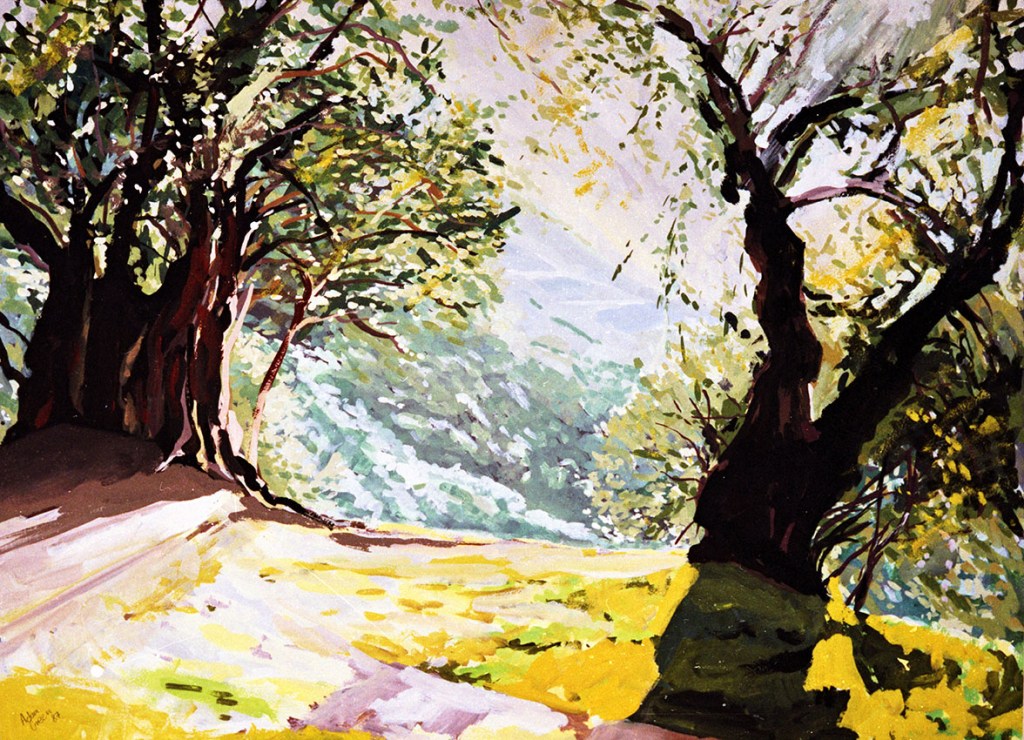
Olive Trees at Delphi – 1987 (59 x 84cm / 23 x 33″). I’ve always held olive trees in a kind of awe. I think this picture describes both their hardiness and their beauty. Little did I know when I made this picture, that just six years later I would have olive trees of my own.
Jerusalem Pines near Jerusalem – 1987 (84 x 59cm / 33 x 23″). Another tree-themed picture, derived from the only trip abroad I devoted entirely to painting. Together with my friend from Saint Martin’s, Danny Gibson, we spent three weeks walking and sketching in the hills west of Jerusalem above the picturesque village of Ein Kerem. The reams of sketches I did there (mostly in coloured pen and ink) provided me with excellent source material for years to come.
“SHOT!” – 1989 (84 x 59cm / 33 x 23″). I’m not by nature sensationalist or morbidly voyeuristic, but there was something about this image of man being shot in El Salvador that I found fascinating, powerful and strangely graceful . it was copied from a photo in a newspaper, and I have not done anything like it before or since.
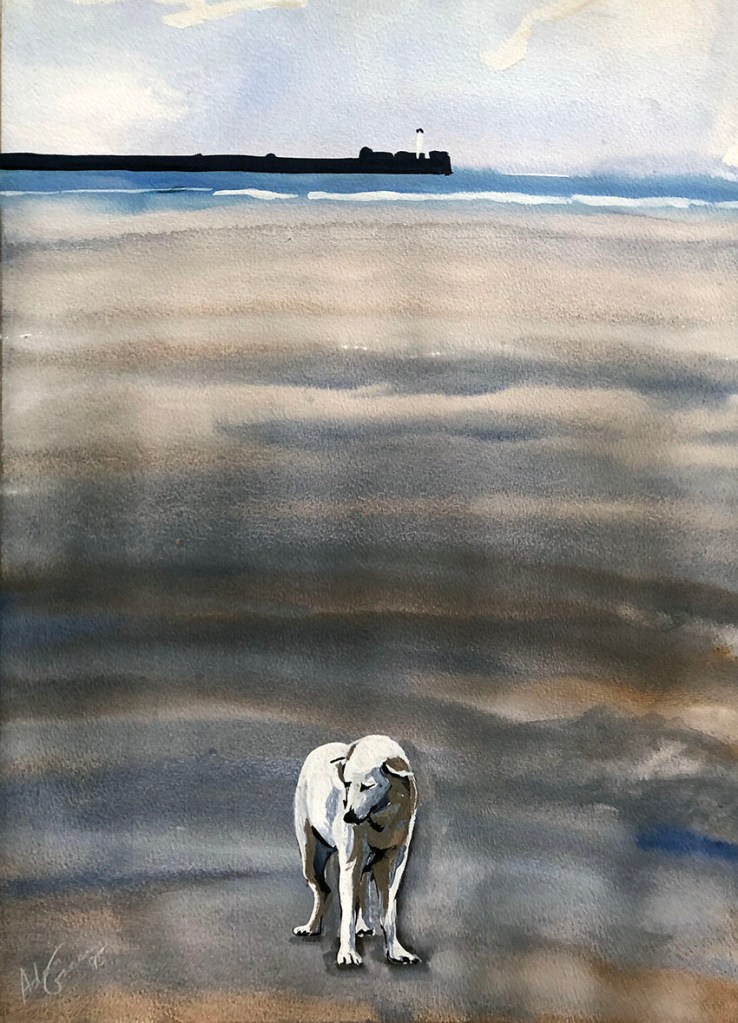
Aura on Boulogne Beach – 1995 (84 x 59cm / 33 x 23″). The most watercolour-like of the painting presented here, a sponged wash. However, the subsequent contrast in texture of the dog (our late beloved Maremma Sheepdog, Aura), in thickly applied Titanium white would be harder to achieve in pure watercolour. This picture dates from a later period than the others, when I had moved into commercial art. This was a spur of the moment (note the rippled, unstretched paper), somewhat emotional testament to our miserable , enforced sojourn in Boulogne-Sur-Mer.

ADAM’S NORTH LONDON…

the end of a close 65-year relationship*

Last month we sold our little flat in Hampstead, North London. In and of itself, not exactly an earth-shattering event, but in the context of my life, an extraordinary moment. The reason being, that for the first time in my then-64 years and 11 months I no-longer had even a toe-hold in the city of my birth.

Regular readers of these posts will know that I have always endeavoured to keep my blog as free from controversial subjects as possible, despite the fact – as those who know me well can testify – I am highly politically aware with a range of opinions, some strongly held.

Given the recent and current state of the world, this policy has not always been easy, but this blog, originally intended to publicise my books and my art, is not a forum I wish to use for expressing my views on putting the world to rights. Ultimately, from my own experience of sampling and following other people’s politicized sites, one inevitably ends up with a corrosive and destructive clash of echo chambers. Thus, our reasons for leaving London will remain known to only our intimates.

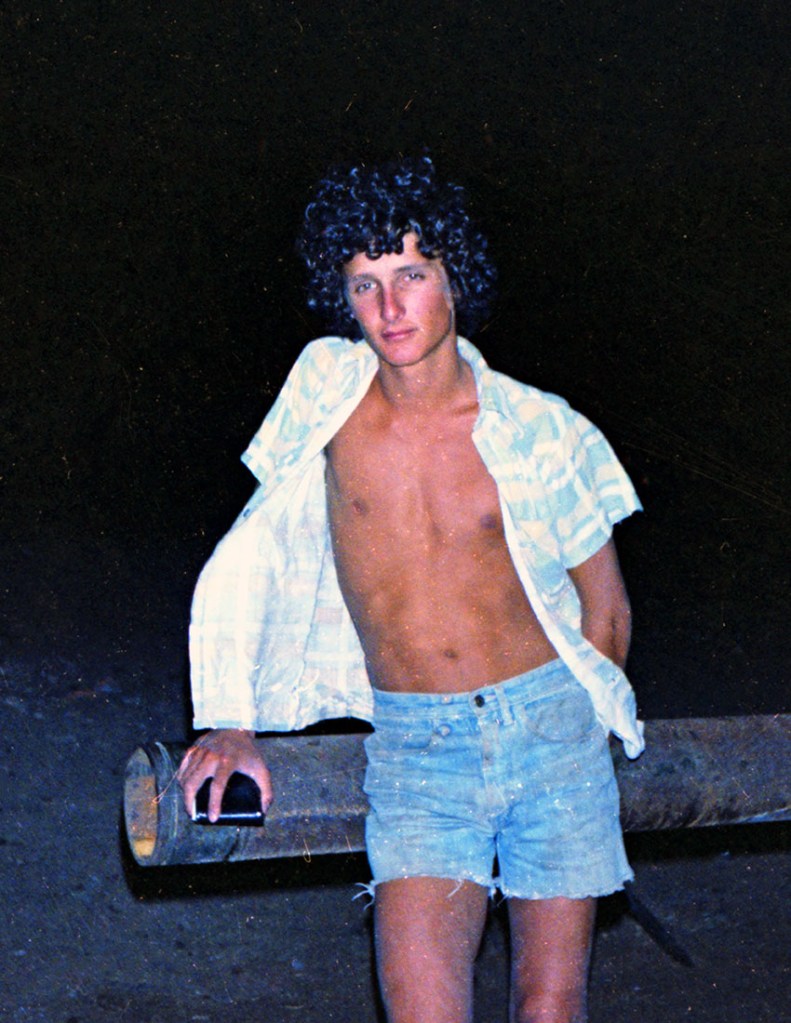
Presented here is a photo-record of the first 30 years of my own personal London life (several suitably grainy and scarred), from times past, when I could never have dreamed that I would ever cut my ties with my once-beloved city “north of the river”.

I was born in Edgware, in the county of Middlesex in 1960, strictly speaking, before it became part of Greater London. Famous for its eponymous Roman road, as the composer Handel’s temporary home, and being at the end of the Northern Line Tube, it was where I grew up. This picture shows me as a baby, with my mum, Hannah, older brother Michael and my great auntie Ray at my grandparents flat…
My final day at nursery in 1963 with my mum (left) and a friend. I seem to be clutching a postcard though I have no idea who from…
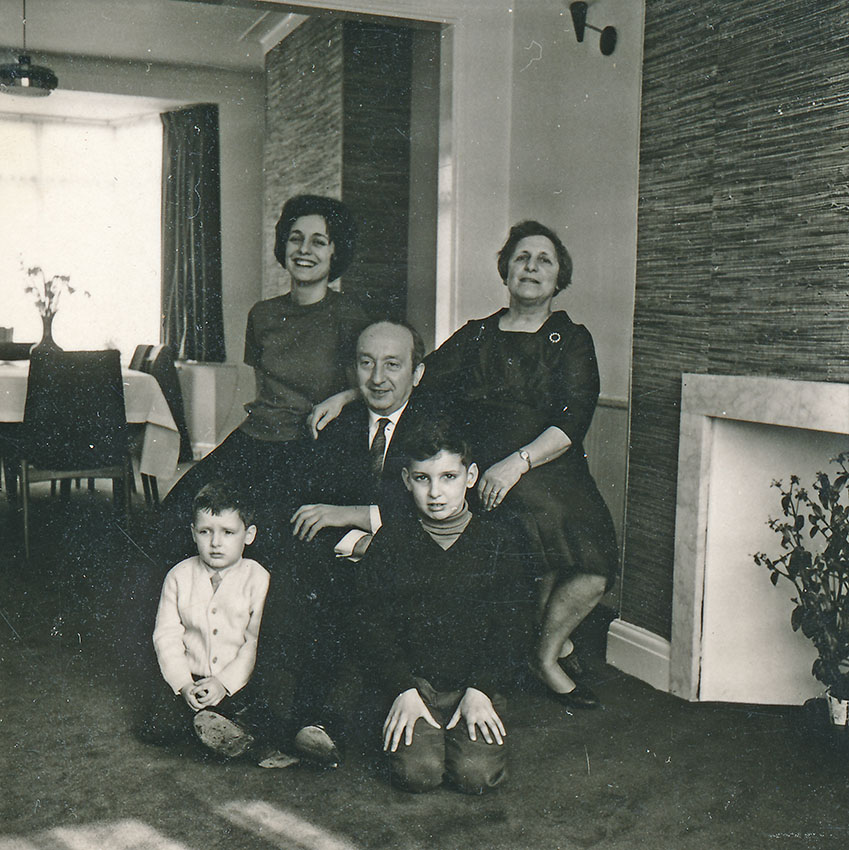
Apart from a bout of glandular fever when I was six, my childhood was exceptionally happy. Although my father had departed the scene when I was a babe-in-arms, my little family was a more than adequate compensation for his absence. Here we have Hannah and her parents, Becky and Harry, me and my brother Michael (my uncle Sidney took the picture), in my first home…
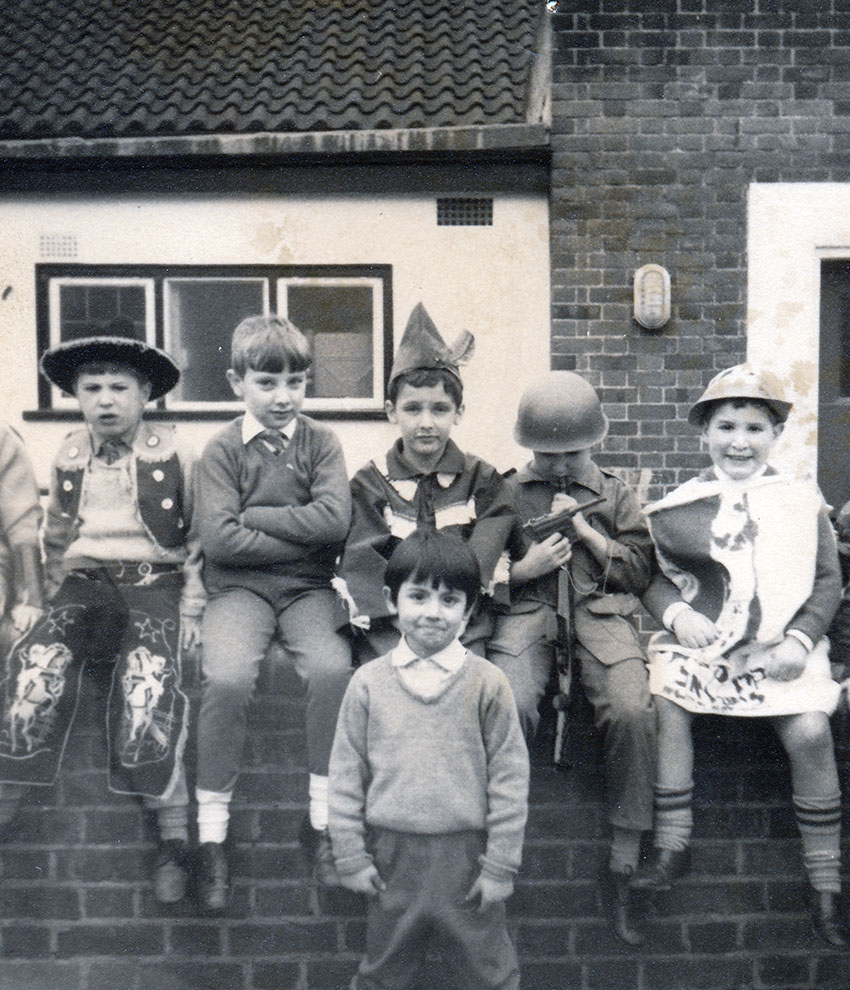
Purim at my primary school. I’m a rather lame-looking Robin Hood sat between cowboys and GI’s
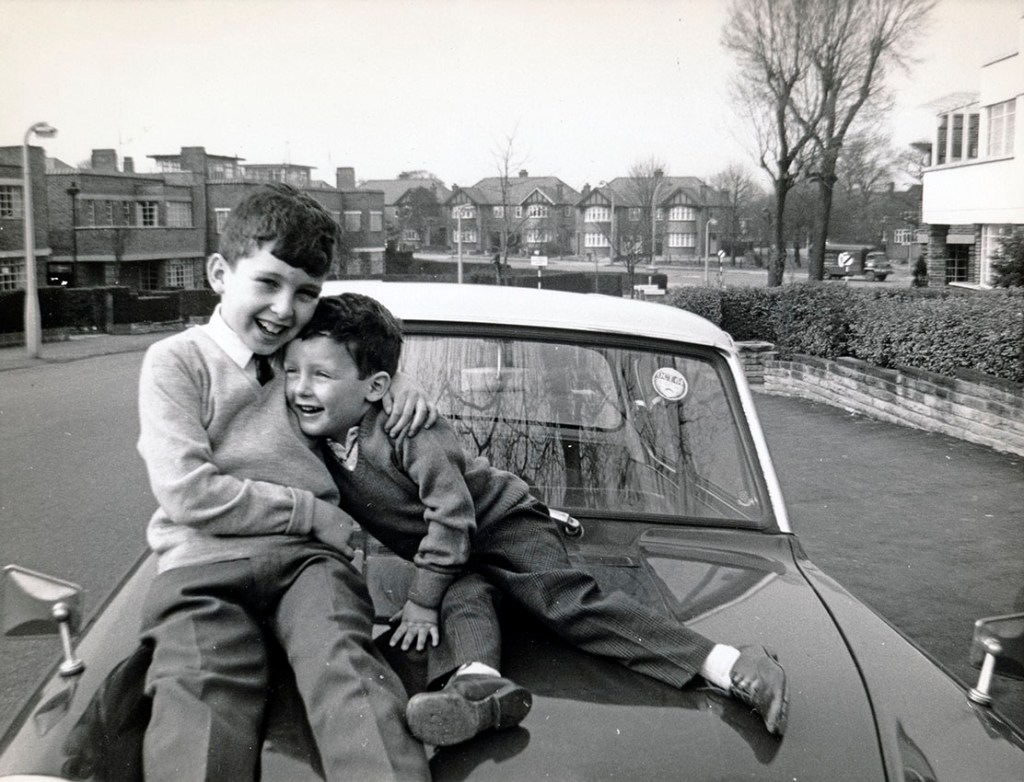
Between the War and my birth, my mum’s family lived in Hendon. Many of our closest family friends remained there, and this is Michael and I during a visit to one of them. We’re sitting on the bonnet of mum’s first Ford Anglia – eat your heart out, Harry Potter!
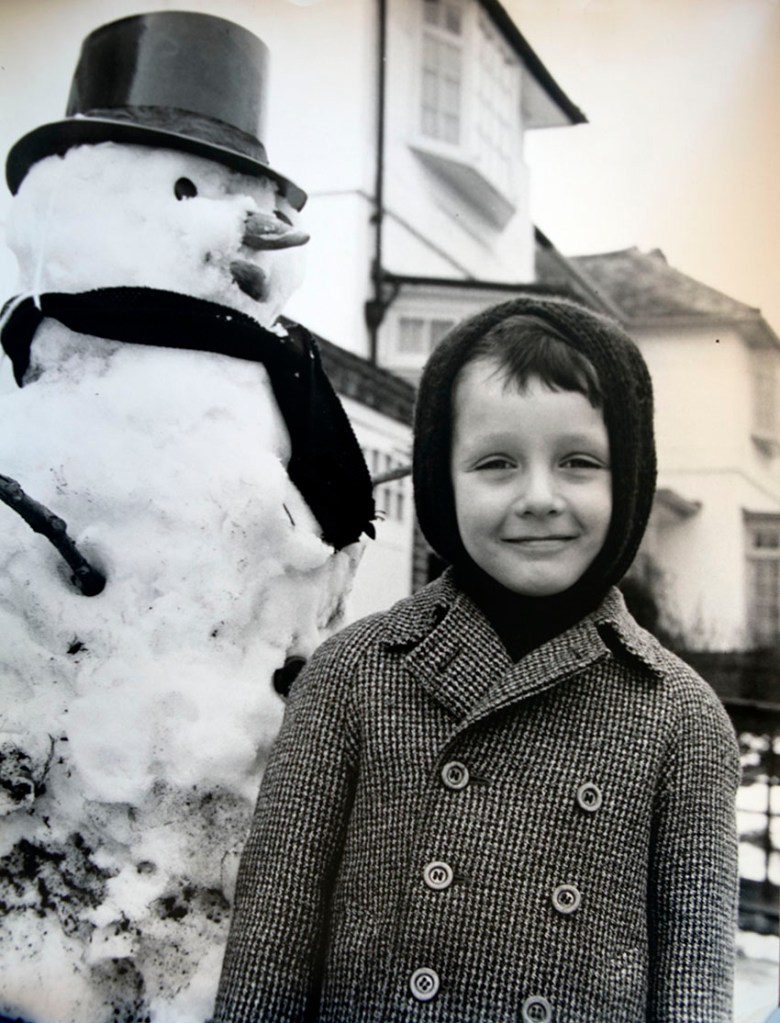
We took our snowmen very seriously back then
Our second house in Edgware had a large back garden and by “London-clay” standards, half-decent soil. Sidney and I were both keen gardeners, something I remain to this day…
My studio space at Saint Martin’s, with friends and fellow students. The guy on the far left is my lifelong friend Simon – not an artist, just visiting. Next to him, looking at the camera is Robert, a hugely gifted portraitist, and the girl is Piyawan, another very talented painter and cartoonist. Judging by the coats, this was at the end of the day and when we would typically be preparing for a visit to one of the many local Soho pubs…
My final act at St. Martin’s was to undertake this temporary mural commission (I describe the story here) in James Street, Covent Garden
My grandparents were moderately observant Jews (outside the Haredi communities – and even they differ from one another – there are as many nuances and degrees of “observant” as there are Jews who observe), and the traditional Shabbat supper was always partaken of. Here I’m “making Kiddush” (the blessing over wine) on one such occasion. By this time we had left Edgware and moved to West Hampstead, also North London, but closer to the centre…
I lived at home (in West Hampstead) well into my late 20’s, and this was my painting studio, which we built at the end of the garden…
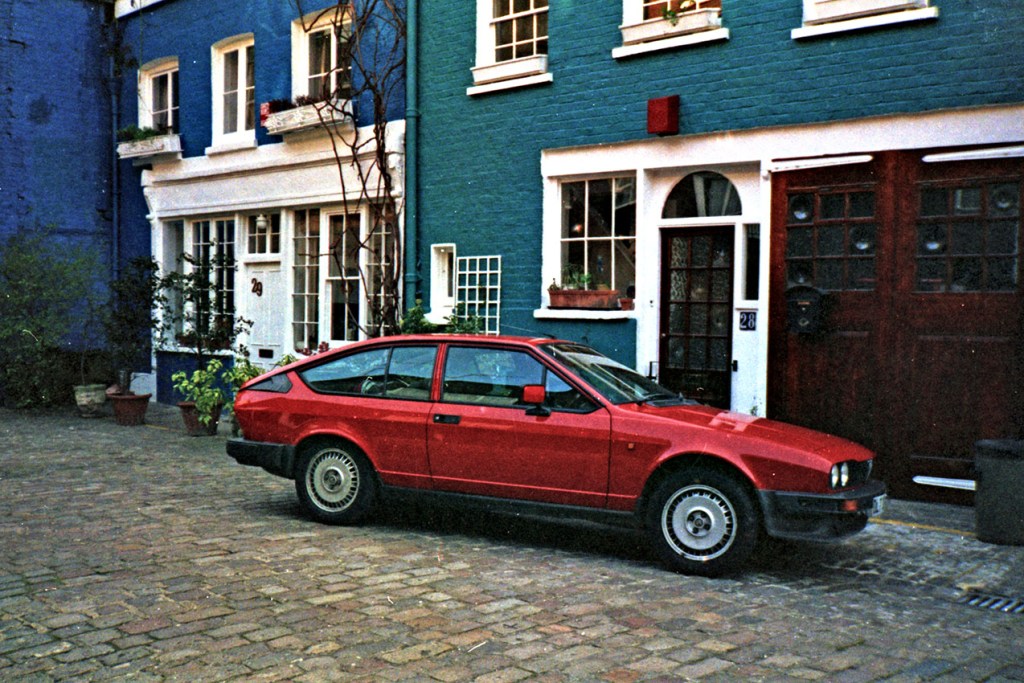
I met my future wife, Dido Nicholson, in 1988 and we married two years later. This was her cute little mews house in Lancaster Gate, close to Paddington Station and Hyde Park. She inherited the Alfa GTV from her uncle Leonard, who sadly died while playing real tennis at Lords (the “HQ” of world cricket)...
Dido and I were married at Marylebone Registry office, attended by her parents, my mum and Sidney, and of course, our maid of honour, our best friend Aura, looking unusually sheepish for a large sheepdog…
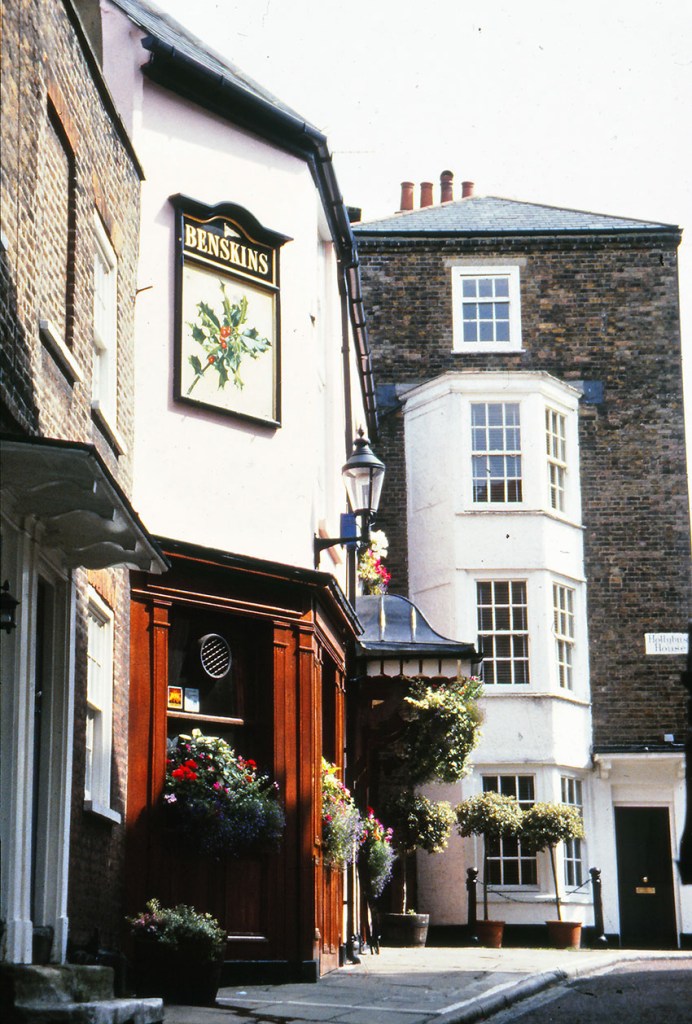
Like most Londoners, I was rarely happier than when visiting one of my local pubs, like the Holly Bush, here in Hampstead, which has turned out to be our final London Address…
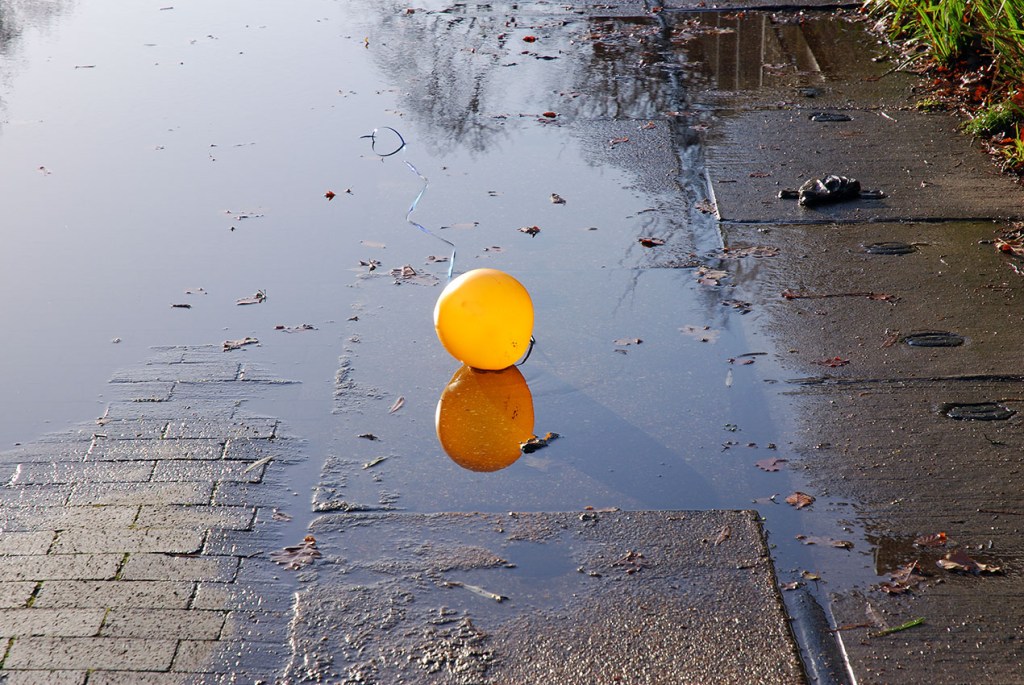
A melancholic New-Years-Day scene on the tow-path of the Regent’s Park, one of our favourite regular walks, and a fitting image to end this homage to a lost city.
  • The title picture is the top of Primrose Hill. It offers, arguably, the best view of London from north-west of the city. I always found the scene somehow reassuring, and no more so than one misty autumn morning in 2010, when my mother had just left for the airport on her way to Dignitas.

The Beauty of Line…

part 1 (drawings of Dido)

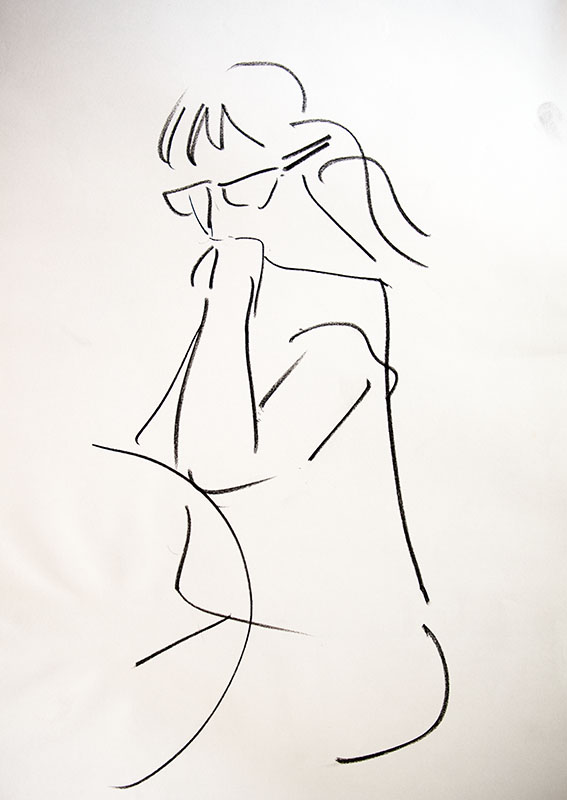
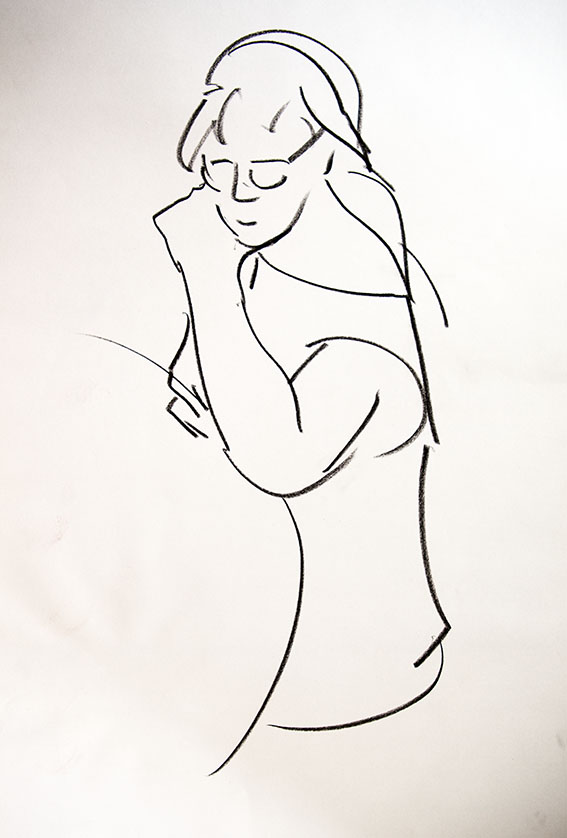
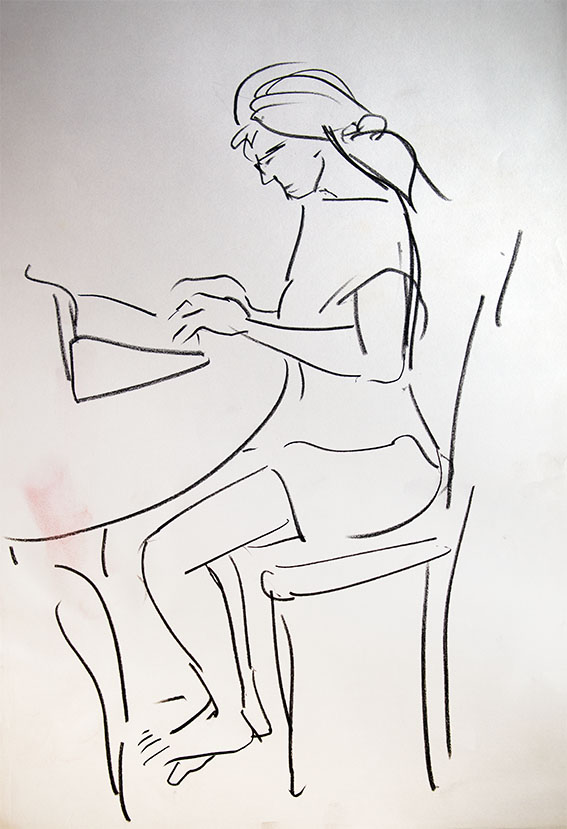
Yet more house tidying, yet more exciting discoveries of my ancient artwork. This time, of long-lost simple line figure studies, of my then-young wife Dido and of her friend and former ballet colleague, Frin.

Both, were natural and highly sketchable models as the images here attest, plus, I seem to have been in unusually relaxed with the old charcoal stick and conte crayon. My muses’ unaffected air and my good drawing form was a happy combination which I now look back upon, some 30 years later, with a deal of pride and not a little amazement.

Regular visitors to these posts will be aware of my respect for skilled drawing, and that I regard an ability to draw well as being the prime tool of any artist. Picture making without this tool is like attempting to speak without a tongue, with similar, incoherent results.

Sadly, modernism and later, abstract expressionism (admittedly with a few glorious exceptions – from Modigliani to Rothko), inadvertently gave free license for non-drawers to thrive, resulting in the often talentless gimmickry that infests so much of today’s “art world”.

Ho hum…

Fortunately, my utter disillusionment expressed above, came after I had time to make my own joyous-if-modest contribution to the corpus of half-decent picture-making, as these humble sketches bear evidence…

Another Roman Holiday…

…and more unrequited love in the eternal city and beyond…

As I’ve mentioned before on these pages, the main reason I gave up the prospect of an academic career was because I was a lazy student and had a precocious talent for drawing and painting. In other words, I took the easy, relatively effortless option. However, if one person, other than yours truly was also highly influential in pushing me towards a career in art, it was my art teacher at Carmel College, Hermann Langmuir *.

Hermann (as we were bidden to call him) was a tall, bearded, charismatic Dutchman, whose knowledge of art and art history was only matched by his infectious enthusiasm for his subject. From the moment he joined the teaching staff, the Carmel art room metamorphosed from a gloomy, educational backwater, into the most happening and vibrant teaching space on the campus. This, combined with my loathing of formal classroom study and the fact I became one of his two star pupils (a huge nod to Jeremy Gerlis – a gifted draftsman and now FRSA), ensured that I would give up the chance of an Oxbridge future (virtually guaranteed to top Carmel academic performers back then) for the presumed bright lights and glamour of a London art college.

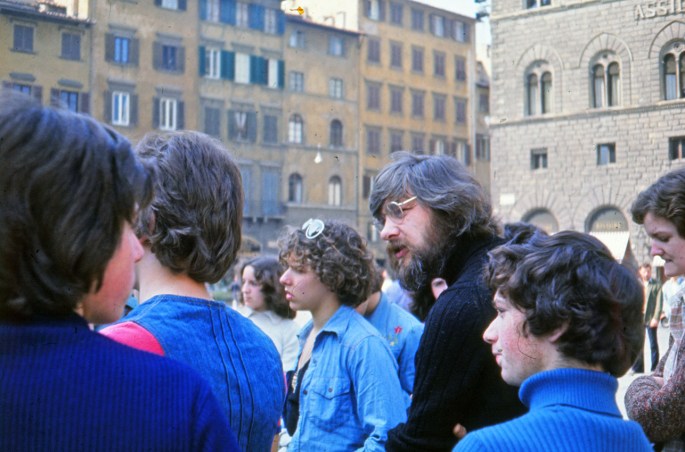
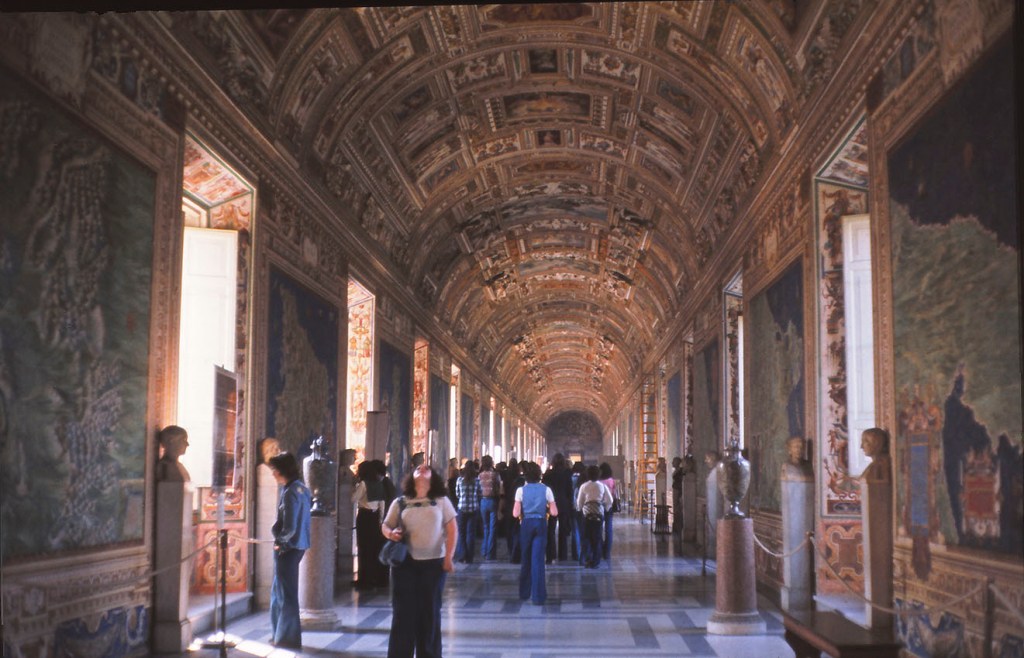
How all that turned out is well covered in previous posts, but what I have overlooked until now, was a trip Hermann organised for all his pupils, in the March of 1976, to Rome, Florence, Siena and Pisa. The following – un-treated – ancient photos (all taken on my old Canonet 28 Automatic), tell some of the story of that magical and hugely formative experience.

* If anyone reading this post has any knowledge of the whereabouts of Hermann these days, assuming he is still with us (I guess he would be well into his eighties by now), I would be keen to catch up with him. I should point out here, that if not for Hermann’s pleading with the headmaster, Rabbi Jeremy Rosen, I would not have been on the trip. I had entered Carmel in 1971, with my estranged father paying the considerable fees. However, when he fled to America in 1973 during the oil crisis and the subsequent crash of his advertising business, the school, very kindly allowed me to stay on at half-fees. As generous as this was, with my mother working as a poorly paid secretary, it still entailed my maternal grandparents using up much of their life-savings to keep me at the school. Thus, when the Italy trip was announced, my family had no cash spare to pay for it, and hence Hermann’s interceding with Rabbi Rosen on my behalf. Once again, the school came up trumps, and completely covered the costs of my travel and half-board accomodation, leaving me with only my lunches and daily refreshments to pay for. For this purpose, my very hard-up mum gave me the grand sum of £25 spending money, which I somehow managed to make last the entire ten-day trip, by restricting myself to slabs of margarita pizza, purchased from “hole in the wall” vendors. In any event, I never once felt deprived, and had one of the adventures of a lifetime. Thank you Hermann, wherever you are…

Milan Railway Station – Designed by Ulisse Stacchini in 1931: We flew to Milan (I suppose it was cheaper than flying direct to Rome?), and then got the train to Rome. I for one was pleased, as, much to Hermann’s horror, I was in awe of the station’s “fascist architecture”…
The oddly named Vatican “Square”, from the top of Saint Peter’s: One of several times I was fortunate to see a wonder of the world with virtually no crowds to mar the experience…
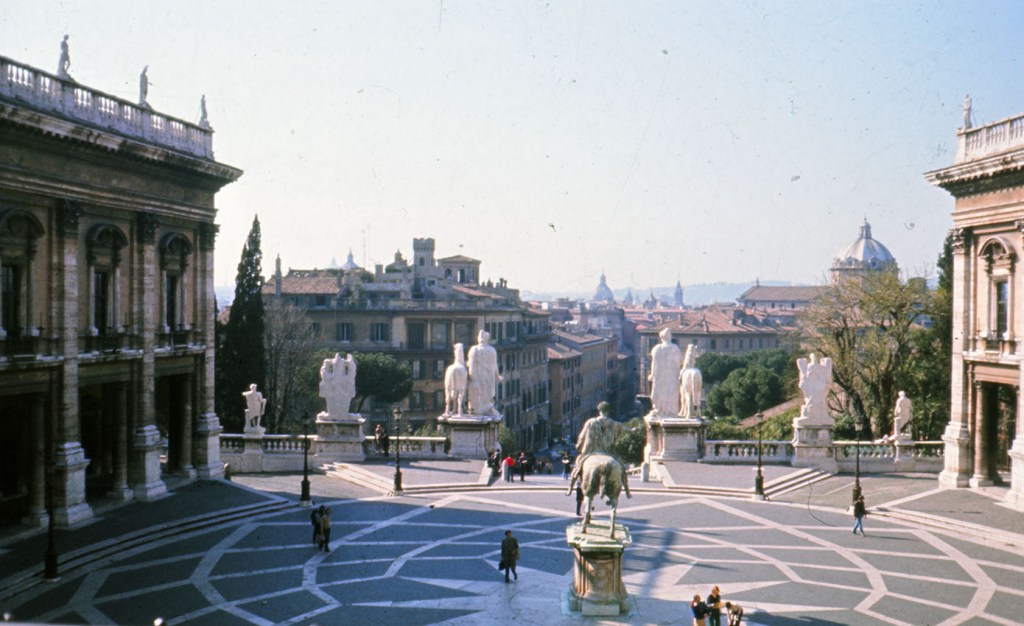
The rear view of the famous equestrian statue of emperor Marcus Aurelius – Piazza del Campidoglio: Again, despite the marvelous early Spring weather, almost no people…
Tritone Fountain – Bernini: Our very modest pensione was close to the red-light district of Rome, but also very near this fabulously and typically over-the-top masterpiece. Many a pizza slab was consumed at its feet – or should I say, its fish (yes, I know they’re idealised dolphins, but…)…
Jael on the Palatine: Jael was one of the few girls at Carmel in those days, and although I doubt she was aware, I was in love with her. She was Italian, from Fiesoli, above Florence, and the daughter of one of Italy’s foremost post-war domestic electrical manufacturers. We all visited her home on the Florence leg of the trip. It was a medieval castle, jam-packed with yet more wonderful works of art. I believe she is now a successful fine artist based in Germany …
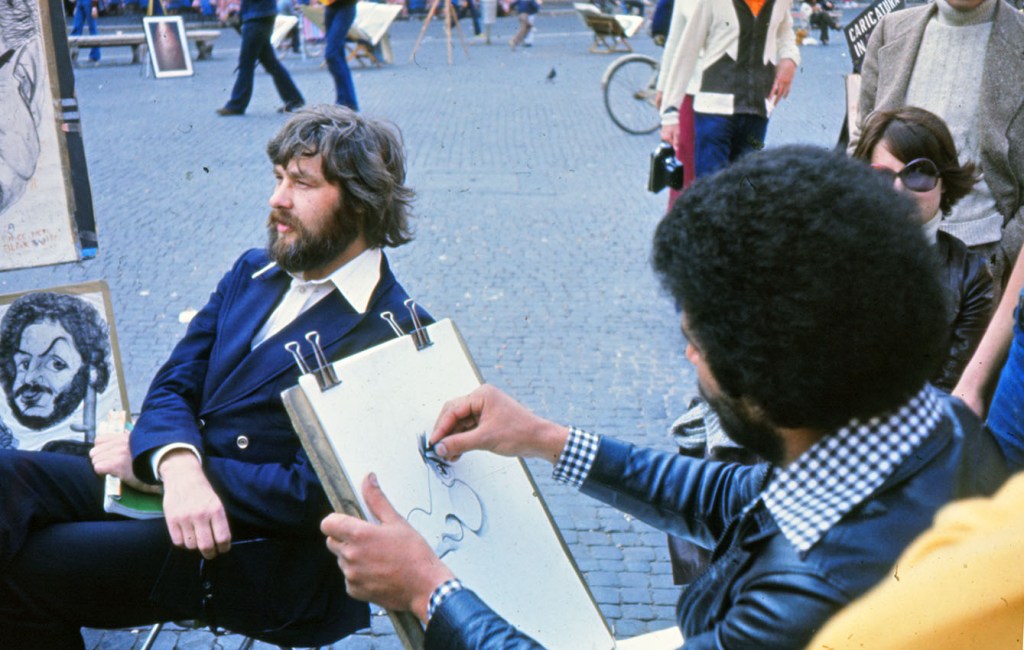
Hermann being sketched: I think this was in Florence. Hermann had been one of the many foreign student volunteers to help in the cleanup of Florence following the disastrous 1966 flood. I used much of what he told me about his work in and around the Uffizi to inform an early chapter in my novel ARK…
The Uffizi Gallery: As was normal for me in such places, a few of the Michelangelo sculptures notwithstanding, I was far more impressed with the gallery itself than much of the art it held. Can’t complain about this particular crowd, as it was my school group…
Florence from Giotto’s Campanile, (the cathedral bell tower), with Brunelleschi’s magnificent dome in the foreground: Florence was the star of the trip for me. Not so much the art (which was stupendous), but the city itself. I’ve been back many times since, but it never felt quite as perfect as in that March of 1976 …
Sarah, in the Boboli Gardens: I was in love with Sarah, and like Jael, she too had not the faintest idea. I was still a month away from my 16th birthday, and could barely make eye contact with a pretty girl, let alone declare my affections. Nevertheless, those ten days, in the warm Italian March sunshine, remain a mostly joyous memory. And after all, unrequited love is often a powerful muse of sorts.

A CONSTRUCTIVE TRANSITION

MY JOURNEY FROM HARROW SCHOOL OF ART TO ST. MARTINS IN GOUACHE

I’m not sure what the art education system is these days as I have totally lost touch (and interest) with the British art world and all its academies, institutions and philosophies. However, in my time, after leaving high-school for art college, one did a one or two-year foundation course, and then typically went on to do a BA.

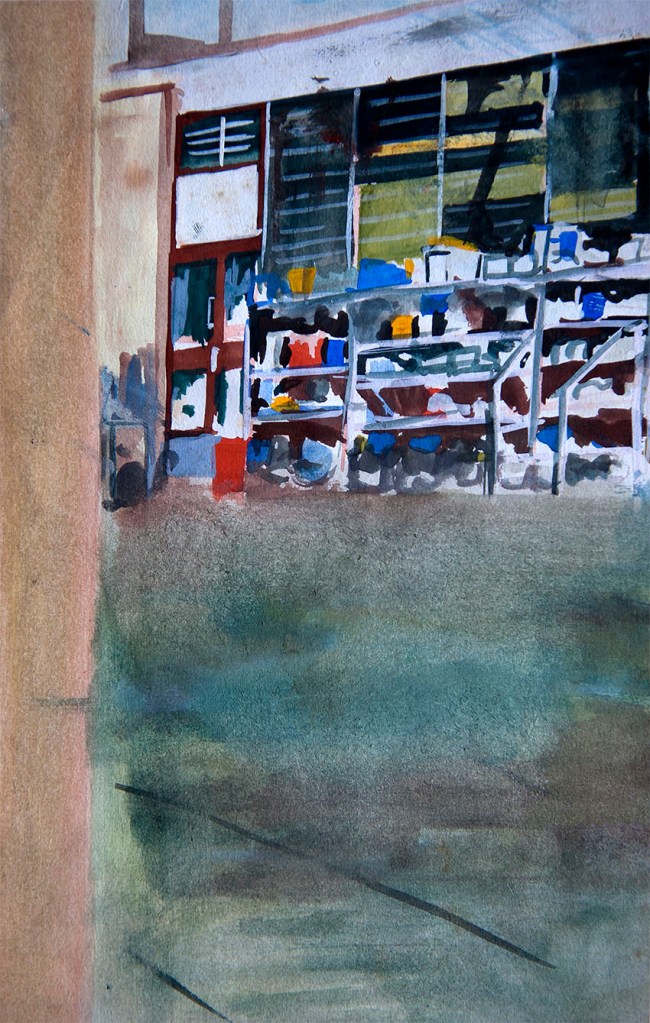
Northwick Park Hospital (Harrow) – gouache on paper – 1976

My era at art school ran from 1976 – 1981 and was something of a grand experiment, as it more-or-less coincided with the formalisation of art as an “academic” subject. Whether or not there was any merit in this move is still debated today, but from my own experience, and that of many of my art school acquaintances, the BA’s we left school with were utterly useless for furthering our careers as artists (or anything else). Ultimately, our degrees were little more than educational bling.

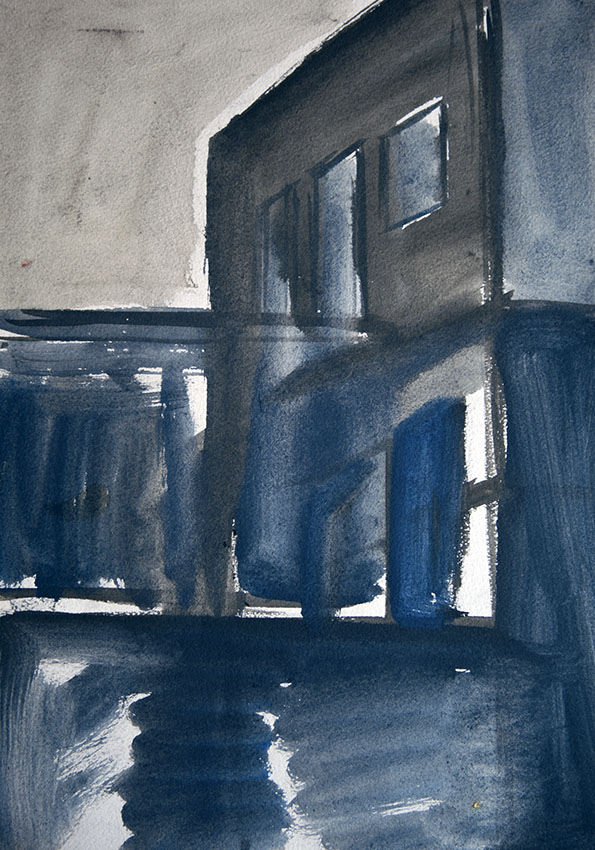
The Pottery Courtyard (Harrow School of Art) – gouache on paper – 1976

All these years later I console myself with the fact that both Harrow and St. Martins, in their very different ways offered many valuable (if often somewhat turgid) life experiences, and that the fairly successful artist I went on to become was as much in spite of those experiences, as because of them.

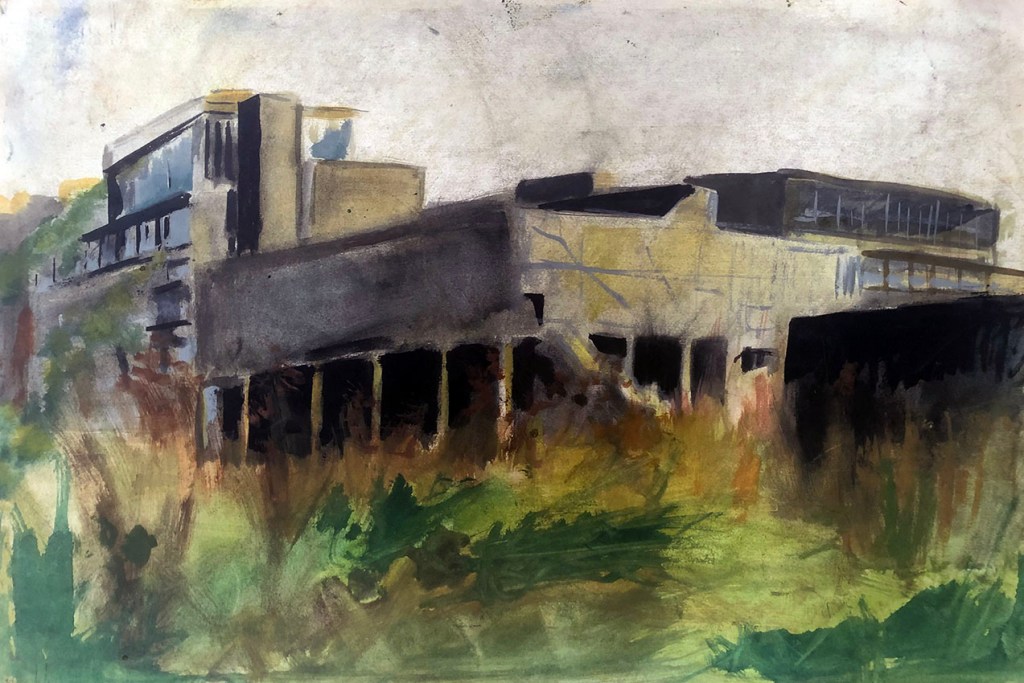
Northwick Park Hospital on a Winter’s Eve – gouache on paper – 1976

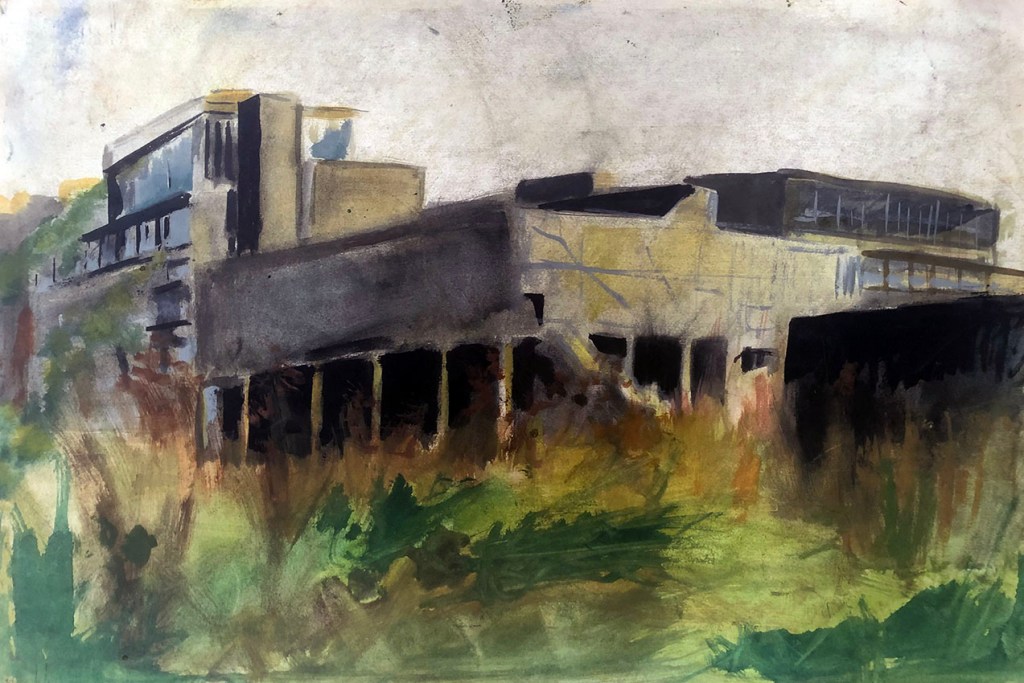
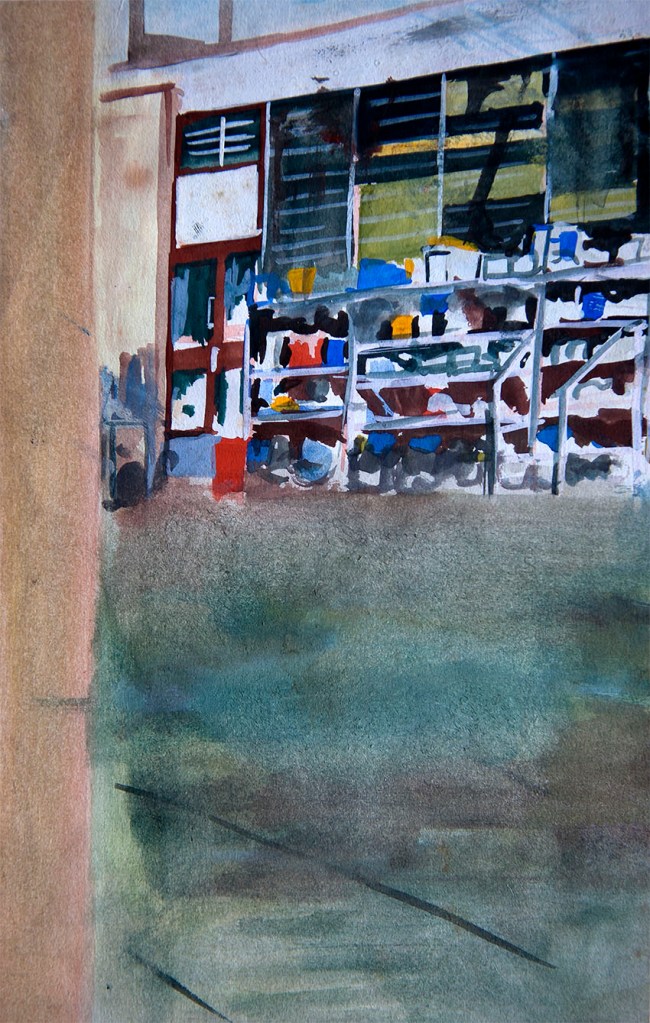
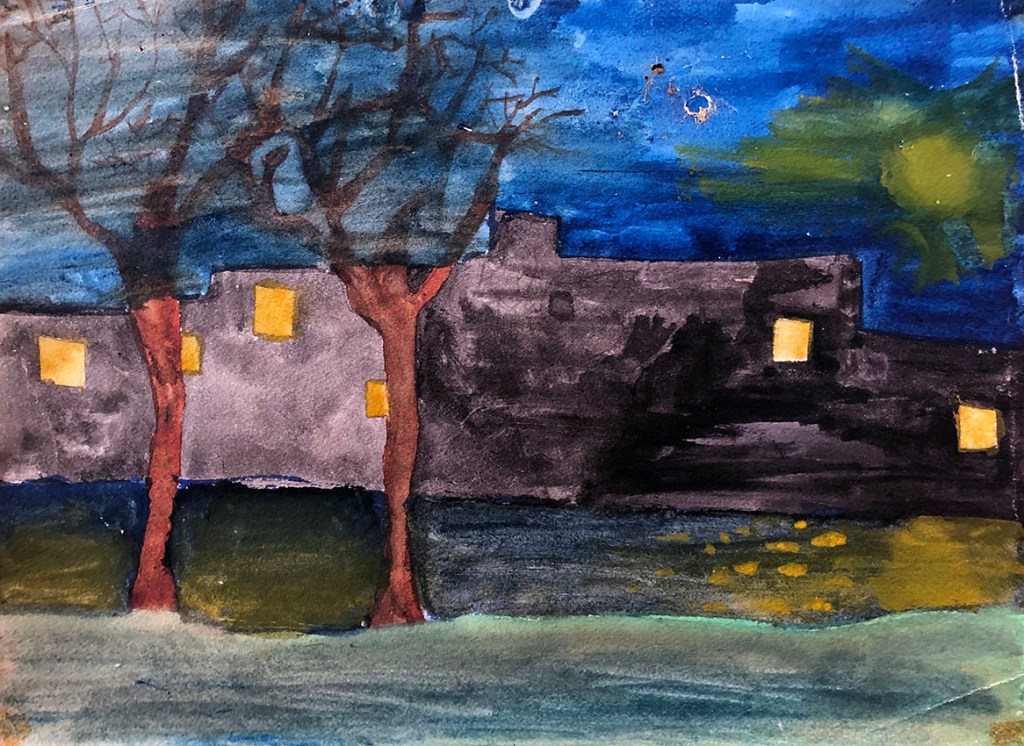
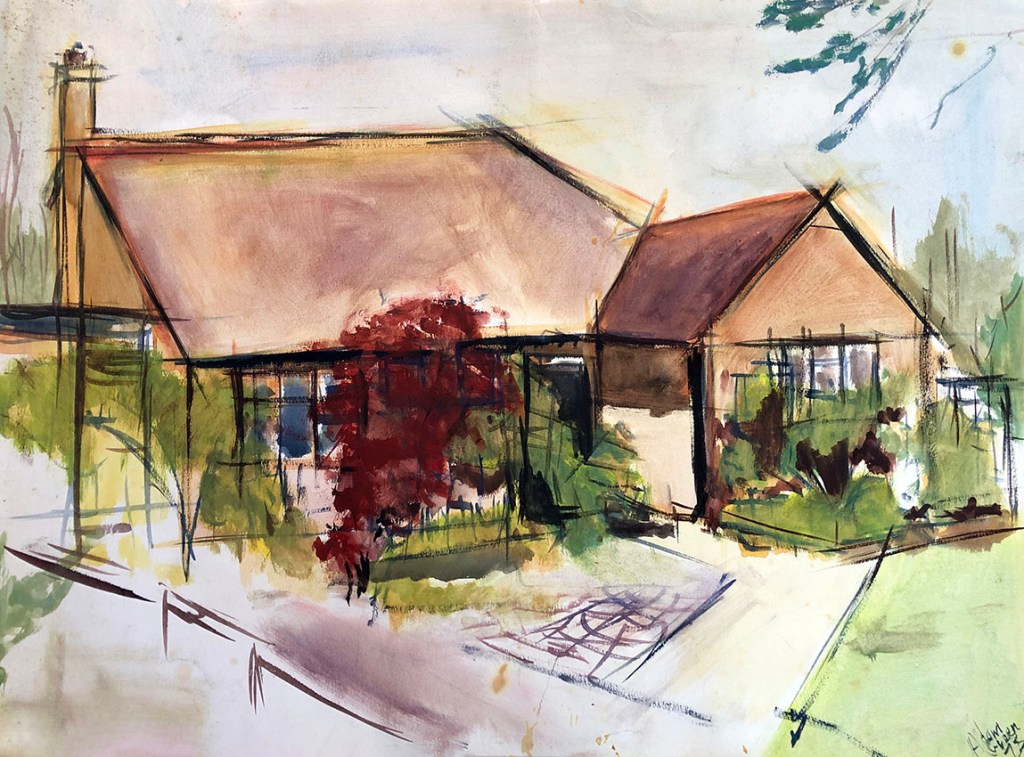
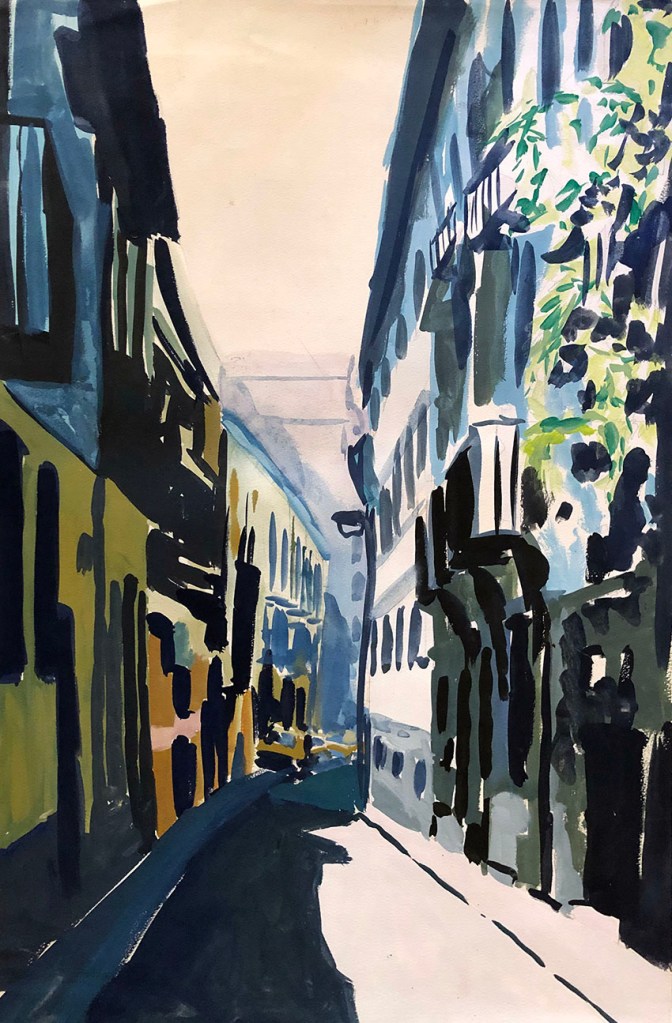
The half-dozen gouache washes here cover the end of my time at Harrow and my early days in Soho, with a visit to Spain in-between. They reveal my dabbling with a gentle form of constructivism, which was in reality a mostly contextual necessity, given the locations of my subject material. In any event, as with most of my work, in all its forms, they are ultimately all about the light – light that can lend drama and even a little beauty to most brutalist of concrete structures. There’s a deep message in there somewhere, but that’s another story…

A Street in Seville – gouache on paper – 1976

YAHWEH’S ANVIL – SINAI “THE GREAT AND TERRIBLE WILDERNESS” (revisited…)

Bedu playing a form of draughts with petrified camel turds

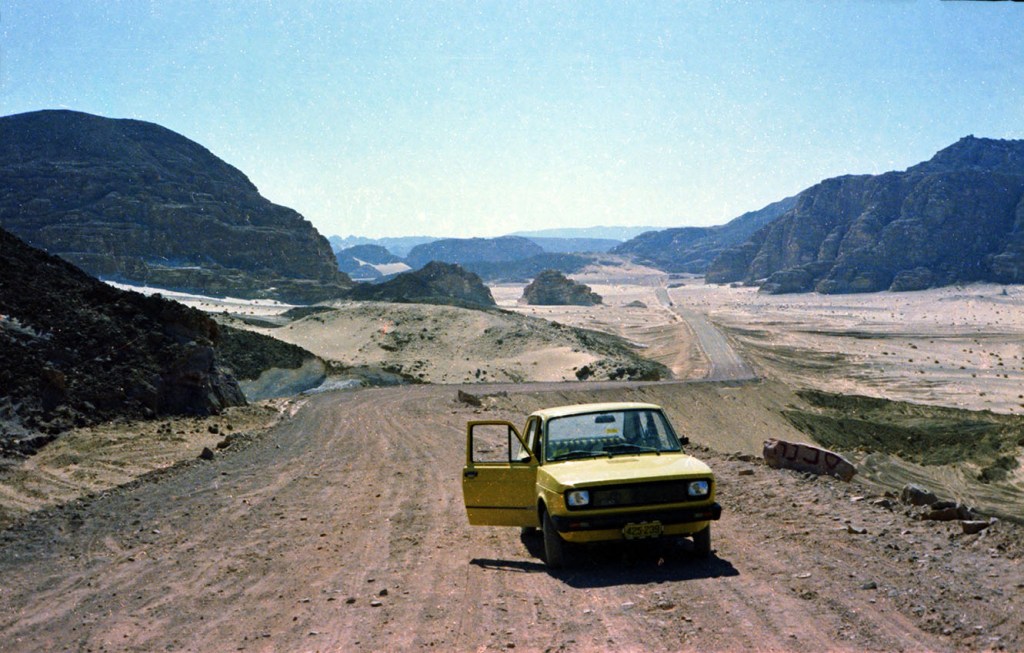
In 1978, my oldest friend Simon and I spent the summer as volunteers on a kibbutz in northern Israel. Although our labour was voluntary we were paid a weekly amount to cover basic needs such as cigarettes, booze and staples from the kibbutz general store. Fortunately, we didn’t smoke; the beer was cheap, and we were sufficiently content with the food produced in the members’ dining room that we’d spent relatively little, and by the end of the stay had a reasonable amount of money saved up. We decided to pool our savings with another couple of English guys, Tim and Ben, hire the cheapest car available (which happened to be a typical 70’s yellow Fiat 127) and drive down south to spend a week in the Sinai Desert.

Our trusty yellow “horse with no name” above the Valley of the Inscriptions

The Sinai was still under Israeli rule back then, free to roam almost all the way to the edge of the Suez Canal. Little did we appreciate then, that a uniquely peaceful era in the modern history of the Sinai was nearing its end and that we were about to enjoy privileged access to virtually the entire peninsula.

A typical scene at Nueba

These days, most travellers associate the Sinai primarily with its exotic beach resorts and scuba diving and snorkelling. And little wonder, as the peninsula is blessed with a sublime coastline both above and beneath the waves. Even now, the beach at Dahab remains the most beautiful I have ever seen, and the Sinai’s coral reef―as regards accessibility and quality―is a match for any other in the world.

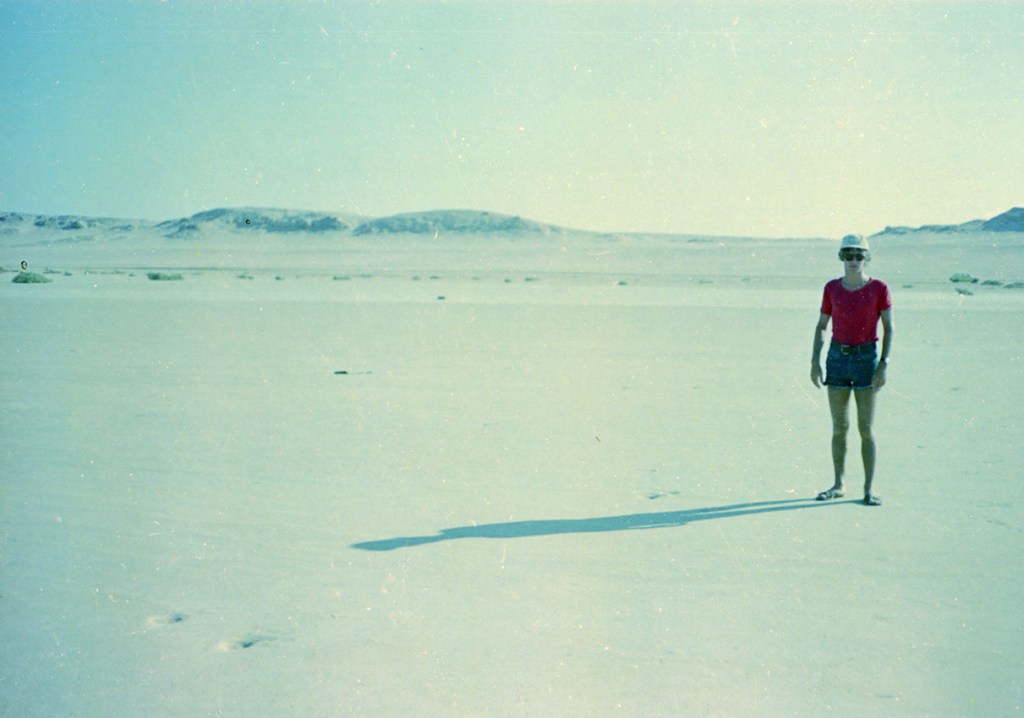
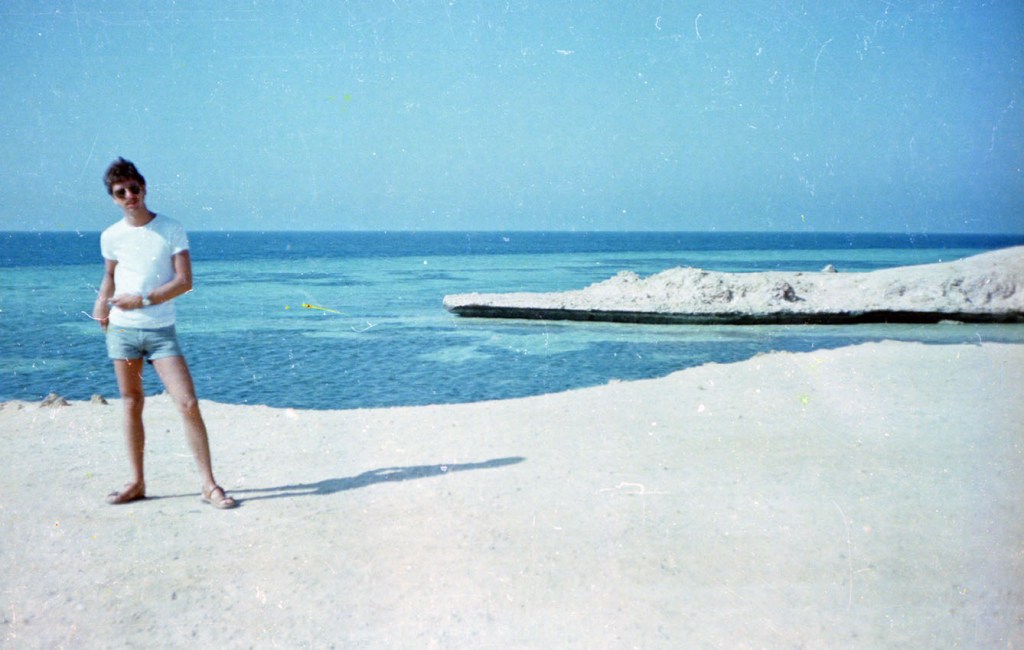
My old mate Simon, on salt flats near Ras Mohammed

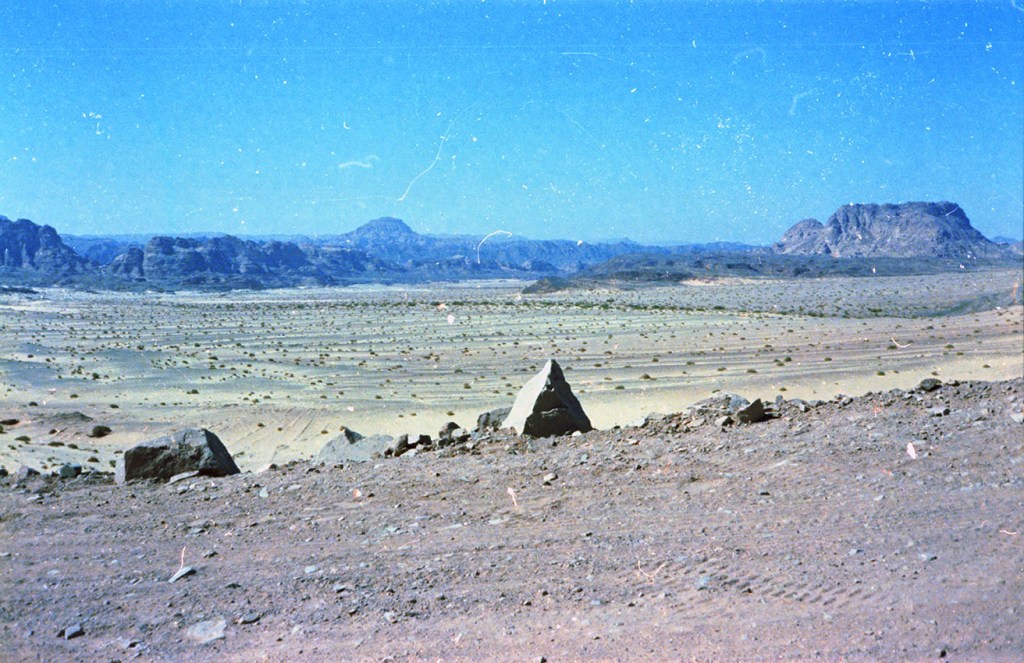
But for me, from the moment we passed through Eilat and entered the peninsula its superlative watery attractions notwithstanding, the feature which most grabbed my attention was the equally extraordinary landscape. The combination of desert plains and craggy mountains in a myriad of different colours; from white, to golden ochre through deep umbers and sienna, and culminating in blues and purples, was simply astonishing. The changing light; the chromatic sunrises; the intense sapphire of the day and the copper-tone sunsets reacted with the multi-surfaced sand and rock, presenting an optical feast of shifting tones and colouration.

The southern Sinai range erupting from the flat desert plane “like brooding granite ice bergs above a gravelly, sandy ocean…

In the south of the Sinai Peninsula in particular it was easy to see how its awesome visual dramatics gave birth to Yahweh―the eventual supreme divinity of the Israelites, and which would gradually evolve into the monotheistic Judeo-Christian concept of “God”. And funnily enough, of all the many remarkable aspects of the Sinai, the one which struck me most had an appropriately biblical reference: I recalled, even back then, the passage (Exodus 19:12) where Yahweh warns the Children of Israel not to touch the sacred mount (Mount Sinai / Horeb) “or they shall certainly die”. Until witnessing for myself the “biblical wilderness”―familiar then, only with the mountains of Europe which have nothing like defined parameters, but rather evolved from their neighbouring foothills which themselves slowly emerged from undulating plains―I had always found that to be an odd warning. I even recalled as a child in Synagogue on a Saturday morning, when first reading the relevant passage, asking my grandfather how the poor Israelites were supposed to know where the sacred mount began. But now, looking at the actual mountains of southern Sinai, thrusting forth from ironing-board-flat plains like brooding icebergs above a gravelly, sandy ocean, I could immediately attest to the voracity of the biblical author’s knowledge of the geography he was describing. And it sent a shiver down my spine.

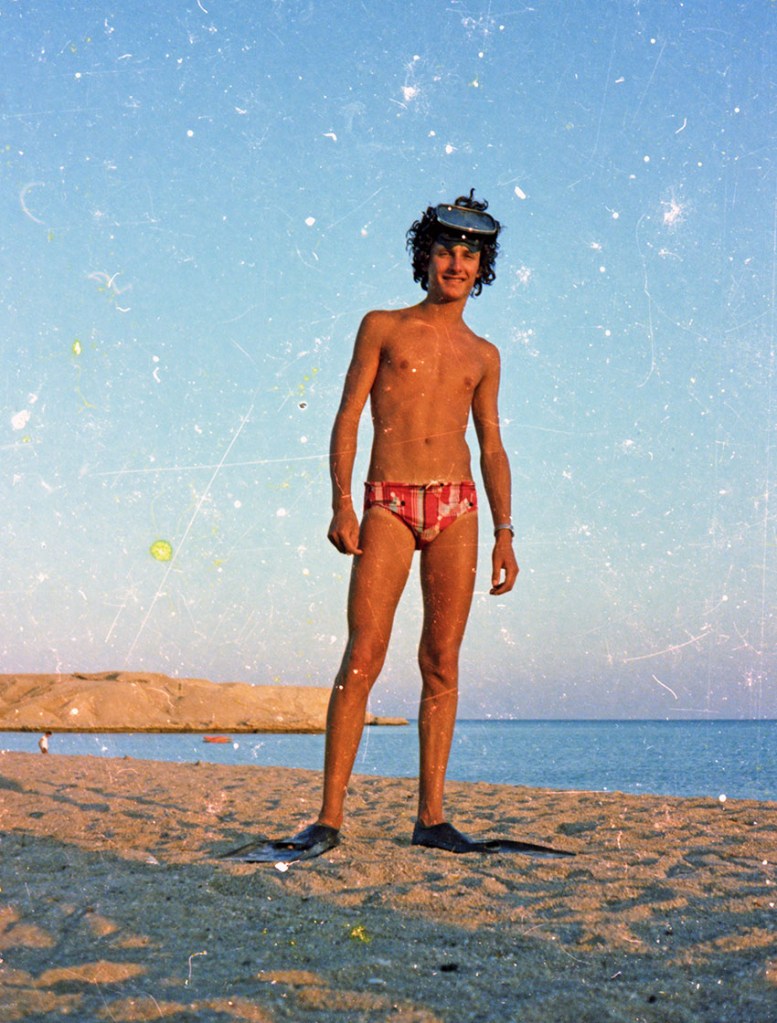
Snorkelling off the southern Sinai coast was beautiful and awesome in equal measure…

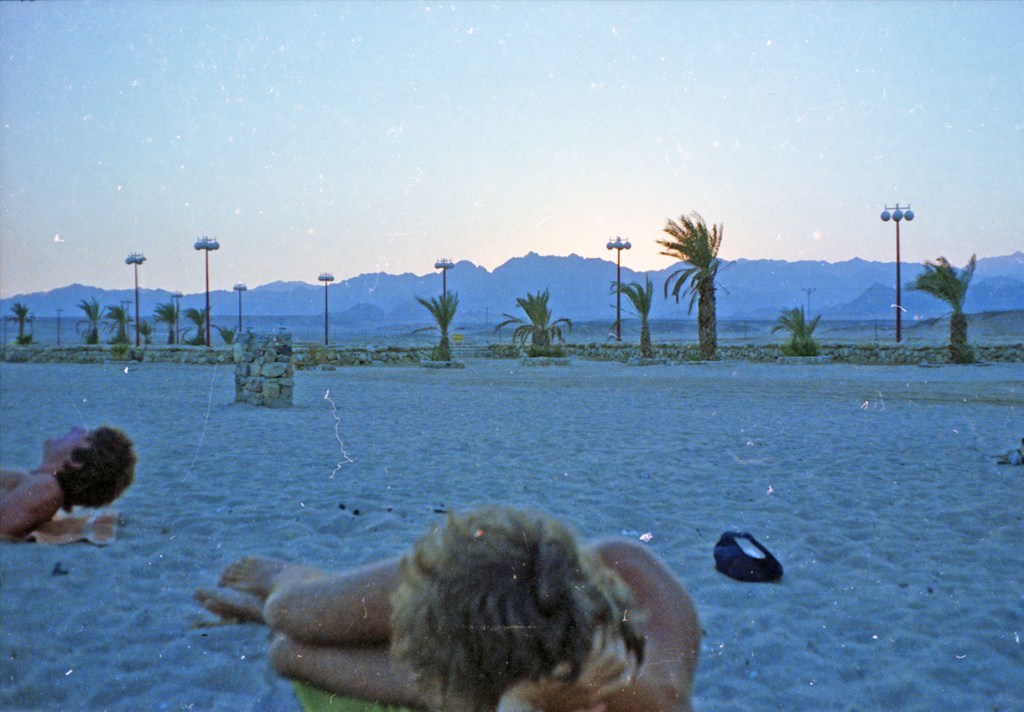
Presented here are a handful of the dozens of photos I took on that trip with my old Cannonet 28 on high-speed Ektachrome film. Sadly, most of the transparencies were too damaged to convert, but I think these few, in their raw, scratched and grainy condition, begin to convey to sheer wonder of what we saw on that wonderful trip to that “great and terrible wilderness”.

Finally, and on a lighter note, I recommend viewing these images to the sound of America and their iconic track The Horse With No Name . This song became a kind of unofficial anthem to our trip, and thus the adoptive name of our trusty little Fiat…

The exquisite beach at Dahab.

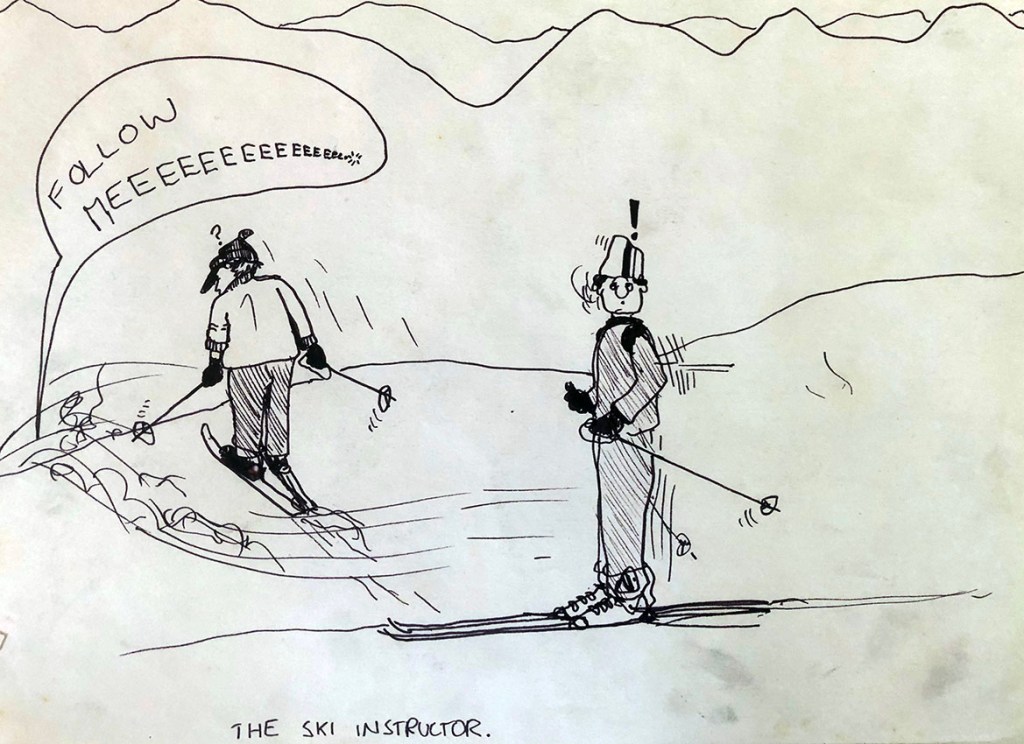
PARALLEL TURNS AND COMIC TURNS

A long, long time ago, before all of our spare physical energy and free time became dominated by farm work, we used to spend a week or two every year skiing, normally somewhere in the Alps…

While I began going on winter sports holidays from a very young age, Dido, for contractual reasons (to avoid injury) was only able to start skiing after she retired from the ballet; which was highly ironic, seeing as she was forced to give up her professional career due to an injury she acquired dancing at Covent Garden…

Another irony was that our final skiing holiday was in the Spanish Pyrenees, at the culmination of the trip we made to find our finca in southern Spain, the very finca that would put an end to our skiing adventures…

While in the early years we missed the thrills and spills, the adrenaline rush of schussing down the pistes, the spectacular Alpine scenery, and the fun apres-ski, gradually, the process of building up our little farm offered even more feelings of pleasure and accomplishment…

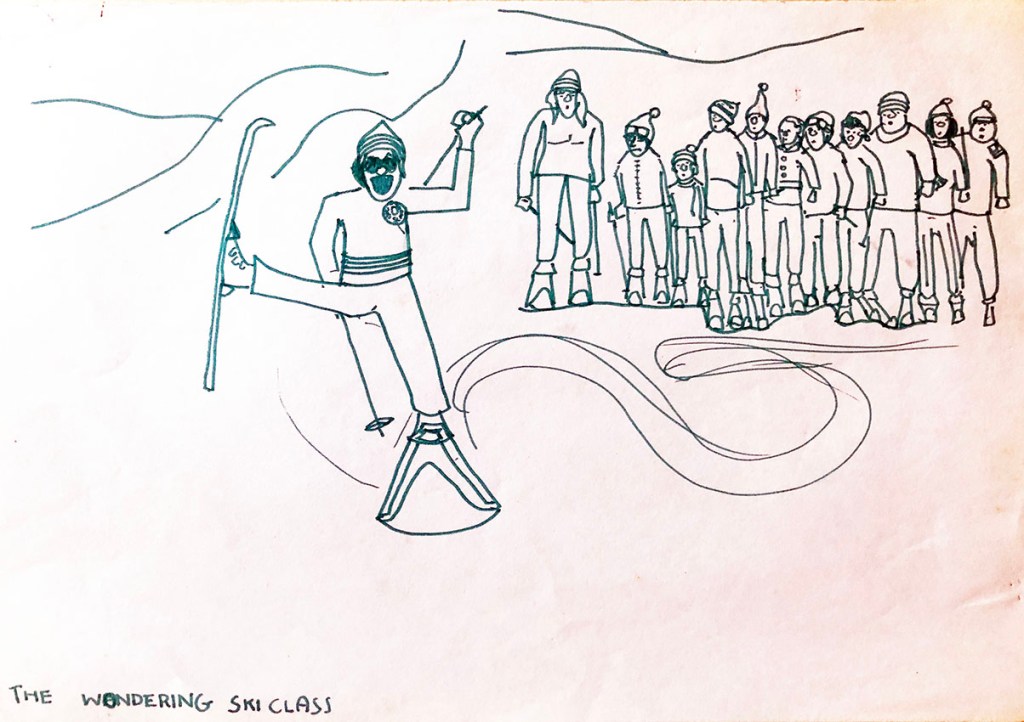
However, as my seemingly never-ending trawl through my old artwork continues, I’ve recently rediscovered a pile of cartoons I did as a 12 and 13-year-old boy, on one or two of my very earliest ski-trips, and which brought amusing winter memories flooding back…

Given the timeframe, it’s obvious why ski-school seems to be the dominant theme…

Although we skiid in Switzerland, Austria, France and even Greece, we eventually fell in love with the north-Italian resort of Courmayeur and returned there numerous times…

One or two readers of this piece might even recognize my depictions of them in these cartoons, and if so, I hope their memories are as happy as my own…

AND FINALLY – NEARLY…

EXERPT 7 FROM MY NOVEL “ARK”

One of the snatch team opened the doors of the van and they stepped out to find themselves inside a large storage shed.  

Apart from a stack of old oil drums in one corner and a small pile of cardboard boxes labelled “fragile” in the other it was completely empty. The walls and the pitched roof were formed of large sheets of dull green corrugated metal. A glazed narrow window strip ran along the top of the walls. It was filthy with grime and what were probably floodlights outside, appeared like dirty splashes of white paint against the external surface of the glass. The concrete floor was a drab greyish brown and reminded Alex of the rundown indoor basketball court at his old secondary school. 

The distinctive smell of aviation fuel hung heavy in the air and every so often the entire structure vibrated with a thunderous roar as a large airliner passed low overhead on its landing approach.

In addition to Alex, Elena and Omri, there was the driver, his companion and another two men present at the warehouse. All four were snatch team members and wore dark blue boiler suits and black balaclava hoods concealing their heads and faces. Two of them carried Galil semiautomatic machine guns slung over their shoulders.  

Alex noticed for the first time since their pick-up at the underground car park beneath the hotel that the van had the EL AL logo painted on the outside.  They stood in a group by the side of the van. Alex and Elena were holding hands, almost reflexively, something they rarely did. He shuddered once or twice, either from the chilly air in the shed or from nervous anticipation. Feeling him shiver she squeezed his hand reassuringly but unconvincingly as her own hand was equally cold and clammy.  

‘We’re back somewhere at Ben Gurion aren’t we Omri’ Alex said as a matter of fact. 

‘What was that?’ Omri replied breaking off from a conversation he was having with one of the men. ‘What did you say?’

‘We’ve come back to the airport haven’t we? We’re somewhere on the apron.’

‘I couldn’t possibly comment’ Omri replied grinning disingenuously.

‘We’ve been here over a minute and none of you have lit a cigarette. I’ve never been with a group of more than two Israelis without at least one them lighting up within thirty seconds. But you can’t smoke here can you because of the air fuel…What is this place Omri’ Alex persisted, ‘a customs shed or something?’ 

‘What does it matter?’ answered Omri.

‘I didn’t say it mattered, but it is ironic.’

‘How so?’

‘It’s as if the Ark hasn’t entered Israel at all.’

‘But this is Israel Alex. This is very much Israeli soil. And by the way, speaking of irony, according to the United Nations this is indisputably Israel while the Temple Mount is not…’

‘You know perfectly well what I mean Omri.’ 

‘Sure I know what you mean and you know I feel the same as you do. But you heard the PM.’

‘I heard him. I couldn’t believe my ears but I certainly heard him.’ 

‘I’m truly sorry Alex.’

They were quiet for a moment and then Elena asked Omri, ‘What are we waiting for exactly?’

‘The director of Mossad with the code’ he answered.

‘The code to what?’ she queried looking puzzled.

‘The key code to the access panel of the vault where the Ark is being stored. Only he and the P.M. know it.

According to these guys he’ll be here any minute.’  Then, almost the instant Omri finished speaking a siren blasted above the sliding door to the shed. Elena nearly jumped out of her skin and Alex grimaced and covered his ears with his hands. Immediately the two armed men trotted away towards the shed door.

‘My apologies!’ Omri shouted as the siren died away. Putting his arm round Elena’s shoulders he said. ‘If I’d known I’d have warned you. It’s intended to be heard over the noise of the aeroplanes. In any case, Avi’s here.’

‘Avi?’ queried Alex.

‘Oh sorry! Avi Peled, the Mossad chief. He and I go way back.’ 

One of the armed men slid the door open just wide enough to allow in a tall slim middle-aged man in a light khaki suit before immediately closing it again.  

Avi Peled approached them at a leisurely gate, barely lifting his large feet off the ground. The sideways sway of his long arms seemed slightly out of sync with his stride and gave the impression that he was walking more slowly than he actually was. 

He smiled when he saw Omri and greeted him in Hebrew. They then shook hands and half embraced. A well-rehearsed exchange of banter followed during which Alex detected the word “professor” mentioned two or three times. He guessed that Omri wanted to avoid Avi repeating the PM’s earlier faux-pas. Then, after a minute or so they turned towards Alex and Elena.

‘You must excuse us Professors Martinez’ said the Mossad chief smiling warmly and in perfect, American accented English. Then holding out his hand towards Alex, ‘but Omri and I are old friends…’

If one didn’t know, Alex thought as they shook hands, looking at the two friends, one would never have guessed that they were the same age. Perhaps running Mossad was an even more onerous job than he could have imagined but to Alex’s eyes Avi could have been a good ten years older than Omri. 

His ovular face was pale and yellow and the little hair he had left was a dull grey and combed over his bald pate in lank strands. His eyes were bloodshot and deeply shadowed and with heavy eye bags. His high forehead was furrowed with permanent worry lines and his thin lips were chapped and chewed. The matching dimples on his chin and at the tip of his broad nose seemed to accentuate his haggard and world-weary appearance. 

‘Old friends my arse!’ Omri exclaimed smacking Avi playfully on the back. ‘We had no choice! We were in the army together. From basic training onwards Avi here was forced upon me!’ and they both laughed.

‘That’s true’ continued Avi, ‘and what was worse, the bastards at officer school made Omri my commander for nearly all of our time together.’

‘Was he a hard task master?’ Alex asked Avi picking up on the jovial spirit between the two men.

‘Are you kidding? He ran our unit like he was Genghis Khan…’

‘He’s lying!’ exclaimed Omri giving his old colleague another playful thump. ‘I was the model of leniency…’

‘Sure! With the girls!’ Avi cut in. ‘With the girls Omri was the most lenient officer in the entire army!’

‘Now I know you’re telling the truth’ Alex said laughing too. ‘That’s my Omri okay!’

Omri was standing with his arms folded across his chest feigning a look of righteous indignation.

‘If we didn’t have a lady present’ Avi continued nodding at Elena, ‘I could tell you stories about Omri’s leniency towards the girls in his command that would make you blush…’

‘Don’t mind me, please!’ said Elena gesturing encouragingly with her hands. ‘Please, do go on.’

‘I think not!’ Omri said firmly wagging his finger.

‘But seriously though’ Avi said, his tone suddenly altered to earnestness, placing his hand on Omri’s shoulder, ‘this guy was the best unit commander in the army and the bravest. He saved my life twice during the battle for the Old City. Once during the assault on the Lions’ Gate he rugby tackled me away as I was about to tread on a booby trap and then later, on the Via Dolorosa he took out a sniper who had his gun trained on me…’ 

‘I can quite believe that too’ said Alex smiling at his friend who looked distinctly uncomfortable being praised so effusively. 

There was an awkward silence for a moment and then Omri eager to change the subject said to Avi; ‘Speaking of the Old City, there’s a rather important relic from the Old City just behind that wall over there which our distinguished Spanish guests are eager to see.’

‘Sure’ said Avi nodding affirmatively. ‘You people follow me.’

As he led the three of them towards the far wall of the shed Alex and Elena found themselves holding hands again. 

Then Alex felt Omri’s great paw-like leathery hand gently squeezing his neck and he turned to find him grinning at him; a tight lipped twinkly eyed grin, as if to say ‘well old pal, this is it. This really is it…’ Alex tried to smile back but could only return a wide-eyed nod.   

Then suddenly the contact of his wife’s and his friend’s hands were irritating and stifling and with an involuntary jerk he wriggled clear of both of them. They looked at him with concern but he held up his hands and between two deep breaths said; ‘I’m fine. Really I’m fine. I just…I just need to be on my own for this…until I’ve seen it…then afterwards…’

Meanwhile Avi pushed firmly with his index finger on what appeared to be a multiple light switch fixed onto the corrugated steel wall. After a couple of attempts the front; switches-and-all, sprung open to one side revealing what looked like an entry-phone keypad typical of an apartment block. The only difference Alex could detect from the regular sort was the presence of two large flat faced buttons beneath the pad; one scarlet and the other green.

 Avi turned around. ‘Not much of a holy of holies I’m afraid’ he said looking at Alex, ‘but under the circumstances I’m afraid it’s the best I can offer you. Now if you’d be so kind as to look the other way for a moment while I tap in the code…’ 

They dutifully turned their backs and Alex heard seven beeps as Avi entered the code.

‘Okay, that’s done’ Avi said. After they had turned back around he pointed towards the green button and asked Alex; ‘Would you like the honour Professor Martinez?’ 

Alex took another deep breath then nodded. ‘Yes’ he almost whispered.

As he approached the panel Avi added; ‘Stand back as you press it…’

Another deep breath and Alex nodded again and mumbled ‘bien’. Overwhelmed by his nervousness he instinctively reverted to Spanish. 

The green button was at exactly his eye level. He stood staring at it, his breathing now verging on hyperventilation. 

He felt lightheaded and as he gazed at the button he found it hard to focus. It seemed to have the form of a ball and for a moment there were two of them and then they melded back into one and parted again, first sideways, then up and down, together, apart, then together. Large beads of sweat ran down his temples and the back of his neck, soaking his shirt collar…’

‘Alex’ he heard someone saying to him, as if in the distance, then again, louder this time, ‘Alex old friend’ it was Omri, ‘are you alright?’

Suddenly there was a thunderous noise and the shed shook and Alex felt as if he had been woken from a trance. 

 As the howling of the four RB211 turbines faded into the distance he turned to Omri and said ‘I’m fine now.’ 

 He smiled at Elena. In Spanish he said; ‘Fifteen years of my life—of both our lives—and this is what it’s all come down to’ and still looking at her, searching for calm and reassurance in her astonishing eyes, he pushed the green button.

For a second nothing happened. Then there was a shushing sound of air being compressed. A corrugated panel, a foot or so above the ground, six feet wide by eight feet tall, just to the right of the key pad, advanced forwards from the wall about ten inches. Then there was a series of clunking and clicking noises and the panel slid smoothly and silently across towards the right. 

As it moved away Alex saw eight inches of gleaming metal and he realised that the corrugated surface was merely a camouflage for what was in reality a steel door to a vault. 

‘This is where we keep our most special and valuable imports and exports Professor’ he heard Avi informing him from over his shoulder. ‘It’s rarely used at all and normally for highly classified bits and pieces— important that is from a national perspective—but nothing to compare with this. I would say with extreme confidence, that this is the most sacred cargo ever placed here.’

Alex peered into the vault but it was pitch black. 

‘Here. Let me professor’ Avi said reaching around the left-hand side of the vault’s entrance, presumably reaching for the light switch. ‘Omri explained to me that you would like to go in on your own to start with.

Well professor, it’s all yours for as long as you need…’ 

There was a click followed a moment later by the distinctive whirring of fluorescent tubes firing up, and the strobe-like flash, flash, flash as the bulbs lit…

THE PENANCE OF CARLOS

EXERPT 5 FROM MY NOVEL “ARK” 

After Ramirez left Carlos sent everyone home. 

 Marie Carmen protested, saying that she wanted to clean the bathroom but Carlos told her that he would do it himself. She then complained that he had never so much as cleaned a cup so how on earth would he manage to clean a bathtub. 

‘I don’t expect you to understand my love’ he said to her holding her gently by her broad muscular and fleshy shoulders, ‘but this is something I have to do myself. I owe it to Miguel.’

She did not answer but simply looked back at him with her typical doleful open mouthed expression.

‘Now you be a good girl Marie Carmen and go home and get some rest. I’ll follow just as soon as I’ve finished here. I’ll clean the bath and then I’ll phone Jorge and Moisés and then I’ll walk home. Then we can start arranging the funeral and the wake.’

Carlos saw her to the door and watched her large form silhouetted against the early evening autumn sky waddle away heavily down Loli’s immaculate narrow path. 

He watched her with that same mixture of affection and pity that had characterised his attitude to her for most of their forty years together. 

Still, he thought it was better what he felt for her now than when their two families had forced them together in matrimony all those years ago, even though she had at least been slim and pretty then.

But it had never been her looks that had bothered him nor her considerable dowry. It was the fact that she was so intellectually backward and dull; an ‘idiot’ in fact, as he had complained bitterly to his father when the wedding was announced.

‘So, you’ll educate her!’ his father would respond laughing.

‘But she’s not educable Father, she’s verging on being retarded…’

‘What the hell do you care if she’s retarded? She’s about to make you rich!’

‘But I can’t discuss anything with her. She doesn’t understand anything I say…’

‘So what? Wives aren’t meant for discourse! They’re for child rearing and for cooking your meals and keeping your home. If you need to chat, do it with your colleagues and your friends. You can even find educated whores who will listen to what you have to say, just so long as you pay them.’

‘I don’t love her father, I don’t even like her.’

‘Please Carlos—be sensible about this. Be content that you’re getting an attractive and wealthy young wife. For goodness sake boy, at least she isn’t ugly! If she was ugly I might have some sympathy with you, but this? This is a dream marriage—one of Malaga’s most eligible girls wedding Malaga’s—and perhaps Spain’s—most promising young scientist’

‘But Father…’

‘And anyway Carlos, you’ll learn to like her, I guarantee it. You might even come to love her in time.’

With time Carlos’ feelings for Marie Carmen did indeed change but not quite in the way his father had predicted. He never grew to love her, or even like her but familiarity and regular and comfortable sex made him feel a tenderness towards her that evolved over the years. So much so, that even as childbirth took its toll on her body and she gradually grew into the broad shape typical of most Malagueña matrons his tenderness merely faded into a kind of protective compassion.

The only blip in his ‘virtual matrimonial idyll’ (as he described it wryly to himself) occurred several years later when his youngest brother Miguel, with barely a raised eyebrow from their father married the girl of his choice; Gloria Hernandez.

‘But you’re our first born Carlos’ their father would say whenever the subject was broached. 

‘Little Miguel is not my heir—you are. And in any case, his Loli is from a good Madrid family—no money worries there. He has done well for himself. But with you, we had to be certain. You were a loose cannon and we couldn’t take a chance.’ And then he would pause for a moment before adding with sublime insensitivity; ‘It’s funny how things work out isn’t it Carlos? You, the brainy one of the family wedded to a dimwit and Miguel, the dimwit of the family married to one of the brightest and most talented girls in Madrid. Ha!’ Then he would walk off, chortling at his own sense of irony.

But it was not so much the relative injustice of the two unions that irked Carlos as it was the painful fact that he fell in love with Loli the instant Miguel first introduced her to the family in Malaga.

The moment she walked into the large sitting room of the Garcia house, slightly ahead of Miguel, full of purpose and self-assurance he knew that she was everything that Marie Carmen was not. 

Loli was petite, with the bearing, poise and physique of a classical dancer, with pert breasts, a narrow waist, toned bottom and lean athletic legs. Her short jet black hair cut immaculately, framing a small but elegantly sculpted face oozing intelligence with every glance of her large green eyes.

The fact that later in the evening she entertained the family at the piano with the skill of a young Rubenstein and that she was charming and attentive towards Marie Carmen throughout and that she was his little brother’s girl all conspired to make Carlos thoroughly enchanted and miserable in equal measure. And while the passage of time helped him come to terms with his marriage to Marie Carmen it did nothing to temper his feelings of love and desire towards his sister in law. 

Not that there was anything he ever would have done to assuage these feelings, even if Loli had been ‘available’ which she most definitely was not. The idea of betraying Miguel and jeopardising their good relationship was abhorrent to him. 

Ultimately Carlos learned to channel his feelings for Loli into his fantasies, both when alone and when having sex with Marie Carmen. Then later, when he got tenure at the University of Madrid and they began to see Miguel and Loli practically every weekend and holiday he found an even more effective way of sublimating his desire. He embarked upon a long series of affairs; at first, mostly with secretaries, but later in the 50’s and 60’s, as more girls joined the faculty, with students, and occasionally the odd colleague. 

Somehow, through all of this Marie Carmen remained none the wiser. Either because she was not sufficiently mentally alert to understand and interpret all the many oversights and faux-pars that Carlos made; such as the scent of perfume on his clothes, lipstick on his collars, dried semen stains around his flies, on his underwear and most typically, him calling her by the name of his current fling; or that he somehow managed to part with all of his girlfriends on amicable terms so that none of them ever “made trouble” for him. So it was, that evening, alone at last in his brother’s house when he entered the bathroom Carlos had the feeling he was about to embark upon an act of penance. 

He stood for a moment looking down at the bath now drained of water. Almost the entire tub, except for two oval patches where Loli’s buttocks had been pressed against the enamel was stained with a dark maroon film. The blood spatter on the wall tiles around the soap tray where Loli had placed the razor had turned a deep umber. 

Carlos looked around for a cloth of some kind and spotted an orange moppet on a low shelf behind the sink. He rolled up his shirt sleeves, took the flat sponge and turned on the telephone shaped hand-shower above the bath taps.

As he started wiping and rinsing around the wall, diluted blood and water seeped from the sponge and ran through his fingers and down his wrist and forearm.

Instinctively, almost unconsciously Carlos put the back of his hand to his mouth and then touched the moisture with his tongue. 

Tears began to well in the geneticist’s eyes and he continued with his curiously intimate chore.  

‘It’s amazing’ he thought, ‘how easily blood washes away—just like life itself.’ 

Then he imagined Loli’s DNA diluting into the Madrid drains.

TAPAS BEFORE TEMPLARS…

EXERPT 4 FROM MY NOVEL “ARK” 

La Gamba was situated in the aptly named Via Frontera, on the border of the theatre and financial districts. It was a lively informal bar with an authentic Andalucian feel, inside and out.  

Black wrought iron window grills festooned with obscenely healthy geraniums screamed scarlet against glossy viridian window frames and whitewashed walls. Just beneath the foliage on the narrow pavement along the front wall, a row of small tile-topped tables were perched precariously on the edge of the high curb. Regulars at La Gamba knew to keep their hands and elbows well tucked in when sitting at these tables to avoid constant jostling from pedestrians on one side or more serious knocks from passing motor traffic on the other. They also needed to be impervious to the acrid exhaust fumes belching out from the frequent 50cc Puch motorcycles and Vespas—the vehicles of choice for most working class “Madrineros”.

Inside, La Gamba’s walls were swathed in cheaply framed bullfighting and flamenco show posters. Ornamental pinewood beams stained dark with thick treacly varnish posed as unconvincing supports for the nicotine stained ceiling. The linoleum floor was littered with used “tapas tissues”, cigarette butts, mussel shells and prawn skins. The long bar was harshly illuminated by a double row of eerily yellow fluorescent strip lights bolted precariously to the fake beams. 

In addition to the assault on the visual senses, it was the smoke you noticed most when you entered; a sweet pungent grey-blue mist bearing strong hints of alcohol, coffee and garlic frying in olive oil. And all the time this murky soup churned around and upwards and regurgitated into spirals by a dozen sluggish ceiling fans.

But then, in defiance of this lurid environment, emerging from the monochrome mist like a glorious Technicolor oil painting there was the tapas itself:  

Tapas on an epic scale reflecting the collective culinary glory of Seville, of Granada, of Cordoba, of Cadiz, of Malaga, of Huelva and even humble Almeria. Tapas of such high quality it compelled people to brave the kitsch, the fug and the noise in vast numbers from all over the city and beyond.  

The bar was all of forty foot long, starting at the entrance and continuing two thirds of the way down the narrow room. 

Along the bar’s entire length were glass and steel chilling and warming cabinets. Within the cabinets were scores of hot and cold raw and cooked meats: Pork, rabbit, tripe, chicken, game and veal; stewed, baked, fried and grilled ‘a la plancha’ and then the fish and the sea food; starting at one end with the braised salt cod and culminating at the other end with piles of alive, gently pulsing clams and mussels, and in between; all the edible booty of the sea from gilt-head bream and baby whiting to spider crab, squid, razor clams, octopus and prawn and shrimp in heaps  and then; a row of earthenware platters resting above the cabinets, laden with steamed wild snails, deep fried baby green peppers, black pudding stewed with chick peas, tripe with potatoes in saffron sauce, four inch thick egg tortillas, mini wooden skewers of cubed pork loin marinated in paprika saffron and cumin, cured ham fried with broad beans and on and on. 

Directly above, hanging from a straining iron rod were dozens of precious Jabugo black hams. And behind the bar, on the back counter; more plates and carving boards, piled high with “Iberico” sausage, cured meats, chorizo and black puddings of all shapes and sizes. 

And finally, above the sausage, a phalanx of dark oak barrels stacked up to the ceiling: Full sized 256 litre (give or take) casks of dark sweet viscous Malagas, dry clean yellow Montillas and yeasty nutty Sherries and Manzanillas. 

And manning this visual-cum-olfactory sensory battering ram; a cohort of waiters and barmen (all men), attired in black trousers, tieless white shirts and green fronted waist coats and armed only with sticks of white chalk jammed behind their ears. No note pads here, just chalk marks scratched onto tables and bar alike. 

It was central Madrid on a Thursday night and La Gamba was heaving with a mixture of pre-theatre crowd and office workers lingering far too long on their way home from work. It occurred to Alex that perhaps it was not the ideal spot after all for what he anticipated would be a long and discreet conversation. Fortunately though Carlos Garcia had been good to his word and secured a booth at the rear beyond the bar and well away from the main crowd which tended to gravitate around the ranks of tapas like moths to a flame.

The booths were surprisingly insulated from the noisy crush beyond, but on the down-side there was a mild odour of urine and cheap soap emanating from the toilets over in the far corner. This was partially compensated for however by the fact that above, on the far wall was a row of open narrow windows which drew the worst of the smoke.

At the first instant, when Carlos saw that Alex had not come alone a look of barely disguised annoyance started to cross his high deeply furrowed brow. But then, within an instant, he took in Elena as she glided toward him ahead of Alex, smiling, eyes gleaming, hair gently swaying and a crisply tailored charcoal two piece work skirt and jacket adding to the effect, his lower lip fell. 

As she approached radiating confidence and self-assurance, right arm outstretched Carlos suddenly realised that he should stand up.  While he clumsily clambered to his feet Elena announced herself; ‘Doctor Elena Ortiz Martinez.’ 

Carlos took her hand, barely holding it, unsure whether to shake it or kiss it. He felt foolish. He had never been approached in this way by a Spanish woman and the fact that she was so attractive totally unnerved him. Fortunately though, Elena took the initiative for him, firmly grasping his limp fingers and giving a vigorous couple of shakes. ‘It’s a great thrill to meet you Professor Garcia. I simply had to come along once I realised it was you Alex was meeting. I’m a fan of yours. I even read your book. The one you wrote for human beings. That was the way you termed it if I remember correctly? Blood and History wasn’t it called?’

The History of Blood, Doctor Martinez’ Carlos gently corrected her as they all sat down.

Elena, please just call me Elena Professor. But I do remember the main theme of the book. Your incredible idea—how one day soon we will be able to map all of humanity through our genetic codes and how it will be possible to determine exactly where we came from. Our own personal genetic histories going back thousands of years.’

‘Well, that’s oversimplifying it somewhat but yes, you got the gist. And it’s just Carlos if you please…Elena. And may I ask? What is your doctorate in?’ 

‘I’m a lecturer in modern history at the university.  I guess we’re colleagues come to think of it.’

‘Only half colleagues now regretfully. I semi-retired last year and am emeritus these days. In truth I really miss the stimulation of being a full time researcher.’ Carlos felt emboldened by Elena’s spirit of forwardness and added; ‘I also miss rubbing shoulders with some of the fabulous young female lecturers emerging these days.’ 

Alex smiled. He was impressed with Carlos’ speedy powers of recovery, not to mention his obvious talents as a schmoozer.

‘I can’t claim to be either fabulous or all that young these days’ she replied, ‘although I do my best to flow with the years in most other respects.’ 

Carlos smiled back, his eyes twinkling, ‘You’re far too modest if I may be so bold Elena, and flowing certainly becomes you.’

‘Ahem!’ uttered Alex, beginning to find the exchange tedious.

Carlos turned towards Alex and said; ‘My apologies Alex, but my goodness, you really are a most fortunate man.’

‘I suppose I must be, as I’m told so often’ Alex said a touch sardonically. 

‘You are quite right. Please forgive the pathetic stirrings of an old man’ Carlos responded apologetically having noticed Alex’s tone.

Elena leaned across the table and gently squeezed Carlos’ hand. ‘Don’t apologise Carlos. He’ll get over it. It’s just that all this Transito business has made him grouchy lately.’ 

He smiled at Elena, patted her hand before returning it across the table. ‘No, but Alex is right. I have much to tell you and we don’t want to be here all night do we?’ Carlos’ face immediately took on the same serious, almost business like expression Alex remembered from their encounter at the hospital. ‘And to save us some time I took the liberty of ordering a selection of tapas before you arrived.’

‘Good idea’ said Alex relieved by the change in subject. ‘Miguel and I normally propped up the bar when we met here. The couple of times we took a table outside the service was slow.’

‘Miguel was always raving to me about this place’ Carlos continued, ‘but somehow we never met here. He was funny about doing anything with me in public. It was a shame, because I always liked his company and we got on well.’

‘Maybe he had a bit of an inferiority complex when it came to you?’ Alex suggested a little disingenuously, recalling what Loli had told him earlier that day.

‘Yes, but it was so irrational. After all, he had no problem being seen in your company, and you’re a professor too.’

‘But Carlos, you’re his brother’ Elena said. ‘That’s different from a mere work associate like Alex. I never met Miguel unfortunately but from what Alex tells me I think he enjoyed rubbing shoulders with people like Alex for the same reason that he didn’t want to be seen out with you. Whereas your eminence perhaps would have highlighted to the outside world Miguel’s self-perception of his own underachievement being seen out with Alex actually built up his self-esteem. Made him feel a sort of eminence by association, if that makes any sense?’

At that point a waiter arrived with a large steel tray expertly balanced on his shoulder laden with plates of food. 
As he deftly began placing the dishes on the table Carlos told them; ‘I actually ordered half portions, not tapas. I can’t stand a table covered in dozens of little plates, half of which one never gets to taste. In any case, I hope you find I covered all the bases food wise?’

Elena and Alex eagerly nodded their assent. Despite the fact it was not as adventurous a selection as Alex and Elena would have ordered, it was all so well prepared and they were so hungry they did not care. In fact, Carlos had chosen a virtual beginners introduction to Andalucian dishes. There were the ubiquitous large boiled prawns in their shells with sea salt, lightly battered deep fried baby squid, pickled sprat fillets in olive oil garnished with parsley and garlic, grilled goujon of garlicky rosada, a plate of thinly sliced ham and a ceramic platter of piping hot meat balls in a bread-thickened almond and saffron sauce. 

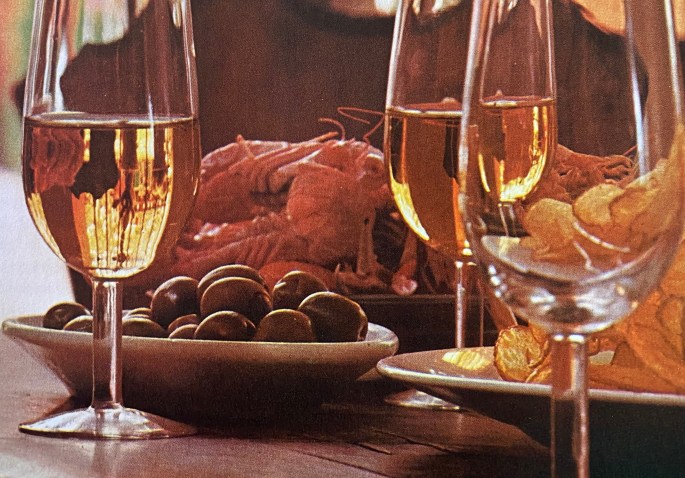
The waiter also brought a half bottle of ice cold Manzanilla and three chilled tulip shaped glasses. As he poured the palest of pale wines Carlos said; ‘I also took the liberty of ordering drink. I hope fino is to your liking?’

‘We both love it’ answered Alex, ‘but I think I’ll get a beer to start with if that’s okay. I’m dying of thirst. Anyone else fancy one?’

Elena and Carlos both shook their heads.

‘A large glass of Victoria for me and bring another half of Manzanilla with an ice bucket’ Alex said to the waiter. Then, as the waiter disappeared back into the melee beyond he continued to Elena and Carlos; ‘Might as well get set up for the evening.’ ‘Not a Malaga drinker Carlos?’ Elena asked.

‘No, I’m ashamed to say. Every year when we were boys in late August we were taken up into the Axarquia mountains near Canillas de Aceituno. Our uncle— our father’s older brother—had a finca and grew prize Moscatel grapes. He sold most of them to Scholtz Hermanos in Malaga but he also made a bit of wine for himself—and raisins too. We got roped in with all the associated chores.  And goodness were they chores, picking the grape and making the wine. I don’t know what was more mind-numbing—de-stemming the grape by hand for pressing or later on snipping the raisins. At any rate, by the end of the month we’d been up there just the smell of the Moscatel, either in liquid or dried form, made me feel so nauseated that till this day I can’t go near the stuff.’

‘It’s funny’ Elena remarked, ‘how townies like us tend to think of winemaking as such a romantic thing to do, especially the harvesting and the treading. Did you tread by foot?’ 

‘Yes. Everybody makes the wine the same way, even now. The de-stemmed berries get chucked into a kind of large outdoor trough. Then the treading is done by the men mostly, wearing flat soled rubber shoes nowadays—esparto back then—a bit like flip-flops. The must flows out of a sluice in the trough and gets collected in buckets and then chucked straight into clean empty casks.  The residual grape mush from the trough then gets pressed in a hand ratcheted basket press. The pressing can take days and our uncle would leave the filled press to weep overnight. All the tears— as the locals referred to the liquid—were then added to the cask. The Moscatel are so rich in sugar that they start fermenting well before the treading. The smell was incredible. Most people love it but I found it sickly. And even worse than the smell, were the wasps— nests of wasps in the vineyards which we always inadvertently disturbed.  And then swarms of the bastards around the treading and the pressing attracted by the sugary moisture. One year poor Miguel was stung in the eye.’

‘Ouch!’ Elena said wincing.

‘Yes, it was appalling. He couldn’t have been more than six and his distress was awful. He had to be held down writhing and screaming while our uncle’s wife pressed a poultice of earth and water onto his eye.’

‘I don’t suppose they had any antihistamines back then?’ asked Alex.

‘No! But it wouldn’t be much different now. The peasants down there are still suspicious of modern medicine. With Miguel, they physically bound him to a chair so that he wouldn’t touch his eye. It took nearly two days before he could see again from that eye and more than a week for the swelling to go down and he had sensitivity in it for the rest of his life. So no Elena—wine making in the Axarquia at least, is a dirty, sweaty and smelly—not to mention hazardous business and not the slightest bit romantic. And that’s why I never go near my native drink. Our once-famous ‘Mountain Sac’ might have been the favourite tipple of Queen Elizabeth I of England and even the magnificent Falstaff but neither of them ever had to make the accursed stuff!’

Alex continued the theme; ‘Did you know it’s probable that vines were first brought to the Axarquia by Phoenician colonists? Perhaps more than 3000 years ago? And certainly the Carthaginians and the Romans practised viticulture in that area.’

‘And what about the Moors?’ asked Elena; ‘I’ve always meant to ask you about that. They didn’t drink did they?’

‘Not officially at least’ answered Alex, ‘but they loved their raisins.’

‘Yes’ Carlos interjected, ‘and supposedly, the Moslem landlords employed primarily Jewish vine keepers.’ 

‘The Jews have always had a knack with wine, going all the way back to First Temple period when they produced most of the fine wines drunk across the ancient Middle East’ continued Alex.

‘And now two of Bordeaux’s five premier cru clarets are made by Jewish growers’ Elena chipped in, showing off her wine knowledge. ‘Not that I’ve ever had the good fortune to taste either of them.’

‘Anyway’ said Alex towards Carlos, ‘talking of things Jewish?’

‘Ah yes!’ Carlos responded to Alex’s change of topic. ‘Things Jewish, and much else besides, and which reminds me, don’t let me forget to give you this before we part tonight’ he said picking up a large heavy looking carrier bag from the empty chair to his right. ‘This is copies of all my notes from the last ten years or so about El Transito, The Sons of Kohath and everything.

My research, my theories‒‒what my sister-in-law Loli calls my Grand Hypothesis.’

The waiter then reappeared with Alex’s beer and the sherry in an ice bucket which after a reconfiguration of the plates of food he was able to deposit on the table. 

‘Perhaps we should eat before all this lovely food spoils and then I’ll tell you a story’ Carlos suggested.

‘Good food and wine followed by a ripping yarn— my idea of the perfect evening.’ Elena said.