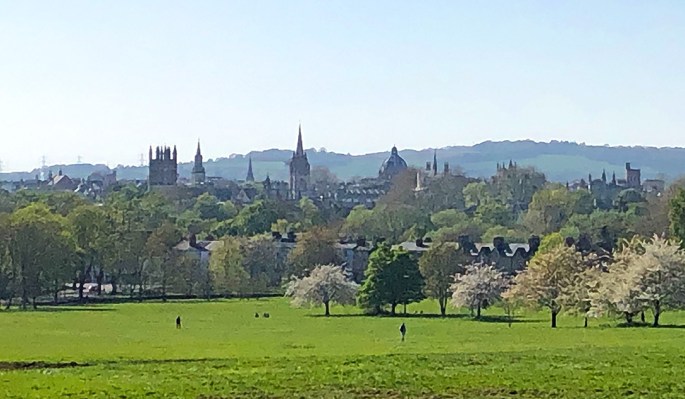
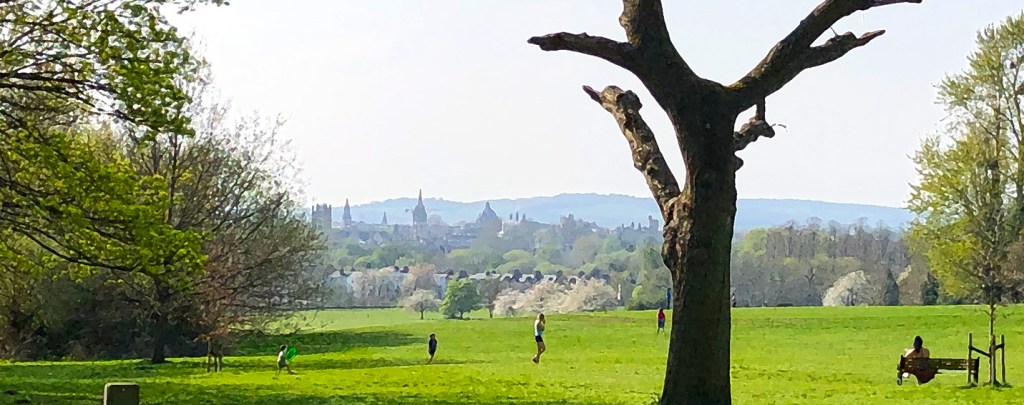
One of the silver linings to our current regime of semi-internment is our daily walk around our local park, and our subsequent reacquaintance with one of world’s genuinely iconic (a much overused and abused term) urban views. Fortunately for us, our local green space is South Park (no relation to its animated Colorado namesake) and the view it offers is over the venerable and elegant city of Oxford and its famous “dreaming spires”*.
*…And that sweet city with her dreaming spires, She needs not June for beauty’s heightening… From the poem Thyrsis, by Mathew Arnold, 1865
From the highest point in the park, just before sunset; the steeply sloping greensward foreground, leading gently yet intently to the gleaming city and shimmering spires and towers of the middle-distance; with the hazy cobalt-tinted Cotswold hills rising in the west; the visual effect has a kind of confidant and – in these anxious times – reassuring drama about it.
It is almost as if, this most famous of university cities, with all its generations of accumulated human wisdom, represents a salutary counterpoint to the current narrative of our apparent ephemeral humanity.
Whether or not these rather flat iPhone generated images can give even the slightest impression of this heartening scene is another matter altogether, but I do hope so.
Since the coronavirus crisis has taken hold, like the editors of The Archers*, I’ve been agonising over whether or not I should keep this a virus-free zone? Then, as often happens to me when planning these pieces, I was distracted / motivated by something unexpected.
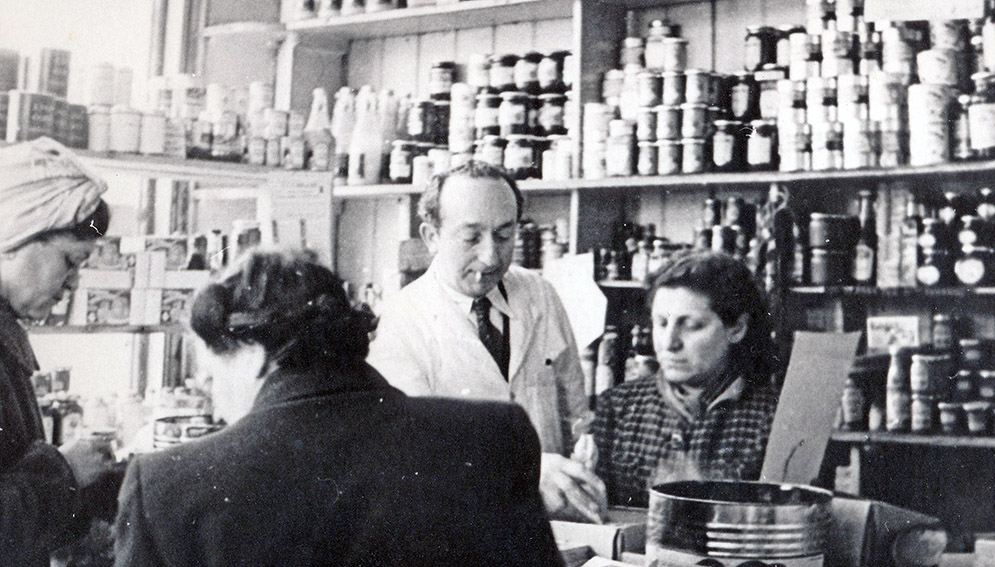
In this case I was mulling over whether to do another art-related post, versus a new recipe, when my attention was caught by a tiny, long-forgotten, ancient photo of my maternal grandparents working in their grocery shop. The photo was on top of a pile of similarly old and decaying pictures I’ve been in the process of digitising for posterity. All the photos are personally fascinating to me in their own different ways as they offer tantalising, often deeply atmospheric glimpses of my family’s history since their arrival on these British shores.
However, the thing which was different, and instantly relevant about this particular, overtly unremarkable image, was its remarkable context. For, what on the surface is simply a scene of ladies shopping at the local grocer’s is actually, ladies shopping at a grocer’s in the Mile End Road of London’s East End in the January of 1941. Anyone reading this with any semblance of knowledge – British or otherwise – will realise that this was at the height of the London Blitz, when thousands of bombs were being dropped on Britain’s capital on a nightly basis.
My maternal grandparents, Harry and Becky Pizan (booba and zaida to me) behind the counter of their grocery shop during January of 1941. My zaida took up smoking at the beginning of the war and gave it up before the end. “Health and safety” meant something altogether different during the war years…
My point is not to minimise the current crisis, or to suggest we carry on “cautiously regardless”, as my grandfather and his customers did during the Blitz (for one thing, then they were being driven together, while today we are being urged physically apart). Rather, I am simply pointing out that many of our parents and grandparents went through far worse and more dangerous times than we are today (over 40,000 British civilians were slaughtered by the “Nazi virus” during the four months of the German raids on Britain’s industrial cities in 1940 and 41).
It’s the very ordinariness of this scene therefore, which makes it so eloquent, and to my contemporary eyes at least, all the more instructive, especially given the moment in history we are living through today. And although, as my grandfather often told me himself, the famous “Blitz Spirit” wasn’t quite all it was cracked up to be, there was sufficient determination, good humour, common sense and sheer guts among the majority of the people to ensure the nation survived the German onslaught relatively unscathed.
It shouldn’t beany different now…………………………..
*For most (but my no means all) of my non-British followers, The Archers is a soap opera, broadcast daily, on BBC Radio 4 continuously since 1951, making it the world’s longest broadcast soap.
Photography has played an ever-growing role in my picture-making since the first day of the second term, of my second year at Saint Martin’s School of Art. It was a bleak winter’s day in 1980 and I remember feeling particularity depressed about the direction – or lack of direction to be precise that my painting was taking. For the past four terms at the school I’d walked a wobbly tightrope between the pressure to emulate my tutors’ abstract expressionism, and my own innate passion for making representational images. The resulting stream of paintings echoed this dichotomy, rarely convincing as abstract or figurative; more often than not, a clumsy, unresolved mishmash of the two forms. If, as occasionally happened, I turned out a pleasing picture, it was always more by luck than by design, with me clueless as to how or why I had achieved this.
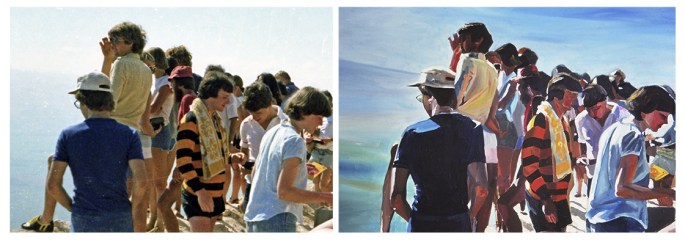
THE COACH PARTY (detail) – 1980 – oil on canvas This was the first painting I made after my talk with David. It was huge (the foreground figures were to-life scale) and liberating in equal measure. I was rarely happier or more stimulated when working on a painting.
Then, on that winter’s day in 1980, while I was pacing back and forth, dreading the coming weeks and months, a new tutor called David Hepher walked into my studio space, and my art career was changed forever. David, unlike all the other tutors at Saint Martin’s was a figurative artist and to this day I have no idea how he came to be teaching there, but for me, his sudden appearance was as timely as that of an Old Testament angel. I distinctly recall his expression as he first set eyes on my paintings – large canvases full of expressively, heavily painted figures of young people hurtling boldly through a romanticised Israeli landscape.
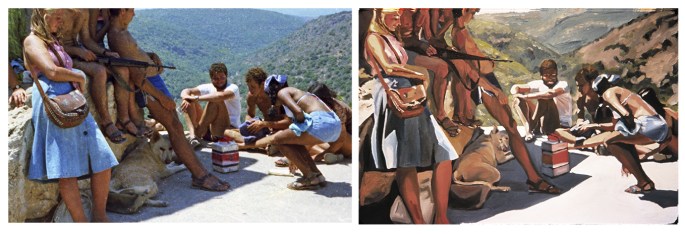
RESTING AT MONTFORT (detail) – 1980 – oil on canvas This was the third painting in what I still think of as my “Hepher Series”, and I was already discovering, as he surely knew I would, that “copying” would provide its own form of interpretation…
A warm quizzical smile came across his face like that of someone unexpectedly bumping into an old friend. Then I remember that he sat down on my rickety paint-spattered moulded plastic chair. During the previous four terms at the school not one tutor had ever smiled this kind of smile when looking at my pictures, let alone sat down in my space. By the end of the ensuing conversation it became apparent that he was almost as relieved to see my work in that school, as I was thankful that he was now teaching there.
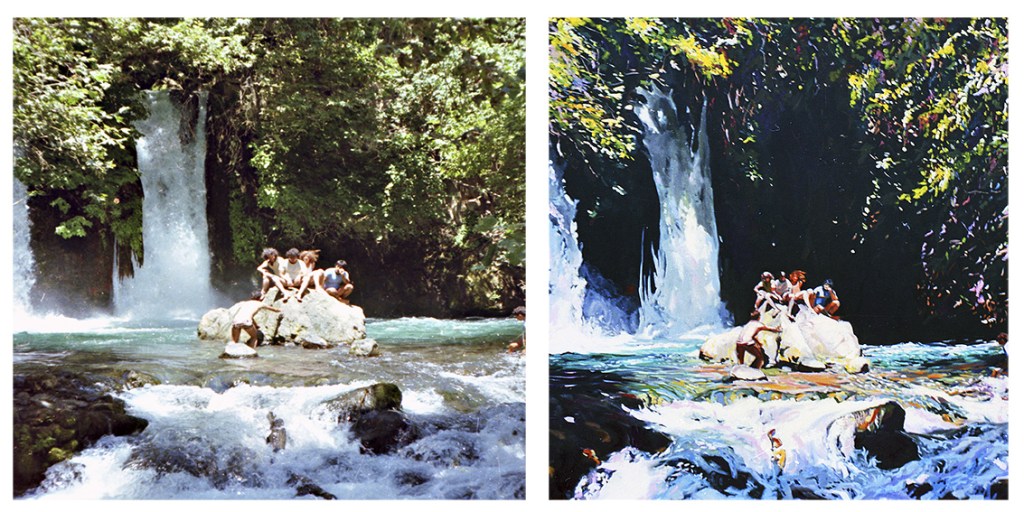
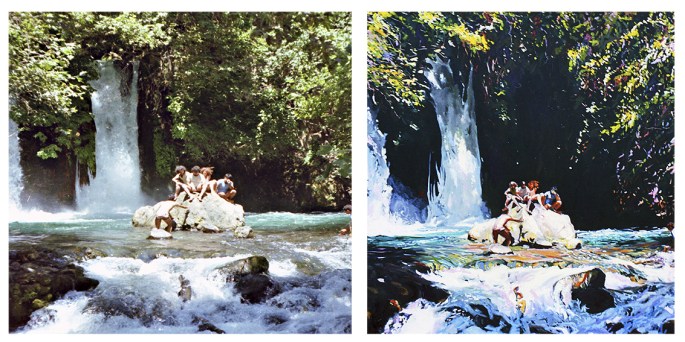
The Banyas Waterfall – 1981 – oil on canvas One of my favourite spots on Earth; the source of the River Jordan, and almost believably, as the Macedonian soldiers believed two centuries before Christ, the birthplace of the god Pan. Notice the way I played with tonality and shadowing to create more drama…
The first thing he asked me was who my favourite artists were, and when I said Vermeer and Hopper he looked curiously at my wild and frenzied pictures. He then reminded me of Vermeer’s reliance on the camera obscura for achieving these perfectly painted captured moments and asked me why I didn’t use my own photos in a similar fashion?
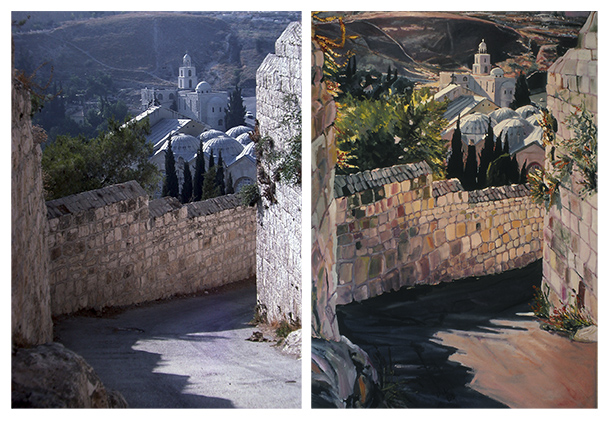
CHURCH OF SAINT MARY MAGDALENE & GARDEN OF GETHSEMANE – 1982 – oil on canvas This painting was commissioned, paid for and then returned back to me as a gift, when my patron’s new girlfriend took against it. It could even yet prove to be the first and only painting I sell twice!
While I’d already been using photographs for the past year or so as a form of rough reference, in the same way I worked from my sketchbook, David convinced me to try something “bolder”, in his words, but hugely controversial; especially within such a temple of conceptualism and abstract expressionism as Saint Martin’s. He suggested that I take my favourite photographs and copy them as faithfully as possible in oils, like huge painted photographic enlargements. He felt certain that in this way I would find the inner artistic peace I was craving.
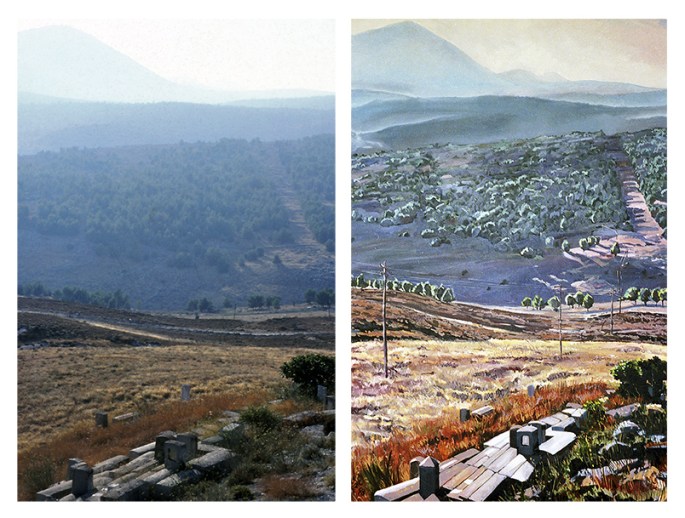
MOUNT MERON FROM SEFAD – 1983 – oil on canvas In a similar way to the Casino painting below, I seem to have slightly shifted the angle of the tombstones, and altered the line of telegraph poles – I’m guessing to increase the sensation of being drawn down into the valley, before being swept up again toward the distant mountain.
And cutting a long story short, David’s empathetic advice proved successful, even though the pictures I went on to produce with this new method ensured that I would prove even more of a problematic enigma for most of his colleagues. Presented here are several of the large canvases I painted as a direct result of David’s tutelage. Some them have appeared on this site before, but never side-by-side with the “offending” snaps!
THE OLD BRITISH CASINO – HAIFA – 1985 – oil on canvas In some ways this is the most faithful photographic copy I made in the entire series of pictures (the removed fisherman notwithstanding), yet the subtle shift in angle and perspective is stark – and effective – I think?
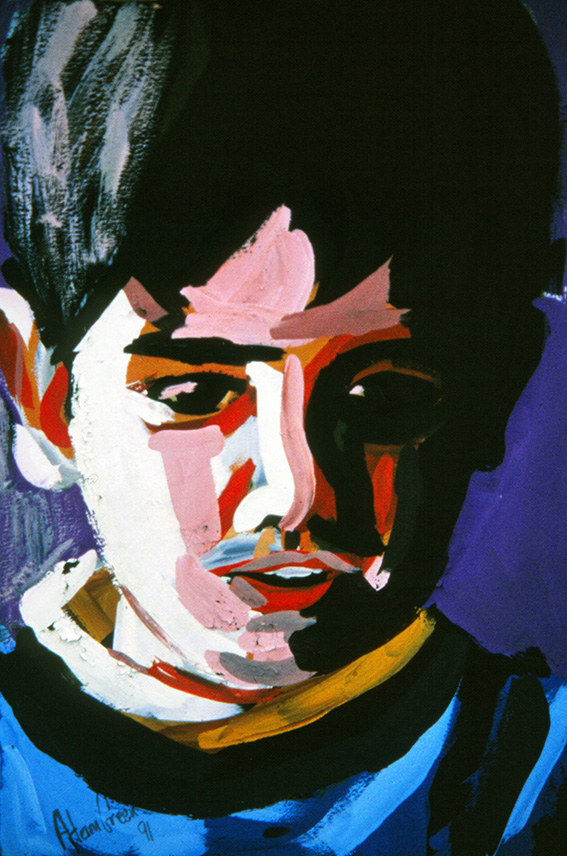
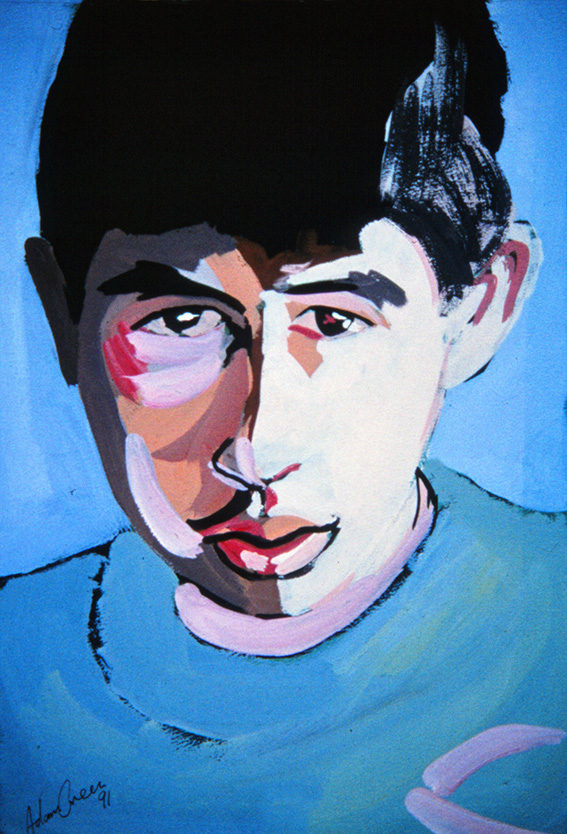
Regular readers of these posts will be aware of how prominently our 1991 trip to Chile has featured, and of its main purpose; for Dido to study the role of folk dance as a therapeutic tool to support social integration and participation for children with learning problems. Thus far however, I’ve only ever touched upon that key element of the trip, focusing more on our impressions as first-time travellers to an incredible country (and-then reborn democracy).
While it would be lying to say that whenever I hear a mention of Chile, my instant mental vision is not of mind-blowing epic scenery, it is also true, that this is always quickly followed by a starkly contrasting melancholy caused by memories of the faces shown here.
The plain truth is, and one of the main reasons I’ve avoided the subject as far as possible, despite the fact this happened nearly 30 years ago, there are issues of confidentiality which severely compromise my scope for description.
Suffice to say here, that with the cache of her Winston Churchill Travelling Fellowship behind her, Dido was able to convince the relevant government authorities in Santiago to grant us access to a group of nine children (all boys in this case) with whom she could work. Nothing however could have prepared us for the circumstances in which the work would take place, for instead of a regular school, or, as we had naively expected, a special needs school, we found ourselves that first morning being driven through the security gates of a home for young male offenders – a borstal.
More shocking still, was that none of the nine boys – all of whom had either been orphaned or abandoned as babies and who all suffered from various forms of mental and/or physical disability – were themselves offenders or delinquents of any sort. Their only crime was to be born into a Chilean society, then-ill-equipped to properly care for them. Hopefully, during the years since, as Chile has developed into a more stable (the current, popular ructions notwithstanding) and socially sophisticated democracy, children born into similar circumstances enjoy a less bleak prospect.
Nevertheless, from the start of the week we spent with them, we were struck by most of the boy’s cheerfulness and sense of optimism, and their enthusiasm and excitement for Dido’s program of dance-based therapy. Despite some shyness and reluctance from a couple of the lads to begin with, by the end of the week all nine boys had become thoroughly engaged and were already showing significant progress with regards to their levels of creative social engagement.
The idea had been for one or two carers and/or teachers working in the home to at least observe, and hopefully participate in the activities, and thereby learn to continue the therapy once we had left. Sadly though, despite their repeated assurances to the contrary, neither the government department who facilitated the project, nor anyone employed at the home showed the slightest curiosity or interest in what Dido was doing until the very last day, by which time, it was too late.
Thus, we left the boys for the last time with as much frustration as satisfaction, and saddened in the realisation that this week had probably been the highlight of their young lives rather than merely the beginning of a brighter future.
Following our return to England, and during the months which followed Dido often wrote to her Chilean contacts in an attempt to secure some kind of followup to her work – at least for the nine boys. Unfortunately, all her appeals went unanswered. The painting here was meant as both an expression of our frustration and also intended to insure that at least we would never forget those nine remarkable young individuals.
THE NINE SAINTS OF SANTIAGO – oil on canvas – 1992 – 100 x 78″ (254 x 198 cm)
This is arguably the most monumental of all my large paintings, and it is certainly the most deeply felt. The “missing” ninth lad, who suffered from schizophrenia, did not want to be sketched and is represented by the padlock in the centre of the painting. The padlock is obviously a metaphor for him and much more besides. The blues and lilacs represent the uniform they all wore.
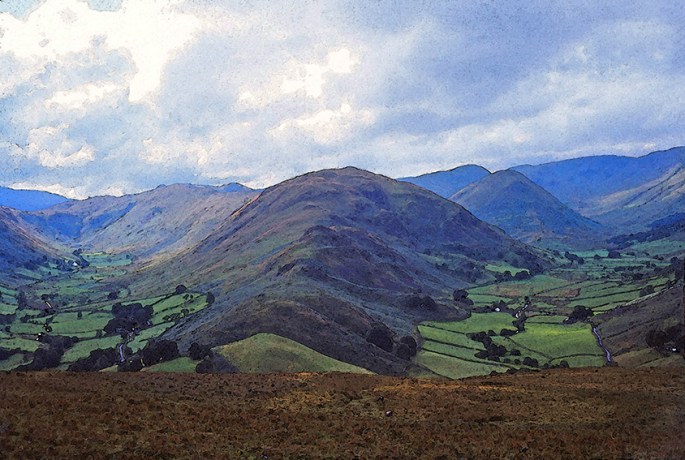
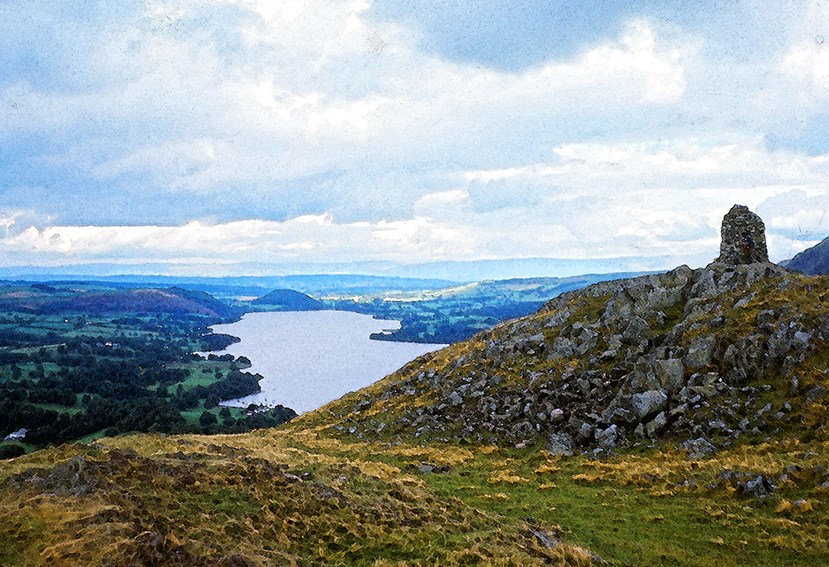
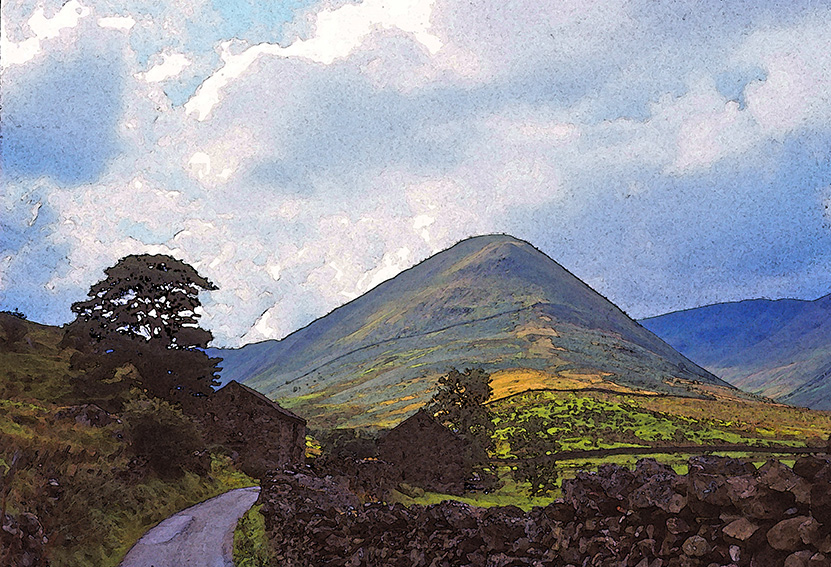
The scenery of the English Lake District isn’t the most spectacular in the world, it isn’t even the most spectacular in Great Britain, yet for many, it remains uniquely, intensely beautiful.
North Ullswater from the Martindale peak
I was reminded of this a few weeks ago, when trawling through hundreds of old slides for scanning, I rediscovered a series of images dating back to a trip I made with my family, in 1973.
A road north of Ullswater with Helvellyn in distance
As I described in an earlier post, we were based on the shore of Lake Ullswater, and spent all of the days trekking in the surrounding fells.
Fell near Sandwick
The pictures here provide me with a vivid reminder of how and why the gorgeous lake-land scenery sparked a life-long yearning in my heart.
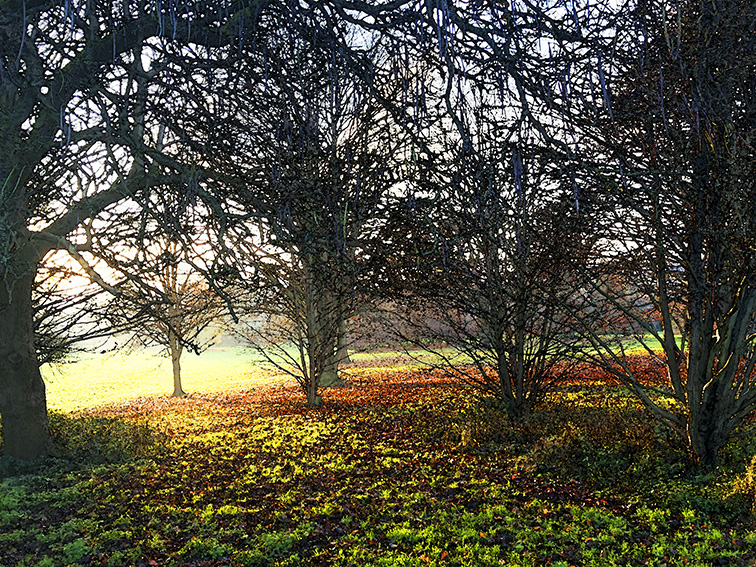
At the risk of breaking my rule of keeping this blog strictly apolitical, I feel the need to point out that these images date from December 10th – just two days before the recent UK general election.
It isn’t giving much away (especially to those who know me), to state that the weeks and days leading up to the election were among the most nerve-wracking and traumatic I have experienced in my life. Conversely, the moment the exit poll was announced, was one of such joyous and euphoric relief as I can recall.
Yet, at the time of the walk in my local Oxford park when I encountered these sublime scenes, I was so convinced by the narrowing of the opinion polls and the broadcast media mood-music that the election result would mean us having to pack up and leave England for good, it was as if the fates of nature were tormenting me with what I would be losing.
Looking at them now however, the images seem to offer the hope of new dawn for this remarkable little country that once again feels like my green and still pleasant home.
As seasonal happenstance would have it, while thinking of a subject for this post I came upon slides of two Hanukkah-related pictures I made many years ago in my mid-teens. My original intention had been to create an epic account of the Hannukah story in the form of a heavily illustrated book-cum-comic, however, I soon found the task to be overwhelming and abandoned it after just a few weeks.
The unfinished project coincided with my growing interest in biblical and ancient history and this had a strong influence on the way I considered the story of the Maccabees and their war of liberation against the forces of the Seleucid Empire. This meant that I was passionate about executing not only an accurate visual portrayal of the Hebrews, their Macedonian foes, and the Judean backdrop, but also an historically objective account of the story itself.
This is my take on the gruesome climax of the highly apocryphal story of Hannah and her Seven Sons. Within the Hannukah context, the episode is set before the Maccabee Revolt, and presented as one of its precursors. There are several versions of the story, and in this one I went for a touch of historicity by having Antiochus IV (Epiphanes) use crucifixion and impaling – a favoured Macedonian method of execution – to kill the seven sons for their’s and their mother’s refusal to submit to the will of the king by transgressing their religion. The scene is set in the western Jerusalem foothills and intentionally contextualises a later, far more famous such execution of another Jew at the hands of a later occupying power…
As a little Jewish boy I had received the traditional, pious version of the story based on the first and second books of Maccabees, in which Judah Maccabee and his family are presented as flawless heroes, struggling against an evil foreign enemy and even wickeder “Hellenised” Jewish collaborators. Until I was about twelve, the Hasmoneans (Maccabees) were totally good and all those who opposed them, totally bad.
This more stylised image was intended as the cover plate. It’s a depiction of Judah Maccabee in the full armour of a Macedonian hoplite (heavy infantryman). Originally, Judah and his fellow fighters would have been lightly armed guerrillas, but with each victory, would have acquired both battle experience and the armour and weaponry from those they defeated. It’s unlikely however that the Hebrew forces ever fought in classic Macedonian phalanx formation, hence the shortened sarissa (pike-spear) for close-order combat.
But as I grew older, and read more deeply into the history of the period I came to understand that the truth was – as it usually is in these sort of encounters – far more nuanced, and that if I’d been around at the time I might very well have seen the Hellenised Jews as enlightened and civilised, and the Maccabees as reactionary, intolerant and often cruel. Evidence for this probability lies in the fact that once the Maccabees were victorious and came to power, they too surrendered to many of the intellectual temptations of Greek culture and thought. Moreover, once the Hasmonean’s established their royal dynasty, the more powerful they became, the more they emulated their Seleucid and Ptolemaic imperial neighbours, including the hiring of large Greco-Macedonian mercenary armies – the very troops they had once fought against – to protect and expand their kingdom.
Thus, what I planned to do was to offer the first objective version of the epic struggle, which neither glossed over some the undoubted barbarities of the Macedonian occupiers, nor the fanatical fundamentalism of the Maccabee resistance fighters – and crucially, all wearing the correct gear, and inhabiting the genuine landscape. Looking at the two plates presented here, if I had completed the project, I might have created an early form of graphic novel. On the other hand, perhaps, my teen-self wasn’t yet ready to reveal myself as the “de-constructor” of a cherished myth and so risk the ire of many of my more traditional fellow Jews, something I did eventually manage to do thirty years later with my history of King Saul…
There’s nothing remarkable about spotting famous people in Hampstead and its environs; especially people famous in the performing arts, for whom it’s something of an English Beverly Hills. At one time or another, NW3 has been home for everyone from the Pythons and Peter Cook to Daniel Craig and Ridley Scott, and hundreds more. So, the fact I’ve had an unplanned beer with Robert Plant, and almost had my head removed from its shoulders (accidentally I hasten to add) by Ricky Gervais (whilst performing some kind of Capoeira-cum-Taekwondo / jogging exercise in the street) is hardly surprising.
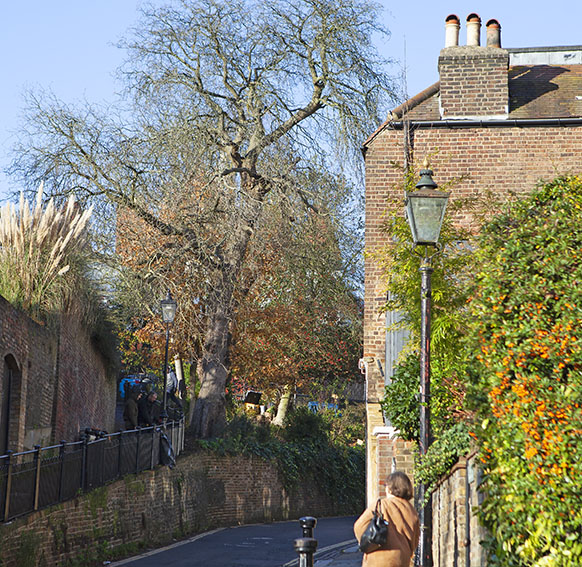
The walk up Holly Hill…
In fact, it’s no exaggeration to state that I spot at least one notable each and every time I take a stroll down the High Street. However, in all these years of involuntary celebrity spotting there’s one such incident that stands out for the way it highlights both Karinthy’s hypothesis of six degrees of separation (more properly just two in this case) and perhaps also a classic “Jungian” synchronism…
Approaching the pub in Holly Mount…
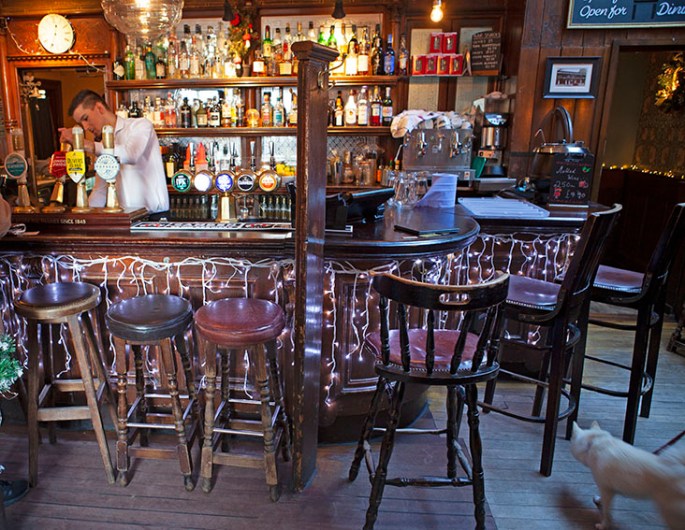
The Holly Bush was and is Hampstead’s quaintest and most picturesque public house. Originally part of the home of the great portrait artist George Romney, it retains an 18th century charm and warmth irresistible to lovers of traditional English watering holes. And being just such a fan, I would often go there during my lunch-time break from my work in a nearby picture framery.
So it happened on one such occasion, when sat in the main saloon, I looked up from my newspaper and spotted a familiar face propping up the corner of the bar, who I instantly recognised as the actor Michael Williams. Although I knew him from his TV roles, he was more famous to me as being the husband of Judi Dench, already established as one of the greatest stage actresses of hers, or anybody else’s generation. Funnily enough, it wasn’t so much Michael Williams who caught my attention as it was his drinking partner – a gentleman in late middle-age with a strikingly luxuriant mop of silver hair.
The corner of the bar where Michael Williams and Leonard Nicholson used to drink…
Over the following weeks, during subsequent lunch-time visits to the pub, I was greeted by this same scene on a regular basis – Michael Williams, and the silver-haired gentleman, always at their allotted places, at the corner of the bar. All of which would have remained nothing more than several in a long list of similar such celebrity sightings during my time in Hampstead.
However, the following year I met my future-wife, Dido Nicholson, whose mother and younger sister it turned out had been at school, with none other than Judi Dench. The fact that Dido’s aunt remains close friends with Dame Judi to this very day is merely interesting of itself, but what is far more intriguing, was the fact that Michael William’s silver-haired drinking partner turned out to be none other than Dido’s paternal uncle John Leonard Nicholson (a noted professor of statistics who had worked for several British government administrations in the 60’s).
The front of the building on Holly Hill with the blue plaque indicating this was once the home of the great portraitist George Romney.
In other words, about a year before I met Dido or knew anything about her, I had regularly shared a pub bar with both her uncle, and her aunt’s best friend’s husband. And perhaps even more remarkably, Leonard’s friendship with Michael Williams, and Dido’s aunt’s friendship with Judi Dench were totally unrelated to each other – the former having met socially in Hampstead, while the latter met at school as explained above.
Despite this apparent synchronicity I remain separated from Dame Judi by those aforementioned two degrees, as I have yet to meet her in person…
About this time, two years ago I wrote a post related to the Jewish New Year (Rosh Hashana) and the Day of Atonement (Yom Kippur) from my perspective as an amateur biblical historian, and illustrated with dramatic images of the Negev Desert.
Spring, in London’s glorious Regent’s Park, bedecked with prunus blossom and daffodils (gouache on paper)
As made plain in that post, my interest in the origins of those and other Jewish / Hebrew / Israelite festivals is now purely of an academic nature – in the literal sense of the word. And in truth, I think it always has been, going all the way back to when, as a little boy, I sat and stood, dutifully at the side of my righteous Zaida (grandfather), in shul (synagogue) for hour-upon-hour in a state of abject boredom.
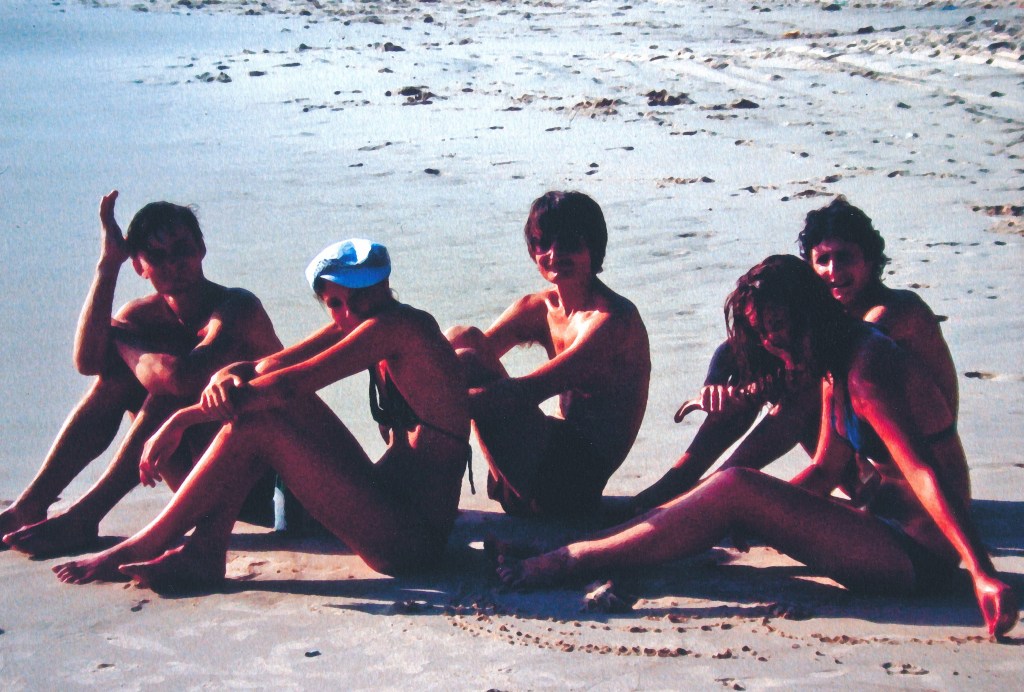
Summer was often a sandy beach in Israel – here with me and four friends at Ashkelon in 1981 (oil on canvas)
As I expressed in the introduction to my book on King Saul, I only survived the tedium by reading my Zaida’s Tanakh (Jewish Bible), which he permitted me to do rather than pray, as a kind of compromise, in the vain hope that I might one day see the light. Although, from a precocious age, I generally skipped through the supernatural stuff and miracles, which I always found unconvincing, I was excited by the narrative and the stories. By the time I was in my very early teens I became fascinated with the two books of Samuel in particular, sensing in them the grains of a history for the birth of the first nation of Israel.
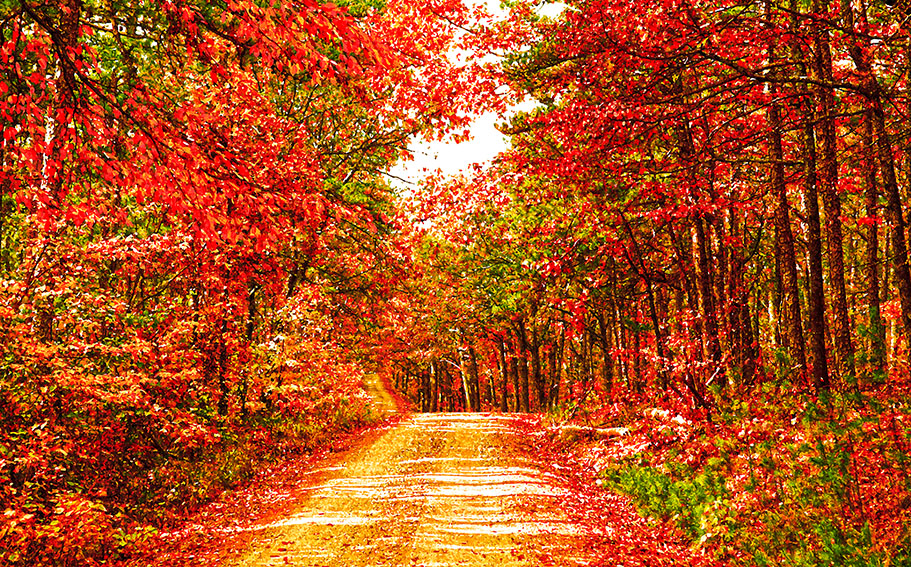
Autumn (or in this context, more properly Fall) in North America, is a sight beyond compare – as here, in the Ouachita Forrest in Arkansas (enhanced photo)
My own writings on King Saul, and my novel about the Ark of the Covenant are my ultimate expressions of that continuing fascination and interest. So, in a way, I suppose I am indebted to those countless hours in synagogue and my forced intimacy with my Zaida’s Tanakh.
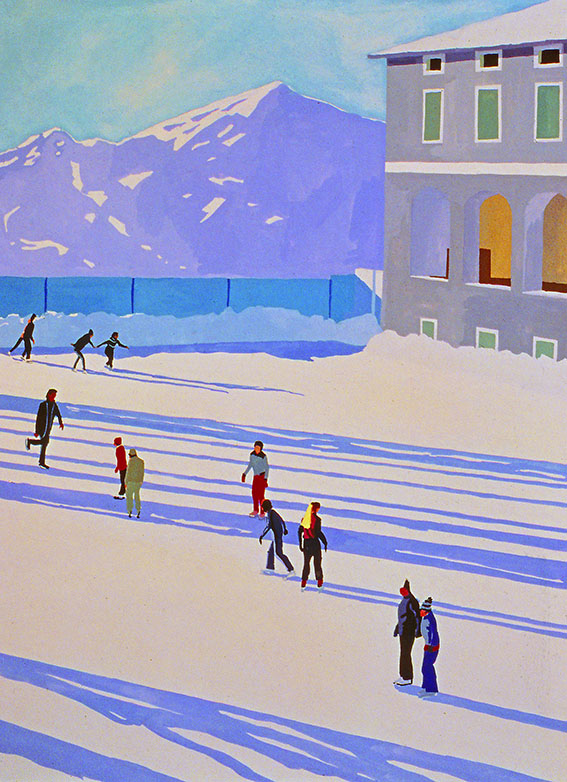
Winter was for many years a ski resort, most often in Italy, like here in the Apennines at Bormio (gouache on paper)
Despite my own acquired indifference to the many annual festivals of my people, I do sometimes miss the sense of the seasons they used to evoke. Pesach (Passover) for instance was always the herald of Spring, while Rosh Hashana, Yom Kippur and the close-ensuing Succot (Tabernacles) resonated with the feeling of Autumn and the approaching dark days of winter. This somewhat rambling post is thus intended as a seasonally inspired salutation to all my readers and followers, whatever your beliefs or none…
Falling in love with a once-loathed painting – of my first love
I first fell in love about the time I turned twenty. The relationship was as torrid, as it was brief and was doomed from the start due to irreconcilable logistics – among other things. I was a near-penniless artist, starting out on my career in London, and she was farmer’s daughter from a village near Cremona in northern Italy.
We’d met in London where she was au-pairing, and enjoyed several weeks of passion and fun. She barely spoke a word of English, and my Italian was all-but non-existent, but verbal communication was never an issue, for the simple reason, we didn’t spend much time attempting to talk. Rather, it was the very cliche of the shared language of love and a fizzing chemical attraction.
A short while after her return home I broke off from a skiing holiday in the Italian Alps to visit her , and despite having a wonderful time, I left her knowing that there was little chance of the relationship continuing.
Until recently, I had always regarded a set of pencil portraits, and some romantic gouaches of her by Lake Garda, as my most pleasant mementos of that brief encounter. But then, a few months ago, trawling through slides of some forgotten oil paintings from that period, I discovered a life portrait in oils I had done of her back in London.
At the time, I had dismissed it as clunky and awkward, and I put its “failure” down to me being too stimulated and emotionally agitated by the sitter, and I loathed it so much, I painted over it within days. However, seeing it again, for the first time in 28 years, I found that I actually quite like it, and that in an albeit quirky way (perhaps slightly derivative of Mark Gertler?), it captures something of the tenderness and fascination I had for the sitter. Although I hadn’t realised it at the time, the portrait was as pure an expression of my love as I could have hoped for…





















 ARKS, ADAM AND AXARQUIA