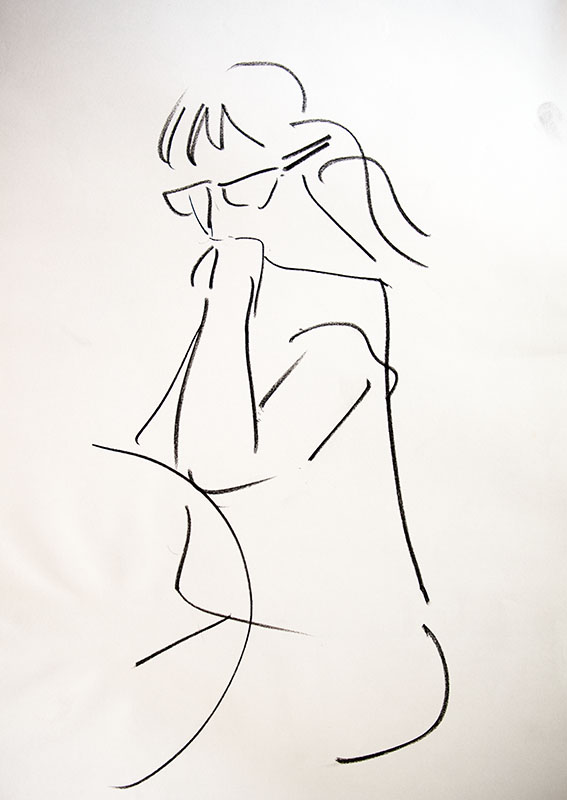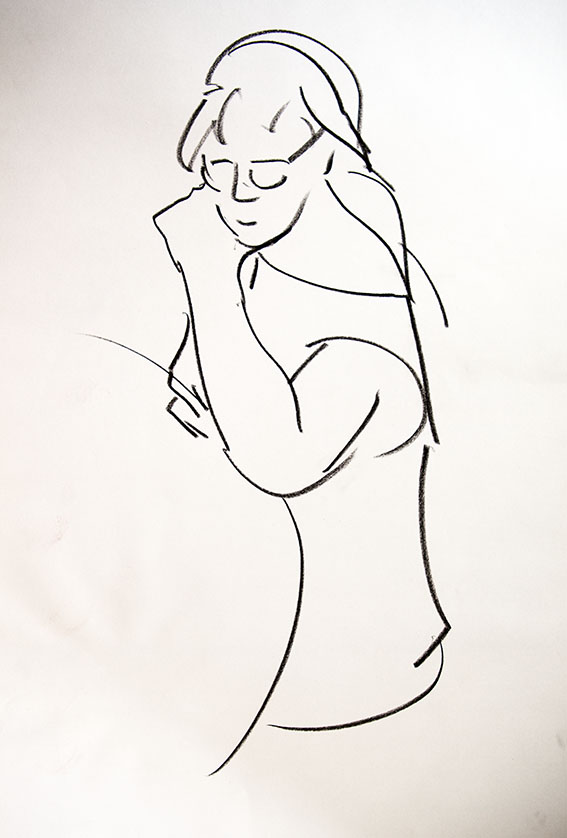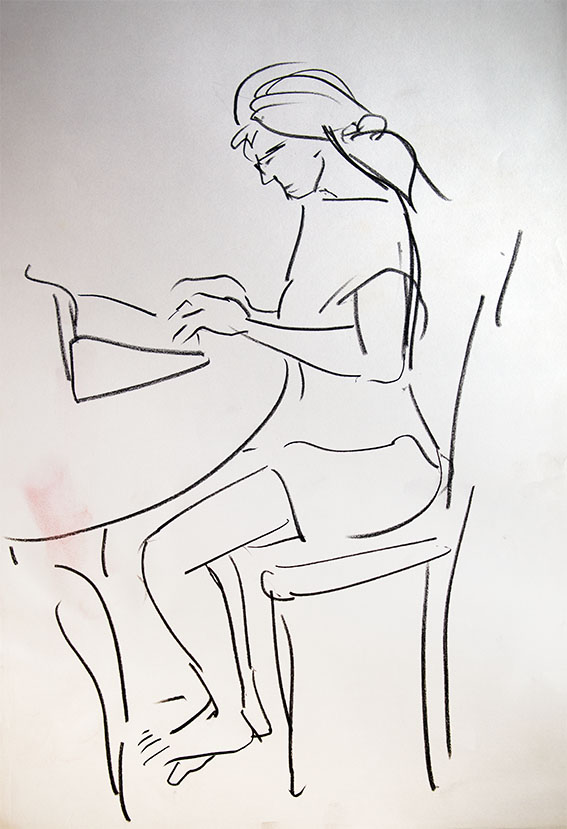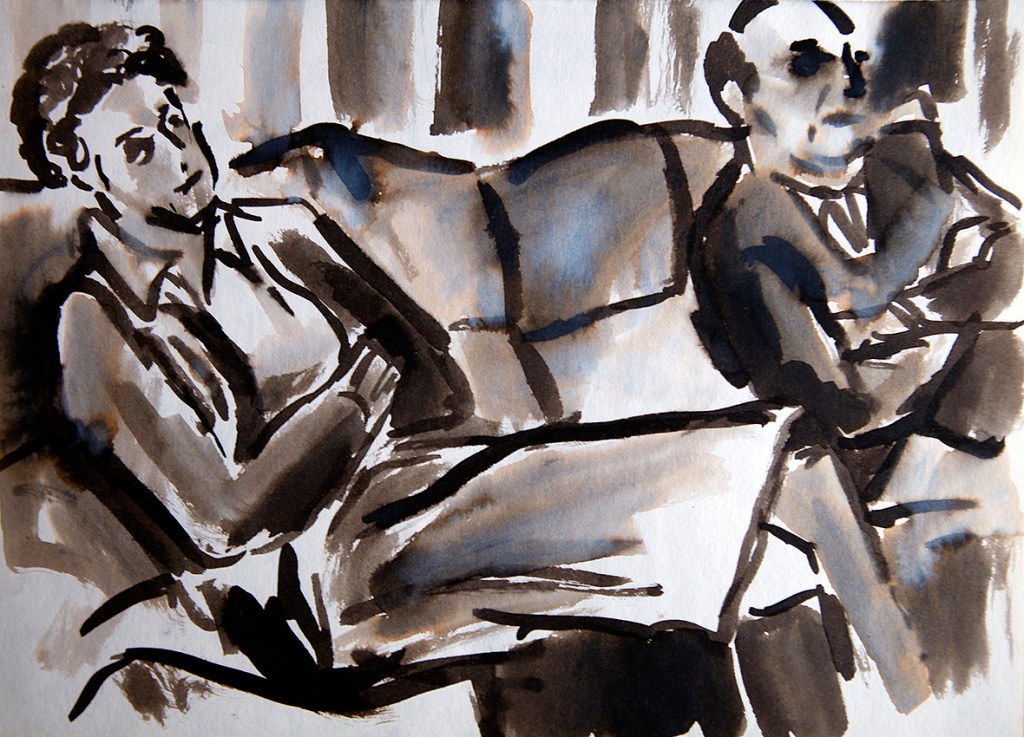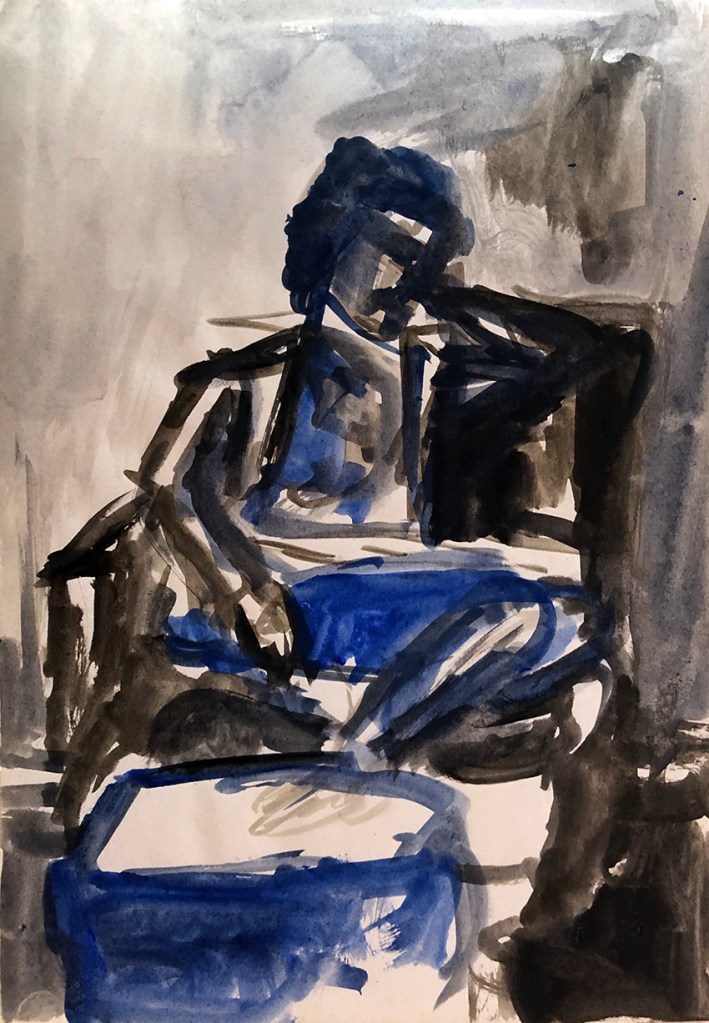
Yet more house tidying, yet more exciting discoveries of my ancient artwork. This time, of long-lost simple line figure studies, of my then-young wife Dido and of her friend and former ballet colleague, Frin.
Both, were natural and highly sketchable models as the images here attest, plus, I seem to have been in unusually relaxed with the old charcoal stick and conte crayon. My muses’ unaffected air and my good drawing form was a happy combination which I now look back upon, some 30 years later, with a deal of pride and not a little amazement.
Sadly, modernism and later, abstract expressionism (admittedly with a few glorious exceptions – from Modigliani to Rothko), inadvertently gave free license for non-drawers to thrive, resulting in the often talentless gimmickry that infests so much of today’s “art world”.
Ho hum…
Fortunately, my utter disillusionment expressed above, came after I had time to make my own joyous-if-modest contribution to the corpus of half-decent picture-making, as these humble sketches bear evidence…
…and more unrequited love in the eternal city and beyond…
As I’ve mentioned before on these pages, the main reason I gave up the prospect of an academic career was because I was a lazy student and had a precocious talent for drawing and painting. In other words, I took the easy, relatively effortless option. However, if one person, other than yours truly was also highly influential in pushing me towards a career in art, it was my art teacher at Carmel College, Hermann Langmuir *.
Hermann (as we were bidden to call him) was a tall, bearded, charismatic Dutchman, whose knowledge of art and art history was only matched by his infectious enthusiasm for his subject. From the moment he joined the teaching staff, the Carmel art room metamorphosed from a gloomy, educational backwater, into the most happening and vibrant teaching space on the campus. This, combined with my loathing of formal classroom study and the fact I became one of his two star pupils (a huge nod to Jeremy Gerlis – a gifted draftsman and now FRSA), ensured that I would give up the chance of an Oxbridge future (virtually guaranteed to top Carmel academic performers back then) for the presumed bright lights and glamour of a London art college.
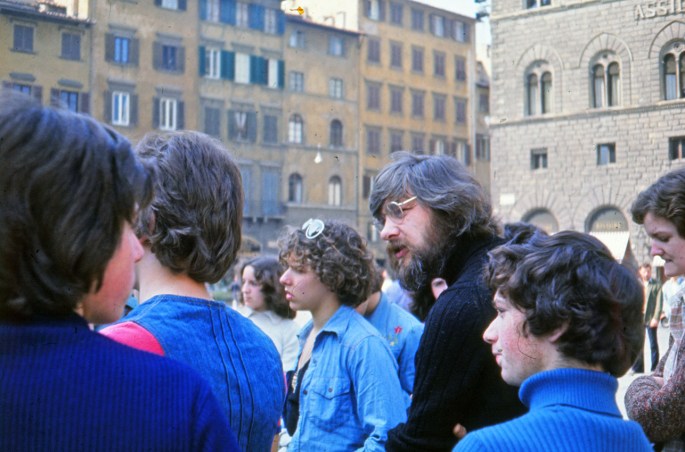
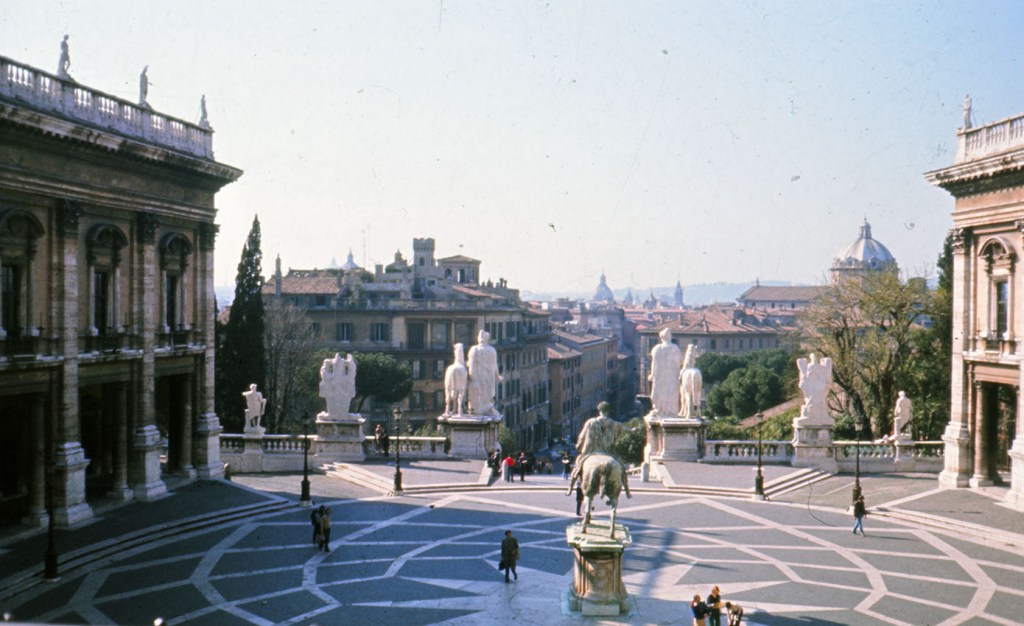
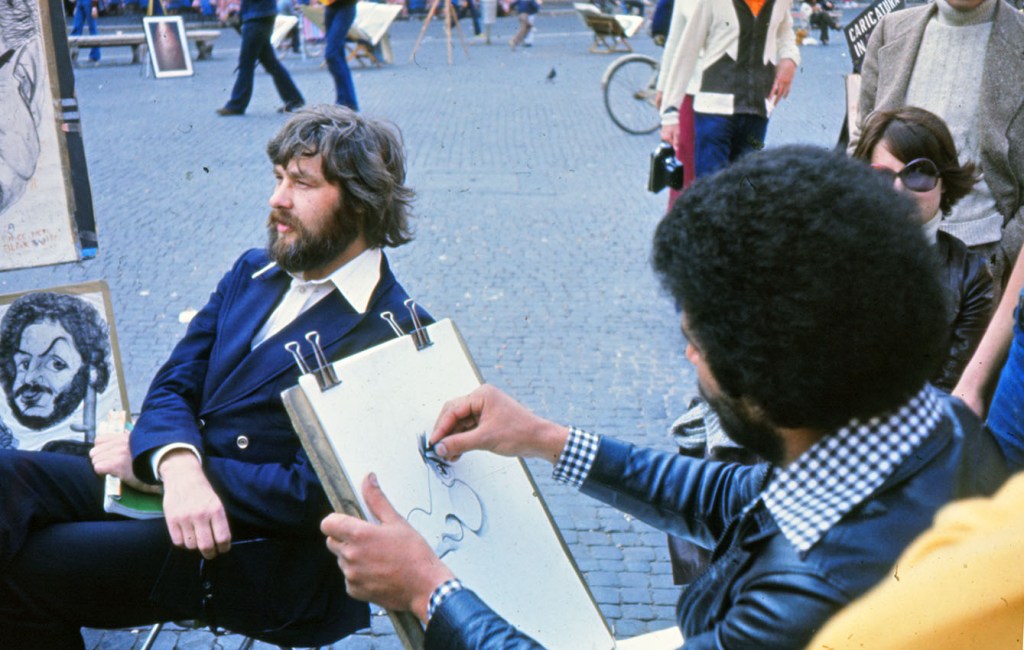
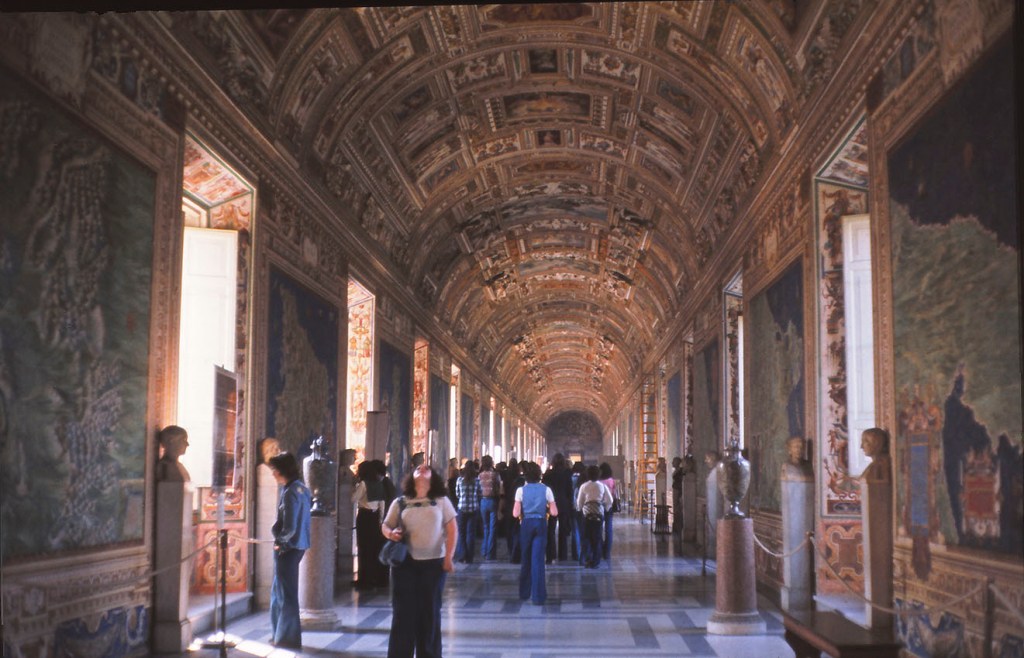
How all that turned out is well covered in previous posts, but what I have overlooked until now, was a trip Hermann organised for all his pupils, in the March of 1976, to Rome, Florence, Siena and Pisa. The following – un-treated – ancient photos (all taken on my old Canonet 28 Automatic), tell some of the story of that magical and hugely formative experience.
* If anyone reading this post has any knowledge of the whereabouts of Hermann these days, assuming he is still with us (I guess he would be well into his eighties by now), I would be keen to catch up with him. I should point out here, that if not for Hermann’s pleading with the headmaster, Rabbi Jeremy Rosen, I would not have been on the trip. I had entered Carmel in 1971, with my estranged father paying the considerable fees. However, when he fled to America in 1973 during the oil crisis and the subsequent crash of his advertising business, the school, very kindly allowed me to stay on at half-fees. As generous as this was, with my mother working as a poorly paid secretary, it still entailed my maternal grandparents using up much of their life-savings to keep me at the school. Thus, when the Italy trip was announced, my family had no cash spare to pay for it, and hence Hermann’s interceding with Rabbi Rosen on my behalf. Once again, the school came up trumps, and completely covered the costs of my travel and half-board accomodation, leaving me with only my lunches and daily refreshments to pay for. For this purpose, my very hard-up mum gave me the grand sum of £25 spending money, which I somehow managed to make last the entire ten-day trip, by restricting myself to slabs of margarita pizza, purchased from “hole in the wall” vendors. In any event, I never once felt deprived, and had one of the adventures of a lifetime. Thank you Hermann, wherever you are…
Milan Railway Station – Designed by Ulisse Stacchini in 1931: We flew to Milan(I suppose it was cheaper than flying direct to Rome?), and then got the train to Rome. I for one was pleased, as, much to Hermann’s horror, I was in awe of the station’s “fascist architecture”…
The oddly named Vatican “Square”, from the top of Saint Peter’s: One of several times I was fortunate to see a wonder of the world with virtually no crowds to mar the experience…
The rear view of the famous equestrian statue of emperor Marcus Aurelius – Piazza del Campidoglio: Again, despite the marvelous early Spring weather, almost no people…
Tritone Fountain – Bernini: Our very modest pensione was close to the red-light district of Rome, but also very near this fabulously and typically over-the-top masterpiece. Many a pizza slab was consumed at its feet – or should I say, its fish (yes, I know they’re idealised dolphins, but…)…
Jael on the Palatine: Jael was one of the few girls at Carmel in those days, and although I doubt she was aware, I was in love with her. She was Italian, from Fiesoli, above Florence, and the daughter of one of Italy’s foremost post-war domestic electrical manufacturers. We all visited her home on the Florence leg of the trip. It was a medieval castle, jam-packed with yet more wonderful works of art. I believe she is now a successful fine artist based in Germany …
Hermann being sketched: I think this was in Florence. Hermann had been one of the many foreign student volunteers to help in the cleanup of Florence following the disastrous 1966 flood. I used much of what he told me about his work in and around the Uffizi to inform an early chapter in my novel ARK…
The Uffizi Gallery: As was normal for me in such places, a few of the Michelangelo sculptures notwithstanding, I was far more impressed with the gallery itself than much of the art it held. Can’t complain about this particular crowd, as it was my school group…
Florence from Giotto’s Campanile, (the cathedral bell tower), with Brunelleschi’s magnificent dome in the foreground: Florence was the star of the trip for me. Not so much the art (which was stupendous), but the city itself. I’ve been back many times since, but it never felt quite as perfect as in that March of 1976 …
Sarah, in the Boboli Gardens: I was in love with Sarah, and like Jael, she too had not the faintest idea. I was still a month away from my 16th birthday, and could barely make eye contact with a pretty girl, let alone declare my affections. Nevertheless, those ten days, in the warm Italian March sunshine, remain a mostly joyous memory. And after all, unrequited love is often a powerful muse of sorts.
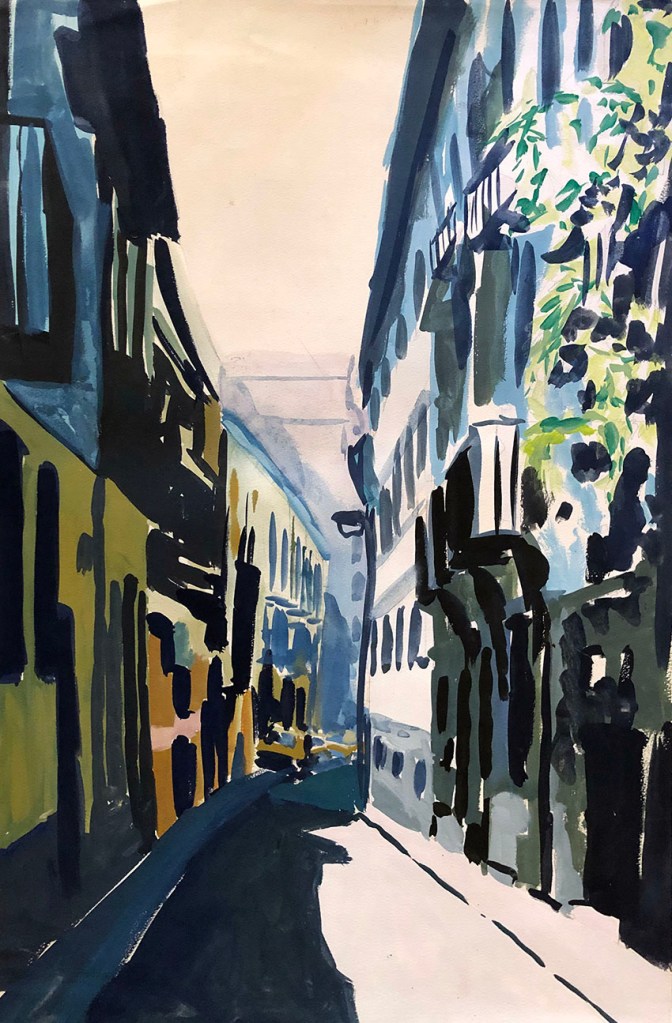
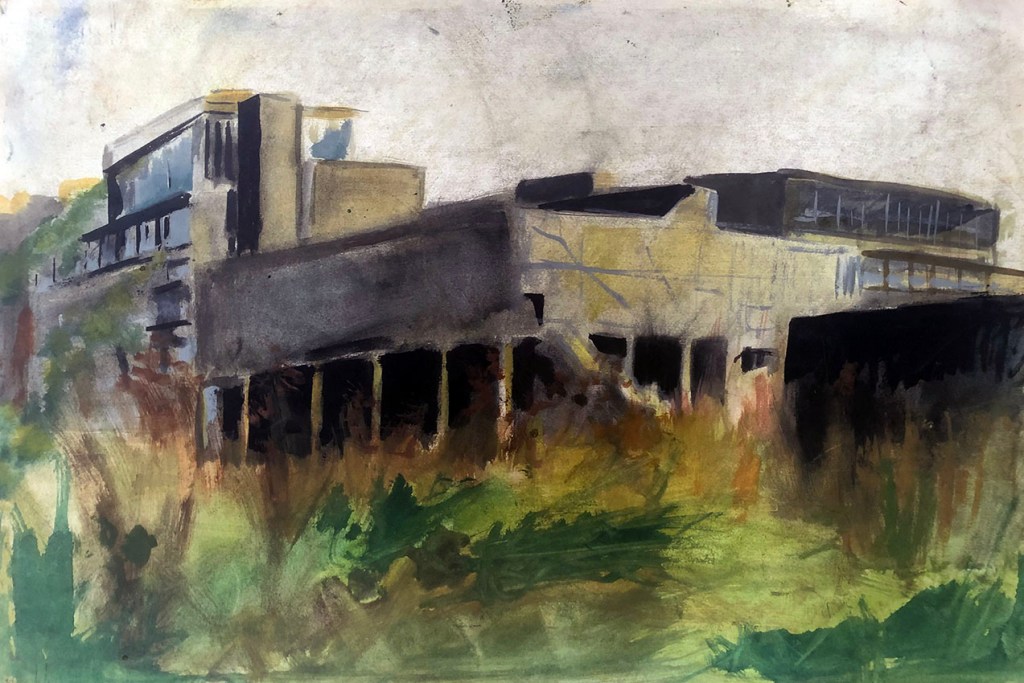
MY JOURNEY FROM HARROW SCHOOL OF ART TO ST. MARTINS IN GOUACHE
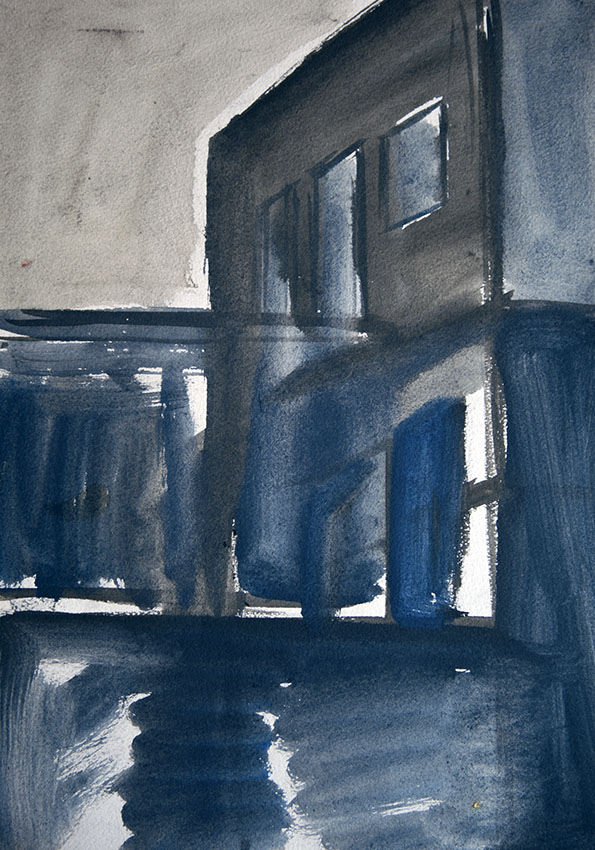
I’m not sure what the art education system is these days as I have totally lost touch (and interest) with the British art world and all its academies, institutions and philosophies. However, in my time, after leaving high-school for art college, one did a one or two-year foundation course, and then typically went on to do a BA.
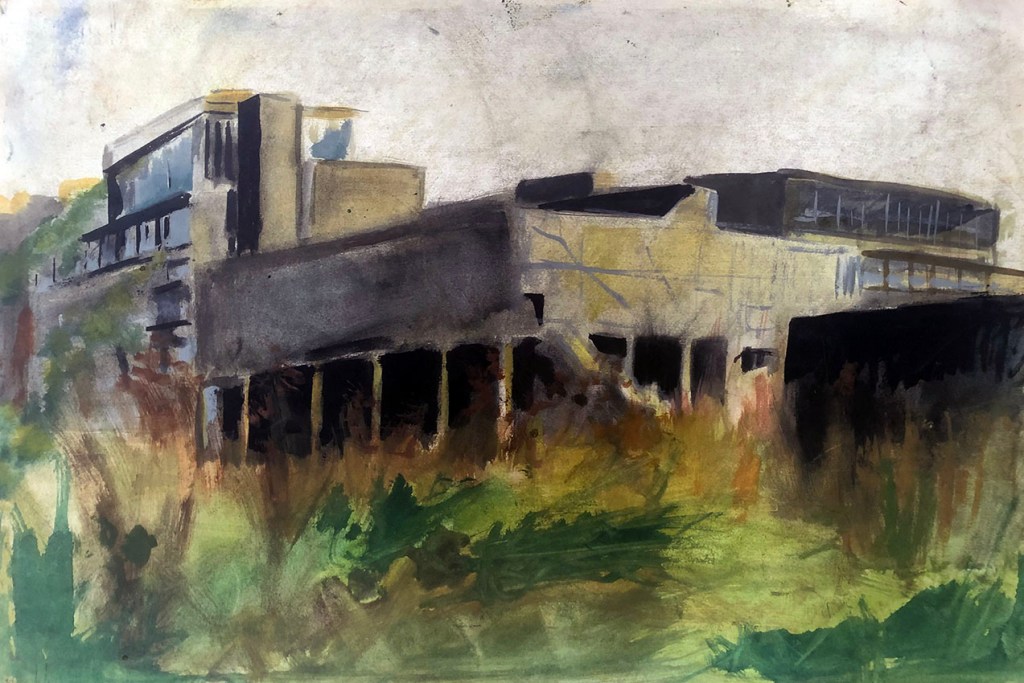
Northwick Park Hospital (Harrow) – gouache on paper – 1976
My era at art school ran from 1976 – 1981 and was something of a grand experiment, as it more-or-less coincided with the formalisation of art as an “academic” subject. Whether or not there was any merit in this move is still debated today, but from my own experience, and that of many of my art school acquaintances, the BA’s we left school with were utterly useless for furthering our careers as artists (or anything else). Ultimately, our degrees were little more than educational bling.
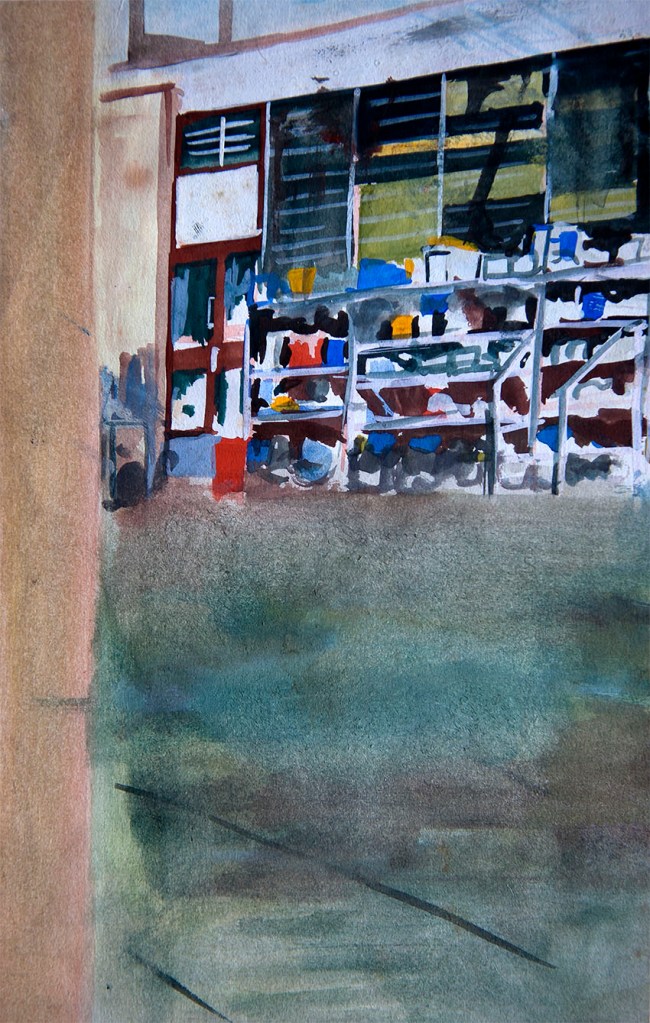
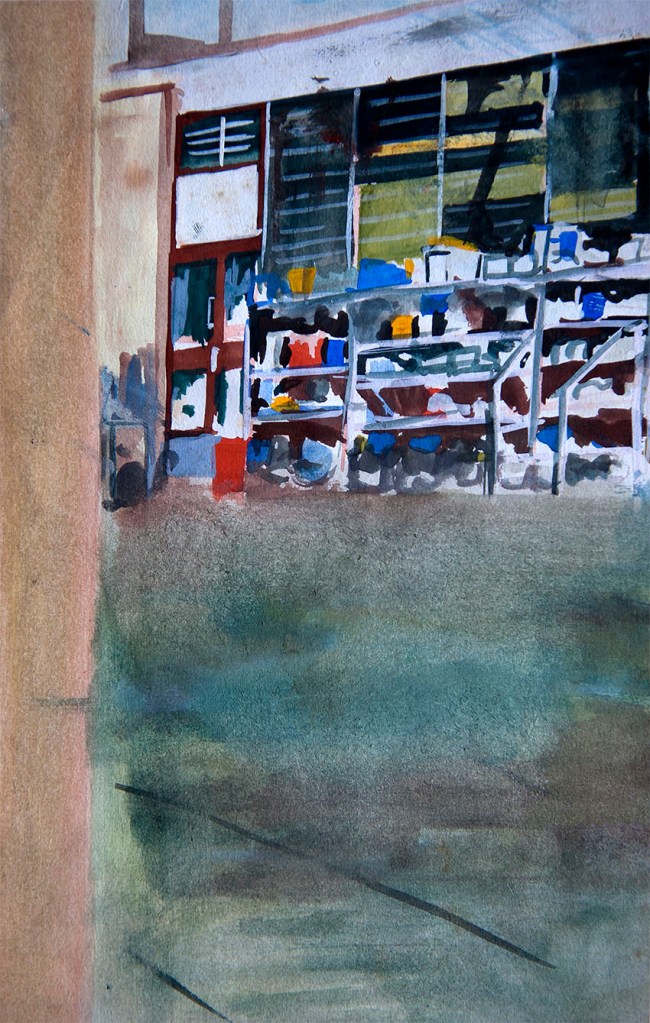
The Pottery Courtyard (Harrow School of Art) – gouache on paper – 1976
All these years later I console myself with the fact that both Harrow and St. Martins, in their very different ways offered many valuable (if often somewhat turgid) life experiences, and that the fairly successful artist I went on to become was as much in spite of those experiences, as because of them.
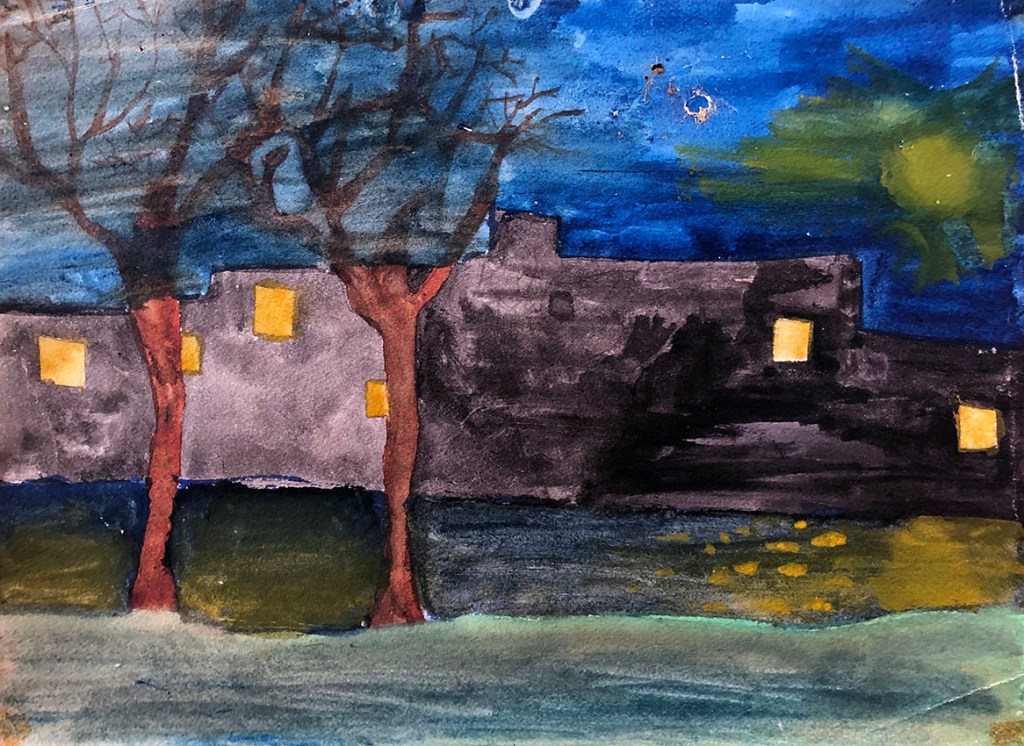
Northwick Park Hospital on a Winter’s Eve – gouache on paper – 1976
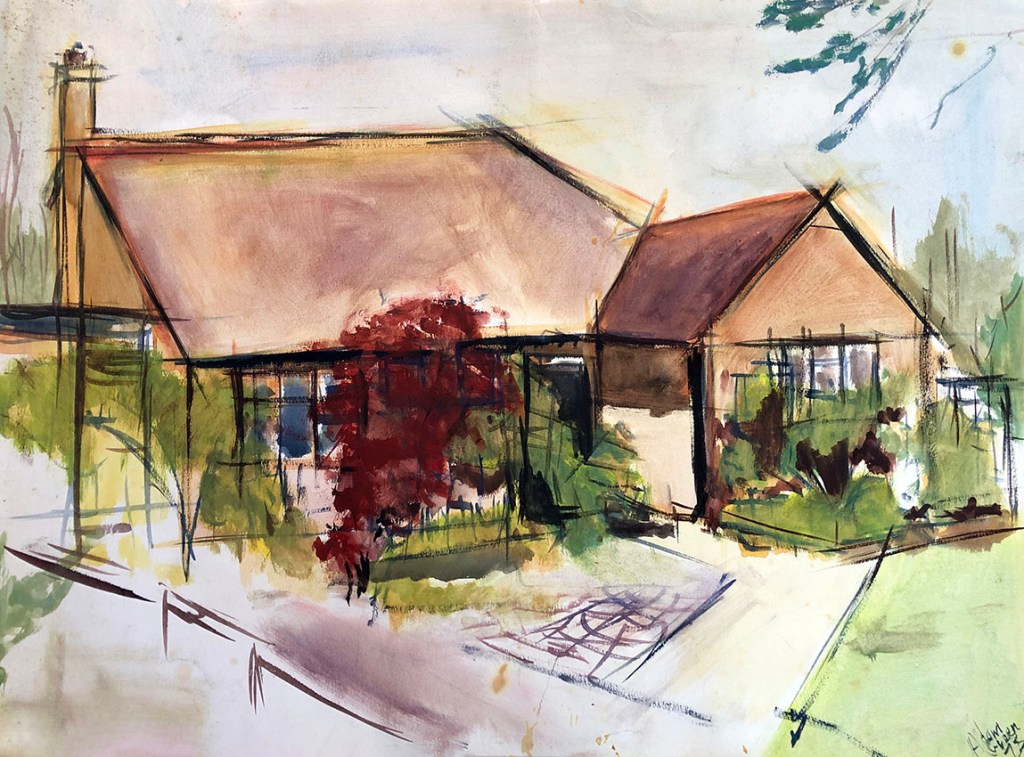
The half-dozen gouache washes here cover the end of my time at Harrow and my early days in Soho, with a visit to Spain in-between. They reveal my dabbling with a gentle form of constructivism, which was in reality a mostly contextual necessity, given the locations of my subject material. In any event, as with most of my work, in all its forms, they are ultimately all about the light – light that can lend drama and even a little beauty to most brutalist of concrete structures. There’s a deep message in there somewhere, but that’s another story…
obscure gems, camera-obscured vermeers and an unwatchable nightwatch…
I am a very fortunate and privileged person. In 1987 I and my then-girlfriend visited the Alhambra Palace in Granada, and had the entire place to ourselves. The stillness of the Court of the Lions in particular, with its serene Solomonic atmosphere, only disturbed by the wing flutters of doves and the chirping of swallows was a transcendental experience.
About ten years later, I had an equally powerful-yet-serene artistic moment of solitary good fortune in the Rijksmuseum in Amsterdam, when I had its famous collection of nine Vermeers all to my lonesome. This was especially lucky, as few great works of art demand peaceful contemplation more than those of the genius from Delft. It was probably no more than five minutes, but easily sufficient time to appreciate a unique opportunity for private quality time with nine of the finest paintings ever conceived.
Young Italian Woman with Puck the Dog – Thérèse Schwartze (1884/5 – oil on canvas). Ashamed to say that I had never heard of Thérèse Schwartze, but I’ll never forget her now after being thrilled by this life-size study of attitude and poise…
But that was then, and now things have changed for the worst, at both the Alhambra and the Rijksmuseum.
Both places are victims of their own massive popularity and their increased accessibility due to an exponential rise in mass-tourism. And, both places resorted to the same “remedy” for dealing with the ever larger crowds of people wanting to see their glories – the dreaded time-slots…
I have visited Amsterdam many times since 1997, but because I knew I could never repeat that incredible Vermeer encounter, I had avoided the museum – until last week.
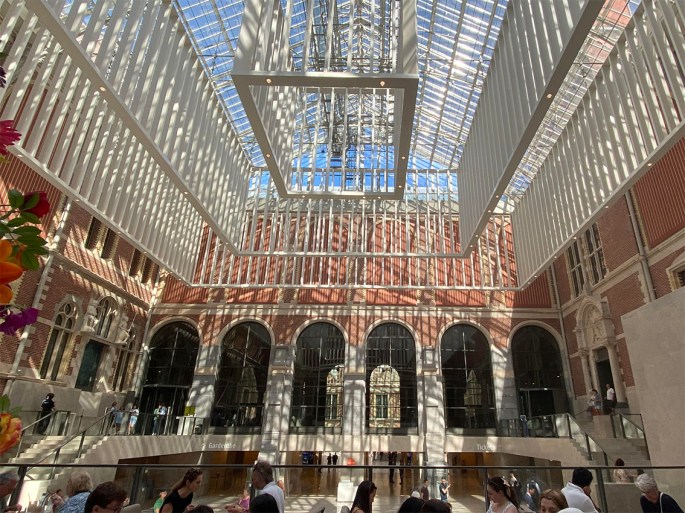
We were in town for 48 hours and our hotel was next door. Everytime I stepped out onto the street, there was the great red-brick edifice, staring me in the face, taunting me. So, I gave in, and booked a 10 am (and first of the day) slot on my iPhone for the second day. Get there early I thought, and I might just have a chance of beating the crowds to the Vermeers, even if only by a minute or two, it would be worth the €20 for the ticket.
A Young Woman Warming her Hands Over a Brazier: Allegory of Winter – Cesar Boetius van Everdingen (1644-48 – oil on canvas) Again (although here I was aware of the painting), I had only a vague knowledge of this exceptionally gifted Dutchman. As with the Schwartze above, the painting in the flesh (so to speak) is unbelievably compelling.These iPhone photos, don’t convey a fraction of their power in real life...
How wrong I was. I got to the entrance at 9.45 (15 minutes before the official opening time) and, much to my pleasant surprise was allowed in. However, my cheerfulness was instantly doused, the moment I entered the grand vestibule, to discover it full of people – mostly grouped in tour parties, with tour guides, whose competing, amplified voices, filled the space with a kind of strident, oddly-American-accented hiss.
On my way to the Vermeers I passed large classes of school children, many spread out, sitting on the floor spaces, surrounding their teachers, like bees around a queen, but all (teachers and children) dressed in white lab-coats. And no, I haven’t a clue either, but it all added to overall feeling of organised pandemonium.
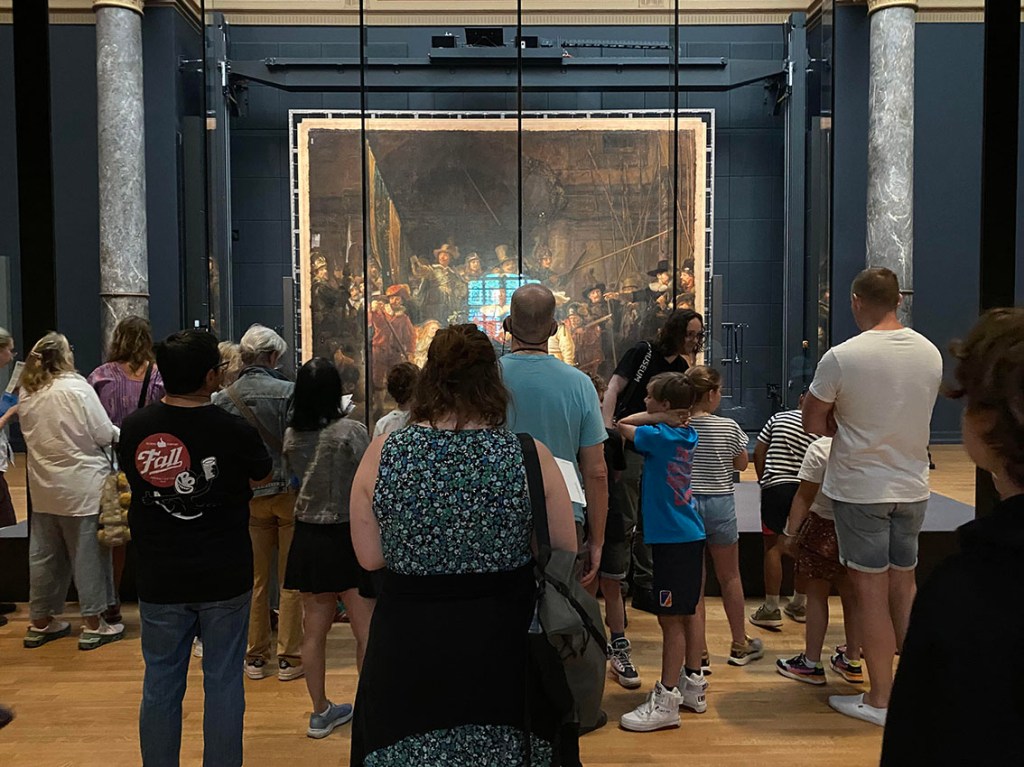
Having navigated my way past these sizable (and voluble) obstacles I eventually made it to the gallery containing the Vermeers, but of course, I was too late. I don’t know when wouldn’t have been too late, seeing as I had entered the museum 15 minutes before the official opening time, but I’m guessing, some time around three in the morning? How/why/where all these people came from – hundreds of them – in yet more tour-guide parties, between me and getting anywhere near the paintings, is a mystery. But whatever, I wasn’t going to see the Vermeers – not that I would have wanted to given the football-crowd environment engulfing them.
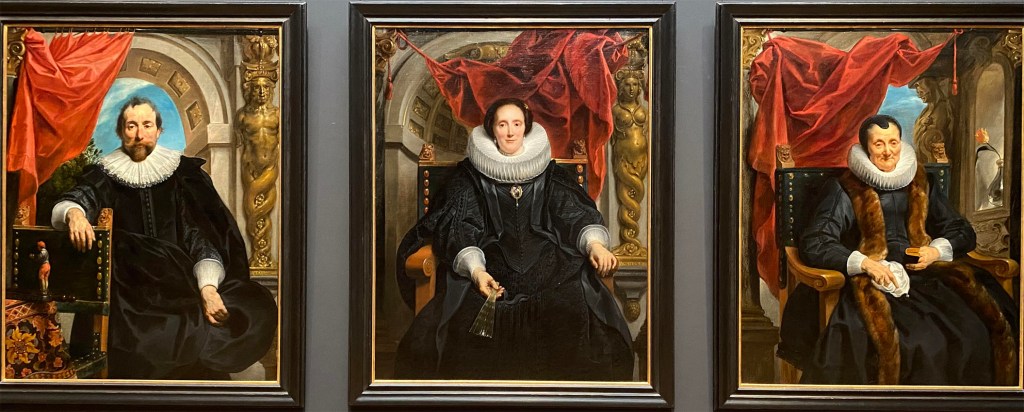
Three Portraits of Notables of Antwerp – Jacques Jordaens (1635/36 – oil on canvas) If, like me, you’re a sucker for the wow-factor possible from supreme painting technique, then this virtual triptych of life-size portraits, by yet another artist I barely knew of (Flemish this time, not Dutch) is the exhibit for you. While it might not have the subtle deftness of The Night Watch, for example, they’re packed with empathy, presence and attitude – and most importantly of all, have no unsightly screens, and rarely any people between them and you!
So, as a second prize I tried for the Rembrandts but fared little better, and ultimately settled for distant side galleries and the often surprisingly superb consolations on offer, which comprises most of the illustrated story accompanying this post.
In short, do visit the Rijksmuseum next time you are in Amsterdam, but be prepared to make do with side galleries and supposedly “minor” exhibits. Fortunately, being one of the greatest art galleries on the planet, insures that there are plenty of allegedly “lesser” gems of outstanding and memorable value on offer, to enjoy in relative peace and harmony.
The other side of the Rijksmuseum coin. Somewhere behind all of that lurks The Night Watch. There has to be a better way…
In my previous post I discussed some of my work on book covers back in the late 1980’s, which also happened to be among the best paid work I ever did. Best paid, both in regards to the amounts, and the time-to-work ratio. I think that the longest I ever spent on a cover was about two days, with the pay, rarely less than four-figure sums, and in the spectacular case of Billy Bathgate, just 20 minutes work for over £3000!
I also made many illustrations for the inside pages of books, and these were often less well rewarded financially. Normally, if one was contributing a single illustration to a text-book, the rule of thumb was £250 for a half-page, and £500 for a full plate. And even this, seemed pretty good most of the time, when the typical job took less than a day to complete. However, on one occasion, in 1996, I received a commission for a half-page illustration which turned out to be the polar-time-to-work-ratio-opposite of the Billy Bathgate job.
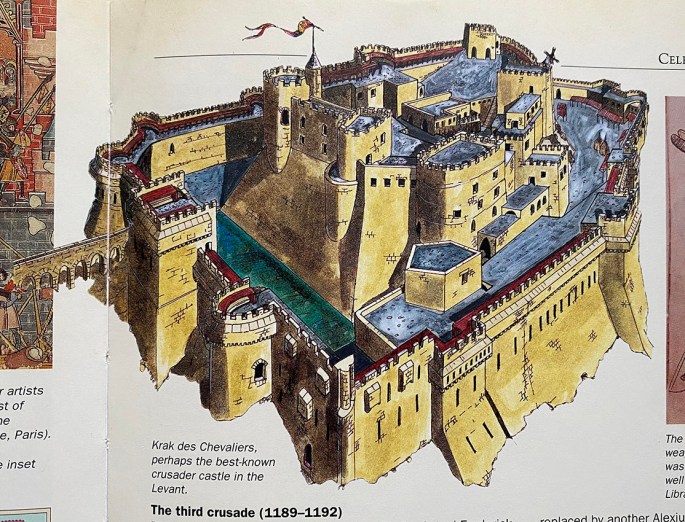
My half-page reconstruction of Krak des Chevaliers – the original being pen and ink, with ink wash.
The commission offer was for only £150 (the lowest offer I ever accepted in my ten years or so as an illustrator), and I knew from the brief, that it would be enormously time-consuming. But, just as struggling actors, never turn down a role, however bleak, so it is with most freelance illustrators (as I then was).
Fortunately, as things turned out, what the commission lacked in remuneration, it more than made up for in job-satisfaction. For, not only was the illustration for a Thames and Hudson publication – the sort of encyclopaedic book I’d devoured as a child – the subject matter – the great Crusader castle of Krak des Chevaliers, in modern Syria – was truly thrilling, and not to mention, extremely challenging.
My task was to draw and colour an accurate as possible reconstruction of the castle based on two large black and white photographs, supplied by the art director, of its ruined state. Fortunately, I dug up some additional colour photos from my local library, and with just a touch of artistic license, after nearly three weeks of hard work, I arrived at a plausible vision for the how Krak would have looked in its intimidating pomp.
When, a little while later, I received my complementary copy of the book, I can honestly say, that seeing one of my own, lovingly executed illustrations, gracing the very sort of book which had thrilled me as a little boy, I have never experienced more gratification. Which all just goes to prove, it isn’t always only about the dosh!
It’s a well known fact that up until relatively recently, painters made up their own colours from ground pigments and whatever carrier mediums they preferred; most commonly oil, water or egg yolk. One of the marks of the successful artist was being able to afford an apprentice (or two, or three…) to do the blending of the paints for them, and so the acquiring of the skill of paint blending became a crucial rite of passage for all aspiring painters.
By the time I entered art school however, the era of commercially produced, convenient pre-prepared paints, of all media was firmly established, and pestles and mortars had long disappeared from our studios. Nevertheless, I, and one or two fellow students of a more traditional persuasion were curious to experience, at least fleetingly, both making and using our own paint.
Fortunately, our school was close by an art shop that still supplied raw pigments, so we were able to have some fun making up our own oils, watercolour and egg tempera and then trying them out on paper and canvas.
Presented here are the results of my own experimentation with tempera and watercolour. Because water was free, and even back then eggs were relatively expensive, I was able to create a far broader palette in the latter, and had to restrict myself to just two colours in egg tempera – Prussian blue and burnt umber – hence the several monochrome sketches…
Becky – tempera on paper – 1981Hannah and Harry – tempera on paper – 1981Hannah – tempera on paper – 1981Hannah on the phone – watercolour on paper – 1981
As a young artist I went through numerous phases and enthusiasms, the briefest of which, being a desire to master the portrayal of animal-kind. I think my “animal period” lasted about five months in all, but despite its brevity, I still managed to fill several sketchbooks and give myself highly useful reference material for my later professional career.
Sadly, I have since mislaid two of the main sketchbooks, and could only find a handful of pictures as examples for this post. Nevertheless, I think they are sufficiently worthy, and interesting to be reproduced here.
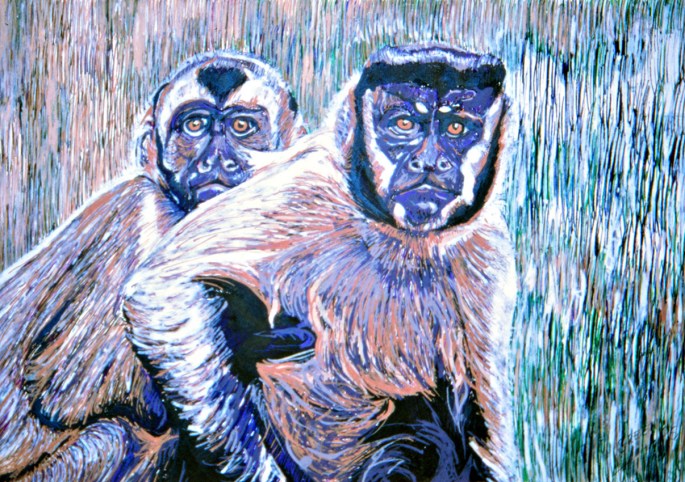
Capuchin Monkey – Pen and Ink Wash – 1981: I spent two or three days at London Zoo studying mostly monkeys, the big cats, and birds. The monkeys were particularly fascinating as they all had distinct personalities and facial expressions. This guy/girl was always alone and sad. I think he/she was in want of a mate, but I can’t be certain. Mother and Child Capuchins – Pen and Ink “linear” – 1995: Fourteen years after those visits to the Zoo in Regent’s Park, I made a small series of highly detailed drawings from some of the better sketches. All sold, and sadly this is the only picture I have on my files from that hugely successful group. There’s little doubt that I could have carved out an extremely lucrative career if I had continued making these drawings, but after about six of them, I couldn’t face doing another. They were painstaking in the extreme, and took many days each to complete, requiring a depth of concentration that drove me half-mad. Cat Studies – Conté – 1981: The zoo was an expensive place to visit, even back in 1981, thus I mostly resorted to studying pets of friends (we had no animals at home) and when out and about in places like pubs. This little girl, whom I seem to recall was called Daisy was no shrinking violet however – hence some my humerous additions to the original sketches.
Make My Day! (British Bulldog) – Pen and Ink Wash – 1982: Meet Harry, who despite the title of the picture was as docile and sweet natured as he appeared.
My two favourite painters, Vermeer and Hopper, shared an amazing knack for turning unremarkable moments and scenes into images packed with dramatic nuance and eternal resonance. Their most famous paintings offer graphic testimony to the enormous power of the “small still voice”, where the importance of the message belies its volume.
Lacking those two gentlemen’s genius, and in common with most regular artists, I was typically more of a megaphone artist when attempting to get my own pictorial messages across, relying on devices like huge canvases and epic subject matter.
However, even an artist of my own normal abilities could occasionally succeed in imbuing the mundane and the ordinary with a little charm and presence, especially, when I resorted to watercolour. For me, watercolour painting was an antidote to everything else I did, in oils and even gouache – a therapy almost – a sort of breathing exercise with brushes and colour, whereby I visually inhaled a scene; processed the scene in the blink of an eye; and then exhaled the scene through my water-sodden brush.
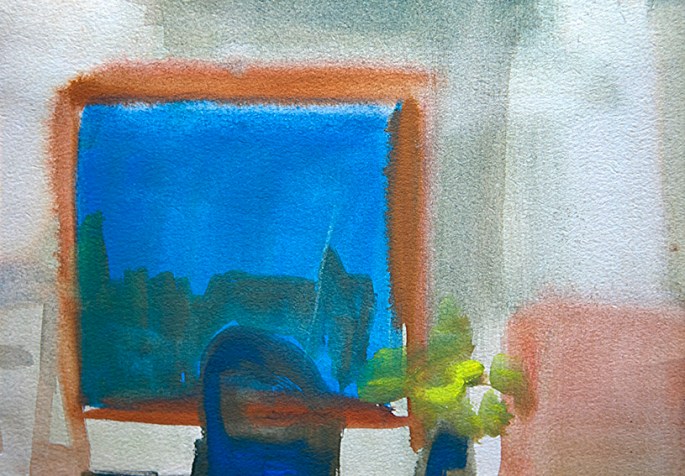
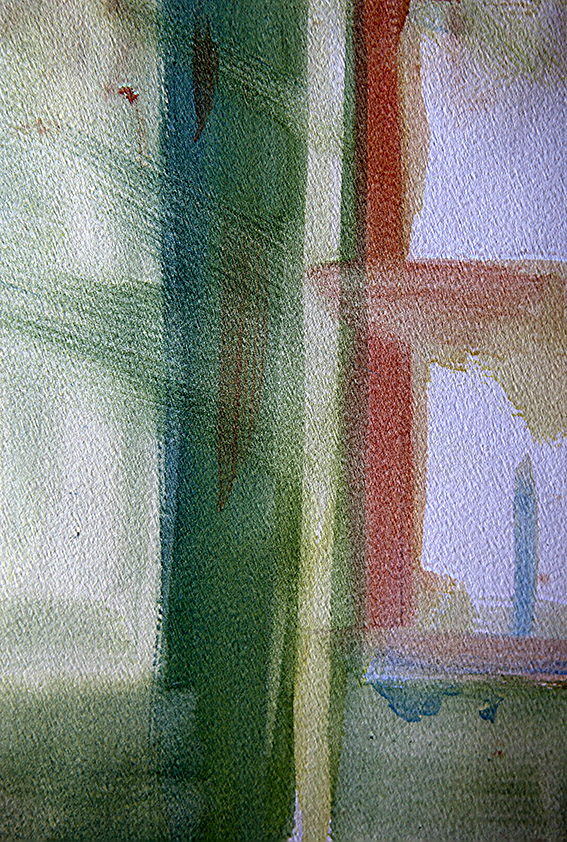
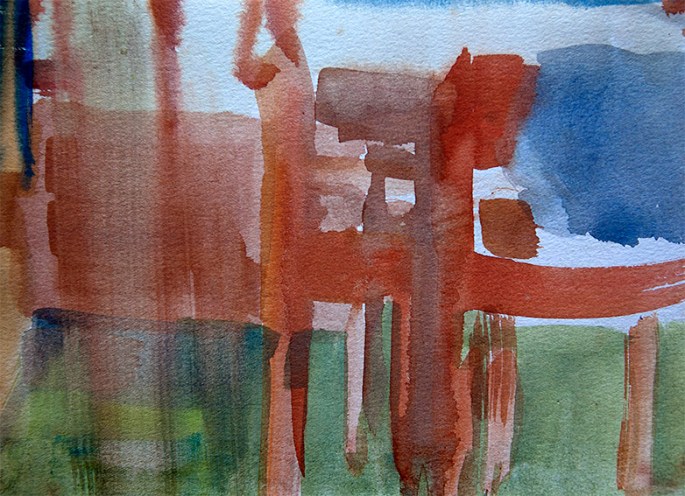
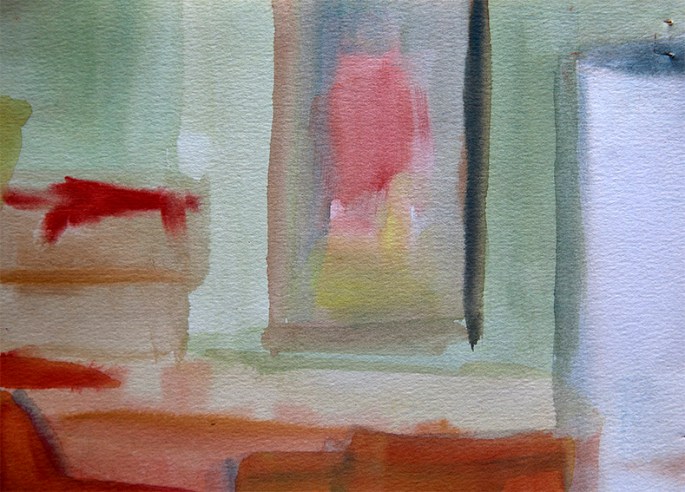
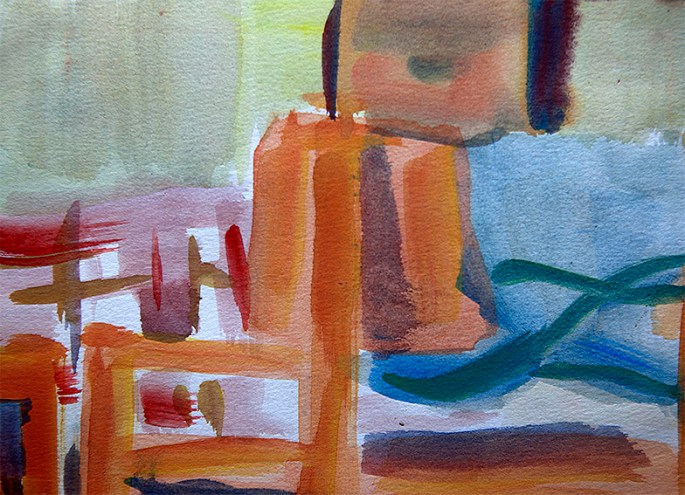
The pictures presented here are good illustrations of how a few simply applied watery daubs can raise a mundane suburban sitting room into a theatre of colour and light. No overthinking; just a touch of keen observation and easy application, and the everyday is morphed into the exotic. These watercolours are the closest I ever got to successful whispering.
(Incidentally, I should mention that I still have the originals of most of these images from my old watercolour sketchbooks and I’m happy to sell them for £400 each, plus, they reproduce beautifully as digital prints on fine papers for £100 each, plus postage and packing. All images, original and repro’ about 25 x 18 cm)
HARTLAND LOUNGE 1 (BILL’S NIGHTSCAPE DAFFODILS) – watercolour on paper – 1982
HARTLAND BEDROOM 1 (MUM’S DRESSING TABLE WITH CURTAIN) – watercolour on paper – 1982
HARTLAND DINING ROOM 1 (DINING CHAIRS AND TABLE) – watercolour on paper – 1982
HARTLAND KITCHEN 1 (THE WASHING MACHINE AND WINDOW TO FRONT GARDEN) – watercolour on paper
HARTLAND DINING ROOM 2 (TABLE WITH BILL’S WOODLAND SCENE) – watercolour on paper – 1982
HARTLAND LOUNGE 2 (REAR WINDOW) – watercolour on paper – 1982
HARTLAND DINING ROOM 3 (CHAIRS) – watercolour on paper – 1982
HARTLAND LOUNGE 3 (BOB’S NIGHTSCAPE WITH DAFFOLDILS II) – watercolour on canvas – 1982
plus several other famous historical battles through the eyes of a battle movie crazy youth…
The Stand of the Phocians (Thermopylae) – pencil drawing – 1974 Drawn when I was thirteen, it is intended to show the Phocian’s vainly attempting to defend Leonidas’ rear from the Persian Immortals.
In addition to the remarkable Mary Poppins (1964) the other two films that first set my spirits soaring – though in a markedly different way to Mr Banks’ joyous kite – were The 300 Spartans (1962) and Zulu (1964)*. Like most little boys growing up in the 60’s (and some little girls too in my experience of the time), I was thrilled by epic cinematic depictions of battle. But, whereas movies like Ben Hur (1959), Cleopatra (1963) and even the extraordinary Spartacus (1960) did that Wagnerian thing of interspersing the brilliant battle and action scenes with boring half-hours of tedious “drama” (or so I thought as a child), The 300 Spartans and Zulu were vehicles for the (beautifully staged) battles themselves – Thermopylae and Rorke’s Drift respectively – with the drama, merely the filler. In other words, perfect films for little Adams everywhere.
The Charge of the Companions (Battle of Guagamela) – pencil sketch – 1975 – based on The Charge of Light Brigadeby Richard Caton Woodville Jr (see below). I was fourteen when I did this, and even copied Woodville’s incorrect depiction of the horses legs (English-American photographer Eadweard Muybridge had yet to show how horses actually ran).
The most ambitious film ever made about a single battle was Sergei Bondarchuk’s enormous Waterloo (1970), which I first saw as a ten-year-old on its UK release. But even then, as much I was awestruck by the superlative battle scenes, I was irritated by the stodgy script (actually, just an endless seam of historical quotes) and the awkward caricaturesque acting, which lurched wildly between the histrionic French and the aloof British.
Waterloo – felt tip on paper – 1974 – This was all my own concept, and executed during an hour-long maths lesson when I was thirteen. Mrs Evans, my teacher liked the picture so much she merely shrugged her shoulders on seeing what I was doing and let me get on with it, muttering, “at least the boy is good at something…” as she walked back to front of the class.
With more modest budgets and far smaller casts, by canny use of camera angles, stunning photography, beautifully paced editing, and (certainly in Zulu’s case) thrilling musical scores, directors Rudolf Maté with his Spartans, and Cy Enfield with his handful of red coats, made films that felt far larger and much grander than they actually were.
A pencil sketch of Macedonian phalanx troops in a defensive position – not sure which battle, although the drawing dates from 1975. The poses are based on those of the British soldiers in Waterloo depiction by Félix Henri Emmanuel Philippoteaux (see below).
But perhaps the greatest testimony to the enduring appeal of all of the above is how well they stand up against their modern CGI equivalents. For example, Frank Miller’s 1998 Thermopylae film, 300 – allegedly inspired by Maté’s 1962 version – despite its having a virtual cast of millions and “authentic Spartans and genuine battle violence” is – apart from one or two scenes – utterly forgettable. Most interestingly of all is how “small” and claustrophobic the later, studio created film feels by comparison with its location-shot forerunner. And similarly, for all the earlier film’s wooden acting and heavily tableau’d dramatic interludes there is a dignity and humanity totally lacking in Miller’s animated comic book treatment.
Red Coats at Waterloo – pencil sketch – 1973. Based on Black Watch poses as depicted in The Thin Red Line by Robert Gibb (see below).
The pictures presented above date from about 1970 – 75, and reflect the obsession I had as a 10-14 year-old boy for attempting to recreate the battles that had thrilled me so much on the cinema screen. Sometimes, I would base my pictures on famous historical battle paintings, using the figures in the original artwork as templates for my own infantry and cavalry, often for battles of different eras. Those wonderful “templates” – all of which influenced my childhood self almost as much as the movies above, are included below.
The British Squares Receiving the Charge of the French Cuirassiers (at Waterloo) by Félix Henri Emmanuel Philippoteaux – 1874 – oil on canvas
The Charge of the Light Brigade by Richard Caton Woodville Jr – 1874 – oil on canvas
The Thin Red Lineby Robert Gibb -1881 – oil on canvas
*Other films which are worth looking out for as noble – if imperfect – examples of pre-CGI historical battle movies are: Clive Donner’s 1969 Alfred The Great – a turgid film, but with decent battles; Tony Richardson’s 1968 Charge of Light Brigade – marred by Richardson’s anachronistic, relativist, anti-war message, laid on with a trowel, but largely successfully staged, and a genuinely epic charge; Cy Enfield’s return to Natal for his 1979 (“prequel” to Zulu), “grittier and more historically accurate” Zulu Dawn – compares poorly to the near-perfect Zulu, only proving yet again, that grit and accuracy (and vast numbers of extras) alone do not guarantee a great picture. Worth seeing though, just for the British scouts first sighting of the massed Zulu impis (11,000 warrior extras) – an astonishing cinematic moment.
Guilt – The Lone Survivor of Thermopylae – watercolour on paper – 1972 This is me taking huge dramatic license with the story of Othryades, the soldier sent home to Sparta, and who then committed suicide at a later battle.
Plus, two more CGI fiascos to avoid at all costs: Oliver Stone’s 2004 Alexander the Great – should be retitled, Alexander the Petulant, and as for the cartoon-filled battles!; Also, the woeful 2004 – Wolfgang Peterson’s Troy – which has to be the leading candidate for worst adaptation of a great and immortal work of literature ever executed. Brad Pitt’s appallingly miscast, pouting, kung-Fu-fighting super hero, isn’t even the worst characterisation in the film!!
This was another piece done illicitly during a school class – around 1971 – this time a French lesson. Mrs Sable, lacking Mrs Evan’s broadmindedness made me stop the moment she saw what I was doing. Hence the incomplete chart…
Finally, one exception to prove the rule, although CGI is mercifully absent from the superb opening battle scene, is Ridley Scott’s exceptional 2000 film, Gladiator (actually, a close reworking of Anthony Mann’s terribly dull, 1964 Fall of the Roman Empire) – which introduced the historical battle movie genre to a whole new generation of little Adams…
Napoleon’s Last Victory (the Guard advancing at Quatre Bras) – watercolour on paper – Circa 1974 Quatra Bras was battle that immediately preceded Waterloo, as the allies attempted to halt the advance of the French northward to Brussels – I based these “Old Grumblers” on the actors from the 1970 movie.
another look at the art of painting from photographs…
The two pictures presented below have both featured in previous posts (here and here), but neither with their template photographs. The “Walking Away” is particularly interesting to me as it has the penned grid over the girl drawn onto the photo itself. Generally, as far as I recall, I would use a sheet of tracing or acetate paper over the photo so as not to ruin it. But, for some reason I didn’t bother in this case. The fact that I only “gridded” the girl is reflected in the relative freedom of the landscape painting. The skiing scene mountain-scape by contrast is much more faithful to the original photo, in form, if not in tonality.
Both pictures present further evidence of what is possible using the humble snap, in terms of expressive potential and dramatic interpretation.
This was a large photograph, and thus atypical for me, as I generally preferred small snaps. I guess that in this case, I felt the figure to be central to the composition and so required the extra detail a larger photo offered. For those interested, the scene is just above the village of Ein Kerem, in the hills just to the west of Jerusalem. The Hadassah University Hospital is at the top left, famous for its synagogue adorned with Marc Chagall’s fabulous twelve stained glass windows, depicting the Twelve Tribes of Israel. “Walking Away” – 1982 – oil on canvasThis was the more typical small postcard-size snap I preferred to use for making large “blown-up” paintings. The tight containment of the image helped my decision-making processes and prevented me getting distracted by extraneous detail. In this case, I only retained five of the skiers as I felt it accentuated the drama of the moment, and the moodiness is also increased by a tonal shift from a highly photographic cyan (almost indigo) screen to a deep gradation of (mostly) dark cobalt.“Bormio 3000” – 1983 – Oil on Canvas