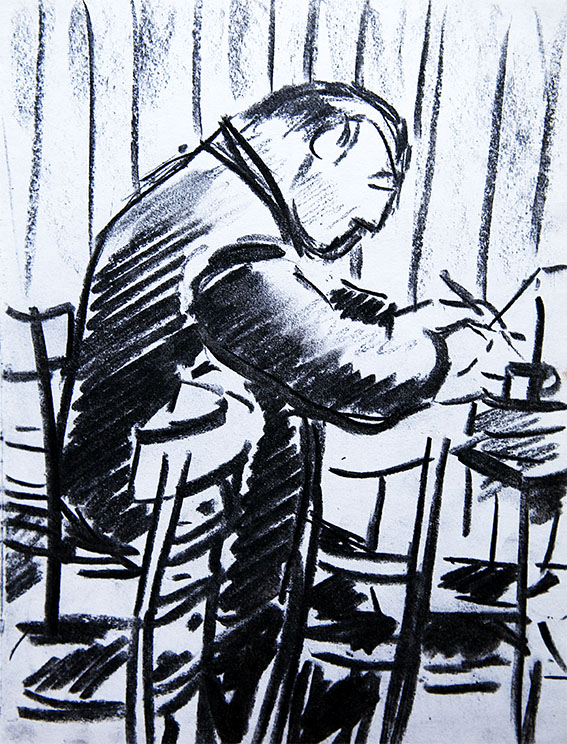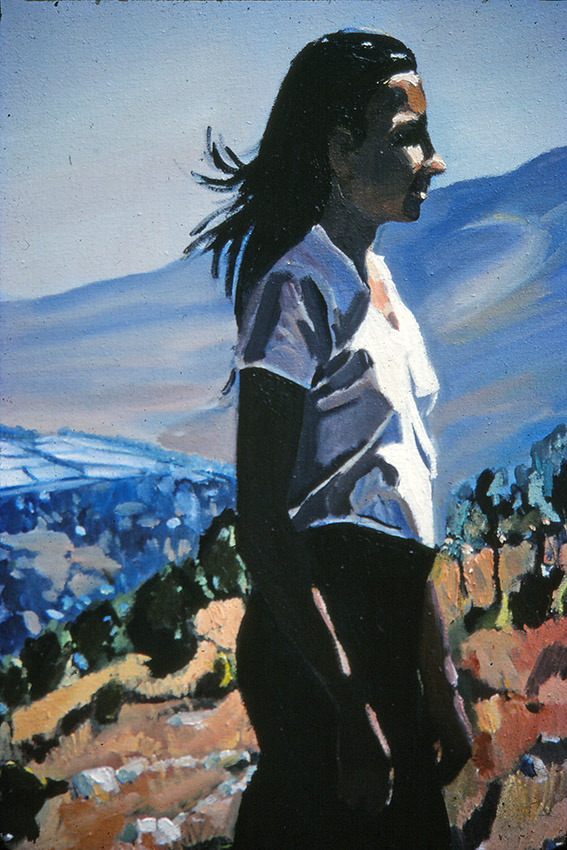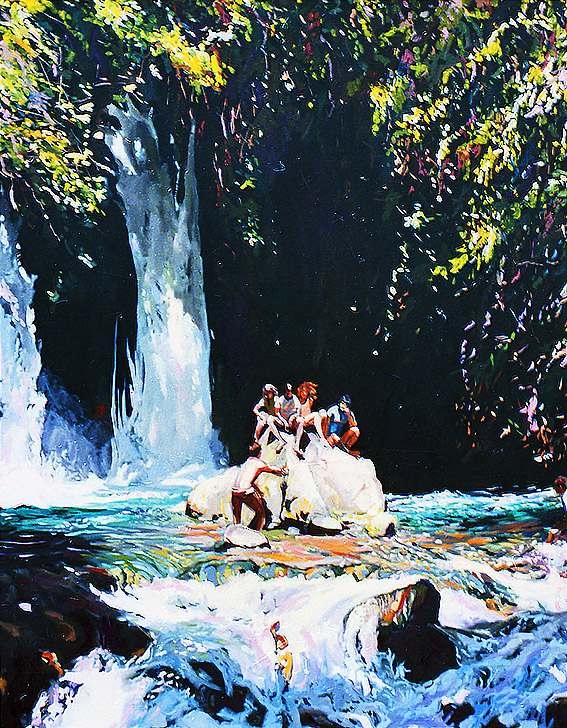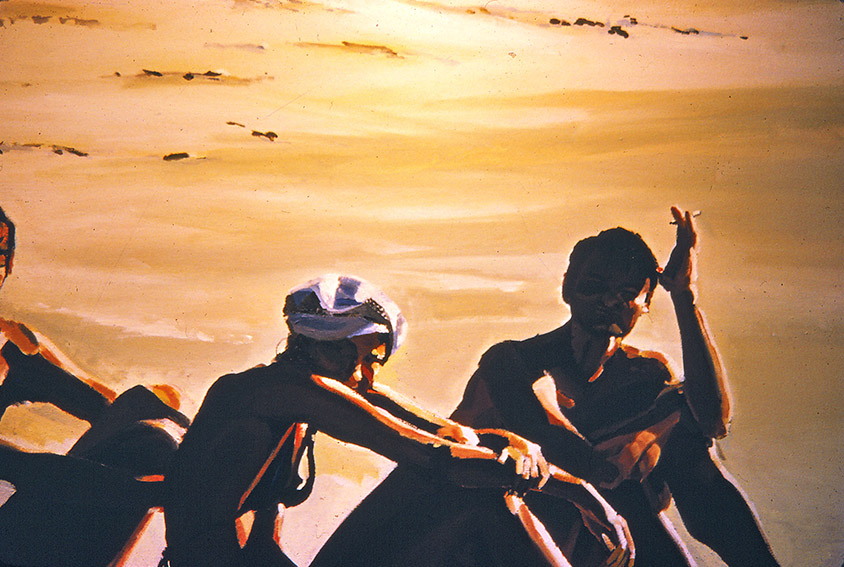
“WORKERS IN THE FIELD”

AND THE “LITTLE RED” ICE LOLLY

I think I’ve mentioned before on these pages how, very occasionally, I had my uses to the powers-that-be at Saint Martin’s School of Art. While generally I was shunned by most of the tutors for my work being “hopelessly representative”, every-so-often, when they required the services of someone with common-or-garden drawing and painting skills they came to your’s truly.

The story of my mural in Covent Garden was the most high-profile example of this expediency, but there was another occasion when my usefulness to the school was probably far more significant.

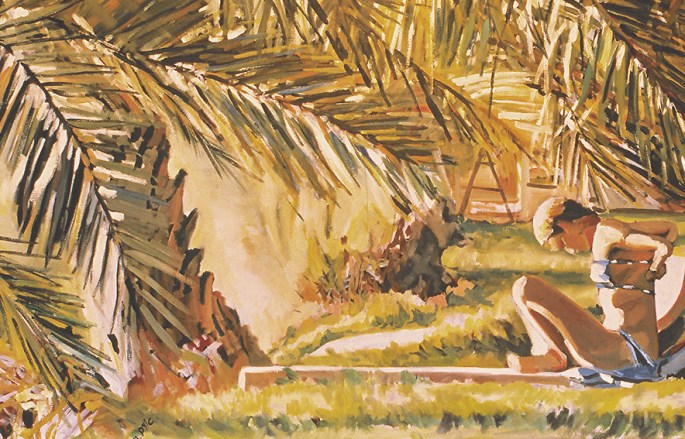
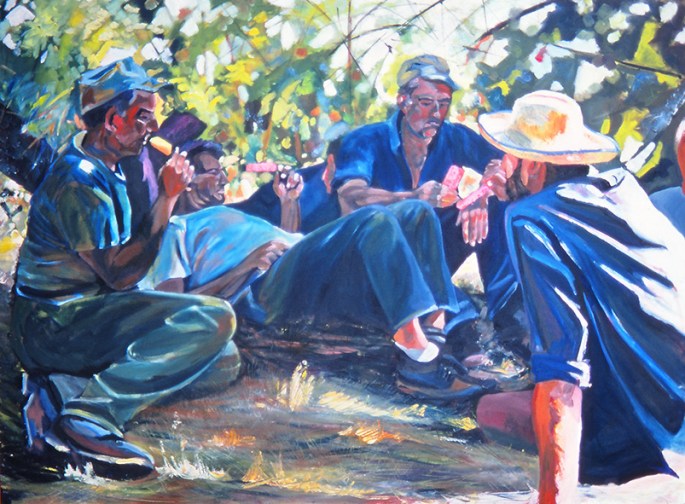
Apple Pickers at Rest – oil on canvas – 48″ x 72″ (122 x 183 cm) 1980 – the painting that caught the attention of the Chinese delegation…

It was shortly after the Easter break in 1981 when St. Martins received a visit from a delegation of Communist Chinese dignitaries from their ministry of culture, led by the minister himself. Although I was blissfully unaware at the time, the visit was part of a drive by China to open up access for their top students to elite academic institutions in the UK and North America. I subsequently discovered that their “shopping list” of British institutions comprised, Oxford and Cambridge, University College London, Imperial College, the LSE, the Royal Ballet School, and (incredibly to me at least) Saint Martin’s School of Art. I was equally ignorant of the fact that the visit mattered at least as much to my school as it did to the visitors, as even back then, foreign students were a lucrative source of revenue.

…A detail from the painting, with the ice lolly “mistaken” for a Little Red Book at the top of the image…

Thus, in effect, I was an unwitting cultural/commercial ambassador for St. Martin’s. The fact that my work was the polar opposite of everything that St. Martin’s stood for mattered not. That it was “safe”, accessible, “good of its kind” and most important of all, unlikely to be considered “decadent” by our communist guests mattered a great deal. When I later asked my head tutor John Edwards, why they didn’t simply visit the Slade School or the Royal Academy Schools, where nearly all the art was like mine, he pointed out that St. Martin’s was “so much more than a mere school of painting”. And that its fashion and film departments, in addition to its art and sculpture “made it uniquely attractive” to the Chinese. “In truth”, he added, “the art department was the least significant element” of the school and the main thing was “not to rock the boat”. As things turned out, not only did my work prove the steady ship my superiors had hoped, one of my pictures actually ended up pleasing our visitors more than anyone could have predicted.
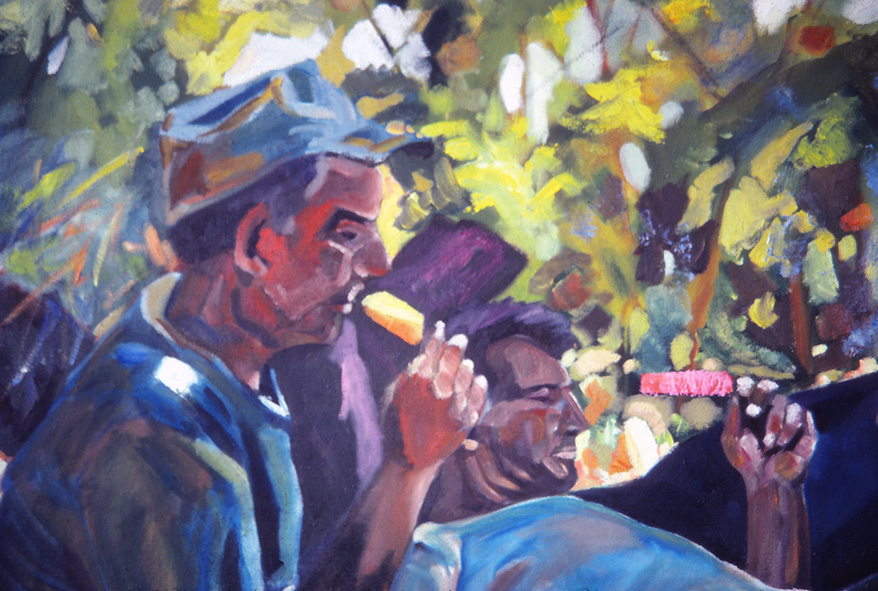
“Workers in the field…” – actually local Druze hired labour – with ice lollies.

On the afternoon of the visit, the art department was cleared of students except for me, and the delegation was brought up directly to my studio. There were about ten Chinese, all men and all wearing expensive English-cut suits, and they were led into the room by John Edwards and the principal of the school, Ian Simpson. After some words of introduction from John, the visitors began to notice my pictures, which wasn’t difficult, as at that time I was working on a series of monumental canvases. However – and it’s a moment I shall never forget – as their eyes (and I mean their eyes, for they turned their ten heads as if a single organism) landed on “Apple Pickers at Rest” they let out a collective “ahhhh…” and all broke into broad smiles. Then, the leader of the delegation (the minister himself as it later turned out) looked at me and asked, or perhaps stated, “workers in the field yes?”. I think I just nodded. He then walked up to the picture, and pointing at one of “workers” contemplatively holding a raspberry ice lolly, he turned to me, and grinning and nodding enthusiastically queried, “Little Red Book, yes?”. Before I could respond, he’d already uttered something to his compatriots, to which they all responded with an even bigger collective “ahhhh…”, followed by more smiles and nods of approval. Finally, after each shaking hands and bowing their heads to me in turn, the principal led them out of my studio to continue their tour. The last person to leave was John, who, as he walked out the door, turned around and gave me a big thumb’s-up.

I was left feeling peculiarly frustrated, having been completely unable to explain what the painting was in fact depicting – a scene of Druze labourers, hired by the kibbutz on which I was a volunteer, enjoying a rest from picking apples with a refreshing ice lolly (ice popsicle). In retrospect, my being tongue-tied was a blessing, as Ian later informed me that the minister had described their visit to my studio as the highlight of their tour of the school and even inquired about the possibility of purchasing the painting. I declined this however, when it was made clear all the proceeds would be pocketed by St. Martin’s. After all, I thought, I had already done more than my bit for insuring the future prosperity of the school!
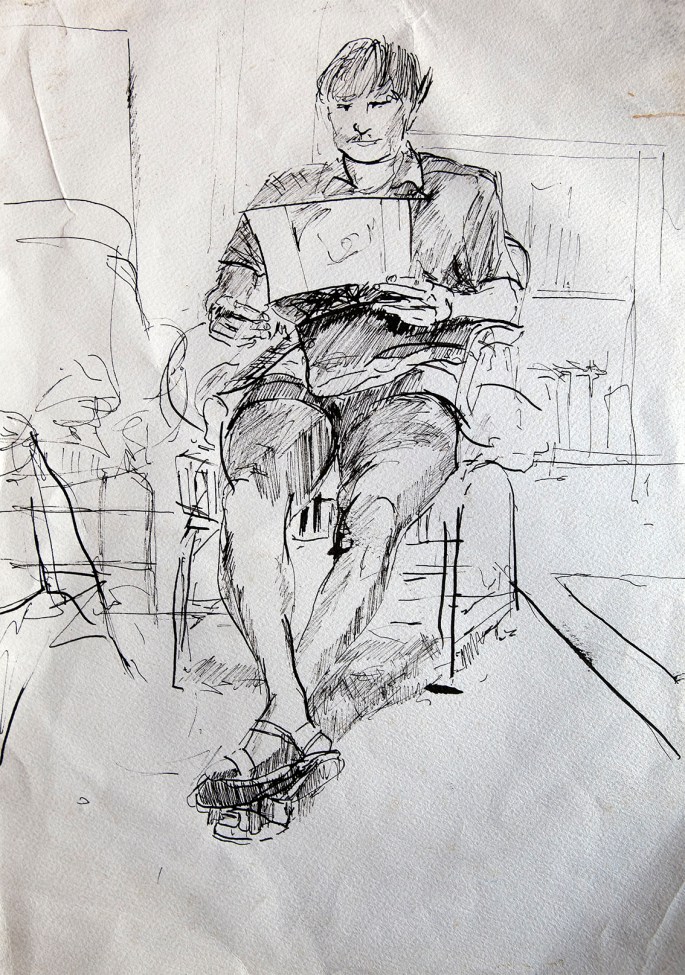
The eternal mystery of how?

or, getting it right and not knowing why…

I began drawing when I was a young boy. Not because I ever enjoyed it, or got any particular satisfaction out of it, but simply because I always could and it helped me get through the many school lessons I found otherwise pointless and boring – specifically maths and French.

Drawing, for all its tediousness was a survival strategy for me at school in a way similar to reading the Tanakh (Jewish Bible) had been for me in Synagogue – the main difference being that I actually found elements of reading the Bible genuinely thrilling (see my previous post).

I rarely got into serious disciplinary trouble at school, but the little opprobrium I did attract from my teachers was normally because of my drawing in class. Fortunately I suppose, my maths and French teachers regarded me as a hopeless cause, and often liked my sketches, and so they generally left me to get on with it undisturbed. I remember one episode in particular, when I must have been 12 years old, my maths teacher did finally loose her patience with me during an algebra class. She marched up to my desk at the end of the hour-long lesson intending to scold me until she saw what I had drawn… an epic depiction of French cavalry assailing the British infantry squares at the Battle of Waterloo. Instead, she simply leaned over my shoulder and marvelled at my felt-tip representation of Napoleonic military mayhem.

Of the thousands of drawings I did, over nearly forty years, this is one of a handful which I feel is accomplished. It’s a pen sketch of an art school friend, and I like everything about it, including the foreshortening, the sense or weight and the hands. It’s something to do with instinctive decision making, but sadly, unlike the greats, from Da Vinci to Watteau, I never learned to bottle “it”, whatever “it” is.

Ultimately my drawing led me to the art room in senior school, where I learned the rudiments of painting, and which in turn led on to a foundation degree and then to a BA. It was all an oddly thoughtless and ill considered career path which was never really planned, but rather just happened to me.

Thus it is, that the vast majority of the thousands of drawings I did over the best part of 40 years are of distinctly average quality, and perhaps more interestingly, that I cannot begin to explain the hows or the whys of the half-dozen or so decent sketches I did manage to pull off.

All I can offer as a theory, is that practise really does make perfect, very occasionally.

FIRST AND nearly LAST – the evolution of my painting on canvas…

One of the many surprises thrown up by my recent digitisation of all my photographs of old artwork was how – once chronologically sorted – it vividly revealed the development of my painting skills – or, if not skills exactly; at least of my comfort with the medium of oil paint. Additionally, they exposed something even more interesting – at least to me – of the dramatic alteration in my spirits and emotions from that heavily pressured time at art school to my days as a confident, free painting spirit.

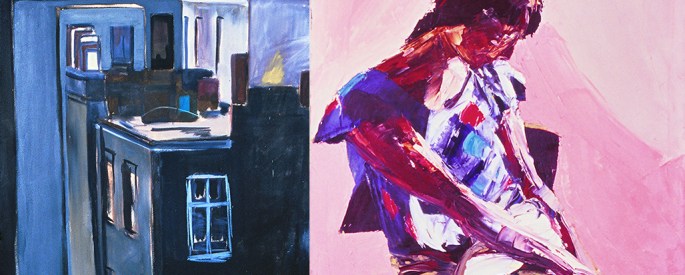
The two paintings I have chosen for this piece graphically illustrate what I mean:

Soho Buildings was the first painting I ever made on canvas, and how it shows! Thin washes, tentative drawing and clumsy composition. Looking at it now, even in photographic form, I can still feel my fear of the canvas, and my hesitant application of the paint. Plus there was the added pressure of being surrounded by – at least – equally talented artists, most of whom were already familiar with painting on canvas. So, I was desperate for it to appear like I knew what I was doing and that I was at ease with the process, which clearly shows in the picture. But, for all that, the painting has some merit; some lucky accidents; like the two white painted windows on the shaded side of the near building…something quite lyrical about them. Plus, it serves now as a powerfully symbolic and accurate reminder of my gloomy mindset during those first terrifying days at Saint Martin’s…

SOHO BUILDINGS FROM SAINT MARTINS – oil on canvas – 1978

Girl Fastening Sandal was painted in 1988 and is evidently, everything the Soho picture is not. By this time I was confident and comfortable with both the oil paint and the painting surface and, more crucially, unencumbered by being part of any “art scene” – I didn’t have to worry about peers and rivals watching me over my shoulder. Whereas, with the Soho painting it was all I could do to produce any kind of image on the canvas, with the Girl painting I was preoccupied with expressing the joys and thrills of both the subject and the paint itself. It should look almost as if the paint flowed directly from my mind to the palette knife; a visual stream of consciousness; like a happy, joyous thought. The two paintings here graphically represent a pretty dramatic 10-year transition from student to artist and from teenage hesitancy to adult assuredness.

GIRL FASTENING SANDAL – oil on canvas – 1995

DELPHI – disappointing runs but thrilling ruins…

To many, the idea of travelling to Delphi to ski might seem as daft as travelling to Zermat for the archaeology, but once, many years ago I went to Apollo’s sanctuary for a winter sports holiday.

Obviously, we didn’t need to consult the local oracle to know that the skiing on Mount Parnassus would be nearly as scarce as Doric temples on the Matterhorn. Fortunately, the stunning ancient Greek ruins were more than a compensation for a lack of powder-covered moguls and red runs. What had primarily been intended as a fortnight of physical thrills materialised as a fitness course for the mind.

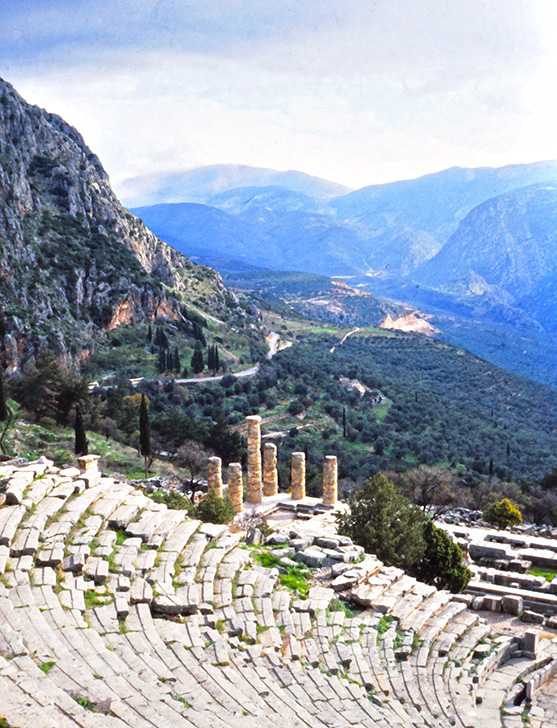
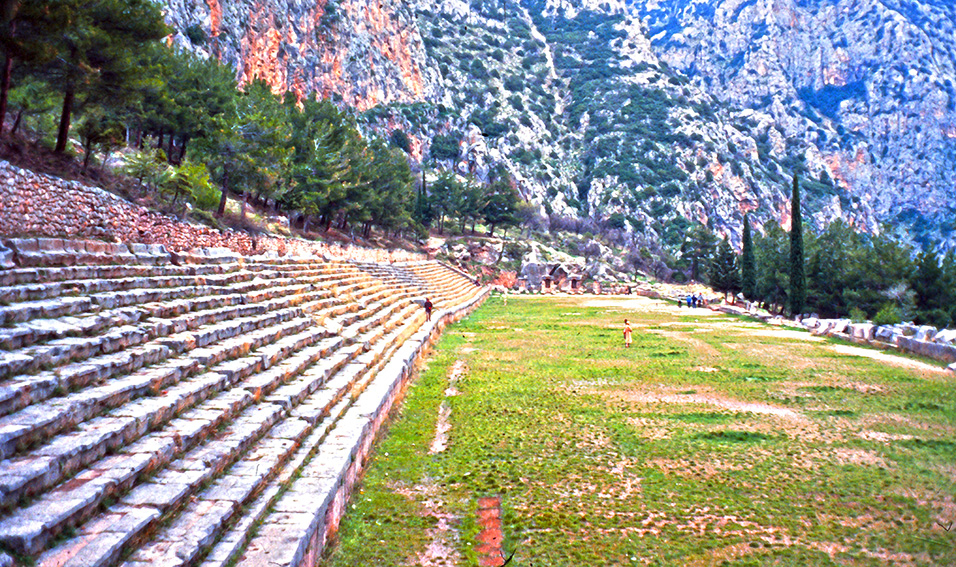
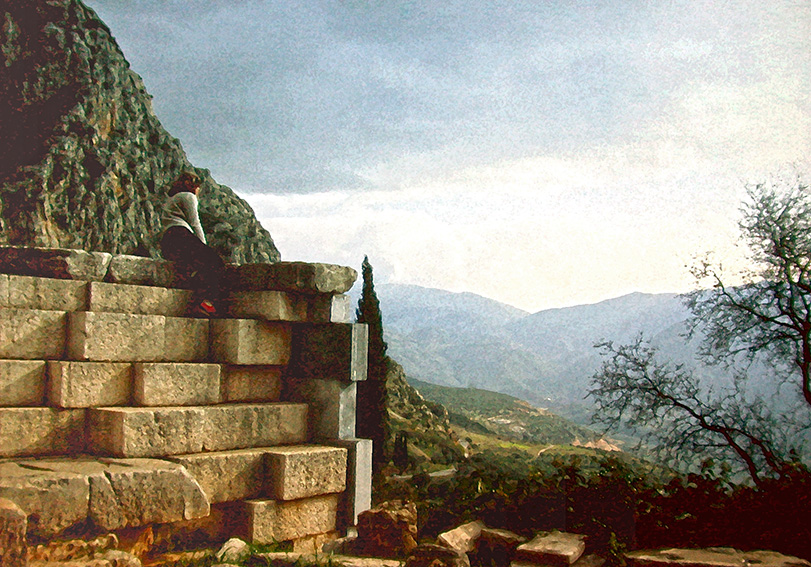
The treated photos here were taken with my trusty old Canonet 28, but I think they get across something of the drama of Delphi and the sheer majesty of the two-an-a-half-thousand-year-old remains of one the world’s most historically influential civilisations…

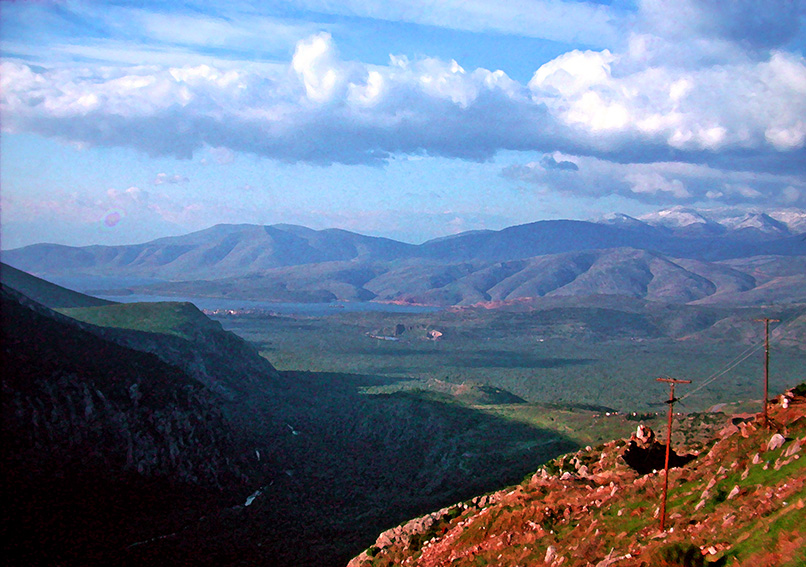
Delphi sits on the south eastern slopes of Mount Parnassus, above the Valley of Phocis, seen here looking west…

These columns of the Temple of Apollo date from the 4th century BC and sit upon remains of a 6th century predecessor…

The reconstructed Athenian Treasury was built in the late 5th century BC to commemorate their naval victory over the Persians at Salamis in 478. Every city state of Greece had a treasury at Delphi where their tributes to the god and payment to the Oracle were stored…

The often-remodelled amphitheatre dates originally from the 5th century BC. It sits just above the Temple of Apollo and has stunning views of the Valley Of Phocis…

The Tholos at the sanctuary of Athena Pronia with its famously resurrected column section has become Delphi’s most iconic and most photographed site. I was so drawn to it myself that I visited the Tholos every day of our visit…
The 6500 capacity Stadium sits high above the rest of the site. The field is about 177 long by 26 meters wide…
This was described to me as a sacred pool,…
These newly cut stones are used for restorations and repairs…
The view from modern Delphi, looking south west, across vast olive groves to the Gulf of Corinth.

KINNERET THREE WAYS – a portrait of the Sea of Galilee in three media…

The Sea of Galilee (known in Hebrew as Kinneret, due to its having the shape of a harp – a “kinor”) is well known to most people in the “Abrahamic” world as it played such a crucial part in Jewish, and especially Christian tradition and history. For followers of Jesus it is of course famous for being the actual site and / or backdrop for several of his miracles, while for Jews, its main city of Tiberius was a post-biblical centre of learning and culture.

Arab boy looking east, from Ginosar – ink on paper

For the modern State of Israel, Kinneret is a major source of both pious and recreational tourist revenue, in addition to its crucial role as the country’s primary fresh-water reservoir.

Kids on the Eastern Shore – ink on paper

Sitting as it does towards the northern tip of the Great Rift Valley; filled by the creeks and streams of the western Golan and the Upper Galilee to its north; at its southern point, spilling into the River Jordan and; surrounded on three sides by steep escarpments, the inland lake (for that what it actually is) has a geography to match its epic traditions and history.

Girl on a Raft – Ein Gev – ink on paper

As an artist, and a romantic it was always the stunning physical beauty of Kinneret which excited me most. To this day, I can still clearly remember my first-ever sight of it, from high up above, standing on the Horns of Hattin (where Saladin defeated a Christian army in 1187) – a dazzling smear of precious turquoise sitting deep within a heat-hazed frame of ochres and pale greens.

Three Generations – Eastern Shore – ink on paper

That was in 1967, when I was seven, and it is a view which I have never tired of since, and which I have been fortunate enough to revisit on many occasions, and never more so than during the summer of 1980…

Mother bathing Child – gouache on paper

It was in that year that I and three friends decided to walk the entire circumference of Kinneret – starting out from, and returning to, Tiberius over the course of two days.

Mother bathing Child – oil on canvas

We decided to do a clockwise circumvention and so set off heading north along the west shore of the lake, with only the clothes on our back, two rucksacks (a couple bottles of wine, cans of beer and packets of crisps and Bissli falafel chips in one, and music cassettes and radio batteries in the other) and a small ghetto-blaster…

Ein Gev Bathers – gouache on paper (commercial poster)

As it turned out, these meagre provisions and sparse equipment helped generate one of the most pleasurable 48 hours of our young lives…

Family Group – oil on canvas (palette knife)

The fact we were two boys and two girls; the wine and beer (chilled each evening in cool water of the lake); two lingering golden evening swims; and some incredibly empathetic music provided by the likes of George Benson and Carlos Santana made for an intensely sensual experience…

Danish Girl at Ein Gev – ink on paper

…So much so, that even though it all happened the best part of 40 years ago, whenever I think back to that walk it still makes me smile.

Ein Gev Girl – oil on canvas

Thanks to the fact that I made many sketches and paintings of Kinneret, and the people I witnessed playing on its pebble beaches and bathing in its refreshing waters, I get to smile on a more less a daily basis. I hope that the pictures shown here provide an equally happy reminder to those of you fortunate to have been there, and an enticement to those of you thinking of going…

“THERE IS ANOTHER SKY…” *

With the festive season well underway (Hanukkah is already over) and the year wrapping up, we now find ourselves dashing madly between Jönköping, London, Oxford and finally Malaga. All of which means that once again I have only a little time for writing these posts.

Normal service will be resumed in the new year, but for now and the following post, my pictures will have to do most of the talking for themselves. In this case, here is a collection of amazing skies I have been fortunate to find myself beneath from time to time, both at home and on our travels…

*Emily Dickinson

Altocumulus floccus – Antofagasta – Chile

Pisa – Italy

Altocumulus lenticularis duplicatus  at sunset – Axarquia – Spain
Winter Sky – Canillas de Aceituno – Spain
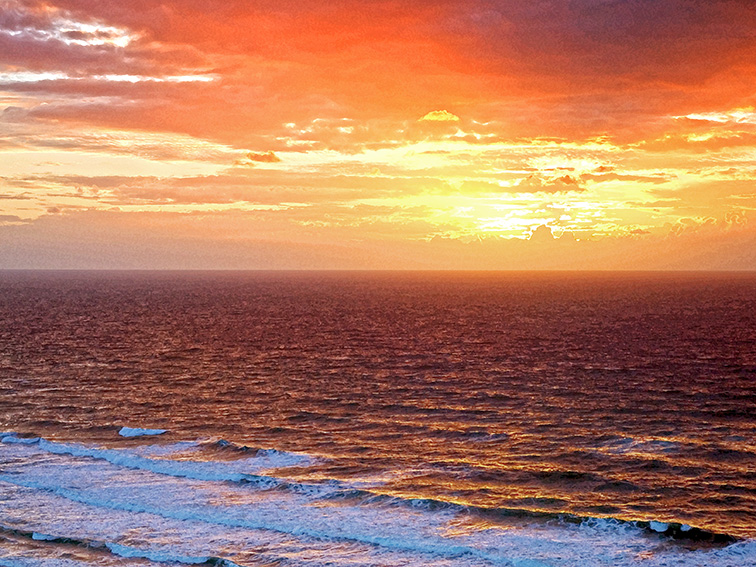
Lorne Pier – Victoria – Australia

Winter Sky – Netanya – Israel
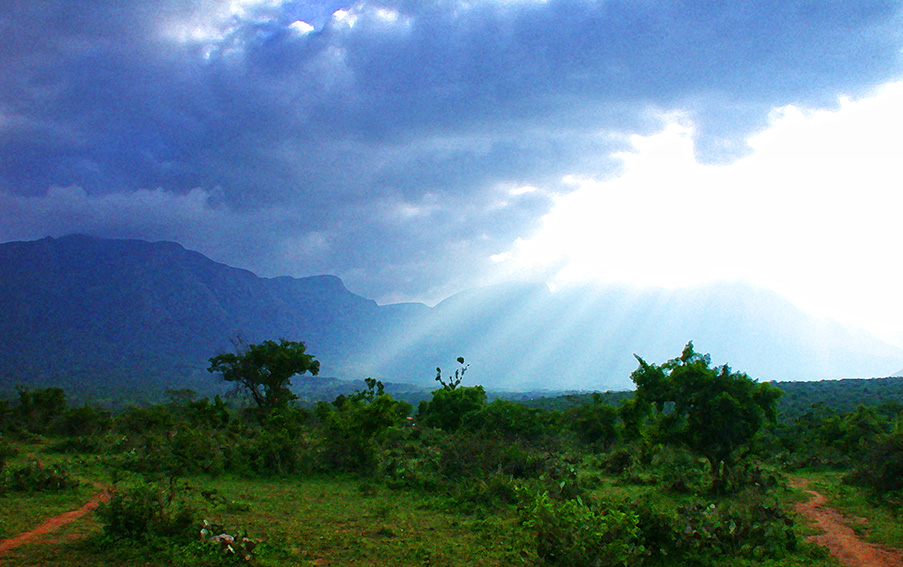
Sun Break – Southern Ghaats  – India

Altocumulus stratiformis translucidus undulatus – Atacama – Chile
The Golden Hour – Netanya – Israel

The Sea and Hills of Galilee from the Golan Heights – Israel

Water Spout about to Hit the Shore – Netanya – Israel

TRIPLE-TAKES AND DOUBLE CHOICES

During my ten  years or so as a commercial artist I had spells with two top London artist’s agents. The main and obvious advantage of having an agent was that they went out and got you commissions.  Most artists by definition, tend to be ill equipped, emotionally and attitudinally for the tasks of both finding and especially negotiating with clients. Artist’s agents on the other hand, often with backgrounds in advertising and / or art production have extensive lists of contacts and the wherewithal for exploiting those connections. 

This scene from a street in the Andalusian town of Arcos se la Frontera remains my favourite image from the series…

The big disadvantage in the artist / artist agent relationship however was the near-total lack of control the artist has over the process, from commissioning to payment.  And, it was ultimately the payment issues which trumped the advantages and convinced me to toughen-up and go it alone. My final artist’s agent’s commission was a case in point and also the last straw. What began as an unusually free brief – to paint a series of of 24 poster-style gouache paintings to decorate 12 luxury, first-class cruise liner suites for a seriously good fee, manifested as an exercise in frustration and acrimony. The fact I had to resort to the threat of lawyers against my own agent to extricate partial payment gives a good idea of just how sour things got.

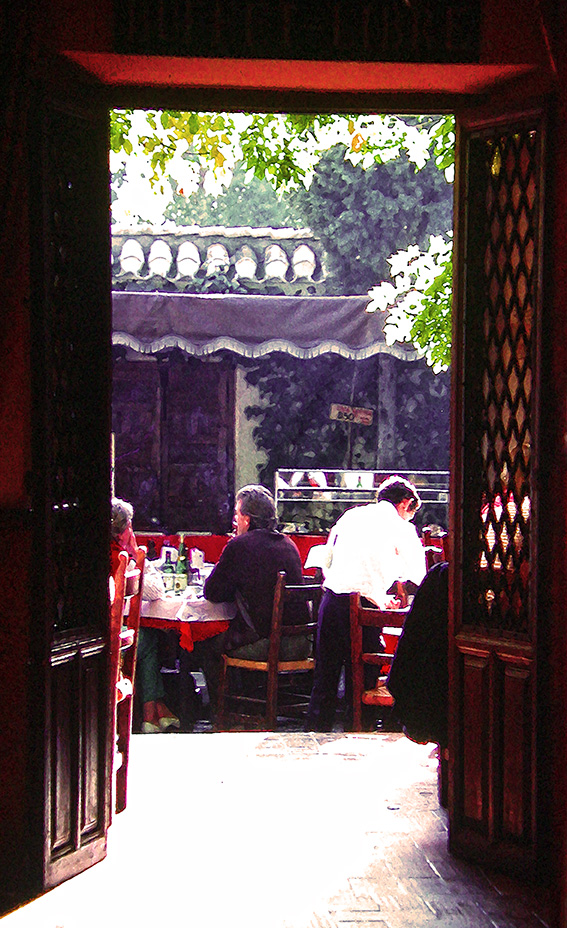
This is a scene from a courtyard restaurant in Granada, right by the Alhambra Palace…

In the normal course of events, I worked directly with the clients, and delivered my work to them myself. For some reason never fully explained, on this occasion I did not get to meet the client and instead dealt exclusively with my agent. What exactly went wrong between the time of me handing over the finished pictures to the agent, and her passing them to the client – or indeed, if she ever handed them to the client, I never discovered. All I did know for sure, was that two months of hard work was never fully paid for.  Fortunately, during my ongoing film-to-digital trawl, I recently came across colour slides of several examples of the artwork from that fateful commission and the original photographic templates.

The delightful “balcon” at Arcos…

If I was ever to receive a similar commission again, apart from making sure to deal with the client on a one-to-one basis, I might also decide to produce Photoshop images (presented on the similar art papers to the original gouaches) rather than paintings. For me the finished results, especially with these highly graphic, minimalist images are at least as good as paintings, and in the awful prospect that I again would not be fully recompensed, would have expended a fraction of the time.

And finally, the Bishop’s palace in Seville.

Presented here (within the text) in triptych form are four of those very images. The photo templates comprise the central images, with the original gouaches on the right, and my new Photoshop treatments on the left. See what you think and don’t be afraid to let me know…

BEER AND BIROS –  or how I learned to prioritise my student grant spending…

I don’t know if it’s the same today, but when I was at art school it was constantly drummed into us students to carry a sketchbook, “always and everywhere”, and to use it frequently. For some reason, this was a habit I found hard to acquire, and thus an early indicator perhaps that I never had the mentality of the true artist.

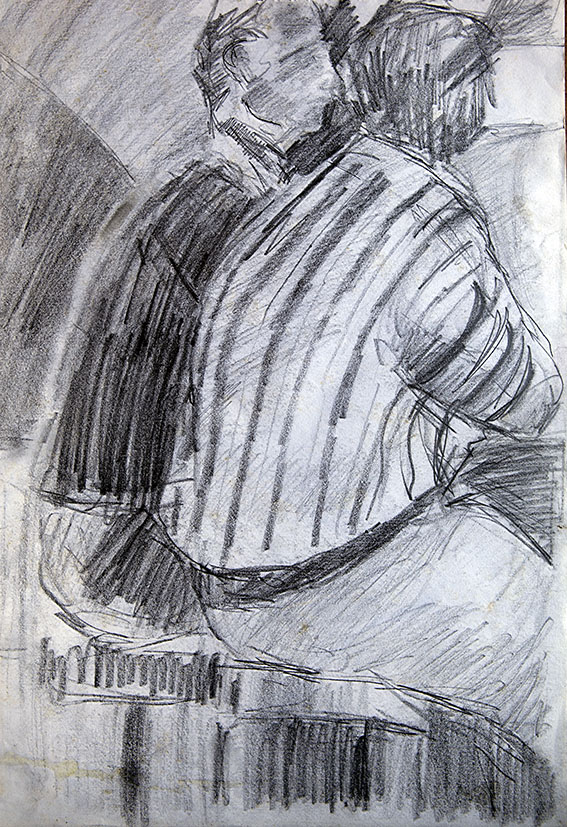
Sitters 1
Bar Props 9 – pencil sketch

It wasn’t so much the issue of self-discipline – I had plenty of that when sufficiently motivated to a given (normally non-art-related) task – it was the somewhat ironic fact that I felt that sketching was more of a barrier to, than an absorber of, the world around me.

Bar Drinker 1
Bar Prop 8 – biro sketch

Perhaps part of my problem was that although only 16 when I started my foundation course at Harrow School of Art, I was already an experienced photographer and had become used to having a camera with me much of the time. Ditching my elegant Nikon, and its power to capture everything I saw at the press of a button for a sketchpad and assorted, often unwieldy drawing implements seemed a retrograde and pointless drudgery.

Pub Couple 1.jpg
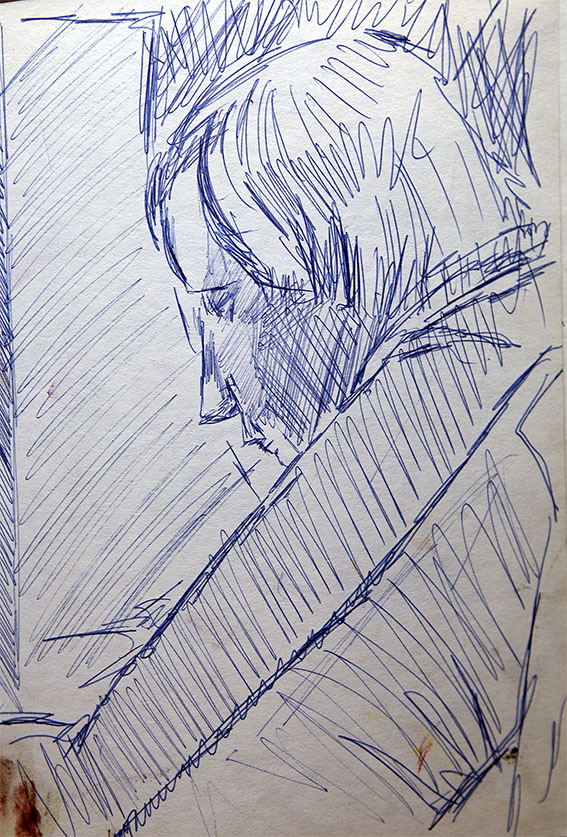
                    Thoughtful Couple – biro sketch

Of course, deep-down, I recognised the wisdom of my tutors’ insistence on me interpreting the world I saw through the point of a drawing implement as a fundamental prerequisite for learning the language of picture-making. Yet I remained resistant for a long time into my art education; a bit like the reluctant music student longing to skip his/her daily four hours of practising scales. Eventually however, although never an enthusiast, by the time I started my degree at Saint Martin’s I’d found a way to become a regular sketcher.

Sitter 2.jpg
Bar Leaner – Conté sketch

The “way” I’d landed upon was to lubricate the grind of the actual sketching by means of large doses of simultaneous self-gratification and self-stimulation in the form of pints of my favourite beverage at the many hostelries adjacent to my Soho-based art school.

Sitter 5
Bar Thinker – biro sketch

In authentic and time-honoured tradition, I found wiling away hours of time in saloons rewarding both sensually and artistically. And while my fellow pub punters may not have offered up images as exotic as those that greeted the French Post Impressionists in the clubs and dives of 19th century Paris, they did nevertheless provide an endless source of unwitting, and thus natural model subjects.

Sitter 4.jpg
Paper Reader – Conté sketch

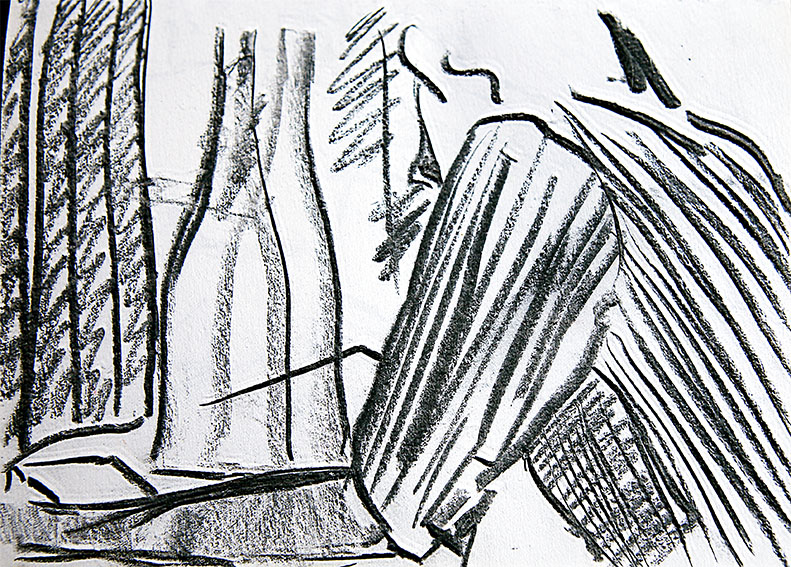
Needless to say, this element of my nascent art career necessitated a significant chunk of my student grant. How good or not this investment was, is a matter for debate. From my, admittedly biased point of view, all these years later, the examples shown here don’t look too bad, and if nothing else, they do go to show that even the humble biro, can be an effective artists tool…after a glass or two of fine English ale…

Sitter 3
Greasy Lunch – Conté sketch (done in a Soho cafe or “greasy spoon”)

WALKING AWAY INTO “LITTLE BIG LAND” – Israel painted through the romantic eyes of youth

My phase of painting large epic landscapes in oils happened to coincide with a period in my life when I spent most summers in Israel. From around 1978 until about 1986 I went there every year, partly out of idealism and partly because I just loved making paintings of the place.

Ein Kerem - Walking Away - Detail 1.jpg
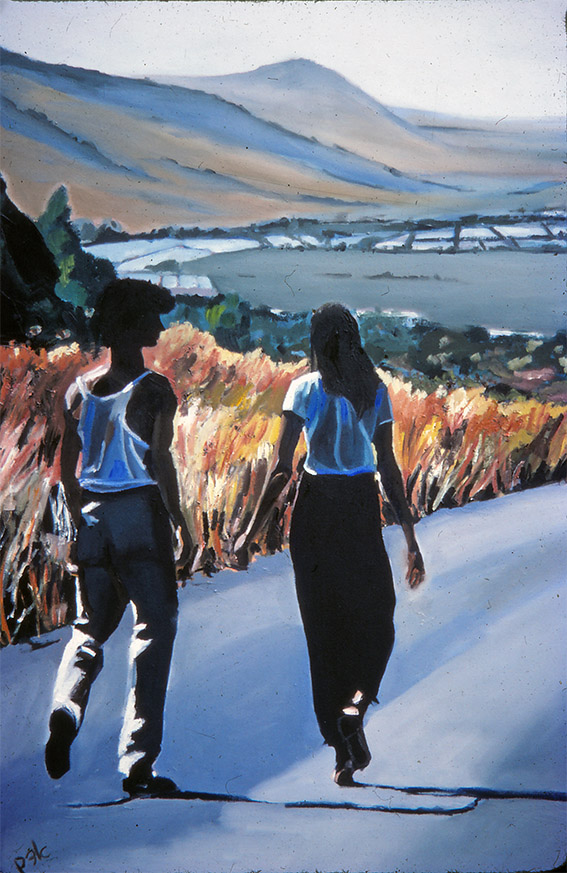
“Walking Away at Ein Kerem” (120 x 170cm∗) – In the Jerusalem Hills – southwest outskirts of the city…

Looking back on that time now I can see that the two motivations were part of the same “condition” and fed an inner yearning to find expression for my youthful optimism and romanticism.

Above the Hula - Detail 1.jpg
“Astrud at Tel Hai”  detail (150 x 100cm) – At the south-western entrance to the northern “pan-handle”…

As I think I’ve said before on these pages, Israel, although geographically a tiny country, can often feel vast to the naked eye. Among the hills and valleys of the “pan-handle” of the northern Galilee, and especially in the arid canyons of southern Judea and the Negev Desert, the landscape creates an illusion of almost infinite enormity.

Ein Kerem Triptych - middle panel.jpg
“Pickers at Rest” (153 x 213cm) – Hired Druze pickers enjoying ice-lollies during a break from apple picking on the northern border kibbutz of Yiftach…

My initial efforts were okay as paintings but they failed to transmit the epic quality of the scenes I was depicting. But then I remembered a device often used by my favourite painters of “sublime” landscape, such as Claude Lorraine, William Turner and John Martin, which was to offset the vista against a peopled foreground. This not only gave scale to the views beyond, but also created a feeling of depth and a sense of “moment” with the human figures caught in time.

The Banyas Waterfall.jpg
“The Banyas Falls” (180 x 120cm)  – The source of the River Jordan, at the north-western edge of the Golan Heights, and thought by the Macedonian conquerors of 332 BC  to be the birth place of the god Pan – hence: the Greek “Panias”, now “Banyas” in modern Hebrew via the previous “Banias…”

So, from about 1981 I began to inhabit my Israeli landscapes with people, normally young people like me, walking away, down a track or road toward some distant horizon. And for me, then, it did the trick, seeming to offer a message of future hope into the bargain.

The Coach Party detail 3.jpg
“The Coach Party”  detail (180 x 240cm) – On a roadside cliff edge overlooking the Hula Valley in the north western pan handle…

Sadly (or perhaps fortunately) I failed to record most of the “Walking Away” series (I think I did around ten of them over the course of that year) on camera. In fact, I have very little photographic record of any of my people-in-landscape pictures from that phase of my career.

On Ashqelon Beach - detail 1.jpg
“On the Beach” detail (120 x 180 cm) – A group of my friends on Ashkelon beach on Israel’s southern Mediterranean coast…

However, I have managed to cobble together what you see here, including two from the Walking Away series (one complete and a detail from another) and the rest, mostly details and sections from other pictures.

Resting at Montfort.jpg
“Resting at Montfort” detail (120 x 180cm) – Our tour party taking a break on the ruins of the Crusader castle of Montfort just south of the Lebanon border. Hence the need for the M16…

Despite the incompleteness presented, I still think one can sense the romance, and the optimism of the mostly-unseen whole paintings.

Wanderers Detail 1
“The Wanderers” detail (130 x  190cm) – The first of the “Walking Away” themed  series, set on the road down from Tel Hai south, towards Lake Kinneret  (The Sea of Galilee).

(∗ All sizes refer to the full canvases)

VINTAGE VACATION


Apologies to my loyal followers but the wine making and other arduous – sometimes pleasant – farming tasks have left me little time to devote to this blog. Normal posting will resume next time. For now, here are a few striking images of the local environment around our small finca in the heart of the Axarquia in southern Spain.

Enjoy…we do.